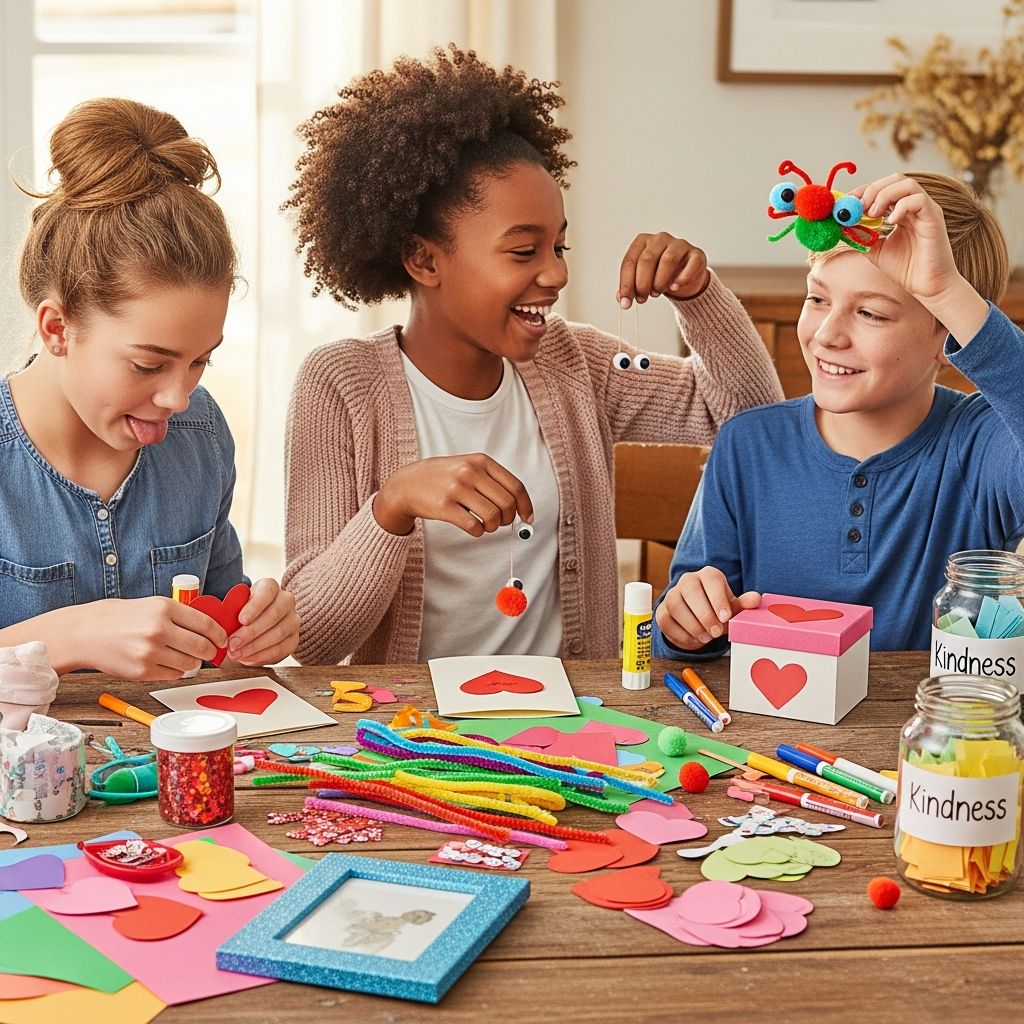
Valentine’s Day is often marketed around romance, but for families it can be an ideal excuse to slow down, get creative, and reconnect with a tween who is growing more independent. Thoughtfully chosen crafts give you something to do with your hands while you talk, laugh, and share stories, which can make conversation feel more natural and less pressured for this age group.
Why Crafting Works So Well With Tweens
Between school, activities, and screens, it can be difficult to find relaxed moments with tweens. Crafting together offers several benefits that support connection and healthy development:
- Built-in conversation buffer – Working side by side, rather than face to face, often makes sensitive topics easier to discuss for kids in early adolescence.
- Stress relief – Repetitive creative tasks like drawing, cutting, or folding paper can help reduce stress and support emotional regulation in youth.
- Sense of competence – Successfully finishing a project can boost a tween’s confidence and sense of mastery, which is linked to better mental health.
- Shared memories – The finished crafts become physical reminders of time spent together, reinforcing a sense of closeness.
Research on creativity and well-being suggests that even brief, daily creative activities are associated with higher levels of positive emotion and flourishing in adults, and similar benefits are observed in young people engaged in arts activities.
Planning a Low-Pressure Valentine Craft Session
To keep the focus on connection rather than perfection, plan your Valentine craft time with your tween’s preferences in mind.
Talk First, Then Gather Supplies
Instead of announcing a craft and expecting enthusiasm, invite your tween into the planning:
- Ask what kind of projects they enjoy (drawing, jewelry, practical items, digital design, etc.).
- Offer two or three options so they feel a sense of choice and control.
- Decide together who the crafts are for: friends, relatives, teachers, or just for fun.
Keep Materials Simple
You do not need complex tools or expensive kits. Tweens often prefer modern, minimal, or slightly quirky projects over traditionally “cute” designs. Consider:
- Cardstock or blank note cards
- Fine-tip markers or brush pens
- Washi tape and stickers
- Embroidery thread or thin cord
- Safety pins, beads, or charms
- Fabric scraps or felt
Make the Environment Cozy
Small touches can change the tone from “assigned activity” to “special hangout”:
- Play music your tween likes at a comfortable volume.
- Offer simple snacks and drinks.
- Clear a table so everyone has space to spread out.
- Let them choose the start time so it doesn’t clash with their favorite show or game.
Craft Ideas Tweens Won’t Think Are “Babyish”
Tweens are in between childhood and the teenage years; they often want to avoid anything that feels too young, but they still enjoy play and creativity. These Valentine-friendly crafts are designed to feel age-appropriate and slightly grown-up.
1. Friendship Token Bracelets
Instead of traditional heart doilies, try making simple bracelets or keychains that celebrate friendship and support.
- Use safety pins with small beads, thin chain, or embroidery thread.
- Choose colors that match a friend’s favorite shades or school colors.
- Attach to a small card with a short message like “Thanks for getting my weird jokes” or “You make lunch less awkward.”
Working on pattern-based crafts like simple jewelry can help tweens practice planning and fine motor skills while chatting casually.
2. Pocket-Size Comfort Hearts
Create tiny soft hearts that can slip into a hoodie pocket or backpack as a quiet reminder of support.
- Cut two small hearts from felt or scrap fabric.
- Stitch around the edges with simple running stitches, leaving a small opening.
- Stuff lightly with cotton or fabric scraps, then close the gap.
- Write a small card explaining: “For tests, long days, and rough moments.”
Hand-sewing is a practical life skill and can also cultivate patience and attention to detail.
3. “Real Talk” Valentine Cards
Many tweens roll their eyes at sentimental messages. Encourage them to design cards that sound like them:
- Use bold, graphic designs: stripes, geometric shapes, simple icons instead of ornate hearts.
- Write messages that focus on appreciation, humor, or inside jokes rather than romantic clichés.
- Suggest prompts such as:
- “You’re the reason group projects aren’t terrible.”
- “Thanks for always sharing your notes.”
- “You’re my favorite person to sit in silence with.”
4. Door or Locker Mini-Garlands
Help your tween make a subtle garland they can hang on their bedroom door or, if allowed, on a locker.
- Cut small shapes (hearts, stars, lightning bolts) from sturdy paper.
- Write a word or short phrase on each: “Brave,” “Creative,” “Kind,” “Resilient.”
- String them on twine or ribbon.
- Keep the color palette simple—two or three coordinated shades—to avoid a childish look.
5. DIY Digital Valentines
If your tween loves screens, bring the crafting into their digital world:
- Use free drawing or collage apps to design simple digital cards.
- Add photos, stylized text, and digital stickers.
- Send to friends or family with a short note, or print a few favorites.
Digital design still counts as creative activity and can strengthen visual communication skills.
Choosing Crafts for Different Tween Personalities
Not every tween enjoys the same type of project. Matching the craft to their temperament can prevent pushback and make bonding feel more natural.
| Type of Tween | Best-Fit Valentine Projects | How to Support Connection |
|---|---|---|
| Quiet or introspective | Pocket hearts, simple cards, coloring or lettering pages | Let silence be okay; ask open-ended questions with long pauses. |
| Social and talkative | Friendship bracelets, group card-making for classmates | Invite them to share stories about friends and school life. |
| Practical or analytical | Useful items (bookmarks, keychains, organizers) | Discuss how they might improve the design or make it more functional. |
| Highly creative | Custom designs, mixed-media pieces, digital art | Give broad guidelines and lots of freedom; ask about their ideas. |
Using Craft Time to Strengthen Communication
Beyond the glue and paper, the real value of crafting with a tween is the conversation it makes possible. Parents who maintain warm, open communication during early adolescence can buffer some of the stress and risk behaviors that often appear in later teen years.
Gentle Conversation Starters
Instead of heavy questions, try light prompts that can lead to deeper topics over time:
- “If you could design the perfect Valentine for your favorite fictional character, what would it say?”
- “What’s your favorite kind of compliment to receive?”
- “Who at school deserves a Valentine but probably won’t get many?”
- “If you could redesign this holiday, what would you change?”
Listening More Than You Direct
When your tween talks, try to:
- Reflect back what you hear (“So you felt left out when…”).
- Pause before giving advice; ask if they want ideas or just to vent.
- Avoid criticizing their friends or interests in that moment.
Strong parent–child communication during this stage is linked to better academic outcomes and lower risk behaviors in adolescence.
Group Crafting: Tweens and Their Friends
If your tween is open to it, invite one or two friends for a low-key Valentine crafting hangout. Small groups can help tweens practice social skills while still having supportive adults nearby.
Simple Group-Friendly Projects
- Card stations – Set out different supplies at each end of the table so they naturally move, mingle, and share ideas.
- Charm swap – Provide basic bracelets or keyrings and a bowl of charms or beads; invite everyone to choose and trade.
- Kindness card challenge – Challenge the group to make anonymous uplifting notes for classmates, school staff, or neighbors.
Ground Rules That Keep Things Comfortable
- Make clear that romantic topics are optional; focus on friendship and appreciation.
- Discourage teasing about who likes whom.
- Keep invitations inclusive when possible, so no one feels singled out or excluded.
Honoring Big Feelings Around Valentine’s Day
Not every tween feels excited about Valentine’s Day. Some may feel lonely, left out, or stressed by social dynamics at school. Crafting can offer a safe channel to explore these feelings.
Shifting Focus from Romance to Appreciation
Help your tween see the day as an opportunity to notice and thank many kinds of relationships:
- Make gratitude cards for grandparents, cousins, neighbors, or coaches.
- Create small treat bags for school staff or bus drivers.
- Decorate a “family appreciation board” with notes about what you value in each other.
Emphasizing gratitude has been associated with better emotional well-being and prosocial behavior in children and adolescents.
Supporting a Tween Who Feels Left Out
If your tween is sad about not receiving many Valentines at school or about friendship issues:
- Acknowledge their feelings instead of dismissing them (“It makes sense you’re disappointed.”).
- Suggest making something just for themselves—a decorated journal cover, a poster with their strengths, or art for their room.
- Share a story from your own youth when you felt similarly and what helped.
Keeping Expectations Realistic
Even with your best intentions, not every craft session will be magical. Tweens may be tired, distracted, or simply not in the mood. That is normal for this stage of development.
What You Can Control
- Offering the invitation without pressure or guilt.
- Staying calm if they decline or lose interest halfway through.
- Modeling flexibility—switching to drawing, chatting, or even just sharing a snack if the project falls flat.
What Really Lasts
Over time, it is not the individual glittery card or perfectly stitched heart that matters. What stays with your tween is the pattern of:
- You making time for them.
- You listening without judgment.
- You showing up, again and again, in small, ordinary moments.
Valentine crafting becomes one of many tools you can use to keep that bond strong as they move toward the teenage years.
Frequently Asked Questions (FAQs)
Q: My tween says crafts are boring. How can I still use this idea?
Try reframing the activity around something they already like—designing digital wallpapers, customizing notebooks, or making practical items like bookmarks or phone charms. Offer choices and keep the session short so it feels like a hangout, not a chore.
Q: How long should a Valentine craft session last with tweens?
Aim for 30–60 minutes. Many tweens focus better with a clear time frame; you can always extend if everyone is engaged, or stop early if they lose interest.
Q: What if their finished crafts look messy or rushed?
Focus on the process and the time together, not the final product. Compliment specific efforts—color choices, creativity, or persistence—rather than neatness or perfection.
Q: Is it okay to talk about crushes during Valentine crafting?
Yes, if your tween brings it up and seems comfortable. Follow their lead, stay curious rather than intrusive, and avoid teasing. The goal is to be a safe person they can talk to about feelings.
Q: How can we include a tween who has social anxiety?
Keep the group small, perhaps just family or one trusted friend. Choose calm, predictable projects and let them step away when needed. Emphasize that participation is optional at every stage.
References
- Monitoring Your Adolescent’s Activities: What Parents Should Know — Centers for Disease Control and Prevention. 2012-08-16. https://www.cdc.gov/healthyyouth/protective/pdf/parent_tips_monitoring.pdf
- How Creative Activities Help Children’s Emotional Development — Harvard Graduate School of Education. 2023-02-15. https://www.gse.harvard.edu/ideas/uk/23/02/how-creative-activities-help-childrens-emotional-development
- Arts Education and Social-Emotional Learning Outcomes Among K–12 Students — National Endowment for the Arts. 2019-02-12. https://www.arts.gov/about/publications/arts-education-and-social-emotional-learning-outcomes-among-k-12-students
- Gratitude and Well-Being: A Review and Theoretical Integration — Wood, A. M. et al., Clinical Psychology Review (Elsevier). 2010-11-01. https://doi.org/10.1016/j.cpr.2010.03.005