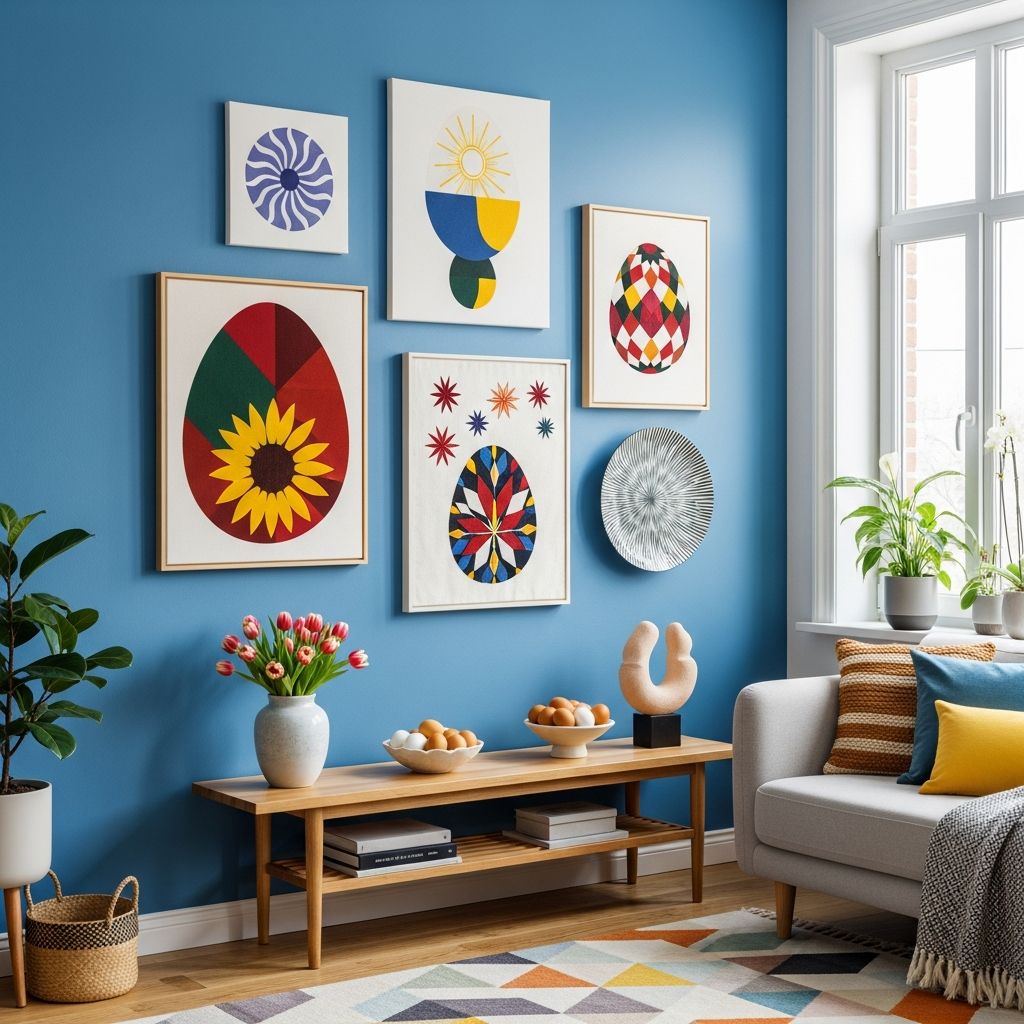
Ukrainian Easter eggs are famous for their tiny details, deep symbolism, and unforgettable color combinations, and those same elements translate beautifully into wall décor that feels fresh, modern, and surprisingly easy to make at home. Instead of working on fragile eggshells, you can borrow the patterns, colors, and meanings and apply them to sturdy paper or canvas for family-friendly holiday art.
This article walks through the basics of Ukrainian egg–inspired design, offers step-by-step projects, and shares display tips so you can fill a wall with vibrant Easter art that celebrates heritage and creativity in equal measure.
Why Ukrainian Egg Motifs Work on Walls
Traditional Ukrainian Easter eggs (often called pysanky) use a wax-resist dye process to layer symbols and colors that represent protection, hope, and renewal. When these motifs are enlarged for a wall, the same symbols suddenly feel graphic and bold while still carrying their original meaning.
Working on paper or canvas instead of eggshells also removes the fear of breaking something delicate, which makes this style ideal for crafting with children, beginners, or anyone who wants to try intricate patterns without the pressure of precision.
Core Design Elements to Borrow
You do not need to reproduce traditional eggs exactly to capture their spirit; instead, focus on a few recognizable elements and reinterpret them in your own style and color palette. Think of each egg as a tiny pattern library you can scale up and remix.
- Bands and divisions: Horizontal, vertical, or diagonal bands that divide an oval or rectangle into sections.
- Geometric motifs: Triangles, diamonds, stars, and crosses arranged in rhythmic, repeating layouts.
- Nature themes: Stylized leaves, wheat, branches, flowers, or simple birds that echo spring and renewal.
- Contrast: Light motifs set against dark backgrounds (or the reverse) to make patterns stand out from across the room.
Suggested Color Palettes
Traditional Ukrainian eggs often use strong contrasts, but you can soften or brighten the palette to match your home. Choose one main palette and use it across all pieces so the wall looks unified instead of chaotic.
| Palette Style | Colors | Best For |
|---|---|---|
| Classic Contrast | Black, red, yellow, white | Bold statement walls and traditional-inspired décor |
| Soft Spring | Cream, soft teal, blush, sage | Subtle, airy Easter displays in neutral rooms |
| Kids’ Rainbow | Bright primary and secondary colors | Playrooms, classroom displays, and kid-centric crafts |
| Earth & Gold | Rust, ochre, forest green, gold accents | More sophisticated entryways or living rooms |
Basic Supplies for Wall-Friendly Egg Art
You can use almost any art supplies you already own, but a few basics make egg-inspired wall pieces easier to design, hang, and store. Gather everything before starting so you can focus on creativity rather than hunting for tape mid-project.
- Heavy cardstock or watercolor paper for durability and crisp edges.
- Acrylic or gouache paints, or bright markers for strong, opaque color.
- Pencils and erasers for sketching guidelines before committing to paint.
- Circle or oval templates (stencils, lids, or bowls) to keep shapes consistent.
- Painter’s tape or washi tape for temporary hanging and testing arrangements.
- Simple frames, clipboard hangers, or washi tape borders for finished pieces.
Project 1: Oversized Egg Panels
Oversized egg panels are large, single-egg silhouettes filled with patterns and mounted individually or in clusters. They look impressive from a distance but are built from straightforward steps that even beginners can follow.
Steps for Oversized Egg Panels
- Draw the egg outline. Use a large oval template or lightly sketch an egg shape onto a sheet of cardstock, filling most of the page.
- Divide the shape. Draw a few curved or straight bands that run across the egg, creating distinct areas for different patterns.
- Sketch simple symbols. In each band, add motifs such as triangles, dots, leaves, or small suns. Keep repeating patterns simple and bold.
- Paint background colors first. Block in the larger sections with paint, letting contrasting colors sit side by side.
- Add line work and details. Once dry, layer fine lines, dots, and borders with a smaller brush or paint pen to echo the feel of wax-drawn designs.
- Trim and mount. Cut around the egg outline, then mount it on a slightly larger piece of colored paper or directly in a frame.
Project 2: Grid of Mini Egg Tiles
A grid of mini egg tiles turns your wall into a gallery of experiments, where each tile explores a different pattern or color combination. This project is perfect if different family members want to contribute without coordinating every detail.
How to Create Mini Egg Tiles
- Cut equal rectangles. Trim several small pieces of cardstock (for example, 4×6 inches) to use as individual tiles.
- Add a single egg to each tile. Use a stencil or a simple hand-drawn oval in the center of every rectangle.
- Assign a theme. Give each tile a loose rule, such as “only triangles,” “only plants,” or “two colors only,” to keep the grid visually coherent.
- Decorate freely. Paint, draw, or collage within each egg, following its theme but not worrying about perfection.
- Arrange in a grid. Once dry, stick the tiles to the wall using removable putty or tape, spacing them evenly in rows and columns.
Project 3: Symbol-Based Banner or Garland
If framing feels too formal, turn your patterns into a hanging banner or garland that stretches across a mantel, doorway, or window. Each piece can highlight a single symbol drawn from Ukrainian egg traditions, such as suns, wheat, or stylized birds.
Banner Assembly Guide
- Create repeating shapes. Cut several identical egg shapes or circles from cardstock or colored paper.
- Choose three to five symbols. Assign one symbol to each card, like a sunburst, leaf branch, or simple cross pattern, and repeat that symbol on several pieces.
- Decorate with limited colors. Stick to two or three colors along the entire banner so the final garland looks unified rather than random.
- Punch holes and string. Add holes at the top of each piece and thread them onto twine, ribbon, or yarn, spacing them evenly.
- Hang with removable hooks. Use small hooks or tape loops to hang the garland where it can drape naturally.
Ideas for Kid-Friendly Adaptations
Children can enjoy the look of intricate Ukrainian eggs without handling real eggs or hot wax. Scaling patterns up and using washable materials turns the process into a playful exploration of symmetry, color, and storytelling.
- Swap paint for thick markers or crayons so kids can focus on pattern rather than brush control.
- Provide pre-drawn egg outlines and partially divided shapes to reduce frustration for younger artists.
- Invite kids to invent their own symbols (favorite animals, weather icons, or initials) and repeat them as if they were traditional motifs.
Displaying Your Egg-Inspired Art
How you display your pieces matters almost as much as how you create them; a thoughtful arrangement can make simple materials look like a curated collection. Aim for consistency in spacing, frame style, or color so the wall reads as one intentional installation.
- Group several large egg panels in a loose grid above a sofa or sideboard.
- Combine framed mini tiles with an egg-symbol garland for a layered, casual look.
- Use clipboards or binder clips for easy swapping each year as you add new designs.
- Create a narrow vertical column of small eggs to fill an awkward wall sliver or hallway corner.
Preserving and Storing Seasonal Pieces
Because these decorations are made on paper or lightweight boards, they store easily and can become part of your yearly Easter traditions. A little protection goes a long way toward preventing bent corners and faded colors.
- Slip flat pieces into large envelopes, portfolios, or shallow boxes labeled by year or artist.
- Keep framed items with glass or plastic fronts out of direct sunlight to preserve intense hues.
- Photograph your display each year to track how your style evolves and to remember favorite arrangements.
Frequently Asked Questions
Do these projects require traditional wax tools?
No. These wall décor ideas take inspiration from the patterns and symbolism of Ukrainian Easter eggs but shift the process to paper, paint, and markers. You are imitating the look of layered lines and sections rather than using the classic wax-resist method.
Is it okay to simplify traditional symbols?
Yes. Many traditional motifs can be translated into simpler versions while still nodding to their roots, especially when you keep the basic shapes and layout. If cultural accuracy is important to you, consider researching the meaning of different symbols and using them thoughtfully.
How can I keep the wall from looking cluttered?
Choose a limited color palette and repeat a few patterns across multiple pieces so your eye can move smoothly across the wall. Consistent framing, even spacing, or arranging items around an invisible central line will all help the display feel cohesive.
Can these decorations stay up after Easter?
Absolutely. If you avoid explicit holiday wording and focus on nature, geometry, and color, the art reads as spring décor rather than a specific holiday display. Many people keep their favorite panels up year-round as a celebration of pattern and heritage.
What if I am not confident drawing freehand?
Use simple templates, rulers, and stencils to build clean shapes, then let color and repetition do the heavy lifting. Tracing around household objects (cups, lids, and tape rolls) is an easy way to create reliable circles and arcs without advanced drawing skills.