Transforming Your Marriage Milestone Into a Family Celebration
Wedding anniversaries mark more than just the passage of time—they represent a commitment that has weathered countless seasons of life. For many couples with children, however, the romantic dinner reservations and weekend getaways of early marriage have been replaced by more modest celebrations. Yet this evolution doesn’t have to diminish the meaning of the occasion. Instead, it offers a unique opportunity to reframe your anniversary as a moment that honors not just your partnership, but your entire family unit.
When children enter the picture, the logistics of celebration change dramatically. What once required only coordinating two schedules now involves managing childcare, planning around school calendars, and budgeting for activities the whole family can enjoy. This practical reality has led many parents to discover that including their children in anniversary celebrations creates something equally valuable—if not more so—than private romantic moments. It transforms a day that could feel like one more obligation into a genuine family tradition that matters to everyone.
Why Anniversary Traditions Matter for Children
Children live largely in the present moment. They experience their parents as existing primarily in their current parental roles, often without fully grasping the depth of the relationship that preceded their arrival. An anniversary tradition provides a concrete opportunity to help children understand that their parents have a story beyond motherhood and fatherhood. It demonstrates that commitment, love, and partnership are values worth honoring and celebrating.
Beyond the surface-level fun of a special day, anniversary celebrations with children serve an important psychological function. They communicate to young people that marriage is a significant commitment worth marking year after year. They show children what dedication looks like in practice—not as a theoretical concept, but as something their own parents actively choose to honor and maintain. This becomes particularly important in an era when many children are navigating complex family structures and may benefit from witnessing sustained, intentional commitment.
Creating predictable rituals around your anniversary also provides children with a sense of security and belonging. Knowing that certain things happen every year—that Mom and Dad have a special day they celebrate together as a family—creates a framework of stability that children find reassuring. These repeatable moments become anchors in the family calendar that children anticipate and remember.
Visual Storytelling: Bringing Your Love Story to Life
One of the most powerful ways to include children in your anniversary celebration is through visual documentation of your history together. Most families have wedding videos or photograph albums that rarely see the light of day after the initial excitement fades. An anniversary tradition centered around revisiting this media transforms these records into active tools for connection and storytelling.
Setting aside dedicated time to watch your wedding video together creates an experience that feels special and intentional. You might create an at-home viewing event complete with popcorn, comfortable seating arrangements, and everyone gathered in one space. This isn’t just passive screen time—it’s an opportunity for children to see their parents in a different context, to witness the emotions of your wedding day, and to ask questions about how you met, why you chose each other, and what that day meant to you.
For families without wedding videos, old photo albums serve the same purpose beautifully. Paging through photographs together gives you natural opportunities to narrate your story—pointing out where you were, what you were doing, and how you felt at different moments. Children find this deeply engaging because it’s both novel and personally relevant. They’re learning about their parents while also understanding the sequence of events that eventually led to their own existence.
Younger children often find it almost incredulous that their parents existed and did things before they were born. Sharing photos from your childhood, college years, and early relationship helps them grasp this timeline. Older children might enjoy the nostalgic aspect of seeing how fashion, technology, and your parents’ appearance have changed over the years. Both age groups benefit from the narrative connection you’re creating.
Structured Activities That Celebrate Your Relationship
While memory sharing is powerful, many families benefit from more structured activities that give children specific ways to participate in the celebration. These activities serve multiple purposes: they keep children engaged, they allow them to contribute meaningfully to the day, and they create tangible keepsakes that preserve the memory of the celebration.
Creative Projects and Crafting
Anniversary-themed craft projects offer an excellent way to involve children across different age groups. Younger children might create simple decorations—paper chains, hand-drawn cards, or painted decorations. Middle-aged children could work on more complex projects like making a family tree, creating a timeline of your relationship, or designing a custom decoration that reflects something unique about your family.
One particularly meaningful project involves having children create artwork that represents your family or your relationship. Some families create collaborative pieces where each family member contributes a section. Others have children paint or draw a scene from a favorite family memory, or create a visual representation of what “love” means to them. These pieces become keepsakes that capture not just the anniversary celebration but also your children’s understanding of family and commitment at different developmental stages.
DIY anniversary cards from children to their parents are another simple but deeply meaningful activity. Children can write messages, draw pictures, or simply sign their names on cards that parents will treasure. The act of creating something specifically for their parents makes the celebration feel reciprocal—the children aren’t just participating in something the parents are doing, but actively contributing to honoring the relationship.
Planning and Preparation Responsibilities
Involving children in the planning process, rather than just the execution day, extends the celebration and gives them greater investment in the outcome. Age-appropriate responsibilities might include:
- Younger children (ages 3-6): Choosing decorations, arranging table settings, selecting songs or helping pick a movie
- School-age children (ages 7-12): Creating invitations or announcements, planning a menu, organizing games, designing decorations
- Teenagers: Taking a more significant planning role, perhaps researching activity ideas, managing a budget, or helping coordinate the day’s schedule
This delegation accomplishes several things simultaneously. It reduces the burden on parents who might otherwise have to do all the planning themselves. It teaches children about event organization and planning. Perhaps most importantly, it signals to children that their input matters and that this is genuinely a family celebration, not something adults are simply imposing on them.
Reimagining Your Anniversary as a Family Milestone
Some families have found it helpful to reframe their anniversary celebration by thinking of it not just as the anniversary of their marriage, but as the celebration of their family’s founding. This subtle shift in perspective can make the occasion feel more inclusive to children, who might not have direct memory of or emotional connection to their parents’ wedding day.
Framing the celebration as a “Family Birthday” or “Family Day” acknowledges that while the relationship between parents originated on the wedding day, the family unit was born later, when children arrived. This reframing allows children to feel that they are central to what’s being celebrated, not peripheral to it.
Celebrations structured around this concept might include:
- A special family meal featuring everyone’s favorite foods, not just the parents’ preferences
- A family outing to a location that holds meaning for the entire family
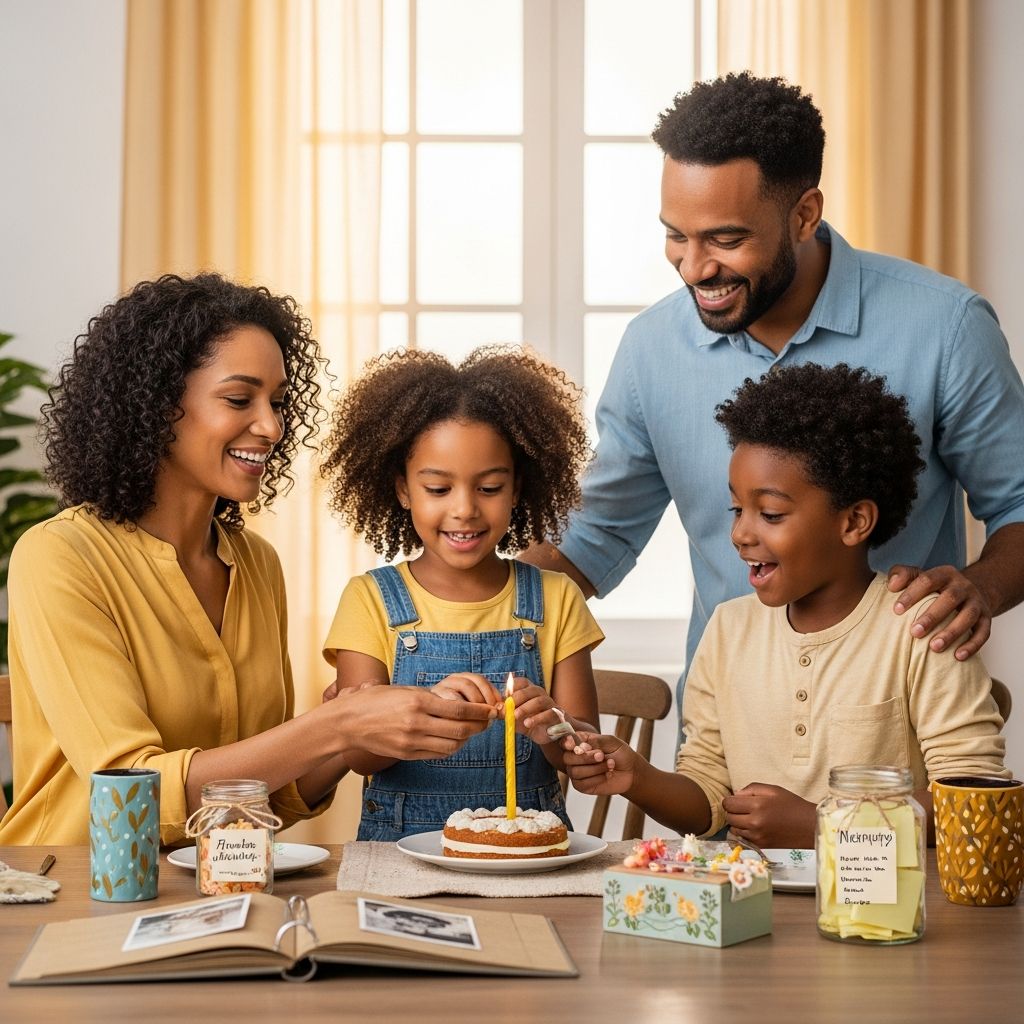
- A cake or dessert that represents the whole family rather than just the couple
- Games or activities that everyone can enjoy together
- An opportunity to reflect on how the family has grown and changed over time
This approach doesn’t diminish the significance of the parental relationship—rather, it acknowledges that marriage and family are connected but distinct aspects of life, and both deserve recognition and celebration.
Balancing Family Time With Couple Connection
Including children in anniversary celebrations doesn’t have to mean abandoning all couple time. Many families find success in dividing their anniversary day into distinct segments, each with its own focus.
A typical day might be structured as follows:
| Time Period | Focus | Activities |
|---|---|---|
| Morning/Midday | Family-centered | Shared breakfast, memory viewing, craft projects, games |
| Afternoon | Independent children’s activities | Quiet time, screen time, individual projects, or childcare arrangement |
| Evening (after children sleep) | Couple-focused | Special meal, conversation, quality time without interruptions |
This structure acknowledges that marriages need dedicated couple time to thrive, while also valuing the family dimension of the celebration. An hour or two of uninterrupted time together after children are asleep is often more realistic and restorative than trying to arrange a full evening out. Setting the mood at home with candlelight, special food, and intentional attention to each other can create meaningful connection without requiring elaborate logistics.
The key is explicit communication with children about how the day will unfold. When kids understand that morning activities are family time and evening is parent time, they’re less likely to feel confused or left out by the schedule shift. This also models for children the concept that different relationships have different needs and deserve different kinds of time and attention.
Creating Keepsakes and Memory Markers
Anniversary celebrations with children create opportunities to establish traditions that children will remember into adulthood. These memories become part of how they understand their family identity and their parents’ relationship.
Some families establish specific traditions that repeat annually, making them easier and more meaningful each time:
- Always watching the wedding video on anniversary weekend
- Having a specific type of cake or dessert that becomes synonymous with the occasion
- Taking an annual family photo in matching outfits or in the same location
- Planting a tree or creating another living symbol of the relationship
- Writing letters or creating messages that get sealed away to be opened years later
- Visiting the same location each year for a family activity
The repetition of these traditions makes them powerful. Children begin to anticipate them, and the rituals become touchstones in the family calendar. When children eventually become adults and establish their own relationships and families, they often carry forward—or deliberately choose to modify—the anniversary traditions they experienced growing up.
Navigating Practical Challenges
Including children in anniversary celebrations certainly presents logistical challenges that child-free couple celebrations don’t require. Limited budgets may mean that elaborate outings aren’t feasible. Divergent interests mean that finding activities everyone genuinely enjoys requires more creativity than simply booking a reservation at an adult restaurant.
The solution isn’t to do everything perfectly or spend extensively, but rather to prioritize connection over complexity. Some of the most memorable anniversary traditions involve minimal cost and logistics: gathering together to watch a video, creating art projects around the kitchen table, or taking a family walk while telling stories about how you met.
It’s worth noting that as children age, the nature of their participation in anniversary celebrations will inevitably shift. Very young children may enjoy aspects of celebrations that older children find tedious. Teenagers might resist family activities that younger siblings find delightful. This is normal, and anniversary traditions can evolve to accommodate changing developmental stages.
The Deeper Message Your Celebration Sends
Perhaps the most important aspect of establishing an anniversary tradition with children is the implicit message it communicates. Children who participate in annual celebrations of their parents’ commitment witness firsthand that relationships are worth honoring over time. They see that their parents chose each other deliberately and continue to value that choice.
In an age when children encounter diverse family structures and may hear relationship cynicism in media and conversation, experiencing their parents actively celebrate their partnership sends a counter-cultural message: commitment matters, relationships are worth investing in, and love is something to mark and remember.
The anniversary celebration also teaches children that different types of love can coexist. The love between partners is distinct from parental love, yet both are present and worth celebrating. This nuance helps children develop a more sophisticated understanding of human relationships and emotion.
Getting Started With Your Own Tradition
If you’re considering establishing an anniversary tradition with your children but aren’t sure where to start, begin with simplicity. Choose one element that appeals to your family—perhaps watching your wedding video, preparing a special meal together, or creating a craft project. Make that your anchor tradition.
Once that tradition feels established, you can add additional elements. The goal isn’t to create an elaborate production but rather to establish a repeatable pattern that marks the occasion as special and intentional.
You might start by having a conversation with your partner about what you want your children to remember about your relationship and family. Let that vision guide which traditions feel most authentic and meaningful to your family’s particular values and circumstances.
References
- Our wedding anniversary became a family tradition—and it has changed how our kids see us — Motherly. Accessed April 2, 2026. https://www.mother.ly/life/wedding-anniversary-tradition-with-kids/
- 8 Creative Ways to Celebrate Your Wedding Anniversary With Kids — The Every Mom. Accessed April 2, 2026. https://theeverymom.com/ways-to-celebrate-your-wedding-anniversary-with-kids/
- How to Plan an Anniversary with Kids at Home — GiftList. Accessed April 2, 2026. https://giftlist.com/blog/how-to-plan-an-anniversary-with-kids-at-home
- Sharing Anniversary Moments With Our Children — Focus on the Family. Accessed April 2, 2026. https://www.focusonthefamily.com/uncategorized/a-favorite-anniversary/
- Our wedding anniversary tradition: family birthday — Haley Wynn Designs. Updated June 14, 2023. https://haleywynndesigns.com/blog/2023/6/14/our-wedding-anniversary-tradition-family-birthday
Frequently Asked Questions About Anniversary Celebrations With Children
Q: What age should children be before including them in anniversary celebrations?
A: Children can participate at any age, though the nature of their involvement will differ. Even toddlers can enjoy gathering together and participating in simple activities like eating cake or watching family videos. Adjust expectations for developmental stage, and gradually increase complexity as children age.
Q: How can we celebrate our anniversary when our children are at different developmental stages?
A: Choose activities that have elements appealing to multiple age groups—craft projects, memory sharing, games, and group meals all work across ages. Divide the day into different segments, with some activities tailored to younger children and others for older kids or parents alone.
Q: Is it okay to put children to bed early to have private couple time on the anniversary?
A: Yes, absolutely. Establishing a structure where part of the day celebrates the family unit and another part honors the couple relationship is healthy and realistic for many families with children.
Q: What if our family doesn’t have a wedding video or photos?
A: Storytelling alone is powerful. Share the narrative of how you met, your courtship, and how you decided to marry. You can create a photo timeline after the fact, or simply use the anniversary as an opportunity for verbal storytelling that children will remember.
Q: How do we make anniversaries feel special on a limited budget?
A: The most meaningful elements don’t require spending—gathering together, sharing stories, creating crafts, making a special meal at home, and establishing predictable traditions all create special feelings without significant expense. Focus on connection rather than cost.