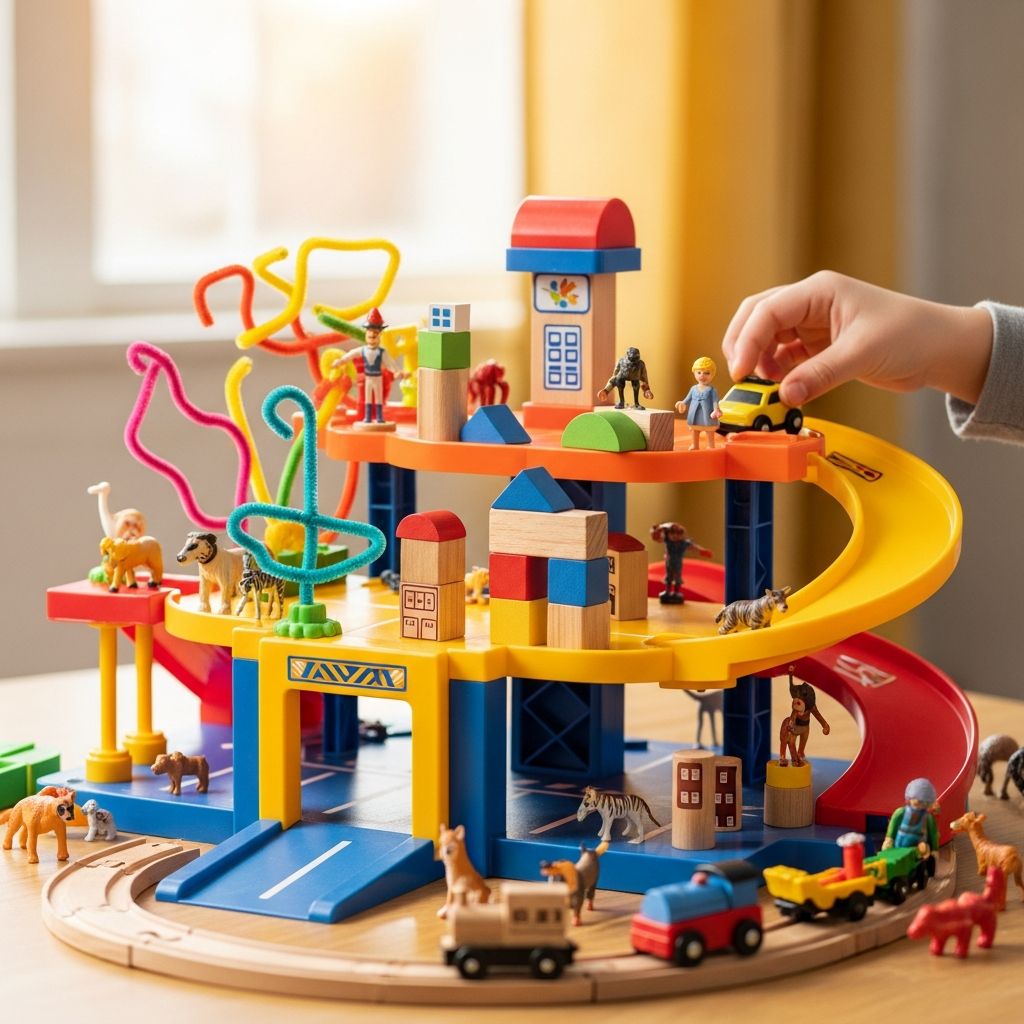
A toy parking garage can be far more than a plastic structure that collects dust in the corner. With a few simple tweaks and some intentional play ideas, it becomes a mini city, a science lab, a storytelling stage, and a surprisingly powerful learning tool for toddlers and preschoolers.
This guide shows you how to turn a basic garage playset into a flexible play station that encourages creativity, problem-solving, early math, and calmer independent play at home.
Why Parking Garage Play Matters
To adults, a parking garage toy may look repetitive—cars go up, cars roll down. For young children, that repetition is comforting and deeply educational. Each lap up the elevator and down the ramp gives them another chance to test gravity, understand cause and effect, and build their own imaginative stories.
- Repetition builds mastery: Children learn by doing the same action many times, noticing small differences and making tiny adjustments.
- Familiar structure, endless scenarios: The fixed layout of levels, ramps, and parking spots provides a stable “stage” where new characters, rules, and adventures can unfold.
- Built-in beginning, middle, end: Even the simple act of driving a car up, parking, and rolling down gives young children a natural story arc to play through.
Key Skills Kids Practice While Playing
When children send a car down a ramp for the tenth time, it may feel like mindless activity, but there is a lot going on under the surface. Parking garage play naturally weaves together physical, cognitive, and social-emotional learning.
Fine and Gross Motor Development
- Fine motor skills: Grasping small cars, turning knobs or levers, lining up wheels with a narrow ramp, and positioning a car into a tight parking spot all help strengthen hand and finger muscles used later for writing and self-care tasks.
- Gross motor skills: Getting down on the floor, stretching across the play mat, crawling around the garage, and reaching between levels support balance, coordination, and body awareness.
- Hand–eye coordination: Aiming a rolling car at just the right angle onto a ramp or through a tunnel requires kids to sync what they see with how they move.
Cognitive and STEM Foundations
Even without formal lessons, a parking garage naturally introduces early science and math concepts.
- Cause and effect: Children discover that pushing the car harder makes it go faster, blocking the ramp stops traffic, and lifting the elevator changes where the car appears.
- Early physics: Differences in ramp steepness, surface texture, and car weight become a playground for exploring speed, friction, and gravity.
- Problem-solving: Kids figure out traffic jams, how to rescue a stuck car, and how to rearrange the setup so everything fits.
- Math skills: Counting levels, comparing car sizes, and matching colors or numbers to designated parking spots all provide gentle math practice.
Imagination, Language, and Social Skills
As soon as a child adds a driver, a destination, or a rule (“this ramp is only for red cars”), parking garage play becomes a small drama filled with language and social practice.
- Storytelling: Cars pick up friends, race to the hospital, wait at the car wash, or go on pretend vacations. Each trip is a story with characters, conflict, and resolution.
- Vocabulary growth: Words like “level,” “garage,” “elevator,” “breakdown,” “jam,” and “shortcut” slip into everyday play talk.
- Turn-taking and negotiation: With siblings or friends, kids must share ramps, decide who drives first, and agree on the rules of the game.
Setting Up an Inviting Parking Garage Play Station
Instead of dumping the garage and cars in a toy bin, treat them as a little “play zone.” A thoughtful setup does half the work of capturing your child’s attention and keeping them engaged.
Choosing the Right Spot
- Low and stable surface: Place the garage on a low table or floor where children can easily reach all sides and levels.
- Nearby storage: Use a shallow bin or basket for cars so children can see what is available without digging.
- Defined play area: A small rug or mat under the garage visually marks the space and helps contain runaway cars.
Organizing Cars and Accessories
A little organization can turn a chaotic pile of vehicles into a tempting invitation to play.
- Sort cars by size, color, or type (construction, emergency, racing) in small containers or muffin tins.
- Limit how many cars are out at once to prevent overwhelm; rotate favorites every week or two.
- Keep a few open-ended accessories nearby—small figures, road signs, blocks, or fabric pieces for rivers and parking lots.
Simple Upgrades to Enrich the Play
You do not need to buy more toys to make the garage more engaging. Everyday household items and basic craft supplies can transform the setup and invite fresh scenarios.
DIY Roads, Ramps, and City Features
- Tape roads: Use painter’s tape or masking tape on the floor to create roads leading to and from the garage, complete with intersections and parking lanes.
- Homemade ramps: Cardboard pieces, wooden boards, or thick books can become experimental ramps with different heights and angles.
- Simple buildings: Repurpose small boxes as a gas station, repair shop, or café; add hand-drawn signs for extra charm.
Adding Real-World Details
Bringing in little touches from everyday life helps children connect play with the world they see around them.
- Draw parking lines and arrows on cardstock or cardboard for more realistic parking lots.
- Add play money, pretend tickets, or cardboard “passes” for entering and leaving the garage.
- Use colored paper circles as stoplights and talk about what red, yellow, and green mean.
Learning Activities With a Parking Garage
For parents who like a bit of structure, the garage doubles as a flexible tool for short, playful learning games. Below are ideas that mix fun with early literacy, math, and science.
Early Math and Sorting Games
- Numbered parking spots: Label parking spaces with numbers and invite your child to park a car in each matching space. Start with 1–3 and gradually add more.
- Color or size zones: Designate different levels for different colors or sizes of cars, encouraging comparison and classification.
- Counting challenges: Ask questions like “How many cars can fit on the top level?” or “How many red cars are parked today?”
STEM Mini-Experiments
Turn the garage into a simple laboratory to explore motion, speed, and design.
- Ramp races: Build two ramps at different heights and invite your child to predict which car will reach the bottom first, then test and observe.
- Surface experiments: Line one ramp with a towel and leave another smooth to compare how far and fast cars travel.
- Load testing: Gently attach small objects (like blocks or coins) to cars and see how extra weight changes their movement.
Language and Storytelling Prompts
- Daily adventures: Ask open-ended questions like “Where is this car going today?” or “Who is waiting on the top level?”
- Problem stories: Introduce a simple problem—“The elevator is broken,” “There is a traffic jam”—and invite your child to solve it through play.
- Role cards: Create small cards that say things like “mechanic,” “valet,” or “police officer,” and let your child choose a role for each character.
Example Activity Table: Quick Ideas at a Glance
| Activity | Main Skill Area | Suggested Age | Time Needed |
|---|---|---|---|
| Numbered Parking Challenge | Counting and number recognition | 3–5 years | 5–10 minutes |
| Ramp Speed Test | Basic physics and prediction | 3–6 years | 10–15 minutes |
| Color-Level Sorting | Sorting and categorization | 2–4 years | 5–10 minutes |
| Traffic Jam Storytime | Language and problem-solving | 3–6 years | 10–20 minutes |
| Garage City Build-Out | Creativity and spatial reasoning | 4–7 years | 20–30 minutes |
Supporting Independent Play (and Buying Yourself a Break)
One of the hidden gifts of a toy parking garage is its potential to encourage focused, independent play. With a thoughtful setup and clear expectations, children can play for longer stretches while caregivers enjoy a few minutes to themselves.
Preparing for Solo Play
- Offer a small, curated set of cars instead of every vehicle you own.
- Place everything your child needs—cars, small figures, and simple props—within easy reach.
- Demonstrate a couple of play ideas, then quietly step back to let your child take the lead.
Keeping the Garage Fresh Over Time
Children are more likely to return to a toy that changes slightly from week to week. Instead of adding more toys, tweak the environment.
- Rotate themes: emergency day, construction zone, car wash, or vacation parking.
- Swap accessories: some weeks include people figures, other weeks animals or building blocks.
- Change the road layout or add a new ramp to surprise your child.
Safety and Age-Appropriateness Tips
Parking garages and toy cars are generally low-risk toys, but a quick safety check helps keep play both fun and safe.
- Check for small parts: For toddlers who still mouth objects, avoid tiny detachable pieces that pose a choking risk.
- Secure ramps and levels: Make sure the structure is stable and cannot easily tip over during enthusiastic play.
- Supervise early experiments: When introducing new materials like coins for weights or household items for ramps, stay nearby until you trust your child’s judgment.
Frequently Asked Questions
What age is best for a toy parking garage?
Most parking garage playsets work well from around 2 or 3 years old, when children can manage small cars, up through early elementary years. Younger toddlers may enjoy rolling cars along the floor, while older children often build complex cities and storylines around the same garage.
How many cars do children really need?
Surprisingly few. A small collection of 6–10 cars is usually enough to support rich play. Too many vehicles can be overwhelming and harder to clean up, while a limited set encourages children to reuse and repurpose the same cars in new ways.
Can a parking garage really be educational, or is it just a fun toy?
It is both. When children play with toy vehicles and structures, they naturally experiment with movement, problem-solving, and social scenarios. They are building STEM foundations, practicing language, and learning social skills, all under the disguise of simple play.
Do I need a big, expensive garage for these activities?
No. A compact, sturdy garage paired with a handful of cars can support all the activities in this guide. You can extend its possibilities with homemade ramps, tape roads, and everyday household items instead of purchasing additional large sets.
How can I keep the play area from becoming a constant mess?
Give everything a clear “home.” Use a small basket for cars, a box or shelf space for the garage, and a simple rule that cars are parked or put in the basket when play is done. Keeping the collection modest and easy to sort makes cleanup faster and more manageable for young children.
Bringing It All Together
A toy parking garage may look like a simple gift, but it can become the centerpiece of a rich play environment. With thoughtful setup, occasional refreshes, and a willingness to follow your child’s lead, this one toy can offer months or even years of imaginative, educational fun—no batteries or screens required.