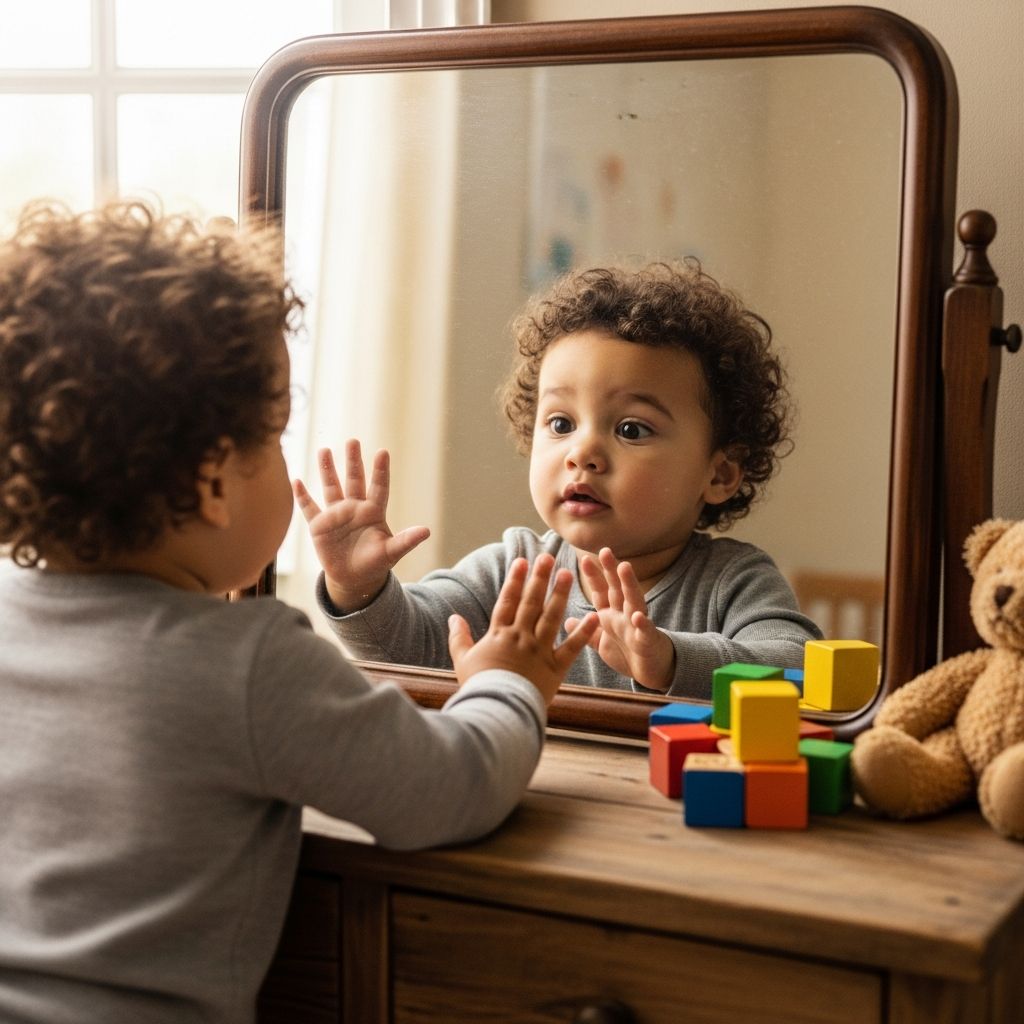
In the vibrant world of early childhood, the period between 15 and 24 months stands out as a transformative phase where toddlers begin to grasp the concept of ‘self.’ This emerging self-awareness is not just a cute parlor trick—it’s a foundational cognitive achievement that influences emotional regulation, social interactions, and personal identity formation throughout life. During this window, children transition from seeing their mirror image as a playful companion to recognizing it as their own reflection, marking a profound shift in consciousness.
Understanding the Foundations of Self-Recognition
Self-awareness develops gradually, building on earlier sensory and social experiences. By 15 months, many toddlers have already navigated initial fascination with mirrors, where reflections were intriguing but separate entities. Now, as motor skills refine and cognitive processing sharpens, they start linking their actions to the image they see. This connection fosters a sense of agency—the understanding that ‘I control my body and image.’ Research highlights this as a key indicator of mentalizing abilities, the capacity to reflect on one’s own and others’ mental states.
Key precursors include object permanence, achieved around 8-12 months, and joint attention, where children follow a caregiver’s gaze. These skills pave the way for the ‘aha’ moment of self-recognition, often tested via the mirror mark test, where a child touches a dot on their own face after spotting it in the mirror.
Key Stages of Mirror Self-Recognition in Toddlers
The journey unfolds in observable phases, each building complexity:
- Initial Differentiation (12-15 Months): Toddlers pat or poke the mirror, exploring cause-and-effect without full self-identification. They treat the reflection as interactive but external.
- Dawning Identification (15-18 Months): Subtle signs emerge, like pointing to their own eyes or mouth in the mirror. This shows early integration of visual and proprioceptive feedback.
- Full Self-Recognition (18-24 Months): Passing the rouge test becomes common. Children wipe marks from their faces, name body parts (‘nose!’), or adjust clothing, demonstrating clear self-concept.
These stages align with Philippe Rochat’s five levels of self-awareness, where Level 3 (identification) solidifies around 18 months, transitioning to Level 4 (permanence) by 24 months.
Observable Behaviors Signaling Self-Awareness Growth
Beyond mirrors, everyday actions reveal this milestone:
- Using possessive pronouns: ‘My shoe’ or ‘Me do it’ while pointing to themselves.
- Emotional responses to appearance: Fussing over messy hair or a dirty face in reflective surfaces.
- Imitation with intent: Copying expressions or gestures deliberately in mirrors.
- Body mapping: Touching specific parts like tummy or toes when named, using reflections for guidance.
- Independence bids: Resisting help with dressing to assert ‘self’ control.
| Age Range | Behavior Example | Developmental Significance |
|---|---|---|
| 15-18 Months | Touches own nose seeing it marked | Links visual cue to tactile sensation |
| 18-21 Months | Says ‘baby’ then ‘me’ in mirror | Shifts from third-person to self-reference |
| 21-24 Months | Fixes clothes or hair alone | Applies self-concept to practical actions |
Emotional and Social Dimensions of Emerging Selfhood
Self-awareness intertwines with emotions. Toddlers now experience pride in accomplishments (‘I did it!’) and embarrassment over mishaps, fueling motivation and resilience. Socially, they distinguish ‘me’ from ‘you,’ enhancing empathy precursors like turn-taking in play.
Challenges arise too: heightened frustration when autonomy clashes with limits, often called the ‘terrible twos’ onset. Caregivers can support by validating feelings (‘You look mad—it’s okay to feel that’), modeling self-regulation.
Practical Ways Parents Can Foster Self-Awareness
Intentional activities accelerate this growth without pressure:
- Mirror Games: Safe, full-length mirrors for dancing or posing. Narrate: ‘Look, your happy smile!’
- Body Part Songs: ‘Head, shoulders, knees, and toes’ with touching and mirroring.
- Photo Time: Show baby photos, asking ‘Who’s that?’ to bridge past and present self.
- Dressing Rituals: Let them choose outfits, praising choices to build agency.
- Reflective Talk: Use ‘I’ statements during play: ‘I see you building a tall tower!’
Incorporate diverse mirrors—funhouse styles for distorted fun, promoting laughter and flexibility in self-perception.
Potential Variations and When to Monitor
Development varies by temperament, culture, and stimulation. Some toddlers self-recognize at 15 months; others near 24. Bilingual homes or frequent mirror exposure may hasten it.
Consult professionals if by 24 months, no self-touching occurs alongside delays in language or social engagement. Early intervention ensures holistic support.
Frequently Asked Questions (FAQs)
What is the mirror test for self-awareness?
The mirror test, or rouge test, involves marking a child’s face discreetly. If they touch the mark on themselves (not the mirror) upon seeing the reflection, it indicates self-recognition, typically by 18-24 months.
Can all toddlers pass the self-recognition test by 24 months?
No, timelines vary. About 75% pass by 24 months, with full consolidation later. Cultural differences affect performance; it’s one milestone among many.
How does self-awareness impact toddler behavior?
It sparks independence, emotional intensity, and social awareness, leading to more ‘mine!’ declarations and selective sharing in play.
Is mirror play safe for 15-24 month olds?
Yes, with shatterproof, stable mirrors placed securely. Supervise to prevent climbing or banging.
What if my toddler ignores mirrors?
It may indicate preference for other stimuli. Introduce gradually with songs or faces; persistence isn’t failure.
Long-Term Implications for Child Development
This milestone seeds lifelong self-concept, influencing confidence, relationships, and adaptability. Nurturing it now correlates with better emotional intelligence by school age.
Parents play a pivotal role: responsive mirroring (echoing emotions) builds secure attachment, amplifying self-awareness benefits.
References
- Mirror Play Stages for Babies & Toddlers – Self-Recognition Development — Little People’s Cove. 2023. https://www.littlepeoplescove.com/blog/mirror-play-stages-for-babies-toddlers-self-recognition-development
- How Children Develop Self-Awareness — Busy Brains Activity Packs. 2023. https://www.busybrainsactivitypacks.co.uk/post/how-children-develop-self-awareness
- The 5 Stages Of Self-Awareness Explain What Babies See — Fatherly. 2023. https://www.fatherly.com/health/children-five-stages-self-awareness-mirror-tests
- Reflecting on Babies and Mirror Play — First Things First. 2023. https://www.firstthingsfirst.org/first-things/reflecting-on-babies-and-mirror-play/
- Babies as Young as Four Months Show Signs of Self-Awareness – Study — University of Birmingham. 2023-10-01. https://www.birmingham.ac.uk/news/2023/babies-as-young-as-four-months-show-signs-of-self-awareness-study