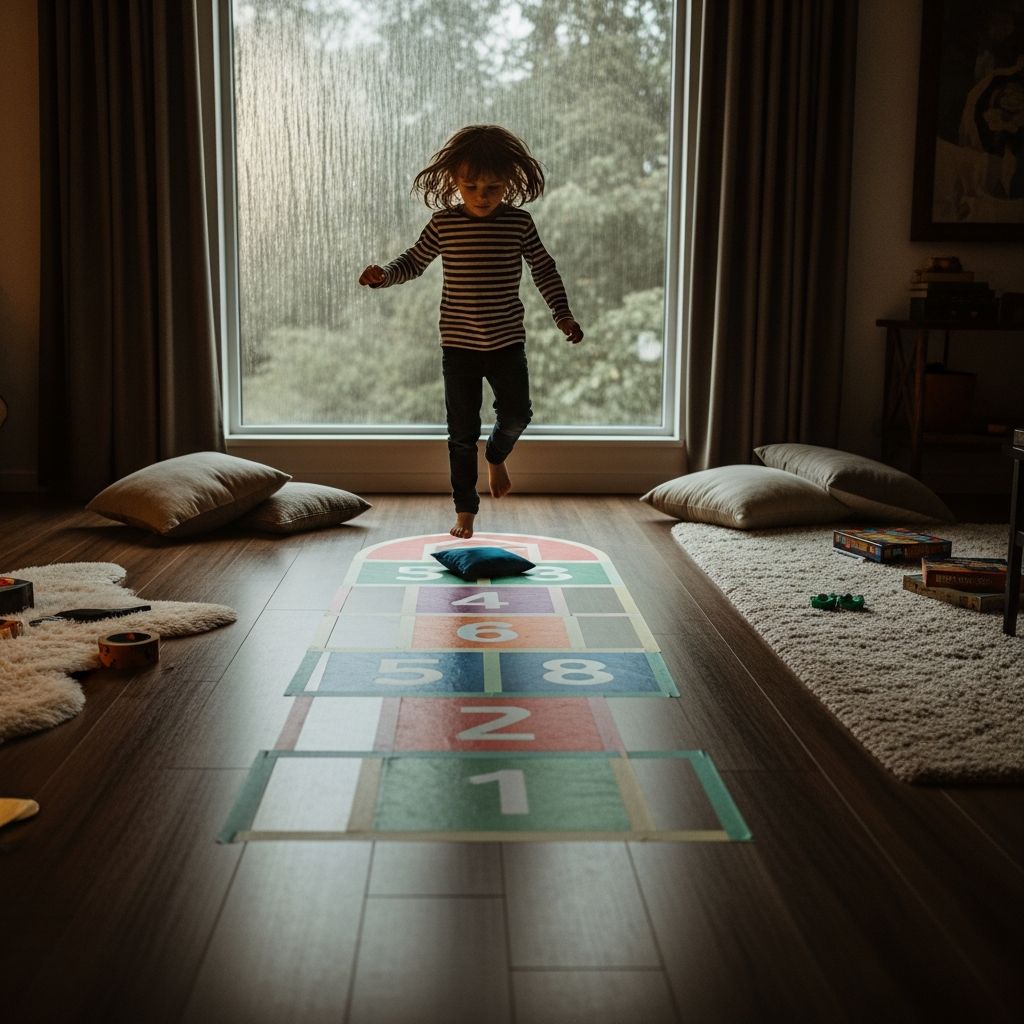
When kids are full of energy and the weather keeps everyone inside, an indoor hopscotch course can turn a hallway, living room, or playroom into an instant playground. This classic jumping game adapts beautifully to small spaces and gives kids a way to move, balance, and giggle without needing special equipment.
Rather than copying traditional playground layouts, you can design a hop path that fits your home and your child’s age, using soft materials and creative themes like colors, letters, or animals. The result is a quick, low-mess, screen-free activity that works just as well for preschoolers as it does for grade-school children.
Why Indoor Hopscotch Works So Well
Indoor hopscotch is more than a way to pass time; it blends physical play with simple problem-solving and turn-taking. Children build balance and coordination as they hop, stretch, and pivot, all while focusing on where to land next.
Because the path can be rearranged at any time, the activity stays fresh: you can shorten it for younger kids or add twists like counting or spelling for older ones. Parents and caregivers can easily join in, turning a simple floor grid into a shared, laughter-filled game.
Materials You Can Use (No Chalk Required)
You do not need a driveway or sidewalk to recreate the feel of hopscotch indoors. Most families already have enough materials on hand to build a simple path in minutes.
- Painters tape or masking tape: Gentle on floors and perfect for creating lines, boxes, or stepping stones.
- Colored paper or cardstock: Tape individual sheets to the floor as hop squares that can be moved and reused.
- Foam tiles or yoga mats: Great for softer landings and for smaller kids who are still learning to hop.
- Pillows or folded blankets: Use as “safe islands” to jump between for a cozier version in bedrooms or playrooms.
- Markers or sticky notes: Label spaces with numbers, letters, shapes, or pictures to add a learning element.
- Small toss objects: Use bean bags, soft toys, balled-up socks, or a scrunched paper ball as a marker.
Planning the Perfect Spot
The best indoor hopscotch area is long enough for several jumps in a row but not so cramped that kids feel squeezed. A hallway, along the side of a living room rug, or an open area of a playroom can all work well, as long as there is room to move forward and back.
Before building anything, walk the intended path yourself to check for slippery spots, sharp furniture corners, or items that might roll underfoot. Clearing clutter and pushing side tables or chairs slightly away from the path makes the game safer and more enjoyable.
Step-by-Step: Building Your Indoor Hop Path
A simple, flexible layout is easier for kids to understand and safer for energetic jumping. Instead of worrying about copying a traditional court exactly, focus on a path that matches your home’s space and your child’s confidence level.
- Mark a starting zone. Place a strip of tape or a piece of colored paper at one end of the space to show where players stand to begin.
- Lay down single spaces. Create three to five single boxes or shapes in a row where players will hop on one foot.
- Add occasional double spaces. Add a pair of boxes side by side so children jump with both feet apart, one foot in each box.
- Finish with a “turn-around” space. Make the final space a slightly larger square, circle, or star where kids land with both feet and pivot back toward the start.
- Label the path. Write numbers, letters, or simple pictures on each space so kids know the order in which they move.
- Test-run slowly. Walk, then hop through the course yourself or with your child to check that all spaces feel reachable and secure.
Basic Indoor Hopscotch Rules for Beginners
You can keep rules as simple or as challenging as you like. For younger children, it often helps to start with a version that focuses only on hopping, with no throwing or skipping yet.
- Players begin at the start line with a small marker (a soft toy or sock works well).
- On each turn, the player tosses the marker onto the first space in the path.
- The player hops along the path on one foot over single spaces and lands with both feet in double spaces.
- When approaching the space holding the marker, the player skips it, hopping over to the next one.
- At the last space, the player lands with both feet, turns carefully, and hops back toward the start.
- On the way back, the player pauses just before the marked space, leans down to pick up the marker while balancing, then hops over that square to finish.
- If the player steps on a line, loses balance, or lands on the wrong space, the turn ends and the next person plays.
Ages and Skill Levels: How to Adjust
Indoor hopscotch can be adjusted easily for toddlers, preschoolers, and older kids. The key is to match the distance between spaces and rule complexity to what your child can manage without feeling frustrated.
| Age Group | Suggested Layout | Recommended Rules | Extra Challenges |
|---|---|---|---|
| Toddlers (18–36 months) | Large, closely spaced mats or papers in a simple straight line. | Walk or step with both feet; no marker or skipping needed. | Say the color or picture on each space out loud. |
| Preschoolers (3–5 years) | Short path with a mix of single and double spaces. | Hop on one foot on singles and land with two feet in doubles; simple marker toss. | Count steps, name shapes, or follow a simple pattern like clap or turn around. |
| Early elementary (6–8 years) | Longer path with more spaces, curves, or zigzags. | Full rules with skipping, balancing, and careful marker placement. | Add timed runs, memory challenges, or specific movement tasks. |
| Older kids (9+ years) | Creative layouts like spirals, figure-eights, or branching paths. | Standard rules plus optional penalties for mistakes. | Math, spelling, or themed prompts on each space, plus friendly competitions. |
Creative Layout Ideas for Small Spaces
If you do not have a long hallway, you can still build a satisfying hop path by using unusual shapes or turning corners. Changing the layout frequently makes the game feel new, even if you only have a few feet of open floor.
- Sideways ladder: Arrange spaces in a gentle zigzag to encourage kids to hop slightly left and right as they move forward.
- Circle path: Place shapes in a loop around a coffee table or rug so kids can go around and around instead of straight forward.
- Spiral course: Start with a small center square and swirl outward, letting children hop toward the middle and then back out again.
- Island trail: Scatter pillows or foam squares as “islands” that kids must reach without touching the “water” in between.
Learning Twists: Numbers, Letters, and More
Once kids understand the basic idea of hopping along the path, you can transform hopscotch into a gentle learning tool. Labeling spaces and adding quick prompts keeps brains working while bodies move.
- Counting practice: Number each space and have kids say the number out loud as they land, or count by twos, fives, or tens.
- Alphabet trail: Replace numbers with letters and challenge kids to shout out a word that begins with each letter they land on.
- Shape station: Draw or tape simple shapes—circles, triangles, squares—onto each space and ask children to name them.
- Color categories: Assign each color a simple category, like animals, foods, or places, and have players name something in that category on each landing.
- Action prompts: Write tiny instructions such as “wiggle,” “spin,” or “clap” on certain spaces so that each jump comes with a surprise move.
Fun Game Variations for All Ages
After a few rounds, children may want more challenge or something a little different. Simple rule changes keep the game fun and also encourage kids to think ahead as they move.
- Silent Hops: Players complete the path without making a sound; if someone laughs or speaks, they start again.
- Backward Run: Kids hop forward on the way out, then carefully move backward through the same path on the return.
- Color Call: Before hopping, someone else calls out a color or letter, and the jumper must reach the matching space without stepping on others.
- Toss and Trade: Two players toss their markers different distances and then swap paths, each finishing the other person’s challenge.
- Time Trial: Use a timer and encourage kids to beat their own best time while still staying on the lines and following rules.
Safety Tips for Indoor Hopping
Since indoor hopscotch involves energetic movement on household floors, a few simple precautions help prevent slips and bumps. Safety rules also give kids clear expectations and make it easier for adults to relax and enjoy watching the game.
- Use tape that peels off easily and does not leave residue; test a small patch on your floor before building the full course.
- Keep the play area free of loose toys, cords, and rugs that could slide underfoot during a jump.
- Introduce rules such as one jumper on the course at a time and no pushing or racing so close that kids collide.
- Encourage children to hop in socks with grips or bare feet rather than smooth socks that may be slippery.
- For younger children, keep spaces larger and closer together to avoid big, awkward leaps.
Making It a Family Ritual
An indoor hopscotch path does not have to be a one-time project; it can become a recurring ritual during long winters, school breaks, or quiet weekends. Leaving a simple layout in place for a few days encourages kids to return to it on their own between other activities.
Families can also establish playful traditions, like building a new layout every Sunday afternoon or picking a weekly theme—space, ocean, jungle—and decorating spaces with related drawings or stickers. Over time, children may begin designing their own courses and rules, building independence and creativity alongside gross motor skills.
Frequently Asked Questions
How much space do I need for indoor hopscotch?
A path as short as two or three meters can be enough for a satisfying game, especially for younger kids. If your home is smaller, consider zigzag or circular layouts so players can hop in place without needing a long straightaway.
Can toddlers safely play indoor hopscotch?
Toddlers can enjoy a simplified version that focuses on stepping rather than hopping, using large, soft spaces like pillows or foam mats. Close supervision, slower movement, and eliminating throwing or skipping rules help keep them safe while they explore.
What if I have carpeted floors?
Carpet often makes an ideal surface, because it is less slippery and a bit softer for landings. Use paper, index cards, or foam pieces instead of tape outlines if adhesive does not stick well to carpet fibers.
How do I keep the game interesting for older kids?
Older children enjoy extra challenges such as timing each run, adding math or spelling tasks, or redesigning the course into curved or branching paths. Letting them create new rules or compete in pairs can make the game feel more like a personal obstacle course.
Is there a way to make the activity quieter for apartment living?
For families in upstairs apartments, use thick mats, folded blankets, or foam tiles to soften each landing and encourage kids to move smoothly rather than stomp. You can also replace some jumps with balance tasks, like standing on one foot and slowly turning, to keep the fun while minimizing noise.