Toddlers do a tremendous amount of learning through play, but it rarely looks like the kind of cooperative games adults expect. One moment they are happily stacking blocks alone, and the next they are sitting beside another child, deeply absorbed in their own activity without saying a word. To an adult, this can look like disinterest or even a social problem. In reality, these early patterns of play are essential building blocks for later friendships, empathy, and communication.
This article explores how solitary, parallel, and early social play support your toddler’s emotional, social, and cognitive growth. It also offers practical, respectful ways to support your child at each stage, without forcing interactions or shaming them for needing space. The aim is to give you clarity: your toddler is not behind because they are playing alone or next to, rather than with, another child. They are practicing exactly what they need to practice right now.
Why Toddler Play Looks So Different from Adult Play
Adults often think of play as something done with others: board games, team sports, group outings. Toddlers, however, are still learning the basic skills that make true cooperation possible—taking turns, using words to negotiate, imagining what another person might want, and managing strong feelings when things do not go their way. Expecting a two-year-old to naturally share or follow complex rules is like expecting them to read a novel after learning the alphabet.
Early play is less about entertainment and more about building the brain and nervous system. When a toddler repeats the same game—pouring and dumping water, driving a toy car in circles, or placing dolls in and out of a box—neurological pathways are being strengthened. What can look repetitive or even boring to an adult is a powerful self-chosen learning exercise for the child.
The Three Key Forms of Toddler Play
During the toddler years, three broad forms of play are especially important: solitary play, parallel play, and early social play. These are not rigid categories with exact ages. Instead, they overlap and appear in cycles. A child may move between them several times in one morning, depending on how rested, stimulated, or secure they feel.
| Type of Play | What It Looks Like | Typical Age Range (Approximate) | Main Benefits |
|---|---|---|---|
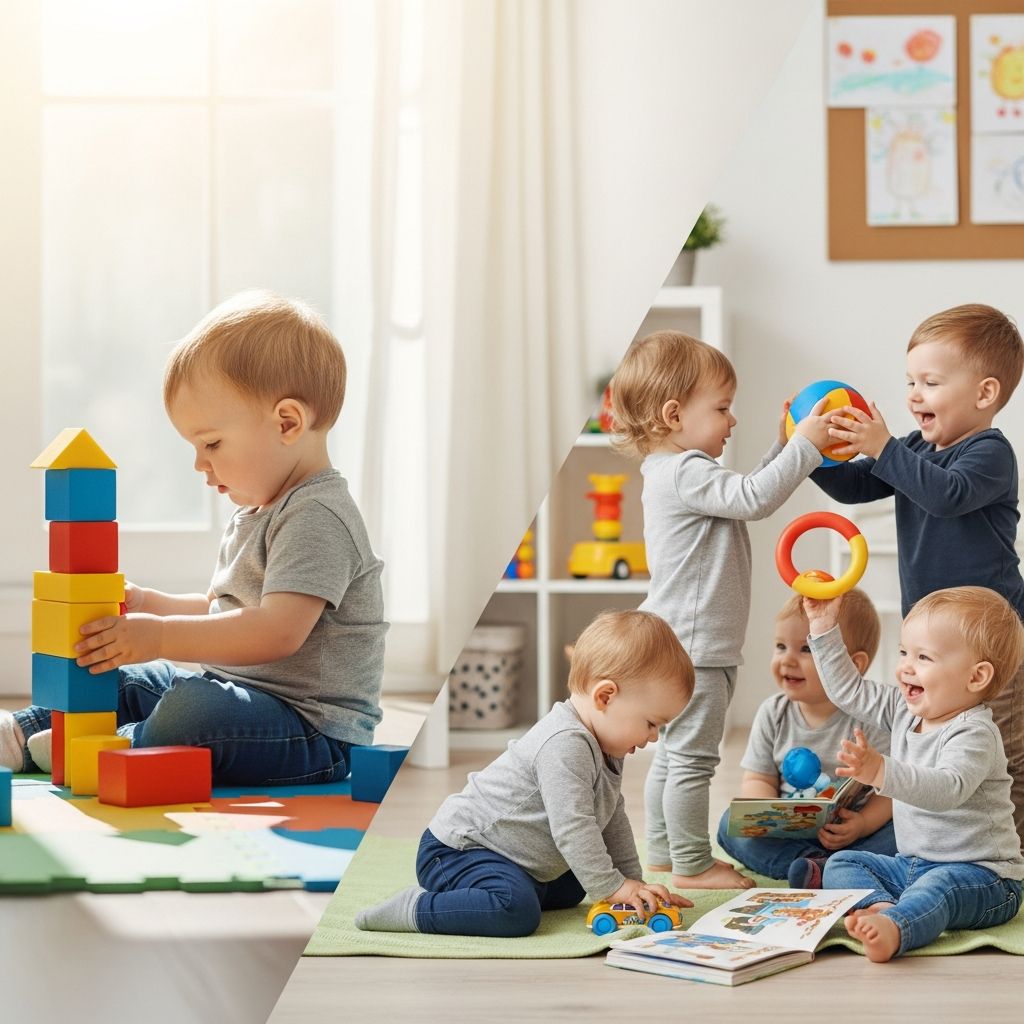
| Solitary play | Child plays alone, focused on toys or activities without trying to involve others. | Common from late infancy through preschool, especially strong in the 1–3 year range. | Builds focus, independence, creativity, and problem-solving. |
| Parallel play | Children play side-by-side with similar toys, often watching each other, but not coordinating actions. | Often seen from around 2–3 years, but can appear earlier or later. | Supports social awareness, imitation, and comfort around peers. |
| Early social play | Short bursts of interaction: offering toys, copying each other, simple pretending together. | Frequently shows up between 2.5–4 years in small, uneven doses. | Lays groundwork for sharing, collaboration, and friendship. |
Solitary Play: The Foundation of Focus and Independence
Solitary play is when a toddler chooses to play alone, even if other children are nearby. A one-year-old emptying a basket of blocks, a two-year-old lining up cars on the rug, or a three-year-old quietly paging through books in the corner are all engaged in solitary play. This is not a sign of isolation; it is a sign that the child is deeply involved in their own exploration.
During solitary play, toddlers learn to follow their curiosity without constant adult direction. They make their own choices, set their own pace, and experience the satisfaction of solving small problems—such as how to fit a puzzle piece or stack blocks without them toppling. This self-directed focus is the seed of later skills like persistence, concentration, and creative thinking.
How Parents Can Support Solitary Play
The goal is not to push a child to play alone before they are ready, but to create conditions where independent play naturally blooms. Toddlers need a secure bond and regular one-on-one connection to feel safe enough to explore without clinging.
- Offer a safe, simple play space. Too many toys can overwhelm a young child. A few open-ended items—blocks, dolls, vehicles, simple household objects—invite deeper engagement than shelves crammed with gadgets.
- Rotate toys rather than piling them on. Putting some toys away and reintroducing them later keeps the environment fresh and helps the child see possibilities in what is available.
- Stay nearby, but not intrusive. Sitting quietly with a cup of tea or folded laundry, occasionally making calm, warm eye contact, communicates, “You are safe. I am here if you need me.”
- Resist the urge to fix everything. If a child’s tower falls and they look briefly frustrated, pause before stepping in. Many toddlers quickly try again and discover effective strategies on their own.
Parallel Play: Side-by-Side Learning
Parallel play emerges when toddlers begin to enjoy being close to other children but are not yet ready to coordinate their activities. Two children may sit at the same table with crayons, each focused on their own drawing. In a sandbox, one may fill buckets while the other buries toy animals. They are aware of each other and may glance over or copy a technique, yet they rarely talk about what the other is doing.
To some adults, this can look like a missed opportunity for friendship. In truth, parallel play is the bridge between playing alone and playing together. Toddlers are practicing how to share physical space, listen to other children’s noises, and adjust to the unpredictable movements of peers while still feeling the safety of having control over their own play.
Why Parallel Play Matters
Parallel play can be thought of as “apprentice socializing.” The child watches how others build, move, and solve problems, and experiments with their own versions. Much of this learning happens without words. Simply sitting beside another child who is stacking blocks higher or drawing circles can inspire your toddler to try something new.
- Builds social comfort. Many toddlers need time simply being near peers before they feel brave enough to speak or share.
- Supports imitation. Copying actions—pouring sand, rolling cars, stirring pretend soup—is an early form of learning from others.
- Helps with regulation. Keeping their own toy or space while another child plays nearby can feel less threatening than being asked to collaborate right away.
Encouraging Healthy Parallel Play
Parents and caregivers can gently set up environments where parallel play naturally unfolds, without pressuring toddlers to “make friends” on a timetable. The key is to think of shared space and similar materials, not shared rules or goals.
- Set up duplicate materials when possible. Two sets of blocks, two buckets, or several dolls reduce competition and make it easier for toddlers to relax near one another.
- Use simple, predictable settings. Quiet corners of a playground, a familiar living room, or a calm playgroup space can feel safer than chaotic environments.
- Stay neutral during minor squabbles. If toddlers grab for the same toy, describe what you see and help them take turns without blame: “You both want the red truck. First Sam, then Maya.”
- Avoid forcing interaction. Inviting a child—“Would you like to sit by Noah while he draws?”—gives them a choice and respects their readiness.
Early Social Play: First Steps Toward Friendship
As toddlers gain confidence and language, short bursts of truly shared play begin to appear. One child may hand another a block, copy their silly dance, or join in feeding pretend animals. These moments are often brief and uneven. A game of “chase” may end suddenly in tears when someone bumps too hard or runs too fast.
Early social play is less about smooth cooperation and more about experimenting with connection. Toddlers are trying out phrases like “mine,” “my turn,” and “come here,” while also experiencing what happens when they push, grab, or ignore another child’s feelings. This is developmentally normal; they are not being mean on purpose. Their brains are still wiring the circuits for empathy and self-control.
Supporting First Friendships
During these early experiments in connection, toddlers need both space and guidance. They cannot yet resolve conflicts alone, but they also do not learn much if adults constantly direct the play.
- Stay close and observant. Being physically near allows you to step in calmly if things become unsafe or too intense.
- Use simple language to name feelings. Phrases like “You look upset. You didn’t like when the block was taken” help toddlers begin to connect actions with emotions.
- Model repair. Instead of forcing an apology, you can guide: “You knocked over her tower. Let’s help her rebuild it.”
- Limit group size. Many toddlers do best with one or two other children rather than large, overwhelming groups.
Respecting Temperament and Individual Differences
Not all toddlers move through these forms of play in the same way. Some children dive eagerly into parallel and social play, thriving on noise and movement. Others prefer long stretches of solitary play and need time to warm up before approaching peers. Both patterns can be healthy. Personality, sensitivity to sound and touch, sleep quality, and past experiences all influence how a child chooses to play.
A shy or observant toddler may watch others from a distance during playgroup, then re-create what they saw at home in private. This does not mean they are missing social learning; they are simply digesting it in a different way. Supporting these differences—rather than comparing your child to more outgoing peers—helps them develop genuine confidence instead of a mask of forced sociability.
When Parents Worry About Social Skills
It is natural to worry when your child behaves differently from others on the playground. Common concerns include a toddler who always plays alone, one who frequently grabs or pushes, or one who seems uninterested in other children. Before assuming there is a serious problem, it helps to remember how wide the range of typical development can be in the first years.
Some questions to reflect on include: Is your child curious about people in general? Do they seek comfort from caregivers? Do they make eye contact, point, or bring you objects? Can they engage in some form of back-and-forth interaction—peekaboo, simple songs, or shared giggles? These everyday connections often show that the underlying social wiring is developing, even if peer play is still emerging slowly.
Gentle Red Flags to Discuss with a Professional
While variation is normal, certain patterns may be worth bringing to a pediatrician or child development specialist for a closer look. The goal is not to diagnose your child yourself, but to seek support early if something feels consistently off.
- A toddler who seems almost completely unaware of other people, rarely looking at faces or responding to their name.
- Very limited interest in toys or play of any kind, beyond repetitive movements that do not change over time.
- Extreme distress in any social setting that does not improve at all with gentle, gradual exposure and support.
- Loss of skills your child previously had—for example, they used to imitate or babble socially and then stopped for weeks.
If any of these patterns persist, reaching out for professional guidance can bring clarity and practical tools. Early support does not mean something is “wrong” with your child; it simply offers them (and you) more tailored help.
Practical Play Ideas for Each Stage
Providing simple, flexible activities can help toddlers fully explore solitary, parallel, and early social play. The aim is not to force a specific type of interaction but to create rich opportunities they can enter at their own level.
| Form of Play | At-Home Ideas | Playdate or Group Ideas |
|---|---|---|
| Solitary |
|
|
| Parallel |
|
|
| Early social |
|
|
Balancing Guidance and Freedom
Supporting toddler play is less about directing activities and more about tuning into what your child is showing you. A child who pushes another away may be overwhelmed and needing more space. One who constantly grabs may need help with impulse control and more chances to experience that toys do, in fact, come back to them after a turn. Rather than labeling these behaviors as “bad,” it helps to view them as signals about what skills are still under construction.
You can gently guide by setting clear, simple limits—“I won’t let you hit; that hurts”—while also offering alternatives: “You can say ‘move please’ or bring me your truck if you need help.” Over time, repeated experiences of being understood and guided, rather than shamed, make it easier for toddlers to tolerate frustration and stay connected to others during play.
Key Takeaways for Parents
- Solitary, parallel, and early social play are all normal and necessary parts of toddler development.
- Playing alone does not mean a child is antisocial; it often reflects deep concentration and growing independence.
- Parallel play is a crucial bridge that lets toddlers practice being near others without the pressure of full interaction.
- First friendships are messy and brief; conflict and tears are part of learning, not evidence of failure.
- Respecting your child’s temperament and pacing helps them develop genuine confidence in social situations.
When parents understand these stages, everyday play stops being a test of social maturity and becomes what it truly is: a rich, unfolding process. By offering connection, simple environments, and gentle guidance, you create the ideal conditions for your toddler to move—from playing alone, to side-by-side, to truly together—at the pace that fits them best.
Frequently Asked Questions
Is it normal for my 2-year-old to ignore other children?
Yes, it can be perfectly typical. Many two-year-olds are most comfortable with solitary or parallel play, where they are near peers but focused on their own activities. Over time, as language and emotional regulation grow, they usually begin to show more interest in interacting.
How can I tell if my child is just shy or if there is a deeper social issue?
A shy toddler may warm up slowly, especially in new settings, but will usually show some curiosity and connection once they feel safe. If your child consistently seems unaware of people, rarely responds to their name, or loses previously gained social skills, it is wise to bring these observations to a trusted health professional for guidance.
Should I make my toddler share during playdates?
Forcing sharing often backfires, increasing anxiety and possessiveness. Instead, think in terms of turn-taking. You can calmly narrate, “It’s your turn with the truck. When you’re done, it will be Ava’s turn,” and support the handover when your child has had a reasonable time with the toy.
How long should independent play last at this age?
The length of independent play varies widely. Some toddlers may play alone for only a few minutes before seeking a caregiver, while others may focus for 20–30 minutes or more. The goal is not to reach a specific number, but to notice gradual increases in your child’s ability to stay engaged in self-chosen activities over time.
What if my child always wants me to play too?
Many toddlers rely on a caregiver’s presence to feel secure in play. You can gradually foster more independence by starting play together and then stepping back in tiny increments—moving a bit farther away, becoming quieter, or engaging in a simple task nearby—while reassuring your child that you are still available.