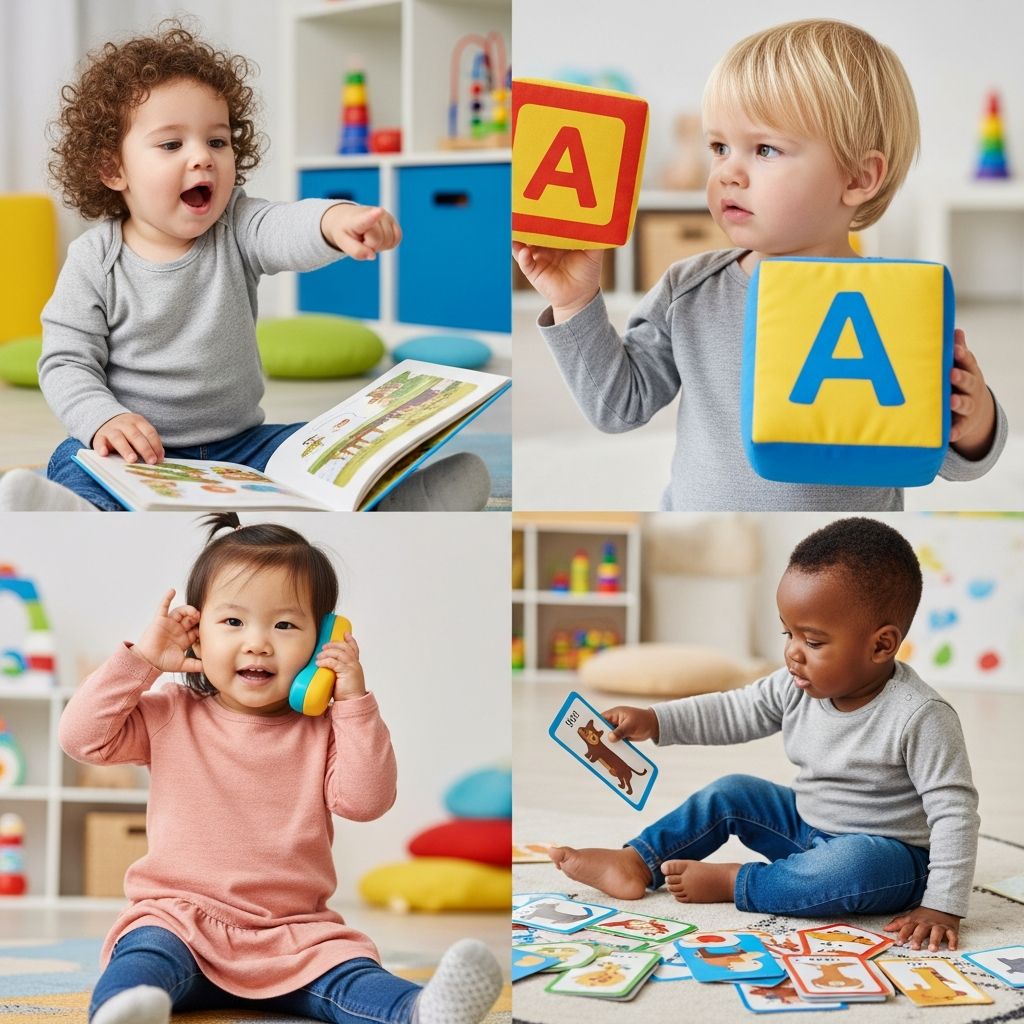
Between 18 and 24 months, toddlers experience a phenomenal acceleration in language acquisition, often adding 10-20 new words each day. This period marks a transition from single-word utterances to simple phrases, laying the foundation for complex communication.
Understanding the Vocabulary Acceleration Phase
The 18-24 month window is often called the ‘vocabulary spurt’ or ‘naming explosion,’ where children’s linguistic abilities skyrocket. Prior to this, infants typically use a handful of words like ‘mama’ or ‘dada,’ but now they catalog the world around them with remarkable speed. Research from developmental experts indicates that by 24 months, many children command 50-250 words, combining them into two-word sentences such as ‘more milk’ or ‘big truck’.
This surge stems from cognitive maturation, allowing toddlers to link symbols (words) to objects and actions more efficiently. Neural pathways in the brain’s language centers strengthen, enabling faster word retrieval and production. Parents often notice this shift suddenly, as if a switch flips, propelling their child from babbling to storytelling.
Key Language Milestones from 18 to 24 Months
Tracking milestones helps parents gauge progress. Here’s what to expect, drawn from pediatric guidelines:
- At 18 Months: Says 10-20 words, follows simple one-step directions without gestures (e.g., ‘Give me the toy’), points to named objects, shakes head for ‘no,’ knows basic body parts.
- By 20-22 Months: Vocabulary expands to 50+ words, imitates overheard words, uses action terms like ‘kiss teddy’ or ‘dolly sleep,’ enjoys animal sounds (e.g., ‘moo’ for cow).
- At 24 Months: Combines 2-3 words into phrases (‘want juice,’ ‘bye daddy’), asks questions (‘What’s that?’), points to pictures in books, follows two-step instructions (‘Put book down and get ball’), understandable half the time.
These benchmarks vary slightly by child, but consistent progress signals healthy development.
Receptive vs. Expressive Language: What Toddlers Grasp vs. Say
Receptive language (understanding) outpaces expressive language (speaking) during this phase. By 24 months, toddlers comprehend 200-300 words and simple questions like ‘Where’s your shoe?’ or ‘Show me nose,’ even if they speak far fewer.
Expressive skills emerge gradually: early on, words are approximations (e.g., ‘du’ for shoe), using limited sounds like p, b, t, d, m, n, w. Frustration arises when caregivers don’t understand, leading to tantrums—a sign they’re eager to communicate more.
| Age | Receptive Milestones | Expressive Milestones |
|---|---|---|
| 18 Months | Follows 1-step directions; understands 200+ words | 10-20 words; tries 3+ besides mama/dada |
| 24 Months | Two-step directions; names pictures | 50-250 words; 2-word phrases; questions |
This table summarizes growth, highlighting the receptive lead.
Factors Fueling Rapid Word Learning
Several elements drive this boom:
- Environmental Exposure: Daily interactions with responsive adults who name objects and narrate actions accelerate uptake.
- Social Play: Pretend play (feeding teddy) and turn-taking conversations build context for words.
- Cognitive Leaps: Improved memory and categorization let toddlers group concepts (e.g., all dogs as ‘woof’).
- Motor Skills: Better articulation from oral muscle development aids clearer speech.
Consistent routines, like mealtime naming, reinforce learning.
Practical Strategies to Boost Your Toddler’s Speech
Parents play a pivotal role. Evidence-based tips include:
- Expand on utterances: If child says ‘ball,’ reply ‘Big red ball rolling!’ to model more words.
- Narrate daily life: ‘We’re putting on shoes to go outside’ during routines.
- Read interactively: Point and name in books; ask ‘Where’s the cat?’.
- Use clear, slow speech: Short sentences with emphasis on key words.
- Incorporate songs/rhymes: ‘Wheels on the Bus’ teaches actions and sounds.
- Respond to gestures: Acknowledge points or nods to encourage verbal follow-up.
Avoid screens; prioritize face-to-face talk for optimal brain wiring.
Play-Based Activities for Language Growth
Fun engages toddlers best:
- Picture Hunts: Hide toys, say ‘Find the truck!’ to practice following directions.
- Body Part Games: Sing ‘Head, Shoulders, Knees and Toes’ while touching.
- Animal Imitations: Make farm sounds together, prompting ‘What does cow say?’.
- Puppet Shows: Use toys for simple dialogues like ‘Dolly wants milk’.
- Snack Time Chat: Name foods, ask ‘More apple?’ to spark phrases.
These 5-10 minute sessions daily yield big gains.
Red Flags: When to Consult Professionals
While variation is normal, seek speech therapy if by 24 months your child:
- Uses fewer than 50 words.
- Doesn’t combine words.
- Doesn’t follow simple directions.
- Shows no interest in communication.
- Regresses in skills.
Early intervention, like programs referenced in guidelines, dramatically improves outcomes. Discuss with pediatricians promptly.
Frequently Asked Questions (FAQs)
Is it normal for my 18-month-old to only say a few words?
Yes, 10-20 words is typical at 18 months, with understanding far ahead. Monitor growth; consult if stagnant.
How can I tell if my toddler understands more than they say?
Test with ‘Point to eyes’ or ‘Give teddy hug’—success without gestures shows strong receptive skills.
What if speech isn’t clear at 24 months?
Half understandable is average; limited sounds like p/b/t are common. Therapy if persists beyond.
Does screen time help language?
No—interactive talk trumps passive viewing for vocabulary building.
Can bilingual homes delay speech?
Milestones apply similarly; total concepts (across languages) matter, not word count per language.
Long-Term Benefits of Early Language Foundations
Strong 18-24 month skills predict literacy, social success, and academic prowess. Investing now pays lifelong dividends through enriched neural connections.
References
- 18-24 months – Speech and Language UK — Speech and Language UK. 2023. https://speechandlanguage.org.uk/help-for-families/ages-and-stages/18-24-months/
- Communication: Infants and Toddlers — Virtual Lab School. 2023. https://www.virtuallabschool.org/infant-toddler/communication-and-language-development/lesson-2
- Language development: Speech milestones for babies — Mayo Clinic. 2024-01-15. https://www.mayoclinic.org/healthy-lifestyle/infant-and-toddler-health/in-depth/language-development/art-20045163
- Speech and language development (from 12 to 24 months) — Great Ormond Street Hospital. 2023. https://www.gosh.nhs.uk/conditions-and-treatments/procedures-and-treatments/speech-and-language-development-12-24-months/
- A Quick Guide to Your Toddler’s Speech and Language Development — Eastern Ontario Health Unit. 2024. https://eohu.ca/en/my-health/a-quick-guide-to-your-toddler-s-speech-and-language-development-18-to-24-months
- Age-Appropriate Speech and Language Milestones — Children’s Hospital of Philadelphia. 2023. https://www.chop.edu/health-resources/age-appropriate-speech-and-language-milestones
- Communication Milestones: 19 to 24 Months — American Speech-Language-Hearing Association (ASHA). 2023. https://www.asha.org/public/developmental-milestones/communication-milestones-19-to-24-months/
- Milestones by 18 Months — Centers for Disease Control and Prevention (CDC). 2024. https://www.cdc.gov/act-early/milestones/18-months.html