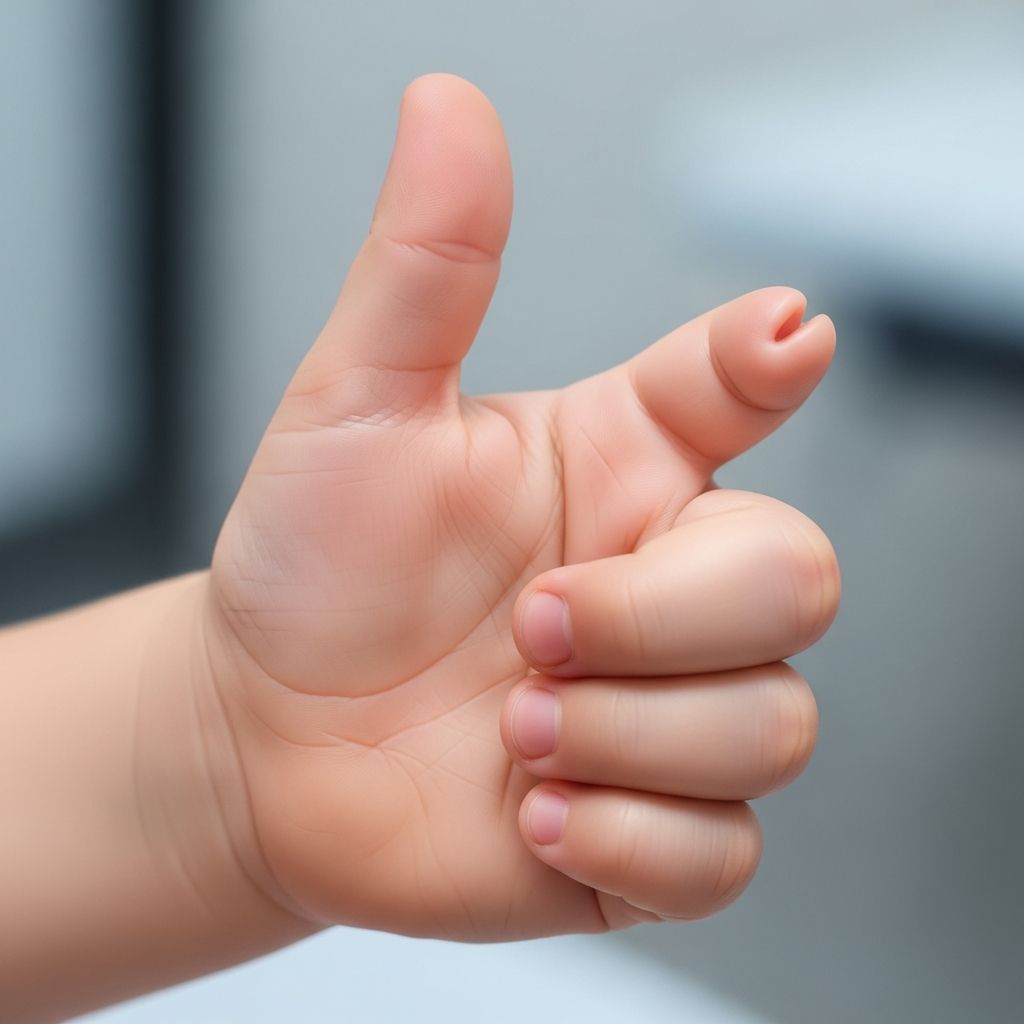
Thumb duplication can be surprising and worrying for parents who notice an extra thumb on their baby’s hand. This detailed guide explains what thumb duplication is, how it is diagnosed and treated, and how you can support your child before and after surgery.
What Is Thumb Duplication?
Thumb duplication is a type of polydactyly, a congenital (present at birth) condition in which a child has more than five digits on a hand or foot. An extra thumb forms on the thumb side of the hand, sometimes called preaxial polydactyly or radial polydactyly.
In thumb duplication, the two thumbs may:
- Be almost equal in size and shape
- Share bone, joints, or soft tissue
- Include one well-formed thumb and one smaller or underdeveloped thumb
Thumb duplication is among the most common congenital hand differences, affecting roughly 1 in 3,000 newborns.
How Thumb Duplication Develops
The hands and fingers form early during pregnancy. Thumb duplication occurs when typical hand development is disrupted while the baby is still in the uterus. Instead of forming a single thumb, the tissues that build the thumb partially or fully divide into two.
Possible contributing factors
- Genetic influences: Some children with thumb duplication have a family history of polydactyly, suggesting a hereditary component in certain cases.
- Isolated difference vs. part of a syndrome: Most children with an extra thumb are otherwise healthy, but in a minority of cases, thumb duplication appears together with other congenital differences or genetic syndromes.
- Complex biology: Research suggests that changes in genes controlling limb patterning can lead to polydactyly, though the exact mechanism is often not identified in a specific child.
In many families, no clear cause is found, and nothing a parent did before or during pregnancy is responsible for the extra thumb.
Types and Classification
Hand specialists often describe thumb duplication using classification systems based on which bones and joints are duplicated. The most widely used system is the Wassel classification for preaxial polydactyly. This framework helps surgeons plan the best reconstructive approach.
| Feature | Examples in Thumb Duplication |
|---|---|
| Location of extra structures | Only tip duplicated, middle joint duplicated, or entire thumb (including its base) duplicated |
| Bone involvement | Extra distal phalanx, extra proximal phalanx, or duplicated metacarpal bone |
| Connection between thumbs | Separate thumbs, partially fused thumbs, or shared joints and ligaments |
| Appearance | Two nearly normal thumbs, or one normal-sized thumb and one smaller, less developed thumb |
Even within the same classification type, no two hands are exactly alike. Treatment is tailored to each child’s anatomy and function.
How Common Is Thumb Duplication?
- Duplicated thumb is reported in about 1 in 3,000 births, making it one of the most frequent congenital hand anomalies.
- It can occur on one or both hands; some children have a duplicated thumb on just one side, others on both.
- Thumb duplication is more frequently described in some ethnic populations (for example, Caucasian and Asian groups) but can occur in any background.
- Many children with thumb duplication are otherwise healthy and have no other structural differences.
Signs and Functional Impact
Thumb duplication is usually visible at birth. However, the impact on hand function becomes clearer as your child begins to use their hands more.
What parents might notice
- An obvious extra thumb on the thumb side of the hand
- Curved or angled thumbs that look different from each other
- Smaller, less developed extra thumb, sometimes with a tiny or absent nail
- Difficulty grasping or pinching objects as the child grows
In some children, the extra thumb does not seriously affect early hand use. In others, the split structure can weaken grip, reduce stability, or make fine motor tasks like holding a pencil harder later in childhood.
Diagnosis and Evaluation
Most cases of thumb duplication are identified soon after birth during a newborn exam. Occasionally, an extra digit can be seen on prenatal ultrasound, but imaging cannot always show detailed bone anatomy before birth.
Steps in the diagnostic process
- Physical examination: A pediatrician, pediatric hand surgeon, or pediatric orthopaedic specialist examines the shape, size, position, and movement of both thumbs.
- X-rays: Plain radiographs show which bones and joints are duplicated and how they line up, which is crucial for surgical planning.
- Family and medical history: Doctors may ask whether other relatives have extra digits or other congenital differences.
- Screening for associated conditions: If your child has other physical differences or developmental concerns, the care team may recommend genetic evaluation or additional tests.
Treatment Goals
The main goals in managing thumb duplication are:
- Creating a single, stable, and well-aligned thumb
- Providing the best possible grip and pinch function
- Improving appearance to help with self-esteem and social comfort
- Reducing the risk of joint problems, pain, or stiffness later in life
For most children, these goals are achieved through reconstructive surgery performed in early childhood.
When Is Surgery Recommended?
Surgery is the standard treatment for thumb duplication in children. Timing and technique depend on your child’s age, anatomy, and overall health.
Typical timing
- Many centers perform surgery when a child is around 12 months old, once the hand is large enough and the child can safely undergo anesthesia.
- Some procedures may be done slightly earlier or later depending on complexity and the surgeon’s judgment.
Why early surgery can help
- Allows the reconstructed thumb to develop along with the hand
- Supports normal motor skill development (grasping, pinching, using utensils)
- May lessen emotional impact because the child is unlikely to remember the surgery itself
What Happens During Surgery?
Thumb duplication surgery is a highly specialized procedure performed by a pediatric hand or orthopaedic surgeon.
Key steps
- Removal of the extra thumb: The surgeon removes the duplicated thumb that is less favorable for long-term function and alignment, often leaving the thumb that has better joints, bones, and soft-tissue support.
- Reconstruction of the remaining thumb: Tissues from the removed thumb (such as bone, ligaments, or tendons) may be used to strengthen and reshape the remaining thumb.
- Joint and ligament balancing: The surgeon adjusts ligaments and soft tissue to create a stable, straight thumb that moves smoothly.
- Skin closure and contouring: Careful suturing aims to provide a natural contour and minimize scarring.
The operation is usually done under general anesthesia. Many children go home the same day, although complex cases may require an overnight hospital stay for observation.
Recovery and Rehabilitation
After surgery, the hand needs time to heal and adapt to its new structure.
Immediately after surgery
- Your child’s hand is typically placed in a cast or splint to protect the reconstruction for about two weeks.
- Pain is managed with child-appropriate medications, and many children experience only mild to moderate discomfort that improves in a few days.
- Swelling and bruising around the surgical site are common and gradually resolve.
Short- and long-term follow-up
- Cast removal: Once the cast is removed, the surgeon checks incision healing, thumb alignment, and early motion.
- Therapy: Some children are referred to occupational or hand therapy to support range of motion, strength, and age-appropriate function.
- Monitoring growth: Because children’s hands grow and change, periodic follow-up visits help identify and address any late curve, stiffness, or joint laxity.
Most children adapt quickly and use their reconstructed thumb naturally during play and everyday activities.
Possible Risks and Complications
As with any surgery, there are potential risks, though serious complications are uncommon when care is provided by experienced pediatric hand teams.
- Infection, bleeding, or wound healing problems
- Residual curve or deformity of the thumb as the child grows
- Joint stiffness or limited motion
- Instability or looseness of the joint
- Need for a secondary procedure later in childhood to refine function or appearance
Your child’s surgeon will discuss specific risks for your child and steps taken to reduce them.
Living With a Reconstructed Thumb
Most children who undergo surgery for thumb duplication go on to have strong, functional hands and can participate fully in play, school, sports, and hobbies.
Daily activities
- Babies and toddlers usually resume play with blocks, toys, and feeding utensils soon after healing.
- As children enter school, they typically can write, cut with scissors, and manage buttons and zippers.
- Sports and musical instruments are usually possible, although individual abilities vary.
Emotional and social aspects
- Parents can foster a positive body image by using neutral, matter-of-fact language about the hand difference and surgery.
- Simple age-appropriate explanations empower children to answer peers’ questions.
- For children with ongoing concerns about appearance or function, counseling or support groups for families of children with limb differences may be helpful.
How Parents Can Support Their Child
Your role is central in helping your child feel safe, confident, and capable throughout diagnosis and treatment.
- Ask questions: Write down your concerns before appointments so you understand the diagnosis, surgical plan, and follow-up schedule.
- Prepare for surgery: Use simple words to tell your child what to expect (for example, “The doctor will help your thumb work better.”).
- Follow care instructions: Keep the cast dry, give medicines as directed, and attend all follow-up visits.
- Encourage play: Once cleared by the surgeon, age-appropriate play that involves grasping and pinching supports recovery.
- Seek support: Connecting with other parents through reputable hospital programs or limb-difference organizations can provide reassurance and practical ideas.
When to Call the Doctor
After surgery or during follow-up, contact your child’s care team if you notice:
- Fever, increasing redness, or drainage from the incision
- Swelling that is getting worse instead of better
- Your child refusing to move their fingers or showing unusual pain
- Cast or splint becoming wet, damaged, or too tight
- New curve, stiffness, or changes in thumb alignment over time
Frequently Asked Questions (FAQs)
Did I do something during pregnancy to cause my baby’s extra thumb?
No. Thumb duplication is a congenital difference that develops very early in pregnancy. In most cases, a specific cause is never found, and nothing a parent did or did not do caused the condition.
Will my child need surgery on both hands if only one thumb is duplicated?
No. Surgery is directed only to the hand with the duplication. If one hand is normal, no operation is needed on that side. When both thumbs are duplicated, each hand is evaluated and treated individually.
How successful is surgery for thumb duplication?
When performed by experienced pediatric hand surgeons, most children achieve a functional, stable, and cosmetically acceptable thumb with good overall hand use. Some children may require minor additional procedures as they grow.
Will my child be able to play sports and musical instruments?
Many children with reconstructed thumbs participate fully in sports, music, and other activities. Early treatment, good follow-up, and practice with age-appropriate tasks support strong functional outcomes.
Should our family meet with a genetic counselor?
If there is a strong family history of polydactyly or your child has other congenital differences, your care team may recommend consultation with a geneticist or genetic counselor to discuss possible inheritance patterns and future pregnancy planning.
References
- Triphalangeal thumb, thumb duplication, and syndactyly: A case report — Alwan SM et al., Medicine (Baltimore). 2022-10-14. https://pmc.ncbi.nlm.nih.gov/articles/PMC9592472/
- Thumb Duplication — Children’s Hospital of Philadelphia. 2021-06-10. https://www.chop.edu/conditions-diseases/thumb-duplication
- Polydactyly — Nationwide Children’s Hospital. 2020-08-01. https://www.nationwidechildrens.org/conditions/polydactyly
- Polydactyly (Extra Fingers or Toes): What It Is & Causes — Cleveland Clinic. 2022-09-20. https://my.clevelandclinic.org/health/diseases/24302-polydactyly-extra-digits
- Thumb duplication (preaxial polydactyly): Overview — AboutKidsHealth, The Hospital for Sick Children. 2018-05-15. https://www.aboutkidshealth.ca/healthaz/plastics/thumb-duplication-preaxial-polydactyly-overview/