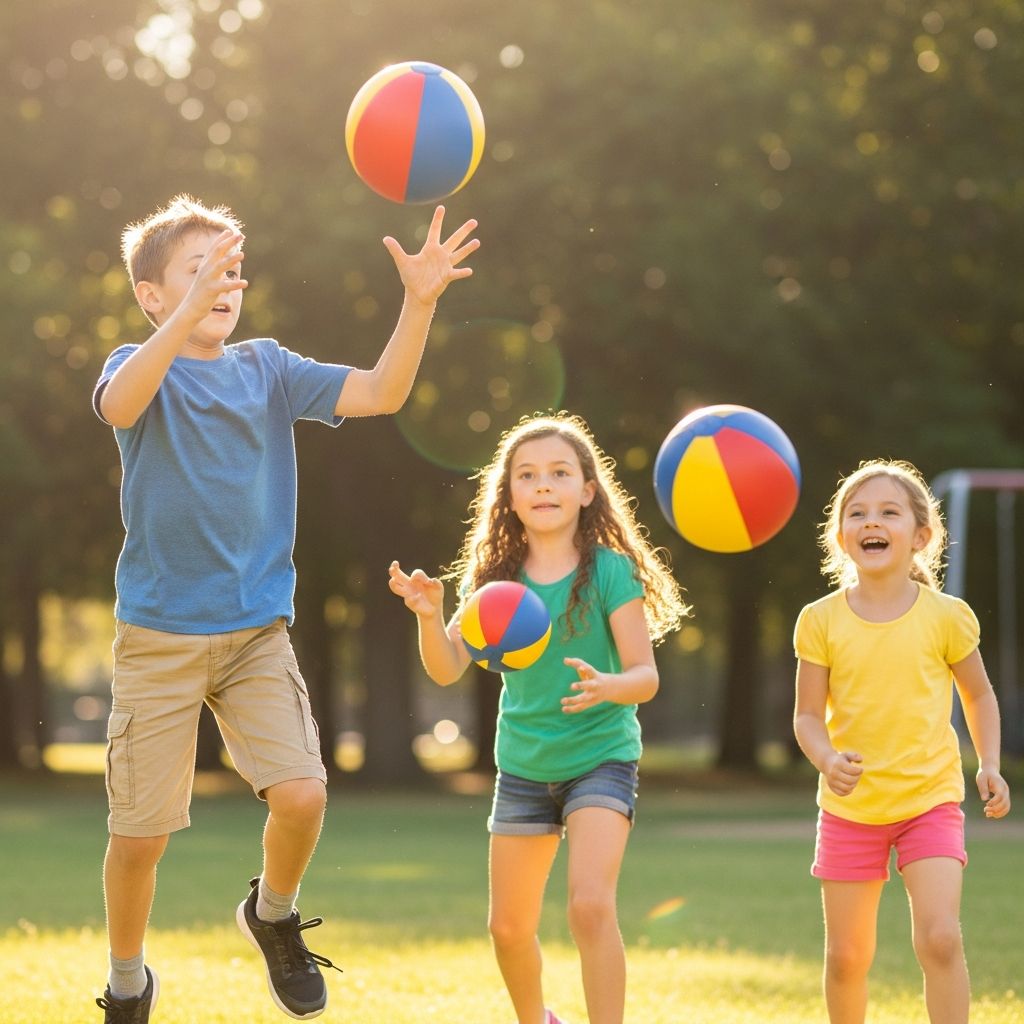
Throwing and catching games are among the simplest ways to help kids move their bodies, sharpen their brains, and bond with the people they love most.
With only a ball and a bit of space, families can create powerful moments that build coordination, confidence, and connection.
Why Throwing and Catching Matter
When a child throws or catches a ball, the body and brain work together to judge distance, track movement, and time each action precisely. This combination builds gross motor skills, spatial awareness, and hand–eye coordination.
Over time, these simple skills support success in sports, playground play, and everyday tasks like carrying objects, navigating crowds, or reacting quickly to surprises.
Key Benefits for Growing Kids
- Physical strength and coordination: Repeated throwing and catching use arm, leg, and core muscles while improving balance and reaction speed.
- Cognitive skills: Kids practice estimating force, direction, and timing, which fosters problem-solving, planning, and flexible thinking.
- Social and emotional growth: Playing catch encourages turn-taking, communication, resilience after missed attempts, and shared joy with others.
- Confidence and perseverance: Seeing steady improvement after practice teaches children that effort leads to progress, strengthening self-esteem.
Getting Started: Gear, Space, and Ground Rules
Most families already own what they need to begin: a soft ball and a safe open area. The right setup can turn a regular backyard or living room into a mini skill-building zone.
Preparation matters, especially for younger or more cautious children, because feeling safe lowers anxiety and makes kids more willing to try new movements.
Choosing the Right Ball
- Size: Larger balls are easier for young children to see and catch; smaller balls challenge older kids’ precision and finger control.
- Texture and weight: Soft foam, fabric, or light rubber balls hurt less on impact and encourage kids who are nervous about getting hit.
- Color: Bright or high-contrast colors are easier to track visually, particularly in lower light or busy environments.
Setting Up a Safe Play Area
- Use flat ground free from loose rugs, toys, or holes that could cause trips or twisted ankles.
- Keep distance from fragile objects, streets, and hard edges to reduce injuries and stress for everyone.
- Decide which direction is the “safe zone” for throws so children learn to aim away from hazards and bystanders.
Simple Safety Guidelines
- Teach kids to throw below the shoulders when playing close to others to avoid face and head impacts.
- Remind everyone to watch the ball and keep hands ready, even when not holding it, to react quickly.
- Set clear rules about not throwing when someone’s back is turned or when another player is not ready.
Age-by-Age Guide to Throwing and Catching Games
Kids develop ball skills gradually, and games can be adjusted to match their growing bodies and attention spans. Matching the challenge to their stage helps them feel successful and eager to keep playing.
The table below offers a quick snapshot of appropriate goals and ideas by age, followed by more detailed descriptions.
| Age Range | Main Skills to Practice | Best Ball Types | Sample Game Idea |
|---|---|---|---|
| Toddlers (1–3) | Rolling, two-handed catches at close range, exploring how balls move. | Large, soft, lightweight balls. | Roll-and-stop games where adult and child take turns. |
| Preschoolers (3–5) | Underhand throws, catching after a bounce, simple aiming. | Medium foam or rubber balls. | Toss-and-clap: toss ball, clap once, then catch. |
| Early Elementary (5–8) | Overhand throws, consistent catching, tracking flight paths. | Varied sizes, including small hand-sized balls. | Target throws at buckets or chalk circles. |
| Older Kids (8+) | Accuracy, power control, strategy, and teamwork. | Sport-specific balls (baseball, softball, football, etc.). | Goal-based throwing games with scoring and roles. |
Toddler-Friendly Ball Play (1–3 Years)
At this stage, the aim is exploration: toddlers are learning what a ball does when it is pushed, dropped, or rolled. The focus should be on shared enjoyment rather than performance.
Keep sessions short and relaxed, celebrating any attempt to interact with the ball, whether it is a smooth roll or a clumsy grab.
- Roll-and-Name: Sit facing your toddler and roll a ball gently back and forth, saying each other’s names as the ball travels.
- Color Chase: Place two or three colored balls on the floor and ask your child to roll a specific color back to you.
- Basket Drop: Let your toddler carry a ball and drop it into a low basket, then push the basket back to reset.
Preschool Play (3–5 Years)
Preschoolers are ready for simple rules and love repeating the same game with minor twists, which strengthens coordination and memory.
At this age, many children start to catch balls with both hands in front of their bodies and enjoy games that involve counting or silly challenges.
- Bounce-and-Catch: Stand a few steps apart, bounce the ball once toward your child, and let them catch it after it rises.
- Shape Targets: Draw shapes on the ground with chalk and ask your child to aim rolls or gentle throws into specific shapes.
- Clap Challenge: Toss a ball straight up and have your child clap once before catching; add more claps as they improve.
School-Age Skill Builders (5–8 Years)
Once children reach elementary school, they can manage more precise instructions and begin to control both power and direction.
Games at this stage can blend agility, speed, and strategy, while still keeping the core skills of throwing and catching at the center.
- Moving Targets: Place cones or boxes at different distances and award points for successful hits with controlled throws.
- Partner Run-and-Catch: One player gently throws the ball ahead while the other jogs forward to catch it, then switch roles.
- Pattern Passing: Line up two or three family members and pass the ball in a set pattern (for example, middle-left-middle-right) as quickly as possible without dropping it.
Games for Older Kids (8+ Years)
Older children often enjoy competitive elements, keeping score, and adding strategy to their games. These preferences can be used to deepen throwing accuracy, catching reliability, and teamwork.
They are also ready for more sport-specific skills that prepare them for organized athletics or recreational leagues.
- Zone Passing: Mark zones at various distances and angles; players earn more points for accurate throws into harder zones.
- Relay Throws: Create teams that sprint to a marker, throw to a partner, then rotate positions, combining speed and precise passing.
- Strategy Catch: In small groups, assign roles such as “thrower,” “receiver,” and “defender” to practice communication and quick decisions.
How Throwing and Catching Support Development
Ball games do far more than entertain: they reinforce multiple areas of development in a way that feels like pure play.
Understanding these layers can help parents feel more confident that each playful moment is also a meaningful learning opportunity.
Physical Development
- Gross motor skills: Running to chase a ball, jumping to catch it, and twisting to throw all strengthen large muscle groups and improve coordination.
- Bilateral coordination: Using both hands together, or throwing with one hand while stabilizing with the other, trains the brain to coordinate both sides of the body.
- Timing and rhythm: Learning when to open and close the hands or when to release the ball polishes timing, which transfers to other skills like dancing or handwriting.
Cognitive and Academic Readiness
- Attention and focus: Tracking a moving ball requires sustained concentration, which supports focus in classroom tasks.
- Problem-solving: Kids experiment with how hard to throw, which angles work best, and how to adjust when they miss, building flexible thinking.
- Pattern recognition: Predicting the path of a ball and responding to repeated game routines strengthens pattern detection and planning skills.
Social and Emotional Benefits
- Relationship building: Playing catch naturally places children face-to-face with caregivers or peers, opening the door for conversation and shared laughter.
- Resilience: Every dropped ball is a chance to try again, helping kids tolerate frustration and see mistakes as part of learning.
- Stress relief: Rhythmic, repetitive movement and physical exertion can reduce stress hormones and improve mood.
Simple Variations to Keep Games Fresh
Kids often love repetition, but even the best game can grow stale if it never changes. Small twists can refresh familiar activities while targeting new skills.
Parents can adjust distance, speed, or rules to adapt games for siblings of different ages or energy levels.
Change the Way the Ball Moves
- Switch between rolling, bouncing, underhand throwing, and overhand throwing during the same game.
- Ask kids to try a “quiet throw” that lands softly, then a “rocket throw” aimed safely toward a soft target.
- Challenge players to catch after one bounce, then two, then none, making the difficulty rise gradually.
Play with Positions and Pathways
- Have kids sit, kneel, or stand on one foot while catching to work on balance and core strength.
- Set up a simple path with cones or household items and have children dribble or carry the ball while weaving through.
- Introduce “freeze” moments when everyone must stop moving and hold their pose, then resume after a signal.
Add Imagination and Storytelling
- Turn the ball into a “meteor,” “magic egg,” or “hot potato” with make-believe rules that encourage creativity.
- Give each successful catch a sound effect or silly word the player must say before throwing again.
- Create a simple storyline, such as delivering a secret message by ball, to keep kids engaged longer.
Coaching Kids Without Pressure
Children improve most when they feel safe to make mistakes and receive clear, gentle feedback. Overly intense coaching can quickly drain the joy from play.
Parents and caregivers can act as guides rather than critics, modeling skills and celebrating effort alongside results.
Practical Coaching Tips
- Demonstrate one simple tip at a time, such as “look at the center of the ball” or “reach your hands out like a basket.”
- Use neutral, descriptive feedback (“That throw went to the side; try pointing your hand where you want it to go”) instead of labels like “good” or “bad.”
- Allow rest breaks and keep early sessions short so kids leave wanting more, not feeling exhausted.
Fostering a Growth Mindset
- Notice and praise persistence: “You kept trying even after missing, and now you’re catching more often.”
- Frame mistakes as data: “Now we know that throwing too hard makes it harder to catch.”
- Invite kids to reflect: ask what felt easier today or what they want to try differently next time.
Making Throwing and Catching a Family Habit
Regular, low-pressure practice builds skills more effectively than occasional intense sessions. Families can weave quick ball games into everyday routines.
Even five minutes of catch before dinner or a few throws during a walk can strengthen both abilities and relationships.
Ideas to Fit Play into Daily Life
- Keep a soft ball near the front door and toss it a few times while waiting to leave.
- Use short commercial breaks or transition times as mini “catch breaks.”
- Bring a ball to the park or on family walks so playful opportunities are always available.
Frequently Asked Questions
How often should kids practice throwing and catching?
Short, frequent sessions—several times a week—are more effective than long, occasional practices. Consistent play leads to smoother movements, greater confidence, and lasting habits of physical activity.
What if my child is afraid of the ball?
Start with very soft, lightweight balls and stand close, using gentle rolls or slow tosses instead of fast throws. Let your child be in control sometimes, such as choosing the distance or asking you to throw higher or lower, so they feel more secure.
When should kids learn to catch without a bounce?
Many children first succeed in catching after a bounce during the preschool years and gradually move to direct catches as their coordination improves. The exact age varies widely, so it is more helpful to watch for steady progress and enthusiasm than to focus on a specific milestone date.
Can throwing and catching help with school performance?
Ball games that require tracking movement, timing actions, and following multi-step rules strengthen attention, planning, and self-control, all of which support learning. Improved coordination and body awareness can also make it easier for children to sit, write, and participate in classroom activities.
What if I am not athletic myself?
Children benefit most from shared enjoyment and encouragement, not technical perfection. Even simple rolling or gentle tossing games provide meaningful practice, and your willingness to play sends a powerful message that movement is for everyone.
Final Thoughts
Throwing and catching games turn ordinary moments into powerful opportunities for growth, learning, and connection. With a simple ball, a safe space, and an open attitude, families can nurture strong bodies, flexible minds, and lasting memories together.