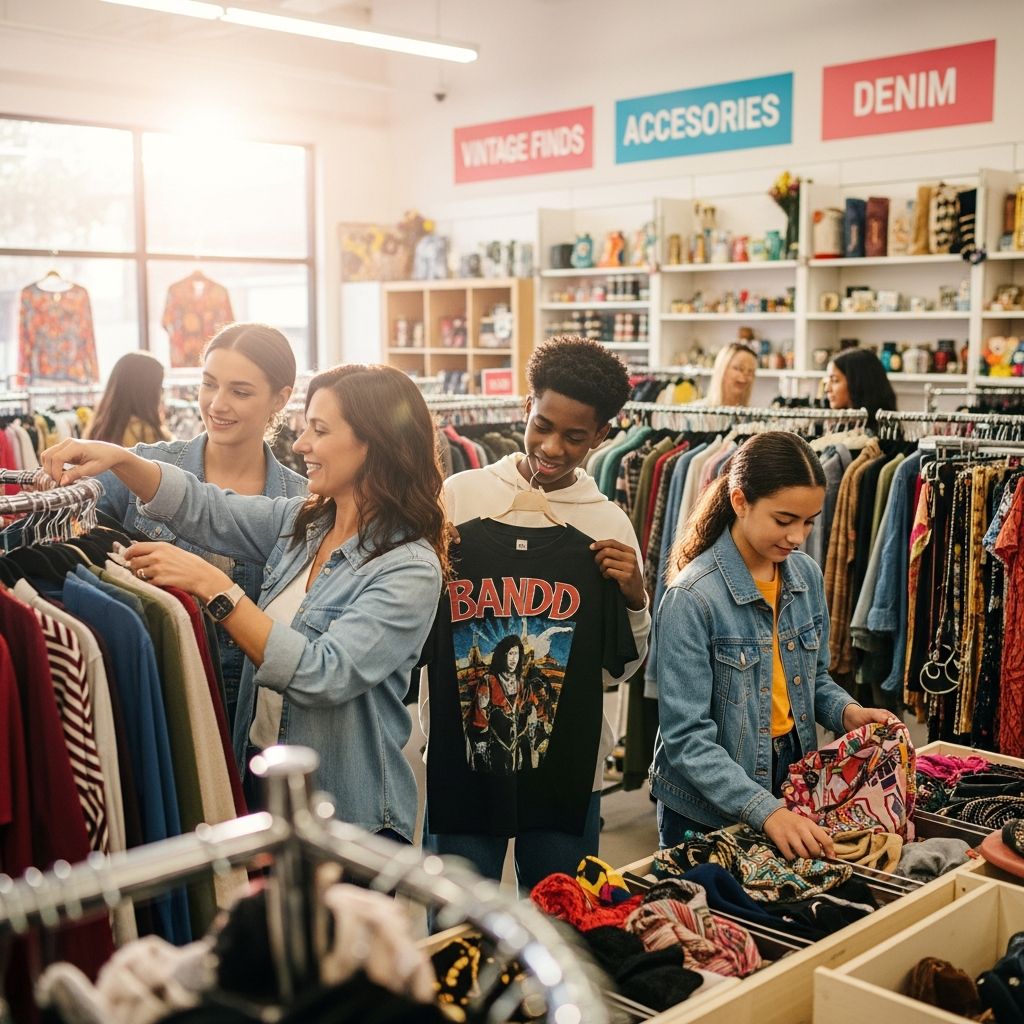
Shopping with teenagers does not have to mean maxed-out credit cards and tense arguments about brand names. Thrift stores and resale shops can become neutral ground where parents and teens explore style, learn money skills, and even laugh together.
Why Thrifting Works So Well For Teens
Teenagers are experimenting with identity, testing boundaries, and looking for ways to stand out without stepping too far outside social norms. Thrifting offers low-risk experimentation: they can try new looks, bolder pieces, and vintage styles without the pressure of high price tags. For parents, it is a practical way to keep up with fast-changing preferences without constantly stretching the family budget.
- Lower stakes: A $6 jacket feels easier to say yes to than a $60 one.
- High creativity: Teens can invent looks rather than copying mannequins in the mall.
- Teachable moments: Every rack is an opportunity to talk about value, quality, and mindful consumption.
Setting Expectations Before You Shop
A successful thrifting trip starts before you even walk into the store. Clear expectations prevent conflict and help both you and your teen feel respected. A quick, honest conversation can set the tone: this is not about policing their style, and it is not about you silently paying for everything without limits either.
Try framing the outing as a joint project: you will bring the transportation, time, and budget; they will bring their style ideas, patience, and willingness to search. That way, you are partners rather than opponents.
Talk Money Up Front
Teens often have little sense of how quickly small purchases add up. Setting a budget in advance turns money into a shared challenge, not a surprise obstacle. You can even share your own internal questions out loud: “Is this worth the price?” or “How many times will you realistically wear this?”
- Decide a total budget (for example, a fixed amount for the whole trip).
- Clarify who pays: you, your teen, or a mix (you cover basics, they cover extras).
- Agree on any non-negotiables, such as no purchases with stains or rips.
Clarify Style Boundaries
It is normal for there to be differences between what your teen likes and what you feel comfortable seeing them wear. Thrifting can bring those differences into sharp focus because the range of styles is so wide. Address these issues before there is a particular piece of clothing hanging between you that both of you feel strongly about.
- Explain clearly which items you will not purchase (for example, offensive slogans).
- Ask your teen what they absolutely will not wear, so you do not push pieces that make them uncomfortable.
- Agree to disagree on minor taste issues and pick a couple of battles that truly matter.
Planning The Perfect Thrifting Day
Thrifting is part treasure hunt, part endurance test. A little planning can transform it from a frustrating slog into a relaxed adventure. Keep in mind that attention spans are limited and that overwhelm can set in quickly when every rack is crowded with possibilities.
Choose The Right Stores
Not all secondhand shops will appeal to teens. Many prefer curated resale stores that feel more like boutiques and less like warehouse basements. Others love the thrill of digging through chaotic racks for hidden gems. Ask your teen what vibe they prefer and choose accordingly.
- Check store social accounts or websites to see typical styles and age range.
- Pick one or two stores instead of trying to hit every option in town.
- Consider starting at a smaller shop to keep the process less overwhelming.
Make A Simple Game Plan
Rather than wandering aimlessly, go in with a shared mini-mission. This adds a sense of purpose and structure that many teens actually appreciate, even if they roll their eyes when you suggest it. Treat it like a flexible plan, not a rigid to-do list.
- Pick a focus: jeans, jackets, formal wear, or accessories.
- Agree on a time frame, such as one hour inside the store.
- Check in halfway: Do they want to stay longer or move on?
Teaching Smart Shopping Without Lecturing
Thrifting is a live classroom for financial literacy and critical thinking. Instead of long speeches, short questions and observations work better. Your teen will remember the moment they spotted a designer label at a low price far more than another talk about budgeting.
Quality Check Skills To Practice
Thrift stores are full of both treasures and duds. Teach your teen how to tell the difference by turning quality checks into a shared process. Make it hands-on rather than theoretical.
- Inspect seams: Are they straight, secure, and not pulling apart?
- Look at fabric: Is it pilling, faded, or stretched out of shape?
- Test hardware: Do zippers move smoothly and buttons feel secure?
- Read labels: Show them the difference between natural fibers and synthetic blends.
Price, Value, And Cost Per Wear
Thrifting is a great way to introduce the idea of cost per wear. A very inexpensive item that never leaves the closet is still a waste, while a slightly more expensive staple piece might be a smart buy. Walk your teen through that thinking process in real time.
- Ask how many outfits they can style with this item.
- Compare prices to what the piece might cost new.
- Talk about trends versus timeless basics, and when each is worth it.
Balancing Teen Self-Expression And Parental Comfort
Thrift stores often carry bolder, more unusual pieces than mainstream shops. That can be thrilling for teens and unnerving for parents. The key is to separate your personal taste from legitimate concerns about appropriateness or safety. You do not have to love what they choose in order to support their right to experiment.
Choosing Your Hills To Die On
If every single item becomes a debate, your teen will shut down quickly. Decide ahead of time which issues are worth a firm no—perhaps clothing that sends messages you strongly disagree with—and which ones you can let go, like patterns or color combinations you simply do not understand.
- Reserve hard lines for safety, school dress codes, or family values you truly cannot compromise on.
- Use curious questions instead of criticism: “What do you like about this piece?”
- Remember that your teen’s style is a moving target, not a permanent statement.
Supporting Identity Exploration
For many teens, clothing is tied closely to identity—cultural, gender, artistic, or social. A thrift store can be a low-pressure place to try on aspects of that identity in a reversible way. Your openness here can send a powerful message that you are a safe person to test new versions of themselves around.
- Avoid mocking or eye-rolling, even if an outfit seems extreme to you.
- Offer practical feedback gently, such as how something fits or functions.
- Celebrate when they find something that clearly makes them light up.
Turning Thrifting Into A Confidence Booster
Done well, thrift shopping can help teens feel capable and creative rather than insecure. Instead of trying to match a mannequin or buy the exact outfit everyone else has, they learn to see potential in unexpected places. That sense of resourcefulness can spill over into other areas of life, from school projects to future jobs.
Letting Them Take The Lead
It is tempting to direct the entire outing, especially if you are paying. However, teens gain the most confidence when they get to make real choices. Give them space to browse alone, to try items you might not pick, and to walk away from things they end up disliking in the fitting room.
- Offer help when invited, but avoid hovering over every rack.
- Encourage them to pick a few wild-card items just for fun.
- Step back and let them interact with store staff, ask prices, or check return policies.
Celebrating Effort, Not Just Outcomes
Some days the perfect piece will not show up, and that is part of the reality of thrifting. Instead of leaving frustrated, reinforce the idea that learning what they do not like is also valuable. Confidence grows when teens understand they can handle disappointment and try again another day.
- Highlight the skills they practiced: patience, decision-making, and budgeting.
- Point out how their taste is becoming more defined, even when they walk away empty-handed.
- Frame the outing as one step in an ongoing process, not a one-time test of success.
Comparing Thrift Shopping To Traditional Retail
Teens often ask why they cannot just go to the mall like everyone else. A side-by-side comparison can help them see that thrifting is not about depriving them; it is about expanding their options and freedom. Consider sharing the key differences in a simple, concrete way.
| Shopping Option | Typical Cost | Selection Style | Learning Opportunities |
|---|---|---|---|
| Thrift / Resale Store | Lower prices, wider range of quality | Unique, unpredictable, often one-of-a-kind pieces | Budgeting, quality assessment, creativity, patience |
| Mall / Fast Fashion | Higher prices, frequent sales but predictable spending | Trendy, standardized, easy to copy peers | Comparison shopping, brand awareness, basic budgeting |
| Online Retail | Variable pricing, added shipping costs | Endless choices, but no chance to try before buying | Reading reviews, analyzing size charts, return planning |
Seeing the contrast laid out like this helps teens recognize that thrifting is not the “cheap version” of real shopping; it is its own skill set with real advantages.
Sustainability And Social Impact (Without The Preachiness)
Many teens care deeply about climate, waste, and social justice, even if they do not always say so. Thrifting offers a practical way to align their wardrobe with those values. You can gently connect the dots between their choices and the bigger picture without turning the whole trip into a lecture on the environment.
- Explain that buying secondhand keeps clothing out of landfills and reduces demand for new production.
- Mention that some thrift stores fund local programs, job training, or community services.
- Encourage them to donate or sell items they no longer wear, closing the loop.
Extending The Experience At Home
The shopping trip does not have to be the end of the story. At home, you can extend both the fun and the learning. This is especially helpful for teens interested in fashion, design, or even entrepreneurship, since secondhand clothing can be raw material for all three.
Styling Sessions And Try-On Time
Once you get home, give your teen time to play with combinations. Offer to be an audience for a mini fashion show if that fits your family’s dynamic. The point is to reinforce that their purchases were thoughtful and that you are genuinely interested in their style experiments.
- Take photos of outfits they like so they remember successful combinations.
- Encourage them to mix thrifted items with pieces they already own.
- Help them notice which silhouettes, colors, or fabrics seem to work best.
Basic Care And Repair Skills
Thrifted clothing sometimes needs a little extra care—a missing button, a loose hem, or a minor stain. Instead of seeing this as a downside, treat it as a chance to teach practical life skills. Knowing how to fix small issues can extend the life of their wardrobe and make them more independent.
- Show them how to sew on a button, steam a garment, or use stain remover.
- Explain the difference between items that are easy to repair and those that are not worth the effort.
- Set up a simple “repair basket” with thread, needles, and basic tools for shared use.
Building A Healthy Long-Term Relationship With Shopping
Ultimately, thrifting with your teen is about more than clothes. It is an opportunity to model a relationship with shopping that is thoughtful rather than compulsive, expressive rather than purely status-driven. Over time, your influence here can help them avoid debt, impulse buying, and the pressure to constantly keep up with others.
- Talk occasionally about how you decide what is worth your own money.
- Normalize walking out of a store without buying anything when nothing feels right.
- Affirm that their value has nothing to do with the labels inside their clothes.
Frequently Asked Questions About Thrifting With Teens
How much money should I give my teen for a thrifting trip?
The right amount depends on your budget and how often you plan to shop. Many families choose a modest fixed amount and make it clear that if the teen wants extras beyond that, they can use their own savings or allowance. The goal is to give them enough to make real decisions without feeling like there is an endless supply.
What if my teen refuses to buy secondhand clothing?
Some teens feel embarrassed about thrift stores at first, especially if they associate them with financial hardship. Instead of forcing the issue, start by introducing secondhand options alongside more familiar shopping trips. Over time, highlight the unique finds and cost savings in a low-key way, and let them warm up to the idea at their own pace.
How do I handle hygiene concerns with used clothes?
It is reasonable to want reassurance about cleanliness. Choose stores that appear well-organized and maintained, and make washing or cleaning every item at home part of your normal routine. A quick wash cycle or trip to the dry cleaner typically resolves most concerns.
My teen spends forever in the store. How do I set time limits without causing a fight?
Before you go in, agree on a time frame and a midpoint check-in. You might say that you have one hour and will reassess once you hit 30 minutes. Framing it as a shared boundary—because you both have other things to do—keeps it from feeling like you are simply impatient.
How can thrifting help teach my teen about money?
Thrifting makes prices and budgets very concrete. You can give them a set amount and talk through their decisions, helping them compare options, imagine cost per wear, and consider opportunity cost. Over time, they start to see that every “yes” to one item is a “no” to something else.