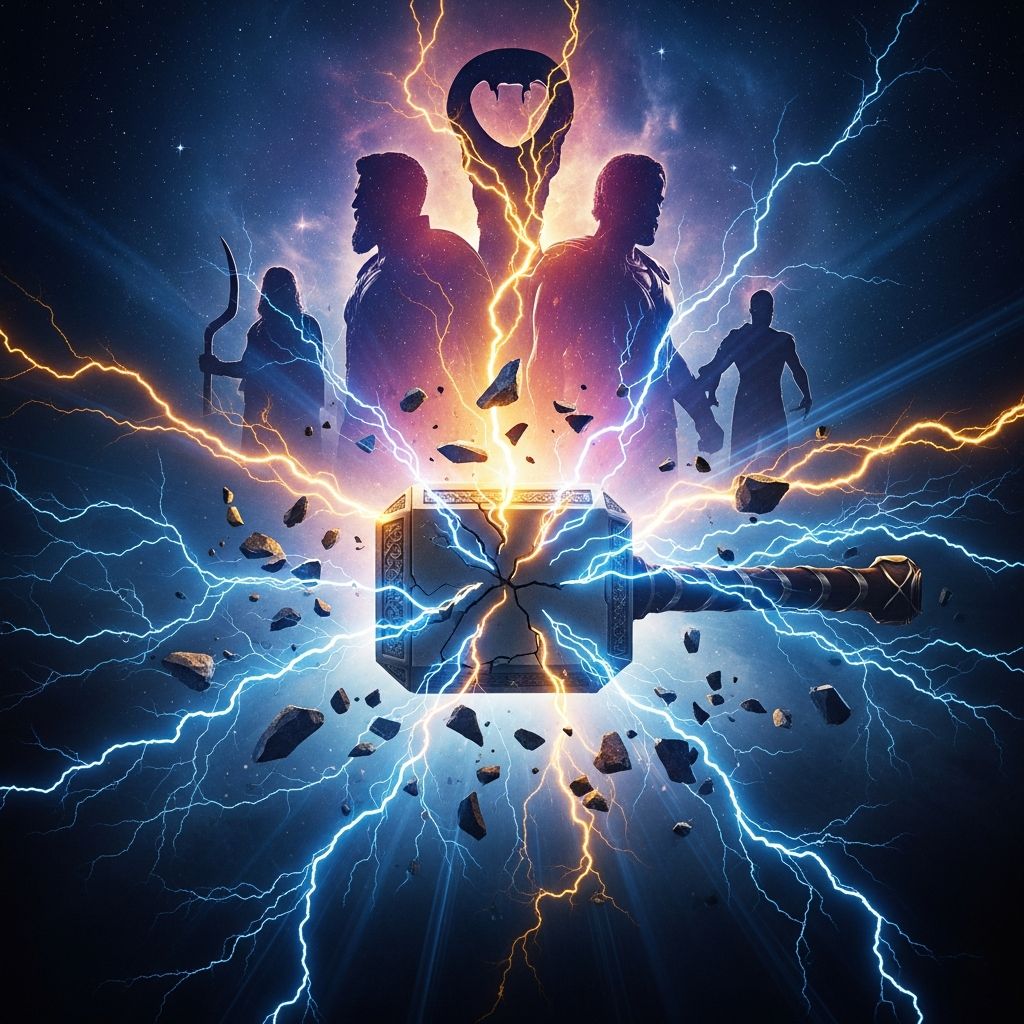
Marvel Studios’ Thor: Love and Thunder is packed with surprise appearances and two post-credits scenes that reshape the God of Thunder’s place in the Marvel Cinematic Universe. Beyond jokes and spectacle, these moments set up new rivalries, hint at afterlife rules, and quietly promise that Thor’s story is far from over.
This guide walks through the key cameos, the mid-credits and post-credits scenes, and the biggest implications for future Marvel projects – all in one spoiler-filled breakdown.
Why Cameos Matter So Much in Thor’s Fourth Film
After more than a decade on screen, Thor is the first MCU hero to receive a fourth solo movie. That milestone pushes Love and Thunder to do three big things at once:
- Advance Thor’s personal arc from aimless drifter to adoptive father.
- Pay tribute to past characters from earlier Thor films and Avengers stories.
- Plant seeds for future threats that stretch beyond this movie’s villain.
Cameos and credits scenes are the main tools the film uses to accomplish these goals without pausing its fast-paced, comedic plot.
Major Cameos: Old Allies, New Threats
Throughout the movie, quick appearances and returning faces deepen the sense that Thor lives in a huge, interconnected world. While the original article focuses heavily on which stars pop up where, it’s more helpful to sort these appearances by what they do for the story.
Legacy Asgardians and Familiar Faces
Several cameos come from Asgard’s past, reminding viewers of what was lost and what Thor is still fighting for:
- Heimdall’s return (in the post-credits scene) reconnects the film to early Thor movies and to Avengers: Infinity War, where he was killed by Thanos. Heimdall’s presence signals that the film is not only about Thor’s future but also about closure for characters who helped define his earlier journeys.
- References to Loki and fallen Asgardians reinforce the idea that Valhalla, the Asgardian afterlife, is a real location in the MCU’s cosmology, not just a mythological concept. This pays off directly in the final stinger.
Gods Beyond Asgard: The Omnipotent City Cameos
A key sequence set in Omnipotent City brings together gods from across the universe. The most important cameo there isn’t actually a cameo at all, but a full-blown introduction:
- Zeus, played as an overindulgent and arrogant ruler, represents the old guard of deities who are more concerned with ceremony than responsibility. His attitude toward Gorr’s murderous crusade sets up both immediate conflict and a longer-term philosophical clash: gods versus superheroes.
- The unseen mention of Hercules during Thor’s time in Omnipotent City hides a payoff that won’t arrive until the mid-credits scene. That delayed reveal turns a throwaway line into a setup for a major MCU debut.
These appearances make the MCU’s pantheon feel vast. Instead of only Asgardian lore, Thor is now tangled up with Olympians and countless unnamed powers scattered throughout the universe.
The Most Important New Face: Gorr’s Daughter, Love
The film’s ending introduces one more vital character: the resurrected daughter of Gorr the God Butcher, who becomes Thor’s adoptive child. In the final scenes, we see Thor training and fighting side by side with her, confirming that she has powers linked to the cosmic entity Eternity.
While she’s not a traditional cameo, her presence reframes the entire movie. What begins as a story about heartbreak and lost faith ends as a story about parenting, legacy, and choosing compassion over vengeance.
Mid-Credits Scene: Zeus Plots Revenge and Unleashes Hercules
The first credits scene appears midway through the credits and functions as the movie’s biggest piece of sequel bait. It answers one important question and raises several more.
Zeus Survives – and He’s Furious
During the Omnipotent City sequence, Thor hurls Zeus’s own thunderbolt through his chest, and viewers are led to assume that the Olympian king is dead. The mid-credits scene instantly overturns that assumption.
We find Zeus alive, nursing a wound but very much capable of rage and scheming. In a bitter monologue, he complains that mortals used to fear and worship gods, but now look up to superheroes instead. To him, this shift isn’t just a cultural change—it’s an insult and a threat to divine authority.
The Debut of Hercules
As Zeus finishes his speech, the camera reveals his son, Hercules, now officially part of the MCU. Zeus commands him to hunt down Thor as punishment for both the lightning-bolt theft and the public humiliation at Omnipotent City.
| Element | What Happens | Why It Matters |
|---|---|---|
| Zeus’ Condition | Alive, recovering from a chest wound. | Confirms Olympian gods can survive seemingly fatal injuries, upping the durability scale for divine beings. |
| Zeus’ Motivation | Wants to restore fear and respect for gods by striking at superheroes. | Sets up a thematic clash between self-appointed protectors (Avengers) and traditional deities. |
| Hercules’ Mission | Ordered to kill Thor. | Seeds a future hero-versus-hero conflict and introduces a major comic character into live-action. |
What Hercules Means for Future MCU Stories
In Marvel Comics, Hercules oscillates between rival and ally to Thor, often sharing a friendly-but-competitive dynamic as two powerful, hard-drinking warriors. Bringing him in via a revenge mission leaves multiple narrative possibilities:
- Immediate conflict: A future movie could feature Hercules as an antagonist sent to bring Thor down in the name of Olympus.
- Eventual alliance: Comics history suggests their rivalry may evolve into camaraderie, giving Marvel another heavy hitter to add to its cosmic-level roster.
- Expanded pantheon stories: Zeus and Hercules open the door to more Olympus-focused plots, possibly paralleling Asgard’s earlier role.
Importantly, the mid-credits scene does not specify when or where Thor and Hercules will clash. It simply assures viewers that, somewhere in the MCU, a vengeful god is preparing a champion for battle.
Post-Credits Scene: Jane Foster’s Journey to Valhalla
The second and final credits scene is quieter but emotionally heavier. Instead of teeing up another antagonist, it provides closure for one of the film’s central heroes.
Jane’s Death and Worthiness
During the climax, Jane Foster chooses to wield Mjolnir again as the Mighty Thor, fully aware that each transformation accelerates the cancer consuming her mortal body. Her decision to sacrifice her remaining time to save others fulfills the Asgardian notion of dying in battle—a key requirement for entering Valhalla.
Arrival in the Asgardian Afterlife
In the post-credits scene, Jane materializes in a serene realm framed by archways and distant landscapes. This is confirmed to be Valhalla when she is greeted by Heimdall, who:
- Thanks her for protecting his son during the film’s events.
- Welcomes her explicitly to the land of the gods.
The scene is brief, but it rewires how audiences think about death in the MCU. Valhalla is now shown as an actual destination that heroic Asgardians (and those who fight as gods) can reach, not just a metaphor or legend.
Is This a Farewell or a Doorway?
Jane’s journey to Valhalla can be read in two ways:
- As a final goodbye: It offers emotional closure by confirming that Jane’s sacrifice is honored, and that she finds peace among Asgard’s fallen. This lines up with the film’s tribute-like tone toward her character.
- As a soft setup: In the comics, characters do sometimes return from Asgardian afterlives, or at least communicate across realms. The scene therefore leaves a narrow but very real path for Jane—or other dead Asgardians—to appear again as guides, visions, or even resurrected heroes.
Either interpretation fits the MCU’s evolution: deaths can be both emotionally resonant and narratively flexible, depending on what future stories require.
How the Ending Reshapes Thor’s Role
Beyond the cameos and credits, the actual end of the film makes sweeping changes to Thor’s identity.
From Wanderer to Guardian
At the start of the movie, Thor is spiritually adrift, traveling with the Guardians of the Galaxy and fighting wars that are not truly his own. By the end:
- Gorr’s dying wish resurrects his daughter, Love, using the power of Eternity.
- Thor promises to raise and protect her, effectively becoming a father overnight.
- The final scenes show them fighting together, with Love wielding cosmic abilities and Thor his trusty hammer.
This pivot reframes Thor’s mission. Instead of only defending the universe at large, he is now also responsible for one extraordinary child’s future—mirroring a broader shift in superhero storytelling toward themes of mentorship and parenthood.
“Thor Will Return” – But Which Thor?
After Jane’s arrival in Valhalla, the film closes on a classic MCU promise: a title card reading “Thor will return.” On its face, that line refers to Chris Hemsworth’s Thor, who ends the film alive, newly grounded, and ready for fresh adventures.
However, the timing of the card—coming right after a scene devoted to Jane—also invites speculation:
- It might point toward Thor Odinson continuing in a fifth solo film or a future team-up like a new Avengers entry.
- It might also hint that the concept of Thor (any worthy wielder of the power) will persist, leaving room for Jane, Love, or others to carry the mantle in some form.
Until Marvel officially reveals its plan, the only sure takeaway is that the franchise is not done exploring thunder and hammers.
What These Scenes Tell Us About the MCU’s Direction
Viewed together, the cameos and credits scenes offer a roadmap for where Marvel might be heading in the wake of Love and Thunder.
- Cosmic stakes remain central. References to Eternity, divine realms, and pantheons of gods underline Marvel’s ongoing investment in cosmic and metaphysical storytelling.
- Legacy characters still matter. Heimdall’s appearance and Valhalla’s reveal show that earlier MCU arcs continue to shape current stories, even when characters have died.
- New power players are entering the arena. Hercules may be just one of many incoming heavyweights, suggesting bigger conflicts among gods, heroes, and cosmic beings.
- Personal relationships drive the narrative. Thor’s bond with Love, Jane’s sacrifice, and the mentorship subplots imply that future conflicts will be as much about families and found families as about saving the universe.
Frequently Asked Questions (FAQs)
How many post-credits scenes are in Thor: Love and Thunder?
The movie includes two credits scenes: a mid-credits scene featuring Zeus and Hercules, and a post-credits scene showing Jane Foster in Valhalla.
Who is Hercules in the mid-credits scene, and why is he important?
Hercules is the son of Zeus and a major Marvel Comics hero. In the mid-credits scene, Zeus orders him to kill Thor, setting up a likely future clash and potentially adding another powerhouse hero to the MCU’s cosmic lineup.
Does Jane Foster really die, and can she come back from Valhalla?
Jane dies from cancer after choosing to become the Mighty Thor one last time, and she is welcomed into Valhalla by Heimdall. In the comics, Asgardian afterlives sometimes allow communication or even returns, so while the scene works as a farewell, it does not completely rule out future appearances.
What is the significance of Thor adopting Gorr’s daughter?
Thor caring for Gorr’s resurrected daughter, Love, turns him into a parental figure and gives him a new personal stake in protecting the universe. Her powers, linked to the cosmic entity Eternity, suggest she could become an important hero in her own right.
What does the “Thor will return” title card actually promise?
The card is Marvel’s standard way of signaling that the character is not done in the MCU. It most directly implies Chris Hemsworth’s Thor will appear again, though its placement after Jane’s Valhalla scene leaves the door open for other versions or successors to play a role too.
References
- Thor: Love & Thunder Post-Credits Scenes Explained — Screen Rant. 2022-07-08. https://screenrant.com/thor-love-thunder-after-credits-scenes-explained/
- Thor: Love and Thunder Post-Credits Scenes Explained — Den of Geek. 2022-07-07. https://www.denofgeek.com/movies/thor-love-and-thunder-post-credits-scenes-explained/
- Thor: Love and Thunder Hercules Post-Credits Explained by MCU Producer — The Direct. 2022-07-13. https://thedirect.com/article/thor-love-and-thunder-hercules-post-credits-explained
- Thor Love and Thunder POST CREDITS Explained & Ending — New Rockstars (YouTube video). 2022-07-08. https://www.youtube.com/watch?v=c-idXIvMEZM
- Thor Love And Thunder Ending and Post Credit Scene — Emergency Awesome (YouTube video). 2022-07-07. https://www.youtube.com/watch?v=X-PurmsHJT0