Thor has always been one of the Marvel Cinematic Universe’s most powerful heroes, but in Avengers: Endgame he becomes something far more interesting: a god who has to live with the fact that his power was not enough.
The God Who Missed
At the end of Avengers: Infinity War, Thor finally lands a devastating blow on Thanos, burying his axe in the villain’s chest—but he does not strike the killing blow in time. That tiny margin of error costs half the universe their lives, and Thor knows it.
Endgame opens in the silent aftermath of that mistake, and that silence is where Thor’s most important transformation begins: not as a warrior in motion, but as a survivor who cannot escape what he failed to do.
From Perfect Warrior to Haunted Survivor
Before the events of the final two Avengers films, Thor’s identity is simple: he is the indestructible hammer that will eventually smash any threat placed in front of him. Across earlier movies, he loses family, home, and even an eye, yet still frames every loss as fuel for the next heroic comeback.
In Endgame, that formula at last fails. Thor did everything he could, reached Thanos first, and still lost on a cosmic scale. When a hero’s best is not good enough, no amount of bravado can plaster over the crack that leaves behind.
- He cannot punch the problem away.
- He cannot bargain or joke it out of existence.
- He cannot simply promise to “do better next time” when there may be no next time at all.
The Cost of a Single Swing
Thor’s fateful strike on Thanos is more than a tactical miscalculation; it becomes a moral verdict he passes on himself. The Avengers lose friends, allies, and loved ones in an instant, but Thor’s grief is threaded with something sharper: certainty that the catastrophe is his fault.
That certainty shapes every choice he makes afterward. The physical wound he gave Thanos is nothing compared to the invisible wound he carries, the conviction that a different angle, a different second, a different decision would have saved trillions.
| Surface Action | Hidden Meaning | Emotional Impact |
|---|---|---|
| Strikes Thanos but fails to stop the Snap | Realizes power has limits | Shame replaces pride |
| Obsesses over the idea he “should have” done more | Rewrites the past in his imagination | Guilt becomes a constant companion |
| Defines himself only by that failure | Forgets earlier acts of heroism | Self-worth collapses |
When Revenge Arrives Too Late
Early in Endgame, the surviving heroes track Thanos to his secluded refuge and overwhelm him with ease. The confrontation is oddly anti-climactic: the titan is weakened, the Infinity Stones are gone, and the grand rematch Thor might have imagined simply does not exist.
In a single, impulsive motion, Thor decapitates Thanos. The revenge he swore he would take finally happens, but it lands on empty ground. There are no cheering crowds, no restored lives, no sense that the universe has been set right—only a room full of heroes staring at a corpse and realizing nothing has been fixed.
- Revenge comes after the loss, not instead of it.
- Justice feels hollow when it cannot restore what was taken.
- Thor’s decisive blow cures none of his guilt and solves none of the larger problem.
The Spiral: Numbing the Pain Instead of Facing It
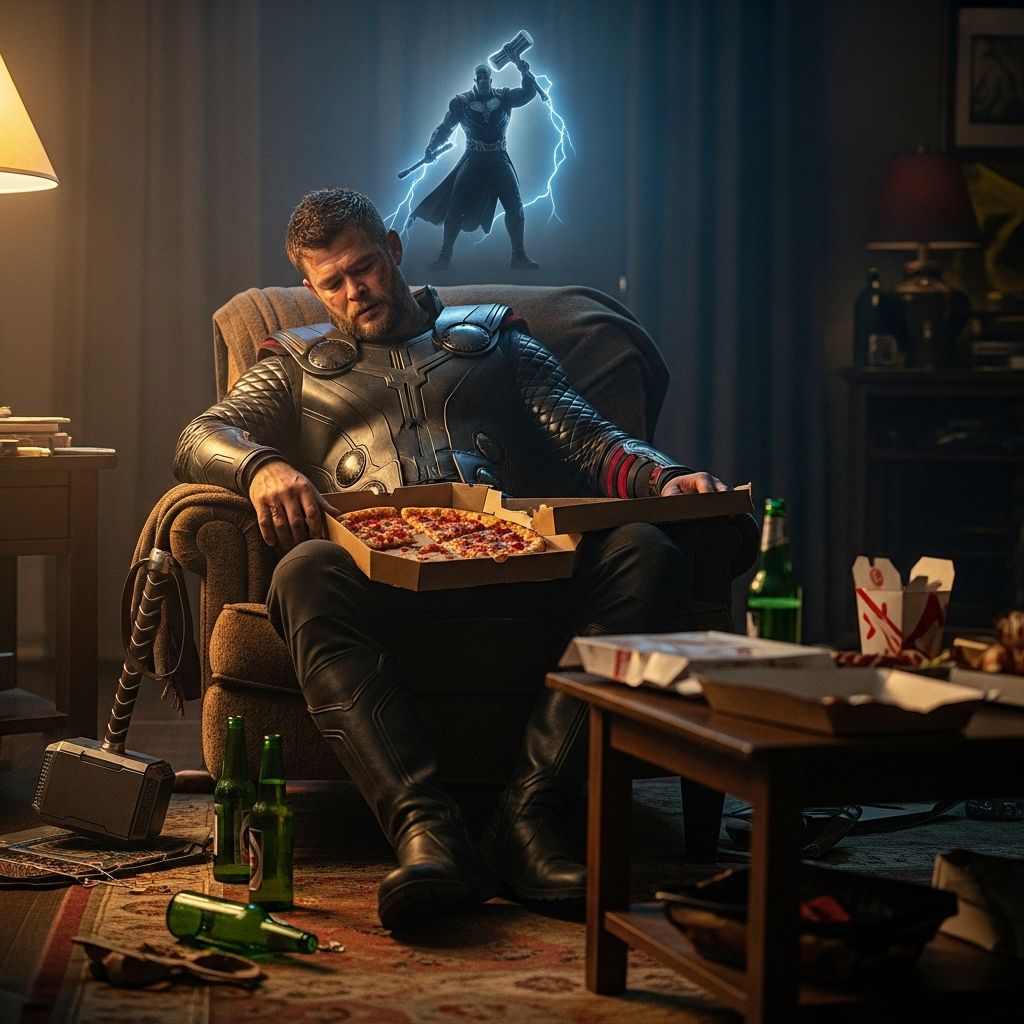
Five years pass, and the god of thunder chooses retreat over reckoning. Instead of leading, he hides in a coastal fishing village turned ramshackle refuge, surrounding himself with distractions, alcohol, and the comforting glow of a television screen.
This version of Thor is not a punchline; he is a recognizable portrait of someone who has decided that feeling nothing is safer than risking feeling everything. The armor is gone, replaced by baggy clothes and clutter; the carefully maintained body of a warrior has given way to the softer, more vulnerable figure of someone who has stopped caring what happens next.
Why Thor’s Physical Change Matters
The visual transformation of Thor in Endgame has often been discussed in terms of jokes, but underneath the humor sits a poignant idea: the body keeps score when the mind tries not to. Sleep, appetite, and self-care are the first casualties when despair takes over.
For Thor, the change does something important for the audience as well. A character once presented as a flawless ideal now carries a body that tells a story of lost routines, abandoned discipline, and the quiet hope that if he looks less like a hero, maybe fewer people will expect him to be one.
- His armor gathering dust signals a loss of purpose.
- His unkempt hair and beard show how thoroughly he has stopped looking in the mirror.
- His reliance on comfort and routine hints at someone trying to freeze time.
Guilt, Trauma, and the Myth of the Invincible Hero
Thor’s breakdown challenges a familiar myth: that great heroes, especially gods, simply absorb trauma and become stronger. Instead, Endgame suggests that there is a finite amount of loss even a god can withstand before something inside begins to fracture.
What makes his struggle compelling is that the film never treats his pain as weakness. The bravado of earlier installments gives way to a more complicated reality where the bravest thing a hero can do is admit that he is not okay—and still try to move forward anyway.
A Chance to Look Backward, Not Just Forward
Thor’s journey through time in Endgame is not just an excuse to revisit an earlier movie; it is a narrative device that forces him to walk the halls of a life that no longer exists. The golden corridors of Asgard, once a backdrop for triumph, now feel like a museum exhibit of choices and possibilities he can never reclaim.
In this return to his past, Thor is no longer the arrogant prince eager to impress. He is a disillusioned son trying to avoid being seen, terrified that the person he has become will disappoint the people he loved most when they were still alive.
The Conversation That Reframes Everything
The heart of Thor’s arc in Endgame is not found in a battlefield, but in a quiet conversation with his mother. She does not know the galactic specifics of what he has done and failed to do, yet she recognizes something much simpler: her son has allowed his worst day to define his entire life.
Rather than offer an easy promise that everything will work out, she asks him to abandon the fantasy that he can ever perfectly live up to who he thinks he was “supposed” to be. The task in front of him is smaller and more difficult: to learn how to be fully himself again, imperfections and all.
- She treats his pain as real, not as an inconvenience.
- She refuses to let him hide behind self-pity or grand destiny.
- She reminds him that failure is a condition of being a person, not a disqualification.
“
Worthiness Revisited: The Hammer Test
After baring his fears, Thor performs a simple, almost childlike test: he reaches out his hand to call his old hammer. For a heartbeat, he is not sure it will come. All of his mistakes, grief, and self-loathing seem to weigh down that outstretched arm.
When the hammer flies back into his hand, the moment is not about raw power but about validation. Worthiness, the film quietly argues, is not the absence of failure. It is the willingness to act despite that failure, to keep showing up even when the past insists that you do not deserve to.
Fighting While Still Broken
By the time the final battle arrives, Thor has not magically healed. He enters the field still carrying his visible weight, his scars, and his tangled hair. The armor he wears does not erase the changes his body has gone through; it integrates them.
This is an important shift in how heroism is depicted. Instead of presenting a purified, reset version of himself, Thor charges into combat as the same damaged person the audience has watched struggle for the entire film. He does not wait to be “fixed” before deciding to stand with his friends again.
From Center Stage to Shared Spotlight
One subtle element of Thor’s arc is his willingness to share, rather than dominate, the spotlight. Earlier stories often frame him as the decisive force who ends the fight with a single, show-stopping blow. At the climax of Endgame, however, he stands as one of several heroes trading weapons and responsibilities.
Allowing others to lead is its own form of humility. The god once convinced he needed to be the central savior now accepts that victory belongs to a team, not a single arm swinging an axe. His power is no less impressive, but it is finally placed in service of something larger than his personal need for redemption.
What Thor Teaches About Living With Failure
Thor’s journey in Endgame resonates because it mirrors a deeply human tension: the desire to rewrite the past instead of learning how to carry it. Most people will never face the burden of a universe-ending mistake, but many know the feeling of replaying one critical decision over and over in their head.
The film offers no magical solution. Thor remains a person who made a catastrophic error and must live in the shadow of its consequences. What changes is his posture toward that shadow. Instead of letting it pin him to the ground, he learns to stand up under it and move forward.
- Failure does not disqualify someone from doing good in the future.
- Grief and guilt can coexist with courage rather than replacing it.
- Accepting help and guidance is a sign of maturity, not weakness.
A God Who Chooses a New Path
By the end of Endgame, Thor makes a surprising choice: he steps away from the throne he once fought to earn and entrusts the protection of his people to someone else. The prince who once saw kingship as his destiny now recognizes that clinging to the old role would only keep him frozen in place.
This decision reframes his story from a closed loop of revenge and regret into an open road of possibility. Rather than define himself forever as “the one who failed,” he allows for the idea that his greatest contribution might still lie ahead—somewhere beyond the familiar halls of Asgard and the identity that once came with them.
Why Thor’s Lowest Moment Is His Most Important
The execution of Thanos is not a triumphant victory; it is Thor’s lowest moment, crystallizing all of his rage, grief, and self-hatred into a single irreversible action. Yet that moment is also necessary. Without reaching that extreme, he might never realize that no amount of violence can undo what haunts him.
In this sense, his worst decision becomes the turning point that eventually leads him toward empathy, humility, and self-acceptance. The god who once measured himself solely by his ability to win battles gradually learns to measure himself by something quieter: the willingness to keep showing up, even when winning is no longer guaranteed.
Key Takeaways From Thor’s Endgame Journey
- Power without peace offers no protection from guilt or grief.
- Revenge can feel satisfying in the moment but often leaves the underlying wound untouched.
- Self-worth cannot rest solely on success; it must survive failure as well.
- Healing is less about returning to who you were and more about learning who you can be now.
Frequently Asked Questions
Why is Thor’s failure in Infinity War so central to his story in Endgame?
Thor’s missed opportunity to stop Thanos becomes the emotional anchor of his character in Endgame. Everything from his self-imposed exile to his drastic physical change stems from the belief that he alone could have prevented the catastrophe and did not.
Is Thor still worthy after he falls apart?
The film strongly suggests that worthiness is not about perfection or an unbroken record of success. Thor remains worthy not because he never failed, but because—even when overwhelmed—he is ultimately willing to confront his mistakes and keep fighting for others.
What makes Thor’s depiction of trauma different from other heroes’?
Unlike characters whose pain is mostly internal, Thor’s trauma is written across his entire life: his home, family, appearance, and behavior all change. The contrast between the pristine god of earlier films and the disheveled survivor in Endgame makes his struggle unusually visible and relatable.
Why does Thor leave leadership behind?
Stepping away from formal leadership allows Thor to pursue growth without clinging to an identity that no longer fits. Rather than remain trapped in a role that constantly reminds him of his failures, he chooses a path that lets him redefine what heroism means on his own terms.
What can viewers learn from Thor’s arc?
Thor’s story invites viewers to see failure as a chapter, not an ending. It encourages anyone burdened by regret to seek connection, accept help, and recognize that moving forward—however slowly—is itself an act of courage.