Eric Carle’s The Very Hungry Caterpillar, first published in 1969, stands as one of the most cherished children’s books worldwide. This simple yet profound story follows a ravenous caterpillar’s journey from egg to butterfly, weaving in lessons on counting, days of the week, healthy eating, and the miracle of metamorphosis. Over 50 million copies sold later, it continues to captivate generations with its vibrant collage illustrations and interactive design.
From Hole Punch to Literary Classic: The Spark of Inspiration
The genesis of this iconic book traces back to a mundane moment in Eric Carle’s studio. Bored one day, the illustrator grabbed a stack of paper and a hole punch, creating playful holes that sparked an idea. Initially envisioning a gluttonous bookworm named Willi who ate through pages, Carle sketched a worm devouring literature until it fell ill. This concept evolved dramatically during discussions with his editor, Ann Beneduce.
Beneduce challenged the worm idea, suggesting a caterpillar instead. Carle’s eyes lit up—he shouted ‘Butterfly!’—instantly seeing the perfect arc of transformation. What began as a tale of overindulgence became a celebration of natural growth, aligning with the life cycle of real caterpillars. This pivot turned a quirky sketch into a narrative powerhouse, blending education with whimsy.
Carle’s own life infused the story with depth. Born in 1929 in Syracuse, New York, to German immigrant parents, he moved to Stuttgart at age six. World War II scarred his childhood; his father, a stern figure, was captured by Russians and returned emotionally broken after years as a POW, weighing just 85 pounds. These experiences of loss and resilience subtly echo in the caterpillar’s triumphant emergence.
Artistic Mastery: Collage Techniques and Visual Storytelling
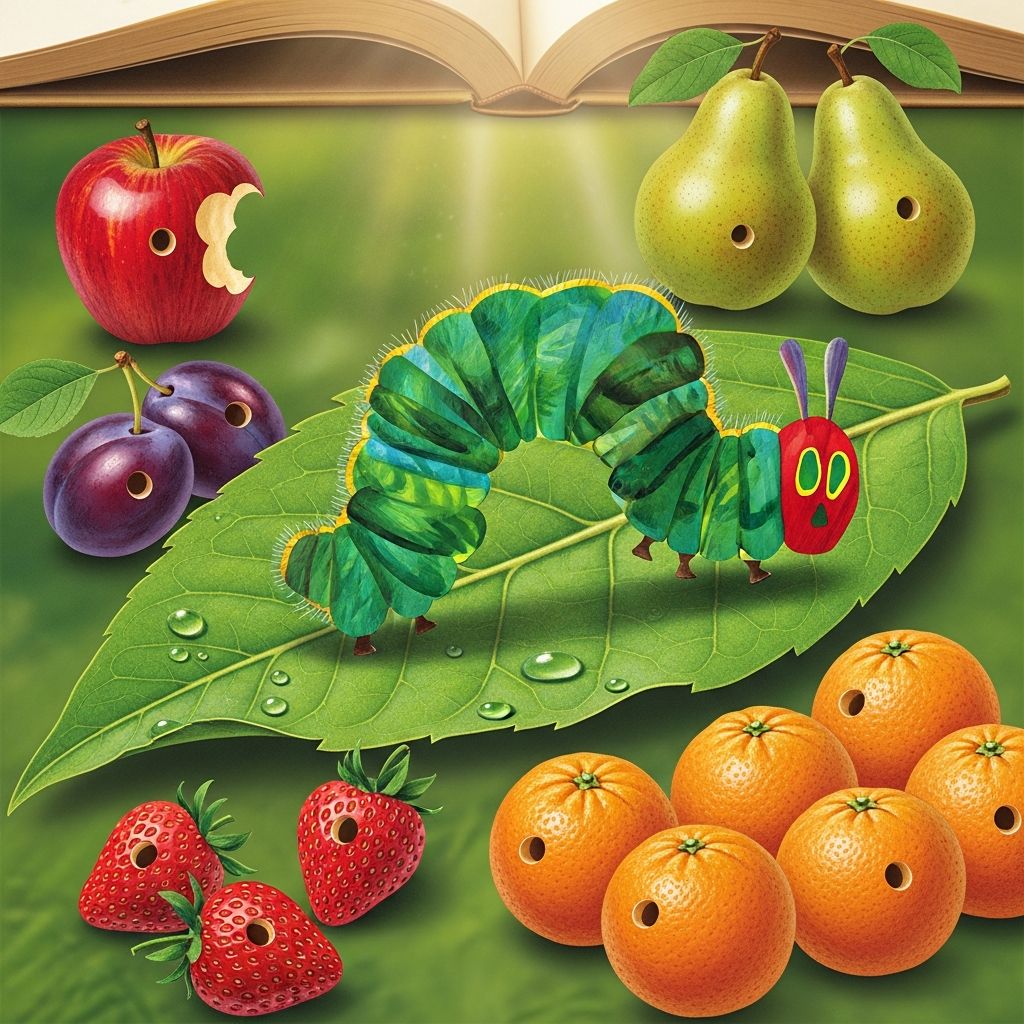
Carle’s signature style—hand-painted tissue paper collages—brings the book to life. Each page bursts with bold, textured colors: juicy reds for apples, sunny yellows for pears. The die-cut holes, punched through pages, invite children to trace the caterpillar’s path, fostering tactile engagement. This innovation, born from that initial hole-punch experiment, makes reading an adventure.
Monday through Friday, the caterpillar munches escalating fruits: one apple, two pears, up to five oranges. These spreads teach counting organically while showcasing healthy foods. Saturday’s chaotic double-page explosion features junk delights—chocolate cake, ice cream cone, pickle, Swiss cheese, salami, lollipop, cherry pie, sausage, cupcake, watermelon—mirroring a child’s picnic fantasy. The caterpillar swells comically, filling the page, before a wholesome green leaf restores balance on Sunday.
| Day | Foods Eaten | Educational Focus |
|---|---|---|
| Sunday (hatch) | Egg to leaf nibble | Life cycle start |
| Mon-Fri | 1-5 fruits | Counting, nutrition |
| Saturday | 10 junk foods | Excess contrast |
| Sunday | Green leaf | Recovery, health |
This structure not only counts to 10 but contrasts nutrition with indulgence, subtly promoting balance without preaching.
The Controversial Stomachache: A Battle with Publishers
One scene nearly derailed the book: the caterpillar’s Saturday night stomachache. After his junk food binge, text reads, ‘That night he had a stomachache!’ Carle vehemently opposed it. In a 2015 Paris Review interview, he revealed a fierce dispute with his publisher, who insisted on ‘punishment’ for overeating to avoid gluttony promotion.
‘This disgusted me,’ Carle said. ‘It ran entirely contrary to the message of the book.’ He envisioned unbridled appetite as transformative fuel, not sin warranting nausea. Publishers feared moral backlash in 1969’s conservative climate, but Carle argued children needn’t fear hunger—indulgence betters the caterpillar, powering his cocoon entry. Reluctantly, he included it, later lamenting it compromised the joyous effect.
This clash highlights tensions between artistic vision and commercial caution. Yet, the stomachache adds realism; real caterpillars purge before pupation. It humanizes the tale, showing consequences without shaming desire.
Life Cycle Magic: From Cocoon to Psychedelic Butterfly
The book’s heart lies in metamorphosis. After his leaf heals him, the fat caterpillar spins a cocoon, rests two weeks, and bursts forth: ‘Out came a beautiful butterfly!’ This reveal, with wings unfurling across the page, symbolizes hope and potential. Carle called it a story of growth: ‘You, like the little caterpillar, will grow up, unfold your wings and fly off into the future.’
Illustrations mimic science: eggs hatch (‘pop!’), larvae eat voraciously, pupae enclose, adults emerge. Yet Carle amps drama—hatching ‘pops’ audibly, impossible in nature, hooking young readers. The psychedelic butterfly ending, with swirling colors, coincided with 1969’s Woodstock era (Carle skipped it over traffic fears).
Educators praise its accuracy; it aligns with entomology basics from sources like university extension services, teaching lepidopteran stages without dryness.
Educational Powerhouse: Learning Layers for Young Minds
- Counting: Sequential fruits build numbers 1-5, junk foods tally 10 holes.
- Days of the Week: Each spread labels boldly, aiding memory.
- Healthy Eating: Fruits vs. junk visually contrasts nutrition.
- Biology: Egg, larva, pupa, adult demystify change.
- Fine Motor: Hole-tracing boosts dexterity.
Studies from early childhood programs affirm its efficacy; repetitive, multisensory elements enhance retention. Parents report kids reciting pages verbatim, internalizing concepts joyfully.
Cultural Phenomenon: 50+ Years of Influence
Since 1969, The Very Hungry Caterpillar has spawned toys, apps, plays, and global editions in 70+ languages. Its appeal endures amid digital distractions, proving tactile books’ irreplaceable magic. Carle, who passed in 2021 at 91, created 70+ books, but this remains his crown jewel.
Cultural critics see deeper layers: nature invading human realms (caterpillar conquers cake), hedonism’s risks, societal processed-food commentary. Yet for kids, it’s pure delight; for adults, nostalgic wonder.
Legacy and Modern Relevance
In today’s wellness-focused world, the book’s nutrition nod feels prescient. It inspires STEM activities—real caterpillar rearing kits mimic its arc. Carle’s optimism counters cynicism, reminding us transformation follows hunger, rest, patience.
Publishers’ caution seems quaint now; the book thrives sans heavy moralism. Its message? Embrace appetite, learn from excess, emerge renewed—like us all.
Frequently Asked Questions
Why did Eric Carle fight over the stomachache scene?
Carle believed indulgence fueled growth, not punishment; publishers added nausea to deter gluttony, clashing with his vision of unapologetic transformation.
What inspired the book’s hole-punched pages?
A bored Carle punched holes in paper, evoking a worm eating books—later refined into caterpillar trails for interactivity.
Does the book teach real science?
Yes, it accurately depicts butterfly stages: egg, larva, pupa, adult, with engaging liberties like the ‘pop!’ hatch.
How has it impacted education?
Used globally for counting, days, nutrition, and life cycles; multisensory design boosts preschool learning.
What’s the book’s core message?
Hope through growth: satisfy hunger, face changes, emerge stronger—like a caterpillar to butterfly.
References
- Eric Carle fought publishers over this scene in ‘The Very Hungry Caterpillar’ — Mother.ly. 2023. https://www.mother.ly/life/eric-carle-very-hungry-caterpillar/
- Why Eric Carle’s ‘The Very Hungry Caterpillar’ is a classic — Tim Warnes Blog. 2021-06-11. https://www.timwarnes.com/blog/2021/6/11/why-the-very-hungry-caterpillar-is-a-classic
- The Very Hungry Caterpillar: A critical analysis — Without a Hitch. N/A. https://www.withoutahitch.co.nz/the-very-hungry-caterpillar-a-critical-analysis/
- The making of Eric Carle’s The Very Hungry Caterpillar — Penguin UK. N/A. https://www.penguin.co.uk/discover/articles/making-eric-carle-very-hungry-caterpillar-story-behind
- Eric Carle, The Art of Fiction No. 229 — The Paris Review. 2015. https://www.theparisreview.org/the-art-of-fiction-carle
- The Story Behind The Very Hungry Caterpillar — Beth Collier Substack. N/A. https://bethcollier.substack.com/p/the-story-behind-the-very-hungry
- Eric Carle – The Very Hungry Caterpillar — PA Keys. N/A. https://www.pakeys.org/eric-carle-the-very-hungry-caterpillar/