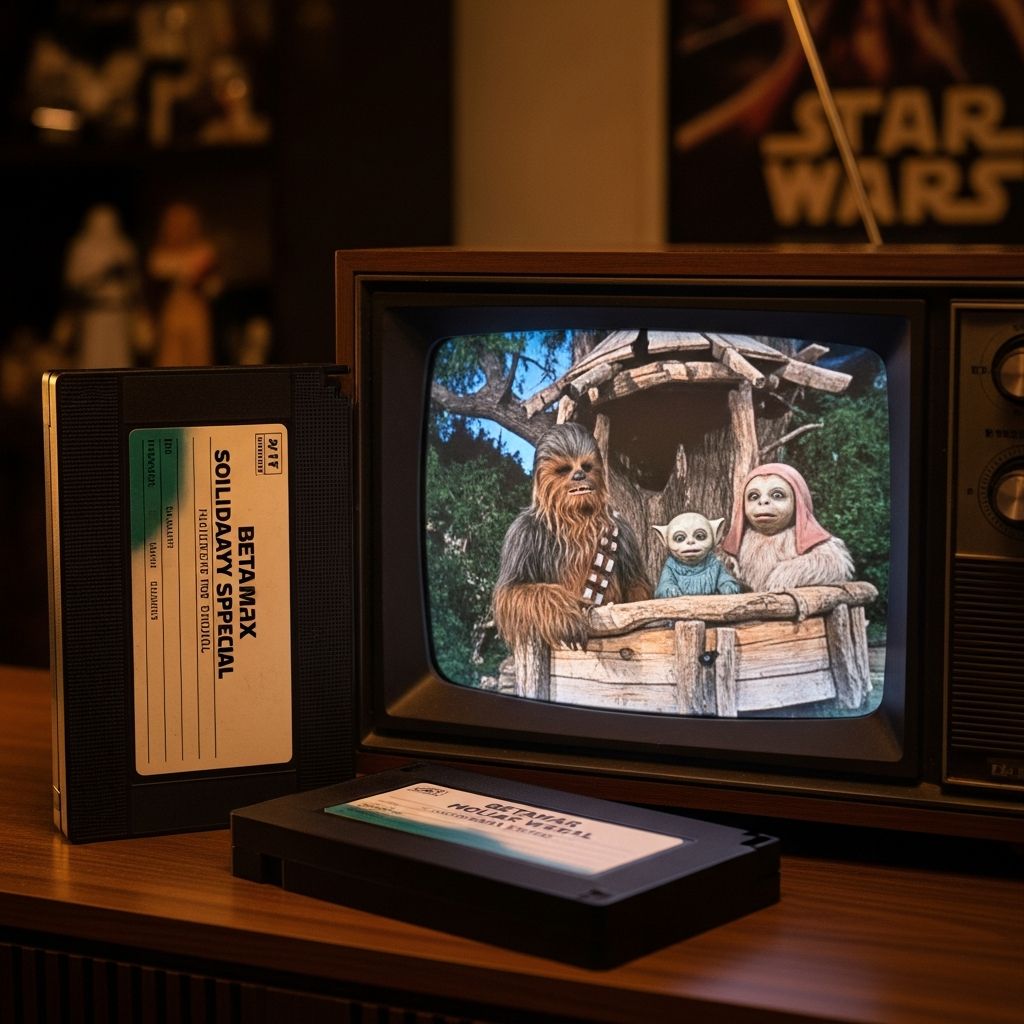
The Star Wars Holiday Special, aired once on American television in 1978, is both a legendary disaster and a strangely important chapter in Star Wars history. It is clumsy, overlong, and tonally bizarre, yet it changed the franchise, introduced new characters, and shaped how fans relate to Star Wars as a shared cultural playground.
This article explores what the special actually is, how it came to be, why it is considered so bad, and the surprising reasons many fans still seek it out each year around Life Day.
From Blockbuster to Bizarre: How the Special Happened
In 1977, Star Wars (later retitled Episode IV: A New Hope) transformed moviegoing and launched what would become a vast media franchise. A year later, CBS aired a two-hour television variety show set in that universe, built around a Wookiee holiday called Life Day. The contrast between cinematic triumph and TV oddity could not be sharper.
The basic premise
The special is framed by a simple, almost sweet idea: Chewbacca is trying to get home for the holidays.
- Chewbacca and Han Solo race against an Imperial blockade to reach the Wookiee homeworld of Kashyyyk in time for Life Day.
- On Kashyyyk, Chewbacca’s family—his wife Malla, son Lumpy, and father Itchy—prepare for his arrival and wait anxiously as Imperial forces patrol the planet.
- While they wait, they distract themselves (and the TV audience) with a series of variety-show style segments: musical performances, comedy sketches, animated adventures, and instructional broadcasts.
What could have been a tight, emotional holiday story becomes a patchwork of unrelated acts loosely connected by the Wookiee family’s day at home.
Who made it and who shows up
The special was produced for CBS as a prime-time event, directed by Steve Binder, an experienced TV variety-show director. To give it authenticity, Lucasfilm brought back nearly all of the main cast from the original film:
- Mark Hamill as Luke Skywalker
- Harrison Ford as Han Solo
- Carrie Fisher as Princess Leia
- Peter Mayhew as Chewbacca
- Anthony Daniels as C-3PO
- Kenny Baker (not credited onscreen) as R2-D2
Their presence makes the special feel canon-adjacent, even though its tone veers wildly from the films and it has never received wider official release.
What Actually Happens in the Special
To understand why the Holiday Special became so notorious, it helps to outline the core story and its many detours.
The main narrative: getting home for Life Day
At its core, the story is straightforward adventure melodrama.
| Story Thread | What Happens | Why It Matters |
|---|---|---|
| Han & Chewie in space | They evade Star Destroyers, fight TIE fighters, and rush toward Kashyyyk for Life Day. | Supplies the few scenes that feel like classic Star Wars. |
| Chewie’s family at home | Malla, Itchy, and Lumpy cook, watch broadcasts, and worry as Imperial troops search their house. | Shows everyday Wookiee life, something the films barely depict. |
| Rebel friends checking in | Luke and Leia contact the family, trying to reassure them and locate Chewie. | Reminds viewers that this is connected to the main saga. |
| The Life Day finale | Wookiees in red robes gather at the Tree of Life; the heroes appear and Leia delivers a speech and song. | Creates the first on-screen version of Life Day as a galactic holiday. |
The bizarre variety segments
Between the main plot beats, characters tune into various forms of in-universe media or technology, which become excuses for skits and performances. Highlights (or lowlights) include:
- A cooking show with an over-the-top alien chef teaching Malla to make an elaborate dish.
- A virtual reality “fantasy” sequence Itchy watches, featuring a glamorous singer performing directly to him.
- An educational tech manual in which a glitchy droid explains how to assemble a device, watched by Lumpy.
- A cantina segment on Tatooine, where a bartender deals with rowdy patrons under an Imperial curfew, culminating in a melancholy farewell song.
Each of these segments interrupts the story for several minutes, dragging the special toward a full feature length and giving it the feel of an awkward variety revue set in the Star Wars galaxy.
The animated segment: Boba Fett arrives
The most important and widely praised portion is a short animated adventure that Lumpy watches on a viewscreen.
- Luke, Han, and Chewie are featured in a stylized cartoon that introduces a new bounty hunter: Boba Fett.
- Fett initially appears as an ally, helping save the heroes, but secretly communicates with Darth Vader and tries to betray them.
- The heroes escape, and Fett retreats with the promise they will meet again—foreshadowing his later appearances in The Empire Strikes Back and beyond.
This animated debut makes the special historically significant within Star Wars lore, even if the rest is largely derided.
Why the Holiday Special Is Considered So Bad
Over time, the Holiday Special gained a reputation as one of the most notorious missteps in franchise television. That reputation comes from both creative and contextual problems.
Clashing tones and TV logic
Where the original film is a tightly plotted space opera, the special behaves like a 1970s prime-time variety show:
- Comedy sketches sit next to serious scenes of Imperial occupation.
- Musical numbers halt the story for long stretches.
- Entire sequences play out with Wookiee dialogue and no subtitles, leaving general audiences confused and restless.
Critics have characterized the result as kitschy, meandering, and off-brand, especially when watched after the polished theatrical films.
Production limits and rushed execution
The special was made on a TV schedule and budget, a world away from the resources of a major film production. Contemporary reporting and later analysis highlight several constraints:
- Limited sets and lighting to evoke alien worlds.
- Complex costumes, like full Wookiee suits, used in domestic sitcom-style scenes.
- Integration of pre-existing film elements with quickly produced new footage.
While the original film pioneered visual effects and sound design, the special reflects the limitations of late-1970s television production standards.
Creator disavowal and lack of official release
Unlike the extensive reissues and restorations surrounding the main saga, the Holiday Special was aired once and then effectively shelved.
- It was broadcast on CBS on November 17, 1978, and has never been officially re-aired in full or released widely on home video.
- The absence of an official release pushed fans toward bootlegs and fan recordings, contributing to its underground mystique.
This combination—creator disapproval, rarity, and word-of-mouth horror stories—cemented its reputation as a forbidden oddity.
Why People Still Watch It
Despite its flaws, the Holiday Special endures as a strange seasonal ritual for many Star Wars fans. Several factors explain this longevity.
A window into 1970s pop culture
Viewed today, the special functions as a time capsule of American TV in the late 1970s:
- Network variety shows featuring sketches, celebrity appearances, and musical performances were still common holiday programming.
- The aesthetics—costumes, lighting, musical styles—reflect the broader entertainment landscape more than the future of Star Wars.
For fans and media historians, it shows what happens when a groundbreaking film franchise is squeezed into the expectations of the TV industry of its era.
Life Day as an offbeat holiday tradition
Within Star Wars lore, Life Day started here: a Wookiee celebration of family, peace, and togetherness on Kashyyyk. Decades later, Life Day has reappeared in books, games, and Disney park celebrations, often with a wink toward the special that originated it.
Many fans now mark Life Day much as they do other seasonal fandom rituals:
- Watching the special (or at least the highlights) once a year.
- Sharing jokes, memes, and commentary online.
- Hosting group viewings where the point is communal laughter as much as nostalgia.
The awkward sincerity of the Life Day finale—glowing orbs, red robes, and Leia’s closing words—captures a kind of earnest holiday sentiment, even if the execution is widely mocked.
The appeal of “so bad it’s good” media
The Holiday Special also benefits from a broader cultural interest in fascinating failures and cult oddities. Social scientists and media scholars have noted that fans often bond over shared criticism and ironic enjoyment, especially in long-running franchises.
In this context, the special offers:
- Shared language: references to certain scenes or characters function as in-jokes among fans.
- Contrast: its weaknesses highlight what the films and later series do well.
- Participation: fan edits, commentary tracks, and retrospectives turn the viewing into a creative, communal act.
What the Holiday Special Changed for Star Wars
For all its reputation, the special marks several firsts and experiments that had long-term effects.
Early transmedia expansion
Media scholars point out that Star Wars was among the first modern franchises to embrace transmedia storytelling, where different formats (films, TV, animation, novels, games) all extend a shared universe. The Holiday Special is one of the earliest attempts to extend Star Wars beyond the film itself:
- It focuses on side characters and a new planet (Kashyyyk) instead of repeating the film’s plot.
- It experiments with mixing live-action and animation inside the same narrative frame.
- It tests whether audiences will accept a more domestic, everyday look at the galaxy.
Although the execution faltered, the impulse behind it anticipated later, more successful projects like animated series and streaming shows.
Boba Fett and the power of a minor character
Boba Fett’s animated debut is a reminder of how small details in a sprawling franchise can grow into major fan obsessions.
- Here he is introduced with a distinctive armor design and enigmatic persona but limited screen time.
- Within a few years, his appearance in The Empire Strikes Back and Return of the Jedi turned him into a cult favorite.
- Decades later, he would headline his own series, The Book of Boba Fett, showing how far that seed from the Holiday Special eventually grew.
This demonstrates how even flawed experiments can introduce elements that later creators and fans embrace and expand.
Should You Watch the Star Wars Holiday Special?
Whether to watch the Holiday Special depends on what you want from Star Wars.
Who will enjoy it most
- Deep-dive fans who enjoy exploring every corner of the franchise’s history.
- Media nerds interested in television history, transmedia storytelling, or notorious failures.
- Group viewers looking for a playful, commentary-heavy watch with friends.
How to approach it
To get the most out of a viewing:
- Think of it as a 1970s variety show wearing Star Wars costumes, not a missing film.
- Embrace pausing or skipping around; many viewers focus on the animated Boba Fett segment and the Life Day finale.
- Use it as a springboard for conversation about how franchises evolve, what fans value, and why some misfires become essential artifacts instead of disappearing.
Frequently Asked Questions (FAQs)
Q: Is the 1978 Star Wars Holiday Special considered canon?
A: Canon status in Star Wars has changed over time. While elements like Kashyyyk, Life Day, and Boba Fett’s existence carried forward into later material, the special itself is generally treated as a non-canonical oddity, and Lucasfilm has not given it an official modern canon designation.
Q: How can I legally watch the Star Wars Holiday Special?
A: There has been no wide, official home-video or streaming release of the full 1978 special, which is why it circulates mainly through recordings of the original broadcast and fan-distributed copies. Official outlets have occasionally released or referenced specific segments, such as the animated Boba Fett short, but not the entire program.
Q: Why do some people call it the worst thing Star Wars has ever produced?
A: Many viewers and critics point to its uneven pacing, confusing structure, and tonal clashes between serious Star Wars scenes and broad TV-variety comedy. Compared with the tightly produced films, the special feels unfocused and dated, so it is often cited as a high-profile creative misstep.
Q: Did George Lucas personally make the Holiday Special?
A: George Lucas created Star Wars and was involved at a conceptual level, but the special was produced largely by television writers and directors working to network standards and schedules. Over the years, Lucas and others associated with the franchise have distanced themselves from the final product.
Q: Is there anything genuinely good in the Holiday Special?
A: Many fans appreciate the animated Boba Fett segment as an inventive early spin-off, and some find charm in seeing the original cast reprise their roles so soon after the 1977 film. Others enjoy it as a so-bad-it’s-good experience that reveals how unusual and experimental early franchise television could be.
References
- The Star Wars Holiday Special (TV Movie 1978) – Plot Summary — IMDb. 2024-01-01 (last accessed). https://www.imdb.com/title/tt0193524/plotsummary/
- Star Wars Holiday Special — Wikipedia (summary of broadcast, production, and plot, used with cross-checking against primary databases). 2024-09-01 (last updated). https://en.wikipedia.org/wiki/Star_Wars_Holiday_Special
- Star Wars: Holiday Special — Rotten Tomatoes. 2024-01-01 (last accessed). https://www.rottentomatoes.com/m/star_wars_holiday_special
- The Star Wars Holiday Special — Wookieepedia (Fandom). 2024-01-01 (last accessed). https://starwars.fandom.com/wiki/The_Star_Wars_Holiday_Special
- A brief history of the infamously terrible ‘Star Wars Holiday Special’ — Stacker. 2021-11-16. https://stacker.com/stories/tv/brief-history-infamously-terrible-star-wars-holiday-special