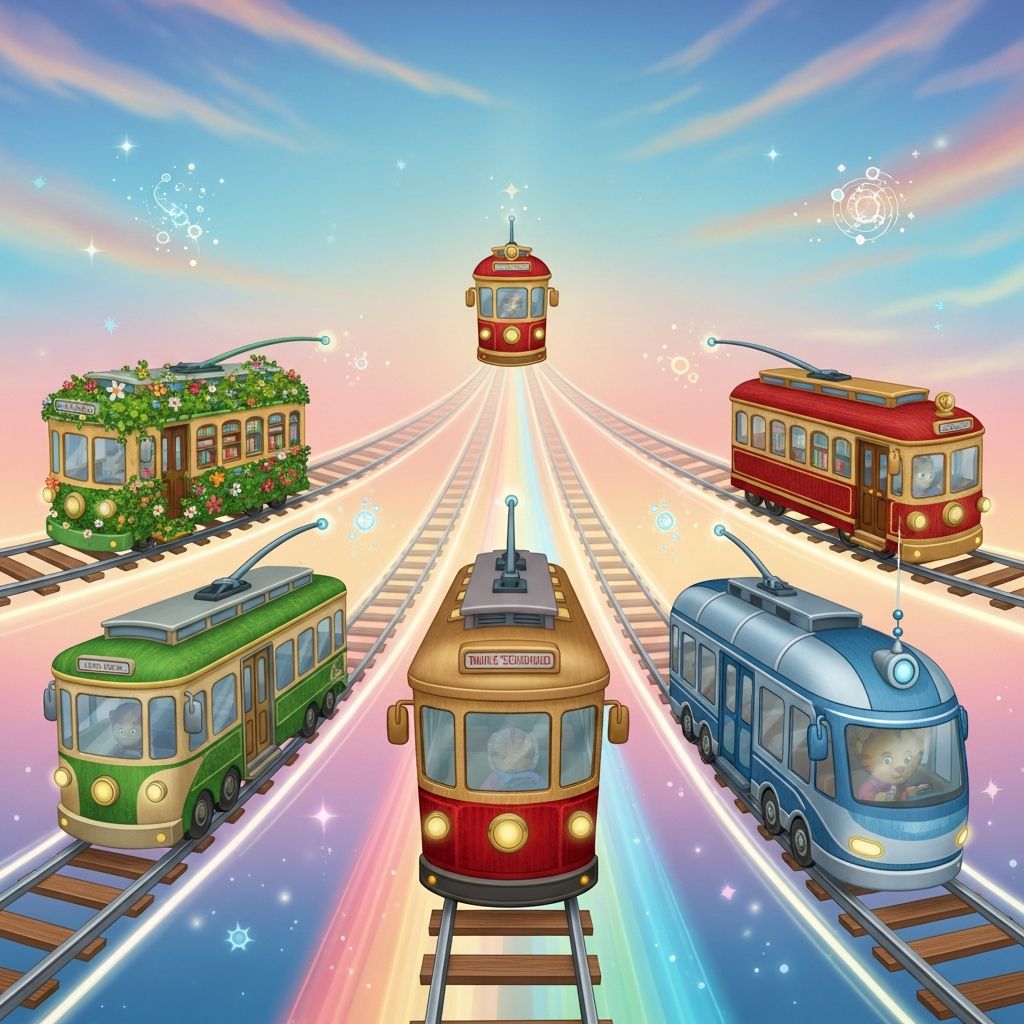
There is a surprisingly rich, interconnected universe beneath the calm surface of PBS Kids shows like Daniel Tiger’s Neighborhood, Mister Rogers’ Neighborhood, and Donkey Hodie, with shared characters, locations, and even a dimension-crossing Trolley tying it all together.
The Gentle Rise of a Kids’ TV Universe
Modern superhero movies have normalized multiverses and crossovers, but children’s television has quietly developed its own, softer version through the legacy of Fred Rogers and his creations.
In this universe, puppets, animated characters, and live-action hosts coexist across generations, linked by emotional themes, familiar names, and a continuous geography that children gradually begin to recognize.
From Mister Rogers to Daniel Tiger
Daniel Tiger’s Neighborhood was conceived as an animated continuation of the puppet-filled Neighborhood of Make-Believe from Mister Rogers’ Neighborhood, reimagining classic characters as fully realized residents of a vibrant town.
The show centers on Daniel Tiger, the son of the original puppet Daniel Striped Tiger, and surrounds him with friends and neighbors whose names and roles echo the earlier series while adapting them for contemporary preschool life.
- Daniel’s world includes royal figures like King Friday XIII and Queen Sara, just as in the original, now integrated into a more fleshed-out community.
- Supporting neighbors such as X the Owl, Henrietta Pussycat, and Grandpere provide continuity across decades of storytelling.
Donkey Hodie: A Puppet Spin on a Classic Side Character
Donkey Hodie builds on a side character originally created for Mister Rogers’ Neighborhood, giving her center stage in a whimsical, puppet-based world known as Someplace Else.
This series embraces Fred Rogers’ spirit of resilience and perseverance, following Donkey as she turns everyday obstacles into opportunities to try, fail, and try again, all within a physical puppet universe designed for today’s kids.
- The setting of Someplace Else draws directly from a location first imagined on Mister Rogers’ Neighborhood.
- Donkey’s stories echo the value-driven lessons of kindness, patience, and problem-solving that parents remember from Fred Rogers.
Trolley: The Quiet Glue of the Trolleyverse
The small red Trolley, once a simple vehicle traveling from Fred’s living room to the Neighborhood of Make-Believe, has evolved into a multiversal ambassador appearing across multiple series.
In Daniel Tiger’s Neighborhood, Trolley functions as everyday public transit, while in crossover events it moves beyond a single show, appearing in Donkey’s world as a visiting character capable of crossing dimensions.
Why Trolley Matters So Much
- It is instantly recognizable to multiple generations, anchoring new stories in familiar imagery.
- It symbolizes gentle transitions: from scene to scene, world to world, and era to era of children’s television.
- Its movement across shows subtly signals that these worlds share history, values, and emotional rules.
Shared Characters Across Decades
One of the clearest signs of an interconnected universe is the migration of characters from one series to another, and here the Mister Rogers lineage is particularly rich.
Dozens of supporting residents from the original Neighborhood of Make-Believe now appear as neighbors, parents, or authority figures in Daniel’s town, creating an extended family spanning generations.
Key Returning Residents
- King Friday XIII and Queen Sara Saturday: Regal figures who continue to rule across iterations, shaping both the puppet world and Daniel’s animated realm.
- X the Owl and Henrietta Pussycat: Treehouse-dwelling friends with deep roots in the original series, now part of Daniel’s community.
- Lady Elaine Fairchilde and others: Quirky and memorable personalities whose presence weaves emotional and narrative continuity for long-time fans.
Places That Prove It’s All One Big Neighborhood
Beyond characters, the geography of this universe reinforces the sense of a shared world, as specific locations reappear with updated aesthetics but recognizable identities.
Children may not consciously map out these places, but they intuitively absorb that these stories all unfold in a single, large-scale Neighborhood where time and style have evolved but the heart remains the same.
Important Locations Revisited
- The Royal Castle, home to King Friday’s family, now prominently visible in Daniel’s hometown.
- The Treehouse and Museum-Go-Round, refurbished as central landmarks that keep old fans oriented in a new series.
- A clock tower with no hands, echoing a whimsical detail from the original puppet land that signals timelessness.
- Someplace Else, now a dedicated setting for Donkey Hodie, upgraded from a concept in the original series into a full world of its own.
Neighborhood Landmarks Table
| Location | Original Appearance | Modern Appearance | Purpose in the Universe |
|---|---|---|---|
| Royal Castle | Mister Rogers’ Neighborhood puppet kingdom | Animated home of King Friday, Queen Sara, and Prince Tuesday in Daniel Tiger’s Neighborhood | Shows dynastic continuity and demonstrates how leadership and family change over time. |
| Treehouse | Shared space for X the Owl and Henrietta Pussycat | Colorful neighborhood hangout in Daniel’s town | Acts as a social hub for friends and a visual bridge across eras. |
| Museum-Go-Round | Whimsical rotating museum in the puppet world | Modernized attraction in Daniel’s animated neighborhood | Encourages curiosity and learning, mirroring Fred Rogers’ educational goals. |
| Someplace Else | Conceptual location born from kids’ complaints about being sent “someplace else” | Fully realized world and home base for Donkey Hodie | Explores independence, persistence, and problem-solving in a dedicated puppet setting. |
Why This Soft Multiverse Works for Kids
The interconnected structure of these series allows children to experience a sense of stability, as familiar faces and places reappear even as they grow older or switch from one show to another.
At the same time, the different formats—live-action, animation, and puppetry—give kids varied visual experiences while preserving core emotional messages about empathy, curiosity, and resilience.
- Young viewers learn that change can feel safe when it is anchored in recurring songs, characters, and environments.
- Parents recognize touchstones from their own childhoods, making co-viewing more meaningful and emotionally layered.
Hidden Easter Eggs for Attentive Adults
While preschoolers mostly focus on the story unfolding in front of them, many details clearly reward adult viewers who remember the earlier series.
From character names to background props, these shows embed subtle nods that essentially confirm they share a timeline, even if that continuity is never explained outright to the kids.
Types of Easter Eggs to Look For
- Small design details in Trolley and neighborhood buildings that mirror sets from Mister Rogers’ Neighborhood.
- Recurring royal crests, signage, or interior layouts that reference the original puppet kingdom.
- Side character cameos that appear briefly in crowd scenes, clearly modeled after older versions.
Watching the Trolleyverse as a Family
For parents wanting to intentionally lean into the shared universe, it can be fun to plan viewing in a loose chronological sequence, starting with classic Mister Rogers’ Neighborhood episodes and then branching into Daniel and Donkey’s worlds.
Doing so makes it easier to point out returning landmarks and characters, turning passive viewing into a gentle scavenger hunt for continuity and shared values.
Simple Ways to Explore the Connections
- After an episode of Daniel Tiger’s Neighborhood, show a short clip of the original puppet counterpart for a character and invite kids to notice similarities.
- Watch a Donkey Hodie episode that includes a familiar visitor and talk about how friends can live in different places but still stay connected.
- Draw a simple “map” of the Neighborhood with your child, adding the castle, treehouse, museum, and Someplace Else as unified parts of one big world.
FAQs About the Daniel Tiger–Mister Rogers–Donkey Hodie Universe
Is Daniel Tiger actually the same Daniel from Mister Rogers?
No. Daniel Tiger is portrayed as the son of the original Daniel Striped Tiger, which allows the show to honor his legacy while placing the stories firmly in a new generation.
How does Donkey Hodie connect to Mister Rogers?
Donkey Hodie started as a puppet character in Mister Rogers’ Neighborhood and has now been given her own series, set in Someplace Else, a location that first appeared as part of the original show’s extended world.
Why does Trolley appear in more than one show?
Trolley has become a symbolic bridge between series, representing continuity across decades while also acting as an in-story vehicle capable of traveling between different neighborhoods and formats.
Do kids need to watch Mister Rogers first to understand Daniel Tiger?
No. Each show is designed to stand alone for preschool audiences, but older kids and adults who know the earlier series will notice extra layers of meaning and nostalgic references.
Is this really a multiverse, or just a set of spin-offs?
In formal storytelling terms, these shows function like a shared universe or soft multiverse, because characters and places move between series while each maintains its own tone and visual style.
Why This Matters in a Noisy Media Landscape
In an era of fragmented media where kids can jump between countless series and platforms, the ongoing Neighborhood created by Fred Rogers’ legacy offers a rare sense of continuity and emotional safety.
The soft multiverse of Daniel Tiger, Mister Rogers, and Donkey Hodie shows that crossovers and shared lore do not have to be frenetic; they can be quiet, kind, and deeply reassuring for both children and the adults who love them.