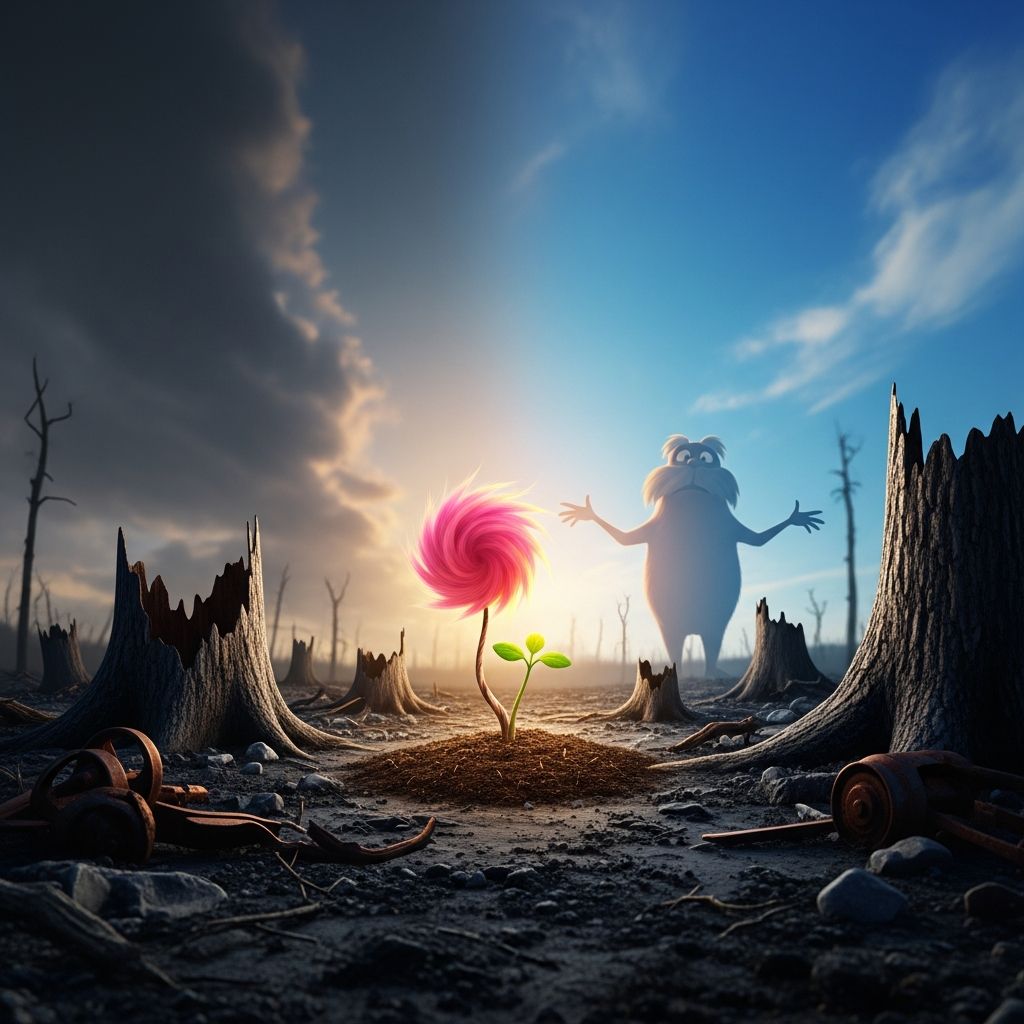
More than fifty years after it was first published, The Lorax has shifted from a quirky eco-fable to a cultural touchstone for conversations about pollution, climate change, and children’s responsibility for the future of the planet.
For many families, this picture book is a child’s first encounter with big questions: What happens when we use too much? Who speaks up for nature? Can one young person really make a difference?
The Origins of a Fierce Little Guardian
Dr. Seuss (Theodor Geisel) wrote The Lorax at a time when environmental crises were entering the public conversation: oil spills, polluted rivers that caught fire, urban smog, and widespread deforestation.
- Setting and mood: The story contrasts a gray, polluted wasteland with the earlier, vibrant landscape filled with fantastical trees and animals.
- The central conflict: A mysterious entrepreneur, the Once-ler, cuts down Truffula Trees to make products, ignoring the Lorax, who “speaks for the trees.”
- The turning point: As factories grow, animals lose their homes, water becomes polluted, and the last tree falls.
Although the book never uses the words “climate change,” its warning about unchecked industrial growth, pollution, and loss of biodiversity foreshadows many of today’s environmental challenges.
From Pollution Parable to Climate Story
When The Lorax was published in 1971, public debate focused heavily on visible pollution: dirty air, toxic rivers, and dying lakes. Today, parents and teachers increasingly connect the story to climate change, which is driven mainly by greenhouse gas emissions from burning fossil fuels, deforestation, and industrial agriculture.
Scientists have shown that human activities have warmed the planet, contributing to more frequent heatwaves, intense rainfall, sea-level rise, and disruptions to ecosystems. The book’s devastated landscape and vanished animals provide a vivid entry point to talk about these consequences at a level kids can grasp.
| In The Lorax | Real-World Climate Connection |
|---|---|
| Truffula Trees are cut down faster than they can grow back. | Deforestation reduces carbon storage, accelerates climate change, and harms biodiversity. |
| Factory smoke fills the sky and chokes the animals. | Burning coal, oil, and gas releases air pollutants and carbon dioxide, warming the atmosphere. |
| A pond becomes too polluted for fish to survive. | Waterways worldwide have suffered from industrial pollution and nutrient overload. |
| The Once-ler ignores warnings until the system collapses. | Delaying climate action raises the risk of abrupt and irreversible environmental changes. |
Why Some Adults Feared This Little Orange Creature
Despite its whimsical rhymes, The Lorax provoked strong reactions. Some logging and timber groups argued that the book unfairly blamed industry for environmental problems and painted workers as villains.
This backlash reveals a powerful tension that still exists in climate conversations:
- Jobs vs. forests: Communities that depend on logging, mining, or fossil fuels worry that environmental rules will threaten their livelihoods.
- Short-term gain vs. long-term health: The Once-ler’s story shows how chasing quick profits can damage land, air, and water so severely that the economy eventually collapses too.
- Responsibility and blame: The book personifies industry in the Once-ler, but it also hints that consumers share responsibility by demanding endless “Thneeds”—products they do not truly need.
In response to criticism, industry-linked groups even commissioned their own children’s book that framed tree cutting as harmless and necessary. The existence of that counter-story underlines how influential The Lorax had become in shaping children’s views of nature and consumption.
What The Lorax Teaches Kids About Power and Responsibility
For children, the most enduring line from the book might be the Once-ler’s message: “Unless someone like you cares a whole awful lot, nothing is going to get better. It’s not.”
That sentence distills several key ideas at the heart of modern climate education:
- Individual agency: Young people are not just passive victims of environmental problems; they can influence their homes, schools, and communities.
- Interdependence: The health of animals, trees, water, and humans is deeply connected, a concept reflected in research on how ecosystems support clean air, clean water, and climate stability.
- Long-term thinking: Planting a seed today—literally and figuratively—can restore damaged places and create possibilities for future generations.
Educators frequently use the story around Earth Day to talk about justice and fairness: How are vulnerable communities affected first and worst by pollution and climate disruptions? Who gets to make decisions about land and resources?
Talking About Climate Through Story Instead of Scare Tactics
Parents often worry that climate change will frighten their children. The Lorax offers a way to address environmental damage without overwhelming kids, because it balances loss with a concrete, hopeful symbol: the final Truffula seed.
When reading with children, adults can emphasize:
- Cause and effect: Show how each decision the Once-ler makes has visible outcomes—for animals, for air and water, and eventually for himself.
- Feelings and empathy: Ask kids how they think the animals feel when they are forced to leave, or how the Once-ler might feel at the end when he sees the results of his choices.
- Possibility and action: Focus on the seed as a sign that change is still possible when people begin to care and act together.
Experts in children’s mental health and climate communication note that pairing honest information about environmental problems with age-appropriate actions—like planting trees or reducing waste—helps prevent anxiety and builds a sense of efficacy.
Simple Ways Families Can Extend the Book’s Message
Using The Lorax as a starting point, families can weave environmental awareness into everyday life without turning it into a lecture.
At Home
- Choose one everyday resource—like paper, water, or electricity—and trace where it comes from and how to use less of it.
- Start a “repair before replace” habit for toys and clothes, echoing the question: Do we really need another “Thneed”?
- Create a family “care list” of small weekly actions (turning off lights, sorting recycling, reusing bags).
In Nature
- Visit a park or forest and invite kids to observe different kinds of trees, animals, and sounds; then compare this to the empty landscape in the book.
- Plant something together—a tree, a shrub, or even herbs in a pot—and check in over time, linking back to the final Truffula seed.
- Participate in a local cleanup or tree-planting event, helping children see themselves as part of a larger community of caretakers.
With Media and Books
- Pair The Lorax with non-fiction picture books about forests, oceans, or climate so children can compare fantasy to real ecosystems.
- If watching the film adaptation, talk about how and why it differs from the book—especially around themes of consumerism and advertising.
- Encourage kids to draw their own imaginary creatures and habitats, then imagine what might threaten them and how to protect them.
What The Lorax Gets Right—and What It Leaves Out
Environmental educators have praised The Lorax for capturing essential lessons, while also pointing out gaps when it is used on its own to teach about climate change.
Strengths of the story include:
- A clear portrayal of how environmental degradation happens step by step, rather than all at once.
- A memorable illustration of the link between economic activity and ecological damage.
- An empowering message that individuals can care and act, even when adults have made mistakes.
Limitations to keep in mind:
- The story focuses on one villainous figure (the Once-ler), which can obscure how systems, laws, and social norms shape environmental outcomes.
- It shows collapse and then a single seed of hope, but not the messy, long-term work of restoration and policy change.
- Climate change specifically involves global processes like greenhouse gas emissions and feedback loops that are not addressed in the book.
Teachers often address these gaps by pairing the story with science lessons, local case studies, and opportunities for students to participate in real-world projects, such as school gardens or citizen science monitoring.
Connecting The Lorax to Today’s Climate Debates
The debates that swirled around The Lorax in the 1970s echo in today’s policy discussions about fossil fuels, renewable energy, and conservation.
Many climate experts argue that addressing global warming requires both technological changes—like shifting to cleaner energy sources—and changes in consumption patterns and values, including how much we buy, waste, and throw away.
In that light, the book can help children recognize recurring patterns:
- Warnings from scientists and advocates that are ignored until damage becomes obvious.
- Communities suffering from pollution and habitat loss before broader society reacts.
- The temptation to believe that growth can continue indefinitely without consequences.
By introducing these themes through rhyme, humor, and exaggerated fantasy, The Lorax makes it easier for families to approach serious topics with honesty and care.
Frequently Asked Questions (FAQs)
Q: Is The Lorax really about climate change?
A: The book never mentions climate change, but its focus on deforestation, pollution, and overconsumption closely mirrors the drivers of modern climate problems. Many educators now use it as a bridge to talk with children about global warming in age-appropriate ways.
Q: Can a single children’s book make a real difference?
A: Research on environmental education suggests that early, emotionally engaging experiences—stories, outdoor play, and role models—shape how children view nature and whether they feel responsible for protecting it. The Lorax is often one of the first stories that frames caring for the environment as a moral and practical choice.
Q: How should I respond if my child feels scared or sad after reading the book?
A: Acknowledge their feelings, then emphasize the hopeful elements: the final seed, the idea that caring matters, and the many people working today to protect forests, oceans, and climate. Pair the story with a simple action—like planting something or reducing waste—to turn worry into constructive energy.
Q: Does the story say that all industry is bad?
A: No. The message is less about banning industry and more about setting limits and using resources responsibly. The same lesson appears in real-world climate policy debates, which focus on transitioning to cleaner technologies and sustainable practices rather than stopping all economic activity.
Q: What age is The Lorax best for?
A: Many families introduce the book around ages 4–7, when children can follow a narrative and connect actions to consequences, and revisit it in later years to explore deeper themes about justice, responsibility, and climate.
References
- Landscapes of the Anthropocene in The Lorax by Dr. Seuss — Niğmet Çetiner, Journal of International Social Research. 2020-01-01. https://www.sosyalarastirmalar.com/articles/landscapes-of-the-anthropocene-in-the-lorax-by-dr-seuss.pdf
- Earth Day and The Lorax — An Darach Forest Therapy. 2022-04-01. https://www.silvotherapy.co.uk/articles/earth-day-and-the-lorax
- The environmental message behind “The Lorax” — CBS New York. 2012-03-01. https://www.cbsnews.com/newyork/news/the-environmental-message-behind-the-lorax/
- ‘The Lorax’ Is a Constant in Classrooms. Does It Send the Right Message? — Education Week. 2023-04-19. https://www.edweek.org/teaching-learning/the-lorax-is-a-constant-in-classrooms-does-it-send-the-right-message/2023/04
- Celebrate Earth Day with the Lorax! — Seussville. 2021-04-01. https://www.seussville.com/themes/celebrate-earth-day-with-the-lorax/