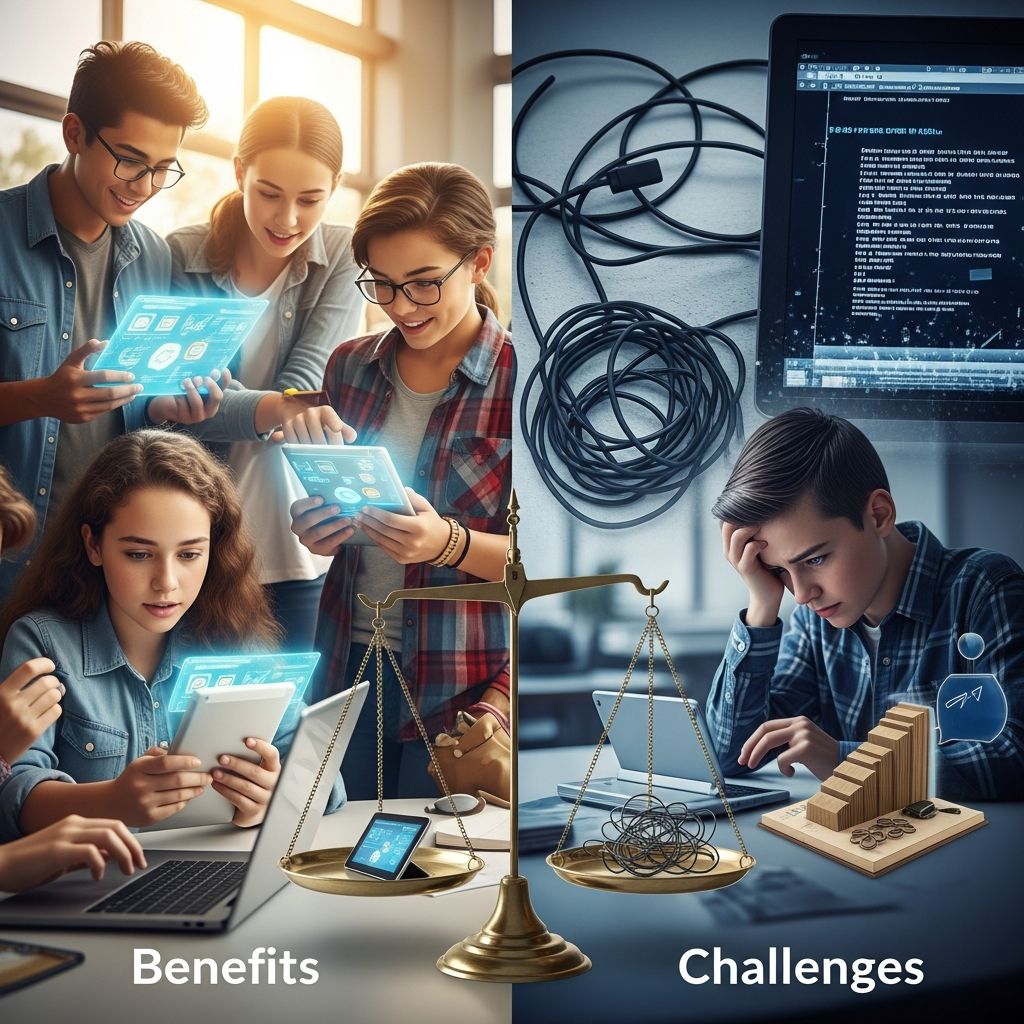
Introduction: Technology’s Evolving Role in Modern Education
The landscape of contemporary education has undergone a remarkable transformation over the past two decades. Where chalkboards once dominated classroom spaces and a single computer per school was considered advanced, today’s learning environments feature interactive displays, mobile devices, and sophisticated software platforms. This technological shift has fundamentally altered how teachers deliver instruction and how students engage with academic content. Understanding the comprehensive impact of these digital tools requires examining both their substantial advantages and the legitimate concerns they present.
Educational technology encompasses far more than simply replacing paper with screens. It represents a philosophical shift toward interactive, personalized, and collaborative learning experiences. Yet this transformation is not universally straightforward; schools and educators must navigate complex decisions about implementation, balance, and pedagogical integration to maximize benefits while minimizing potential harms.
The Productivity Advantage: How Technology Streamlines Learning and Teaching
Modern educational technology fundamentally enhances the efficiency of both teaching and learning processes. Teachers can now convey complex information through multiple modalities simultaneously—combining visual presentations, audio explanations, and interactive demonstrations in ways that traditional instruction could not achieve. This multimedia approach accommodates the diverse learning preferences students bring to the classroom, whether they learn best through visual illustrations, auditory instruction, reading, or kinesthetic engagement.
One significant productivity benefit emerges in the realm of personalized instruction. Adaptive learning platforms analyze individual student performance and adjust content difficulty, pacing, and delivery methods in real time. Rather than all students progressing through identical material at identical speeds, these systems provide targeted support to struggling learners while offering enrichment opportunities for advanced students. This differentiation would be logistically impossible to implement manually at scale.
Additionally, digital resources eliminate temporal and spatial constraints that previously limited educational access. Students can revisit recorded lessons, access educational materials from home, and learn at times convenient to their schedules. Online educational games, simulations, and interactive modules make skill practice engaging rather than tedious, encouraging consistent engagement with content.
Building Engagement Through Interactivity and Collaboration
Research consistently demonstrates that students demonstrate heightened engagement when learning environments incorporate well-designed technology integration. Interactive whiteboards, digital response systems, and educational software transform passive information delivery into active participation. Rather than listening to lectures, students respond to questions in real time, manipulate digital objects, solve problems collaboratively, and receive immediate feedback on their efforts.
Beyond individual engagement, technology enables unprecedented collaborative opportunities. Students can work together on shared documents and projects, communicate through multiple channels, and participate in peer review processes—all enhanced by digital tools. Web-conferencing capabilities extend collaboration beyond physical classroom boundaries, enabling students to connect with classmates during remote learning scenarios and across geographic distances.
This collaborative capacity extends to teacher-student relationships as well. Digital platforms facilitate one-on-one communication outside traditional class periods. Students can submit questions asynchronously, receive personalized feedback on assignments, and access additional support materials—creating more individualized educational relationships within a classroom context.
Expanding Access to Information and Global Learning Opportunities
Educational technology democratizes access to information in unprecedented ways. Rather than relying exclusively on textbooks and teacher expertise, students can explore vast repositories of current, diverse, and multimedia-rich content. This shift fundamentally restructures the role of educators from singular information sources to learning facilitators and critical evaluation guides.
Virtual field trips transport classrooms to museums, historical sites, natural environments, and cultural institutions without physical travel. Video conferencing connects students with experts, educators, and peers internationally, creating authentic learning experiences and cultural exchange opportunities. These expanded horizons cultivate curiosity, encourage deeper exploration of academic subjects, and help students understand content relevance to real-world contexts.
The ability to access continuously updated information is particularly valuable in fast-evolving fields. Digital resources reflect current research, recent historical events, and contemporary applications of concepts, ensuring students learn relevant, timely material rather than relying on static textbook content that may become outdated.
Developing Critical Skills for Contemporary Careers
Integrating technology into educational practices inherently develops digital literacy—a fundamental competency for workforce participation in virtually all modern professions. Students learn not merely to consume digital content but to evaluate source credibility, navigate complex software, synthesize information from multiple digital platforms, and apply technology to problem-solving.
Beyond digital literacy itself, technology-integrated learning environments cultivate critical thinking and sophisticated problem-solving abilities. When students use technology to conduct research, analyze data, create presentations, and develop solutions to authentic challenges, they engage in higher-order cognitive processes. They learn to apply academic knowledge to real situations, evaluate multiple solution approaches, and refine their work based on feedback—all essential professional competencies.
Collaborative technology use builds teamwork and communication skills that employers consistently identify as essential. Students practice articulating ideas in written and visual formats, responding to peer feedback, and coordinating efforts toward shared goals—experiences that directly transfer to workplace contexts.
Addressing Implementation Challenges and Potential Drawbacks
Despite substantial benefits, educational technology implementation presents legitimate challenges requiring thoughtful consideration. Teacher preparation remains a critical concern; simply placing technology in classrooms without comprehensive professional development and ongoing support often fails to produce expected learning gains. Technology must be purposefully integrated into pedagogically sound lesson design rather than used as novelty or replacement for direct instruction.
Classroom management dynamics shift with technology introduction. Students may become distracted by non-educational digital features, face challenges self-regulating screen time, or experience reduced engagement with peers and instructors. Additionally, some research suggests that excessive digital reliance might diminish certain skills; students who always rely on technological solutions may develop weaker independent problem-solving capabilities or mathematical reasoning abilities.
Equity considerations also warrant attention. Technology access disparities mean some students benefit from advanced digital learning environments while others lack comparable tools at home or school. Similarly, not all students possess equal digital literacy competencies, potentially widening achievement gaps if technology implementation doesn’t account for varying skill levels.
Finally, privacy and security concerns arise with increased digital data collection. As educational platforms gather extensive information about student performance, behavior, and engagement patterns, protecting this sensitive information becomes essential.
Optimal Integration Strategies for Balanced Classroom Technology Use
Maximizing technology benefits while mitigating drawbacks requires strategic, intentional implementation approaches:
- Purposeful alignment: Technology should support clearly defined learning objectives rather than serve as an end in itself. Every digital tool introduced must enhance instruction or student learning in demonstrable ways.
- Professional development: Teachers require comprehensive training not only in software operation but in pedagogically effective technology integration. Ongoing support ensures continuous improvement in implementation practices.
- Balanced modality: Technology should complement rather than replace face-to-face interaction, hands-on activities, and direct instruction. The most effective learning environments blend digital and traditional approaches strategically.
- Explicit digital citizenship instruction: Students need explicit guidance in responsible technology use, online safety, source evaluation, and appropriate digital behavior.
- Accessibility focus: Technology selection should prioritize universal design principles, ensuring all students—regardless of ability or socioeconomic status—can benefit from digital tools.
The Research Perspective: What Evidence Tells Us
Educational research presents a nuanced picture of technology’s impact. Studies consistently show that well-implemented technology in supportive learning environments enhances student engagement, motivation, and achievement. Interactive elements, multimedia presentations, and collaborative platforms demonstrably increase student interest and behavioral engagement in learning activities.
However, research also indicates that technology alone does not guarantee improved outcomes. The quality of implementation, alignment with learning objectives, and integration into sound pedagogical frameworks determine actual impacts. Technology can amplify good teaching or exacerbate poor instruction depending on how it’s deployed.
Balancing Digital and Traditional Approaches
The future of education lies not in choosing between technology and traditional methods but in thoughtfully combining both. Technology excels at certain functions—providing immediate feedback, enabling personalization, facilitating collaboration across distances, and delivering multimedia content. Traditional approaches maintain unique strengths—building sustained attention, developing physical skills, fostering in-person relationships, and supporting deep, reflection-based learning.
Effective modern education leverages technology’s distinctive capabilities while preserving the irreplaceable value of human interaction, tactile learning experiences, and unplugged reflection. This balanced approach requires educators to develop sophisticated judgment about when and how to integrate technology rather than defaulting to either uncritical adoption or blanket rejection.
Frequently Asked Questions About Technology in Education
Q: Does technology in the classroom really improve student learning outcomes?
A: When purposefully integrated with clear learning objectives and adequate teacher training, technology does enhance engagement and achievement. However, technology alone doesn’t guarantee improvement; implementation quality matters significantly more than tool availability.
Q: What are the main drawbacks of classroom technology?
A: Key challenges include distraction potential, equity gaps in access and digital literacy, classroom management complications, and risks that technology may diminish certain independent skills if overused without balance.
Q: How can teachers effectively integrate technology without overwhelming students?
A: Balance is essential. Technology should complement rather than dominate instruction. Explicit digital citizenship teaching, strategic tool selection, and preserving non-digital learning activities help maintain healthy, balanced learning environments.
Q: What skills do students develop through technology-integrated learning?
A: Students develop digital literacy, critical thinking, collaboration abilities, problem-solving skills, and workforce-relevant competencies for navigating contemporary professional environments.
References
- How Does Technology Impact Student Learning? — BAU – Bahçeşehir University. 2024. https://bau.edu/blog/technology-impact-on-learning/
- The Impact of Technology on Education — eSchool News. 2023-12-11. https://www.eschoolnews.com/it-leadership/2023/12/11/the-impact-of-technology-on-education/
- Technology in the Classroom: Insights for Optimization — eDesigns Learning. 2024. https://www.edelements.com/technology-in-classroom
- Technology in the Classroom: Benefits and the Impact on Education — Grand Canyon University. 2024. https://www.gcu.edu/blog/teaching-school-administration/how-using-technology-teaching-affects-classrooms
- Effects of Technology on Student Learning — ERIC (Education Resources Information Center). 2022. https://files.eric.ed.gov/fulltext/EJ1290791.pdf
- Technology might be making education worse — Stanford Report. 2023-04-01. https://news.stanford.edu/stories/2023/04/technology-might-be-making-education-worse