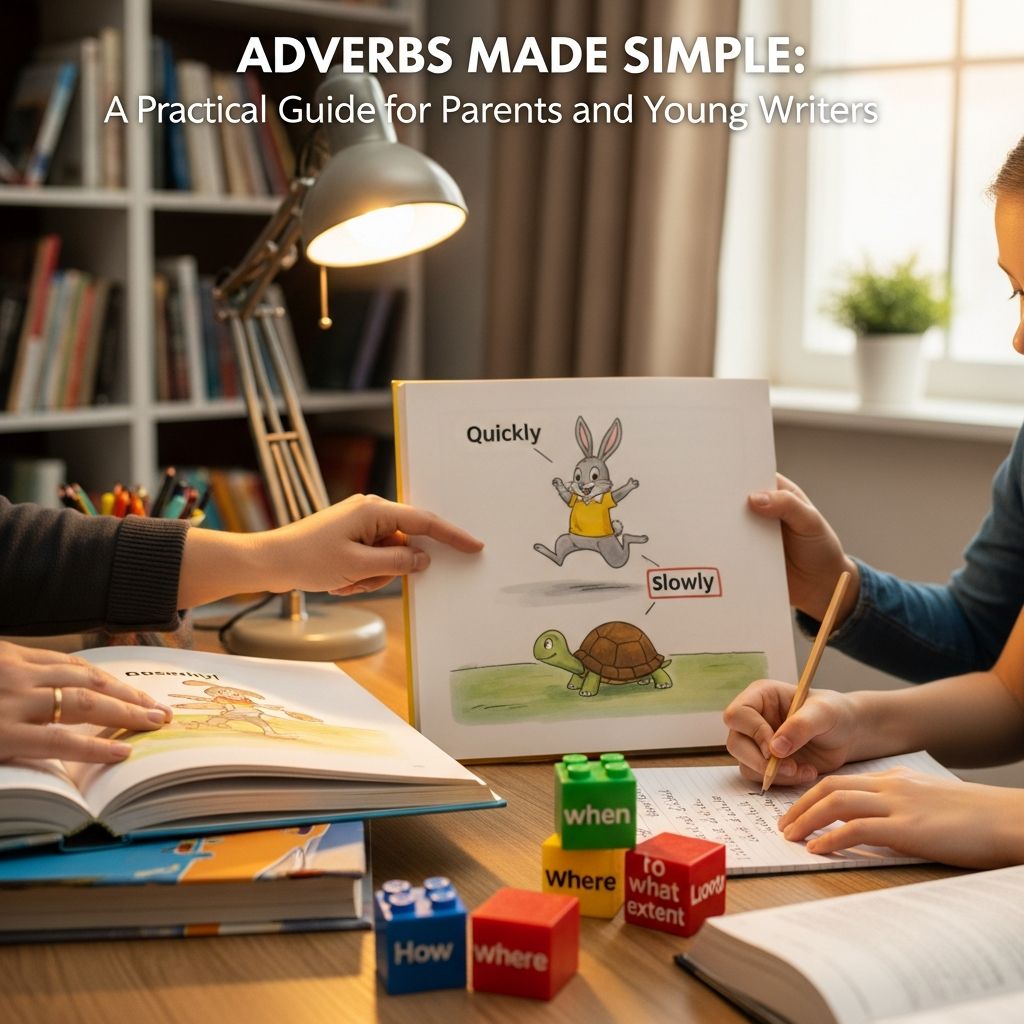
Adverbs are small but powerful words that add color and precision to sentences. They tell us how, when, where, and to what extent something happens, helping children move from basic sentences to vivid, engaging writing.
What Is an Adverb?
An adverb is a word that usually describes a verb, but it can also modify an adjective or another adverb. In simple terms, it answers questions such as how, when, where, or how much.
Many adverbs end in “-ly” (like “quietly” or “carefully”), but not all do. Words such as “very,” “often,” and “never” are also adverbs even though they look different.
- Verbs: Adverbs describe how an action happens. Example: “She spoke softly.”
- Adjectives: Adverbs show the degree of a quality. Example: “The soup is very hot.”
- Other adverbs: Adverbs can adjust the strength of another adverb. Example: “He ran quite quickly.”
Why Adverbs Matter in Children’s Writing
Children often start with short, plain sentences: “The dog ran.” Adverbs help them make those sentences more specific and interesting without forcing them to use complicated vocabulary.
When used thoughtfully, adverbs can:
- Clarify meaning, so the reader understands exactly what happened.
- Add emotion or mood to a scene.
- Support storytelling by showing speed, frequency, and intensity of actions.
Major Types of Adverbs
Adverbs can be grouped into categories based on the kind of question they answer. Teaching the categories helps children recognize patterns and choose the right word for what they want to say.
| Adverb Type | Question Answered | Simple Examples |
|---|---|---|
| Adverbs of manner | How? | quickly, quietly, neatly |
| Adverbs of time | When? | yesterday, soon, daily |
| Adverbs of place | Where? | here, outside, nearby |
| Adverbs of frequency | How often? | always, often, rarely |
| Adverbs of degree | How much? | very, almost, completely |
Adverbs of Manner: Describing How Something Happens
Adverbs of manner are often the easiest for children to spot because so many of them end in “-ly.” They tell us the way an action is carried out.
Ask the child: “How did it happen?” The answer is usually an adverb of manner.
- Examples: slowly, bravely, happily, carefully, suddenly
- Kid-friendly tip: Start with the verb, then add an “-ly” word that fits. “She jumped” becomes “She jumped excitedly.”
Quick Practice Idea
Write simple verbs on slips of paper (run, sing, talk, draw). Ask your child to pull one and add an adverb of manner. Encourage multiple answers for each verb to show how adverbs change the scene.
Adverbs of Time: Talking About When
Adverbs of time show when something happens or for how long. They anchor events in time and help children create a clear sequence in stories and explanations.
They answer questions such as “When?” and “For how long?”
- Examples: now, later, yesterday, soon, always, recently
- In stories: These adverbs help structure events, such as “First,” “then,” “afterward,” and “finally.”
Timeline Activity
Ask your child to describe a typical school day and sprinkle in adverbs of time: “I wake up early,” “We have lunch later,” “I do homework afterward.” This builds both time sense and grammar awareness.
Adverbs of Place: Showing Where
Adverbs of place help the reader picture location or direction. They pair naturally with movement verbs and are useful for describing scenes and settings.
They answer questions like “Where?” and “In what direction?”
- Examples: here, there, upstairs, outside, nearby, everywhere
- Writing tip: Combine adverbs of place with sensory details. “The cat waited outside” can become “The cat waited patiently outside.”
Room Mapping Game
Have your child give you instructions using adverbs of place: “Step forward, look up, and put the book there.” Make it playful by pretending to be a robot that only understands clear adverbs and verbs.
Adverbs of Frequency: How Often Something Happens
Adverbs of frequency tell how regularly an action occurs. They are useful in routines, habits, and descriptions of behavior.
These adverbs answer the question “How often?” and are common in everyday conversation.
- Examples: always, usually, often, sometimes, rarely, never
- Real-life use: Children can talk about chores, hobbies, or schoolwork: “I usually read before bed” or “We rarely eat out.”
Frequency Scale Exercise
Draw a simple scale from “never” to “always.” Ask your child to place activities along the line: “I often play outside,” “We sometimes travel,” “I never skip brushing my teeth.” This connects language with real habits.
Adverbs of Degree: Showing How Much or How Little
Adverbs of degree adjust the strength of an adjective, verb, or another adverb. They can make a description stronger, weaker, or more exact.
These adverbs answer questions like “How much?” or “To what extent?”
- Examples: very, quite, almost, completely, barely, nearly
- In sentences: “The water is very cold,” “She almost slipped,” “He was completely exhausted.”
Intensity Slider Activity
Choose a simple adjective like “tired” or “happy” and ask your child to adjust the intensity: “a little tired,” “very tired,” “completely exhausted.” Then swap in appropriate adverbs of degree: “slightly,” “really,” “totally.”
Where Do Adverbs Go in a Sentence?
Adverbs are flexible, which can be confusing for young writers. The same adverb can appear at the beginning, middle, or end of a sentence, depending on the effect you want.
Encourage children to read their sentences aloud and listen for what sounds natural and clear.
- Beginning: “Quickly, she packed her bag.”
- Middle: “She quickly packed her bag.”
- End: “She packed her bag quickly.”
Common Adverb Mistakes (and How to Fix Them)
Adverbs are helpful, but they can also cause problems when overused or used in the wrong form. Teaching a few simple guidelines can prevent bad habits from forming.
Here are frequent trouble spots to watch for and easy ways to explain them to children.
- Using adjectives instead of adverbs: Children might say “He runs slow” instead of “He runs slowly.” Explain that “runs” needs a word that describes how he runs, so the adverb form is better.
- Stacking too many adverbs: Phrases like “very really quickly” feel cluttered. Encourage your child to choose one strong adverb or, even better, a stronger verb.
- Relying on adverbs instead of precise verbs: Instead of “walked very slowly,” try “crept” or “tiptoed.” This improves vocabulary and style.
Helping Your Child Choose Strong Adverbs
Not all adverbs are equal. Some are vague and overused, while others add real value to a sentence. Teaching children to make thoughtful choices turns adverbs into a tool rather than a crutch.
Guide your child by asking what exactly they want the reader to picture or feel, then choose an adverb or verb that matches that intention.
- Replace bland adverbs such as “really” or “very” with more specific options.
- Encourage them to try a stronger verb first, and then decide whether an adverb is still needed.
- Keep a personal “favorite adverbs” list tailored to your child’s writing topics, such as sports, animals, or fantasy worlds.
Adverbs vs. Adjectives: A Quick Check
Mixing up adjectives and adverbs is common because they often look similar. A fast rule of thumb saves frustration: adjectives describe nouns, while adverbs usually describe actions, qualities, or other adverbs.
Use a simple checklist with your child: “Is this word telling me more about a person or thing (noun), or about an action or quality?” The answer points to adjective or adverb.
| Role | Question Answered | Example |
|---|---|---|
| Adjective | What kind of noun? | “She has a quick mind.” |
| Adverb | How is the action done? | “She thinks quickly.” |
Simple Activities to Teach Adverbs at Home
Adverbs become much easier to remember when children experience them in games and everyday conversation instead of just worksheets. Short, playful activities are usually all it takes.
Here are low-prep ideas you can try at home or in a classroom:
- Adverb charades: Act out an action with a specific manner (“walk proudly,” “eat noisily”). Others guess the adverb.
- Adverb scavenger hunt: Search for adverbs in a short paragraph or a page from a favorite (age-appropriate) book. List them and decide which type each one is.
- Sentence upgrade: Write basic sentences such as “The boy spoke” or “The bird flew.” Challenge your child to improve them with adverbs of manner, time, or place.
Frequently Asked Questions About Adverbs
Do all adverbs end in “-ly”?
No. Many common adverbs such as “often,” “very,” “never,” “soon,” and “here” do not end in “-ly.” The “-ly” ending is a helpful clue for beginners, but it is not a rule that works every time.
Can the same word be an adjective and an adverb?
Yes. Some words, such as “fast” or “early,” can act as either an adjective or an adverb, depending on how they are used. The role changes with the word they are describing, not with the spelling.
Is it bad to use a lot of adverbs?
Using adverbs is not wrong, but piling on too many makes writing feel heavy or repetitive. The goal is to choose adverbs that genuinely add clarity or emotion, not to attach them to every verb.
When should children start learning about adverbs?
Children usually encounter adverbs naturally in reading and speech long before they learn the term in school. Around the early elementary years, they can begin naming and categorizing adverbs in simple examples.
How can I tell if a word is an adverb?
First, find the main verb, adjective, or adverb in the sentence. Then ask: “Is this word telling me how, when, where, how often, or how much?” If the answer is yes and it does not describe a noun, it is likely an adverb.
Bringing It All Together
Adverbs help young writers turn plain sentences into clear, expressive ones by answering key questions about actions and descriptions. When children learn how to choose adverbs with care—and when to replace them with stronger verbs—they develop more control over tone, pacing, and detail.
With a handful of simple categories, playful practice, and regular reading, adverbs become not just a grammar term to memorize, but a practical tool for better storytelling and communication.