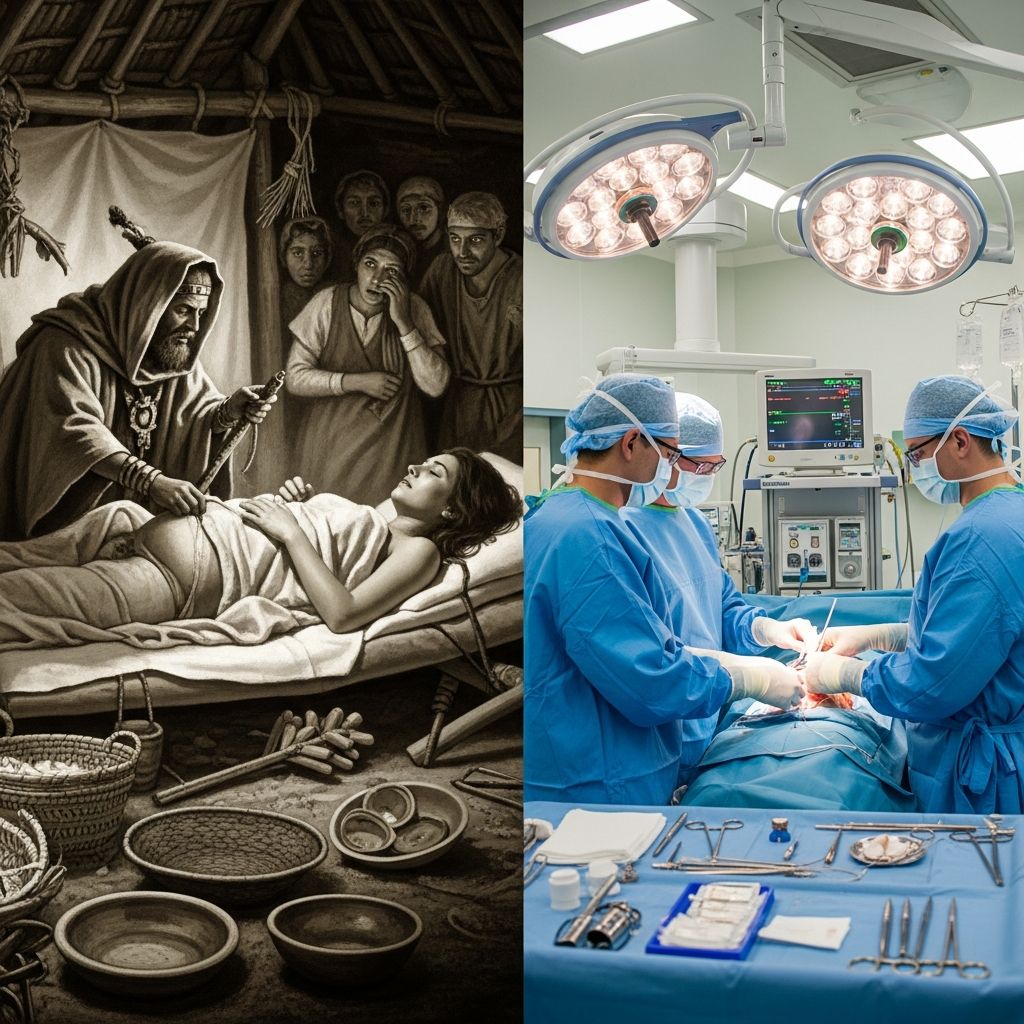
Understanding the Origins of Surgical Delivery in Childbirth
The practice of surgically removing infants from the womb extends far deeper into human history than many realize. Archaeological and historical evidence demonstrates that cultures across the ancient world recognized situations where natural childbirth became impossible and intervention was necessary. The intervention took different forms depending on the civilization, the available knowledge, and the motivations driving the procedure.
In ancient Rome, authorities established formal legal frameworks governing surgical intervention during childbirth. The Lex Caesaria represented one of the earliest documented legal codes addressing this surgical practice. However, the Roman motivation differed significantly from modern medical ethics. Rather than prioritizing maternal or fetal survival, Roman law mandated that if a woman died during pregnancy, her abdomen must be surgically opened to remove the fetus. The underlying purpose was not humanitarian—it was rooted in religious custom, as Roman burial practices prohibited the interment of pregnant women.
Despite popular belief, the procedure’s name likely does not derive from Julius Caesar himself. Historical analysis suggests that if Caesar was born through this method, the etymology represents a misconception. Medical records indicate that until the modern era, cesarean delivery was nearly always fatal to the mother. Caesar’s mother, Aurelia, not only survived her son’s birth but lived for nearly five decades afterward, making it unlikely she underwent this procedure.
The Medieval and Renaissance Periods: Limited Documentation and Survival
Moving into the medieval period and Renaissance era, surgical childbirth remained shrouded in mystery and poorly documented. Most procedures occurred under desperate circumstances, with mothers already in critical condition or deceased. The first well-documented case of a cesarean delivery performed on a living woman occurred on April 21, 1610, when a Wittenberg court surgeon undertook the procedure.
One of the most remarkable early documented cases involved Jakob Nufer, who performed a cesarean section on his own wife in the early 1500s. This groundbreaking event represented a significant milestone—the first recorded instance of the procedure being performed on a living patient. Nufer’s successful intervention challenged prevailing assumptions about the procedure’s inevitably fatal outcomes.
By the early 1600s, descriptions of cesarean delivery began appearing in medical textbooks and midwifery manuals, which formally introduced the term “cesarean section” into medical vocabulary. This increased documentation and standardization of terminology represented important steps toward establishing the procedure as a recognized medical practice rather than a desperate emergency measure.
Eighteenth-Century Breakthroughs and American Innovations
The eighteenth century witnessed transformative developments in cesarean delivery, particularly in North America. Dr. Jesse Bennett earned recognition as the first physician to successfully perform a cesarean section in the United States on January 14, 1794. His patient was his own wife, Elizabeth, who faced complications preventing normal delivery in rural Virginia.
Bennett’s procedure, conducted in a makeshift operating environment using improvised tools and minimal pain management, demonstrated both innovation and desperation. He administered laudanum, a powerful opiate, to render his wife unconscious. His sister-in-law held a candle to provide illumination while he used a knife to enlarge the opening in Elizabeth’s uterus and extract the baby. After delivering the infant, he removed the placenta and ovaries using heavy linen thread for closure—a technique far removed from modern surgical standards.
Another pivotal moment came in 1793 when James Barlow, a surgeon in Lancashire, England, performed a cesarean section on Jane Foster, a woman with a severely distorted pelvis resulting from a traumatic fracture. Foster’s survival marked an important precedent in establishing that the procedure could succeed in the United Kingdom.
These early American and European successes generated renewed interest in the procedure’s potential. Dr. Jesse Bennett’s documented success increased awareness and understanding about viable techniques for cesarean delivery that could save the lives of both mother and child.
The Critical Nineteenth Century: Medical Science Revolutionizes the Procedure
The nineteenth century fundamentally transformed cesarean delivery from a desperate gamble into a medically viable option. This transformation resulted from multiple convergent scientific and technological breakthroughs that collectively revolutionized surgical safety.
Scientific Discoveries and Antiseptic Measures
- In 1862, Louis Pasteur demonstrated the existence of bacteria and their role in causing infections. This foundational discovery reshaped medical understanding of post-surgical complications.
- Three years later, Joseph Lister, a professor of surgery at the University of Glasgow, implemented sterilization protocols in operating theaters using carbolic acid. His antiseptic approach dramatically reduced fatal infections.
- In 1894, American surgeon William Stewart Halsted began promoting surgical glove use at Johns Hopkins Hospital, establishing a practice that quickly spread internationally.
Until the 1870s, cesarean section techniques remained crude and primitive. Surgeons did not routinely use surgical sutures to close the opened womb, leaving mothers vulnerable to severe bleeding and infection. This critical gap in surgical technique represented one of the primary obstacles to successful outcomes.
In 1876, Eduardo Porro, a professor of obstetrics at Pavia, advocated a radical solution: removing the entire womb after delivering the baby as a method of controlling hemorrhage. The first cesarean hysterectomy performed in the United States occurred in 1881, performed by Richardson. While this approach successfully prevented many deaths from bleeding, it eliminated future childbearing capacity.
Modern Surgical Technique Development
The introduction of refined surgical techniques transformed cesarean delivery into a procedure that preserved both mother and uterus. Ferdinand Adolf Kehrer introduced the transverse incision technique in 1881, designed to minimize bleeding and represent the first modern cesarean section approach. The following year, Max Sänger introduced uterine suturing in 1882, allowing the uterus to be safely closed and preserved. In 1882, both Kehrer and Sänger successfully implemented silver and silk sutures for uterine closure, with Kehrer employing a transverse lower-segment incision and Sänger using a longitudinal incision.
These innovations introduced what became known as “conservative cesarean section,” which preserved the uterus and led to significant reductions in maternal mortality. Hermann Johannes Pfannenstiel further modified the technique in 1900, creating an incision approach that bears his name to this day.
Anesthesia: Eliminating Pain and Shock
Perhaps no single advancement proved more transformative than the emergence of effective anesthetics. The ability to eliminate maternal consciousness during surgery accomplished far more than simply relieving pain—it eliminated one of the leading causes of cesarean-related maternal death: shock.
In the nineteenth century, without adequate pain management, mothers undergoing cesarean delivery faced extreme trauma and physiological shock. The combination of pain, blood loss, and the body’s overwhelming stress response frequently proved fatal. Anesthetic agents changed this equation dramatically, allowing surgeons to work methodically while the mother remained unconscious and her vital systems less compromised by pain-induced shock.
The Early Twentieth Century: From Emergency Procedure to Planned Intervention
By the beginning of the twentieth century, advances in anesthesia and antisepsis had rendered cesarean delivery practical and relatively safe by contemporary standards. Medical professionals shifted focus toward refining and optimizing the procedure rather than simply trying to keep mothers alive.
In 1912, German gynecologist Bernhard Krönig argued that successful cesarean delivery outcomes resulted primarily from the lower-segment incision approach rather than the extraperitoneal entry route, introducing the low cervical transperitoneal operation. From 1945 onward, the transperitoneal approach became standard practice, facilitated by widespread antibiotic availability.
By approximately 1920, various surgical refinements and scientific advances had shaped cesarean delivery into the modern surgical procedure recognized today. Crucially, the procedure transitioned from being viewed as a desperate last resort into a preemptive solution designed to improve outcomes for both mother and infant. Rather than allowing mothers to endure hours or days of problematic labor before finally resorting to surgery, physicians began performing cesarean delivery at the earliest signs of complications.
Simultaneously, the location of childbirth underwent dramatic transformation. In the nineteenth century, fewer than ten percent of births occurred in hospitals. By 1938, over half of all American babies were born in hospitals, and by 1955, this figure had skyrocketed to ninety percent. This shift to institutional healthcare settings facilitated access to surgical capabilities and professional medical oversight.
Twentieth-Century Expansion and Modern Prevalence
Despite the emergence of modern cesarean section techniques around 1940, adoption rates remained remarkably modest. The percentage of deliveries performed via cesarean section remained below five percent well into the mid-twentieth century.
Beginning in the mid-1960s, cesarean delivery rates began increasing dramatically, initiating a trend that continues today. Between 1965 and 1985, cesarean section rates increased by over four hundred percent. Currently, approximately one of every three babies is delivered through cesarean section. In 2022, cesarean sections helped 1.1 million people who were unable to naturally deliver by providing an alternative method of birth.
This sudden expansion resulted from multiple interconnected factors, including cultural shifts in medical practice, technological advances, and changing attitudes toward risk management. Electronic fetal monitoring equipment emerged as a significant tool, allowing physicians to assess fetal wellbeing continuously throughout labor. Ultrasound and sonogram technology enabled visualization of fetal development and placental positioning, facilitating earlier identification of complications.
By 2005, one-third of babies in the United States were born via cesarean section, establishing the procedure as the most common surgical operation performed in American hospitals. In contrast, forceps delivery, which was once highly popular for managing difficult deliveries, has declined to approximately ten percent of deliveries today.
Certification and Recognition of Cesarean Surgery in Modern Medicine
Today, cesarean delivery ranks as the most common procedure in the field of obstetrics and gynecology in the United States. Professional medical training now includes extensive education in cesarean surgical techniques, and the procedure has become a keystone procedure in obstetric practice. Medical schools and obstetric residency programs standardize training in cesarean delivery, ensuring that physicians develop competency in this critical intervention.
Frequently Asked Questions
Q: Why is the procedure called a “cesarean section” if Julius Caesar was not actually born this way?
A: The term derives from the Latin word “caedere,” meaning “to cut,” rather than from Julius Caesar specifically. The popular etymology connecting the procedure to Caesar likely stems from a misconception, as historical evidence suggests that mothers who underwent cesarean delivery rarely survived in ancient times, while Caesar’s mother lived for decades after his birth.
Q: When was the first truly successful cesarean section performed on a living mother?
A: The first documented successful cesarean section on a living patient was performed by Jakob Nufer in the early 1500s on his own wife. However, the first recorded cesarean section in the United States with documented maternal survival was performed by Dr. Jesse Bennett on January 14, 1794.
Q: What was the most significant breakthrough that made cesarean delivery safer?
A: Multiple breakthroughs were crucial, but the emergence of effective anesthetics proved transformative by eliminating maternal shock, one of the leading causes of death during cesarean procedures. Additionally, antiseptic techniques pioneered by Joseph Lister and the introduction of surgical sutures by Max Sänger and Ferdinand Adolf Kehrer fundamentally improved survival rates.
Q: How have cesarean section rates changed over time?
A: Cesarean section rates remained below five percent until the mid-1960s. Between 1965 and 1985, rates increased over four hundred percent, and today approximately one-third of babies are delivered via cesarean section. This dramatic increase resulted from technological advances, cultural changes in medical practice, and electronic fetal monitoring capabilities.
Q: What early technique did Dr. Jesse Bennett use for closing the incision?
A: Dr. Bennett used heavy linen thread typically reserved for textile manufacturing rather than medical-grade sutures. This improvised approach was necessary given the frontier conditions in which he performed the surgery in 1794 Virginia.
References
- Cesarean Section History — News-Medical.Net. Retrieved from https://www.news-medical.net/health/Cesarean-Section-History.aspx
- The History of the Cesarean Section — Academic Medicine & Surgery. Retrieved from https://academic-med-surg.scholasticahq.com/article/123289-the-history-of-the-cesarean-section
- Caesarean section — Wikipedia. Retrieved from https://en.wikipedia.org/wiki/Caesarean_section
- Caesarean section: history of a surgical procedure that has always been with us — Ego Journal. 2024. Retrieved from https://egojournal.eu/journal/2024-3/caesarean-section-history-of-a-surgical-procedure-that-has-always-been-with-us/
- Cesarean Section History — Birth Injury Help Center. Retrieved from https://www.birthinjuryhelpcenter.org/birth-injuries/delivery-complications/c-section-birth-injury/c-section-history/
- Anniversary of the First Successful C-Section in the U.S. — Sokolov Law. Retrieved from https://www.sokolovelaw.com/blog/first-successful-cesarean-section/