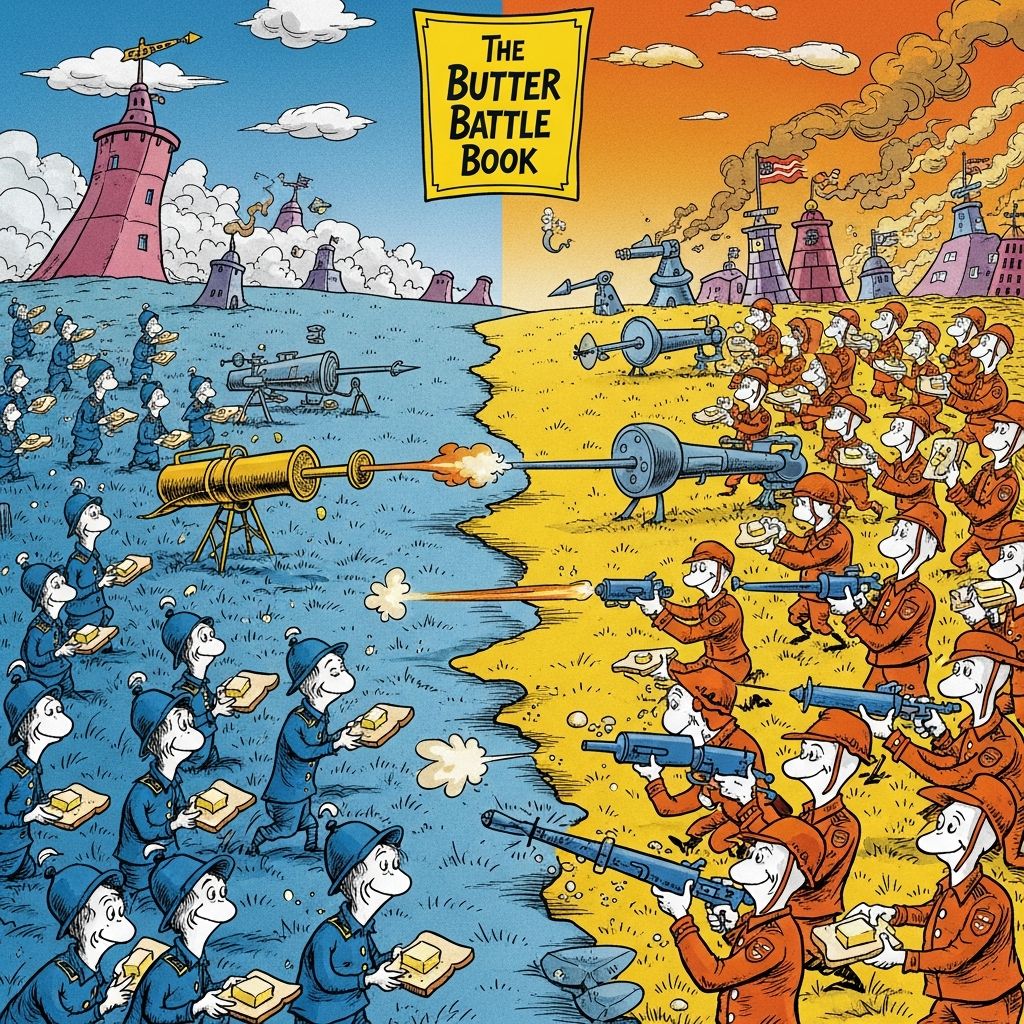
On the surface, The Butter Battle Book is a quirky story about two groups who argue over how to butter their bread. Look a little deeper, and it becomes one of the boldest anti-war picture books ever published, a razor-sharp satire of the nuclear arms race and the terrifying logic of mutual destruction.
This article explores how Dr. Seuss turned a trivial disagreement into a powerful commentary on the Cold War, why the book sparked controversy, and how parents can still use it today to talk with children about conflict, fear, and finding better ways to disagree.
From Breakfast Table to Battlefield: The Story at a Glance
Dr. Seuss sets his tale in a world divided by a long wall. On one side live the **Yooks**, who butter their bread with the butter side up. On the other side live the **Zooks**, who butter theirs butter side down.
That tiny difference sparks an increasingly absurd confrontation:
- A Yook grandfather, serving as a border guard, explains the feud to his curious grandson.
- Minor harassment across the wall turns into an escalating race to build bigger, stranger weapons.
- Both sides proudly display marching bands, uniforms, and patriotic slogans that glorify the buildup.
- Eventually, each side acquires a small doomsday device capable of destroying everyone and everything.
- The book ends not with peace or catastrophe, but with a cliffhanger: both sides stand poised to drop their ultimate weapons, and the reader never finds out what happens next.
Instead of a comforting resolution, Seuss leaves children and adults in a state of suspense, mirroring the anxiety of living under the real nuclear standoff.
The Real-World Shadow: Cold War Fears Behind the Pages
The Butter Battle Book was published in 1984, at the height of Cold War tensions between the United States and the Soviet Union. By that time, both superpowers had spent decades building nuclear weapons capable of annihilating each other many times over.
International relations scholars describe this situation as **mutual assured destruction**: if either side launched a nuclear attack, the other could respond in kind, leaving both countries devastated. Arms-control historians note that by the early 1980s, thousands of nuclear warheads were deployed on each side, making global destruction a real possibility rather than an abstract fear.
Dr. Seuss transformed that grim reality into a child-sized allegory. The wall resembles political borders; the wild weaponry echoes the escalating missile systems, bombers, and delivery technologies developed throughout the Cold War.
| Story Element | Real-World Parallel |
|---|---|
| Yooks vs. Zooks | United States vs. Soviet Union (or any rival powers locked in an arms race) |
| Wall between the two sides | Political and ideological division of the Cold War, sometimes linked to the Berlin Wall |
| Ever-bigger weapons | Development of more powerful bombs, missiles, and delivery systems |
| Final doomsday devices | Nuclear arsenals and the doctrine of mutual assured destruction |
| Open-ended finale | Public uncertainty about whether nuclear war might actually break out |
Why Butter Matters: Tiny Differences, Huge Consequences
Seuss deliberately chose a disagreement that feels ridiculous: which side of a slice of bread should face up. Literary critics describe this as an allegory for how real conflicts can grow from issues that seem small or symbolic, such as rituals, borders, or cultural habits.
By making the dispute so trivial, Seuss drives home a key point:
- Both sides are convinced they are morally correct.
- Neither side seriously considers compromise or coexistence.
- Each escalation is justified as a defensive response to the other.
In international politics, researchers have noted similar patterns, where national identity and ideology intensify disputes over territory or symbols. In the book, the buttered bread is a stand-in for these emotionally charged differences.
Satire in Rhyme: How Seuss Critiques Power
Although The Butter Battle Book is written for children, its humor targets adults who build and justify war machines. Satire scholars point to several techniques Seuss uses to expose the absurdity of militarism:
- Ridiculous weapons – Complex, rhyming inventions with silly names mimic the jargon of military technology.
- Parade-like scenes – Marching bands, cheering crowds, and patriotic songs highlight how societies celebrate military power.
- Uniform upgrades – Each new weapon comes with a more elaborate uniform, echoing how status and prestige often rise with destructive capability.
- Cheerful tone vs. dark stakes – The bouncy rhyme clashes with the possibility of total destruction, making the danger more jarring.
Behind the jokes is a sharp critique of leaders who treat war like a game and of institutions that reward escalation rather than restraint.
Grandfather, Grandson, and the Burden of Inherited Conflict
The story is framed as a conversation between a veteran border guard and his young grandson. This perspective choice matters:
- The grandfather is loyal, proud, and unquestioning at first. He has spent his life serving the Yook cause.
- The child mostly listens, representing the next generation learning the stories, fears, and prejudices of the older one.
- As the confrontation reaches its final moment, the grandfather shows uncertainty, and the grandchild is left staring at a possible catastrophe.
Legal and ethics scholars have argued that this framing raises questions about responsibility across generations: children inherit risks and rivalries they did not choose, especially in the realm of nuclear weapons, where long-term consequences outlast political leaders.
An Ending Without Comfort: Why the Cliffhanger Matters
Unlike many picture books, The Butter Battle Book ends mid-crisis. We do not see reconciliation, retreat, or destruction. Instead, both sides stand ready to drop their ultimate weapon, and the page simply stops.
This unresolved ending serves several purposes:
- Reflecting reality – At the time of publication, no one knew whether the nuclear standoff would ever end peacefully.
- Inviting discussion – The gap forces children and adults to imagine their own outcomes and talk about alternatives to war.
- Highlighting risk – By refusing to provide a comforting answer, Seuss emphasizes how precarious the situation really is.
In classrooms and families, this ending often becomes the starting point for conversations about negotiation, trust, and what it means to “win” or “lose” a conflict that could destroy everyone.
Controversy and Pushback: When a Kids’ Book Becomes Political
When The Butter Battle Book appeared, it quickly drew criticism from commentators who felt it portrayed both sides of the Cold War as equally extreme and foolish.
Some objections included:
- Accusations that the book equated democratic and authoritarian systems by depicting both as equally reckless.
- Concerns that children were being exposed to political messaging about nuclear weapons and foreign policy.
- Discomfort with the absence of a reassuring moral resolution at the end.
At the same time, many educators and critics praised the book as an accessible introduction to peace education and critical thinking. Law and ethics discussions have used it to question whether nuclear deterrence is morally defensible or simply an elaborate version of mutual bullying.
Teaching Big Ideas with a Small Story
Despite its heavy themes, The Butter Battle Book remains a picture book: colorful, rhyming, and humorous. That makes it a surprisingly effective tool for parents and teachers who want to explore conflict and cooperation without overwhelming children.
Some practical ways adults use the book include:
- Talking about disagreements – Using the Yooks and Zooks to ask kids: What small arguments in your life feel big? How could they be solved differently?
- Exploring empathy – Imagining how a Yook or Zook child might feel, or what would happen if someone decided to cross the wall peacefully.
- Introducing history – Connecting the suspense at the end of the book to the tensions of the Cold War and the fear of nuclear war, in age-appropriate ways.
- Encouraging creative endings – Asking children to draw or write their own final pages, focusing on peace-building instead of destruction.
Why It Still Resonates: Beyond the Cold War
Even though the specific U.S.–Soviet confrontation has ended, the themes in The Butter Battle Book remain relevant. Arms control experts note that nuclear weapons still exist in multiple countries, and political tensions continue to rise and fall.
The book’s deeper messages apply to many modern situations:
- Polarized politics, where groups see opponents as fundamentally wrong or dangerous.
- Cultural and religious disputes that start with symbolic differences but escalate into violence.
- Technological arms races in areas like cyber warfare or autonomous weapons, where building “bigger” tools can feel like the only safe choice.
By showing how absurd an arms race looks when the cause is buttered bread, Seuss invites us to step back from our own conflicts and ask whether we, too, are risking too much over too little.
Frequently Asked Questions (FAQs)
Q: Is The Butter Battle Book really about the Cold War?
A: Most literary and historical analyses agree that the story is an allegory for the Cold War nuclear arms race, with the Yooks and Zooks standing in for rival superpowers locked in mutual deterrence.
Q: Is this book appropriate for young children?
A: The language and pictures are accessible to young readers, but the themes are serious. Educators suggest that the book can be shared with children if adults are prepared to discuss fear, conflict, and different ways to handle disagreements in age-appropriate terms.
Q: Why didn’t Dr. Seuss show a clear ending?
A: The open ending reflects the uncertainty people felt during the nuclear standoff and encourages readers to imagine peaceful alternatives instead of passively accepting either war or a tidy resolution.
Q: Does the book say both sides are equally bad?
A: The story focuses on the shared logic of escalation rather than judging one side’s political system. Critics argue that by mirroring the behavior of both groups, Seuss highlights how dangerous it is when any side treats absolute victory as more important than human safety.
Q: How can parents use this book today?
A: Parents can use the story to spark conversations about empathy, compromise, bullying, historical conflicts, and the importance of questioning whether “bigger” and “stronger” are always better solutions.
References
- The Butter Battle Book by Dr. Seuss: Summary & Analysis — Study.com. 2022-04-22. https://study.com/academy/lesson/the-butter-battle-book-summary-analysis.html
- Dr. Seuss’ forgotten anti-war book made him an enemy of the right — The Outline. 2018-09-21. https://theoutline.com/post/5601/dr-seuss-the-butter-battle-book-history
- 40 Years Ago, One Kids Book Dared To Explain The Worst Things In The World — Fatherly. 2024-03-11. https://www.fatherly.com/entertainment/dr-seuss-better-butter-battle-book-retrospective
- The Butter Battle Book Meaning — Shmoop. 2019-06-01. https://www.shmoop.com/study-guides/butter-battle-book/meaning-2.html
- The Butter Battle Book — Random House / Dr. Seuss Enterprises via Wikipedia summary. 1984-01-12. https://en.wikipedia.org/wiki/The_Butter_Battle_Book
- A Critical Reading of Dr. Seuss’s The Butter Battle Book — NYLS Law Review. 2009-01-01. https://digitalcommons.nyls.edu/cgi/viewcontent.cgi?article=1067&context=nyls_law_review
- Book Review: The Butter Battle Book by Dr. Seuss — Erica Lee Beaton. 2014-10-05. https://www.ericaleebeaton.com/dr-seuss-is-for-teenagers-too/
- Butter Battle vs. Cold War — Teaching resource, Mr. Tredinnick. 2016-03-10. http://www.mrtredinnick.com/uploads/7/2/1/5/7215292/butter_battle_show_pptx.pdf