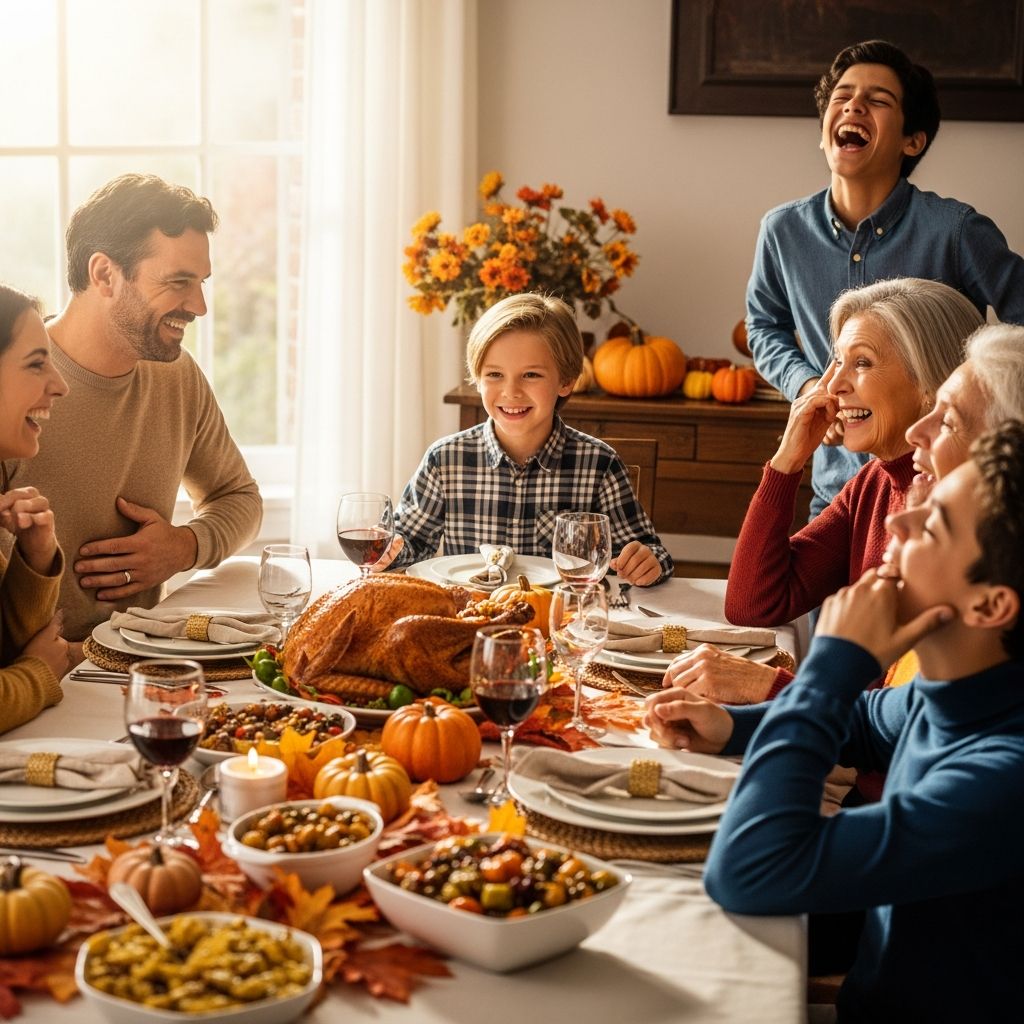
Thanksgiving is usually remembered for family, gratitude, and overflowing plates, but it can also become the funniest day of the year with a little bit of intentional silliness. When parents bring light-hearted humor to the table, kids relax, connect, and create memories that last far longer than any leftover pie. Filling the day with jokes turns small pauses in the action into moments of shared joy, giving everyone something to talk about besides who forgot the cranberry sauce.
Thanksgiving jokes are especially powerful because they are easy for kids to understand, safe for all ages, and often revolve around the same beloved themes: turkeys, side dishes, nap-induced uncles, and the chaos of a crowded kitchen. Instead of focusing only on perfectly timed dishes, families can plan a few perfectly timed punchlines and watch the whole room light up.
Why Thanksgiving Jokes Matter for Families
Children often feel shy at big gatherings, surrounded by relatives they see only once or twice a year. A few silly jokes give kids a simple way to break the ice, offering a low-pressure way to talk, share, and grab everyone’s attention in a positive way. Laughter makes the room feel smaller and friendlier, and it helps kids feel like they belong at the grown-up table.
For parents, joking around is a powerful way to model resilience and joy, even when the turkey burns or the travel plans go sideways. When adults respond to mishaps with humor instead of tension, kids learn that family time is about connection, not perfection. A shared laugh also smooths over minor disagreements, resets sour moods, and keeps the focus on gratitude.
Types of Kid-Friendly Thanksgiving Jokes
Not all jokes fit every audience, and that’s especially true when grandparents, toddlers, and teens are sharing the same table. The most successful Thanksgiving jokes for kids are simple, visual, and easy to retell. Think goofy wordplay, exaggerated images, and harmless misunderstandings that even young children can grasp and repeat.
Below are some categories you can use to structure your family’s own joke collection. Instead of memorizing a long list, think in themes so you can make up new lines on the spot or help your kids craft their own punchlines.
1. Turkey Talk and Bird Brain Jokes
Turkeys are the unofficial comedians of Thanksgiving, and kids love imagining them as clumsy, confused characters getting into trouble. These jokes often poke fun at turkey behavior, appearance, or imaginary personalities in ways that feel playful rather than mean. Parents can encourage kids to think about how a turkey might act if it went to school, got a job, or tried to use a smartphone.
- Build jokes around “keys” and “turkeys,” like wondering why so many keys show up at Thanksgiving.
- Imagine turkeys doing human activities, such as dancing, driving, or chatting on the phone.
- Keep the tone silly, not scary, so younger children stay comfortable and amused.
2. Side Dish Puns and Food Funnies
Thanksgiving dinner offers a buffet of pun material, from mashed potatoes that need cheering up to cranberries with big feelings. Food jokes are vivid and relatable, because kids can look right down at their plates and see the punchline in front of them. Parents can ask kids to imagine what their favorite dish would say if it could talk or what it might be secretly worried about.
- Use rhyming words with common dishes, like “pie,” “roll,” “yams,” and “gravy.”
- Play with contrasts, such as “sweet” potatoes that are actually grumpy.
- Encourage kids to invent conversations between foods on the plate.
3. Pilgrims, History, and Gentle Wordplay
While history-themed jokes should stay respectful and light, they can still use playful word combinations around journeys, ships, or old-fashioned language. The key is to avoid poking fun at real cultures or painful realities and instead focus on harmless misunderstandings or silly interpretations of words kids already know. Parents can gently steer kids away from stereotypes and toward abstract or purely linguistic humor.
- Focus on ships, hats, and old tools instead of real people or specific groups.
- Use misunderstandings about modern life vs. life “long ago” as sources of humor.
- Avoid jokes that make fun of traditions, clothing, or beliefs of any culture.
4. Family and Table-Time Giggles
Some of the sweetest Thanksgiving jokes come from everyday family quirks: the uncle who always falls asleep in the same chair, the cousin who only eats rolls, or the parent who keeps losing the serving spoon. These jokes work best when they are affectionate and gentle, never mean-spirited or embarrassing. Shared family humor can become its own tradition, with recurring punchlines everyone looks forward to each year.
- Turn predictable habits into playful observations rather than sharp teasing.
- Let kids poke fun at parents in small, safe ways, like joking about who always burns the toast.
- Invite each person to contribute a “funny fact” about the day that everyone can exaggerate together.
Age-Appropriate Humor: Matching Jokes to Your Audience
What gets a five-year-old giggling might only earn an eye roll from a teenager, and that’s okay. The goal is not to get one perfect joke that lands with everyone, but to create a space where different ages can take turns being the star. Tailoring the style of humor to the audience helps everyone feel respected and entertained.
Think of Thanksgiving humor as a layered meal: simple knock-knock jokes for little kids, clever puns for older children, and gentle sarcasm or observational humor for adults. By planning a variety of joke types, parents can make sure no one feels left out of the fun.
Joke Ideas by Age Group
| Age Range | Best Joke Style | Tip for Parents |
|---|---|---|
| 3–6 years | Knock-knock jokes, very simple questions with obvious, silly answers | Repeat patterns and let kids finish the punchline themselves. |
| 7–10 years | Puns, playful exaggerations, imaginative turkey scenarios | Explain tricky wordplay once, then let kids try to create similar jokes. |
| 11–13 years | Witty comments, light sarcasm, food-related one-liners | Invite them to write and perform a short “Thanksgiving stand-up” routine. |
| Teens & adults | Observational humor, gentle roasting, inside-family jokes | Keep it kind; avoid jokes that target sensitive topics or personal insecurities. |
Creative Ways to Share Jokes on Thanksgiving
Simply reading jokes from a list can be fun, but integrating them into the flow of the day makes everything feel more natural and memorable. Think beyond the dinner table and sprinkle jokes into transitions, like while waiting for food to cook or during a mid-afternoon lull. Turning jokes into small activities keeps kids engaged and gives them something to anticipate.
Parents can plan one or two playful traditions that repeat each year, such as a “Joke Toast” before dessert or a silly awards ceremony with humorous titles. These rituals make the holiday feel uniquely yours and encourage children to prepare their best material ahead of time.
Fun Joke-Delivery Ideas
- Joke Place Cards: Write or print a different joke on each person’s place card so everyone has something to read aloud before the meal.
- Gobble Giggle Jar: Fill a jar with folded slips of paper, each containing a kid-friendly joke. Every time the conversation stalls, someone pulls a slip and reads it.
- Mashed Potato Mic: Hand a serving spoon to one person at a time and declare it the “microphone” for sharing a joke or funny memory before passing it on.
- Commercial Break Comedy: If your family watches football, let kids tell a short joke during commercials to reclaim a bit of the spotlight.
Helping Shy Kids Tell Jokes Confidently
Even kids who love to laugh may freeze when a dozen adults suddenly turn their attention their way. Parents can support shy children by practicing jokes in advance and offering to act out the punchlines together. Combining a simple line with a funny face, sound effect, or gesture often helps nervous kids feel less alone and more playful.
Consider starting in a smaller setting, such as having your child tell a joke just to siblings or grandparents before sharing it with the entire group. Praise the effort, not just the joke’s success, and avoid pressuring kids to perform if they genuinely dislike the spotlight.
Confidence-Boosting Techniques
- Rehearse the joke with your child and help them remember key words, not every syllable.
- Model playful “mistakes” and show how you can laugh even when the delivery isn’t perfect.
- Stand or sit next to your child while they tell the joke so they feel supported.
- Encourage the group to respond with a big collective “Gobble, gobble!” after each kid’s joke.
Keeping Thanksgiving Humor Kind and Inclusive
Good family jokes make everyone feel warm and welcome, not targeted or uncomfortable. That means steering children away from humor that focuses on body size, appearance, or sensitive personal stories. Parents can calmly explain that kind jokes make people want to hear more, while unkind jokes can hurt feelings and spoil the fun.
It helps to establish a quick “joke checklist” that kids can remember: Is it kind? Is it clean? Would you laugh if someone told the same joke about you? If the answer is yes to all three, the joke is probably safe for the Thanksgiving table. When children understand these boundaries, they are more likely to create better, kinder jokes in the future.
Writing Your Own Thanksgiving Jokes
Instead of relying entirely on jokes found in books or online, help your kids invent their own original punchlines. This turns humor into a creative activity, not just a memory exercise. The best starting point is the classic question-and-answer format, which provides an easy skeleton for kids to fill with their own ideas.
Parents can guide the process with a few simple steps and prompts, turning it into a fun pre-holiday project. The goal is not to create perfect professional-level jokes but to give kids ownership over the laughter they share.
Simple Joke-Building Formula
Use this quick formula to help kids craft original Thanksgiving jokes:
- Pick a subject: a turkey, a side dish, a relative, or something that happens on Thanksgiving.
- Choose a question type: “Why,” “What do you get when,” “How,” or “Where.”
- Brainstorm words: list words that rhyme or sound similar to your subject.
- Find a twist: think of a surprising way to connect the subject and the wordplay.
For example, if your subject is “turkey” and your brainstorming words include “key,” “door,” and “lock,” your child might invent a joke about why turkeys are always losing their keys or what kind of key can’t open any doors.
FAQs About Thanksgiving Jokes for Kids and Parents
Are Thanksgiving jokes appropriate for very young kids?
Yes, as long as the humor is gentle, clean, and easy to follow, young children can enjoy Thanksgiving jokes as much as older kids. Focus on short, repetitive structures like knock-knock jokes and visual humor that toddlers and preschoolers can imagine.
How many jokes should we share during dinner?
There is no fixed number, but a few well-timed jokes can feel more special than nonstop joking throughout the entire meal. Consider scheduling short moments for humor, such as one joke before the meal, one during a pause between courses, and one before dessert.
What if a joke accidentally hurts someone’s feelings?
If a joke lands badly, model empathy and responsibility by acknowledging the issue right away. Encourage your child to apologize simply and clearly, and then gently redirect toward a kinder type of humor that includes everyone.
Can jokes replace a formal Thanksgiving gratitude moment?
Jokes should complement, not replace, time set aside for gratitude. Many families enjoy pairing each joke with a brief thank-you statement or alternating between funny moments and sincere reflections about the year.
How can we turn Thanksgiving jokes into a yearly tradition?
You might keep a small “family joke notebook” with everyone’s favorite lines, adding a new page each year. Another option is creating a simple printable or handwritten sheet of jokes to place at each setting, then saving one copy for your holiday memory box.
Making Thanksgiving a Holiday Kids Can’t Wait to Laugh About
When parents weave jokes and playful humor into Thanksgiving, the holiday becomes less about flawless centerpieces and more about shared smiles. Children remember the feeling of being listened to and laughed with, especially when adults make room for their unique sense of fun. A family that can laugh together over a wobbly pie or a lopsided turkey is a family that knows how to enjoy each other’s company, even when life is far from perfect.
Whether you are testing out a brand-new turkey pun, handing a “microphone” to a nervous young comedian, or writing original jokes together at the kitchen table, you are doing more than just filling the silence. You are building a joyful tradition, one punchline at a time, that your children may someday pass on at their own Thanksgiving tables.