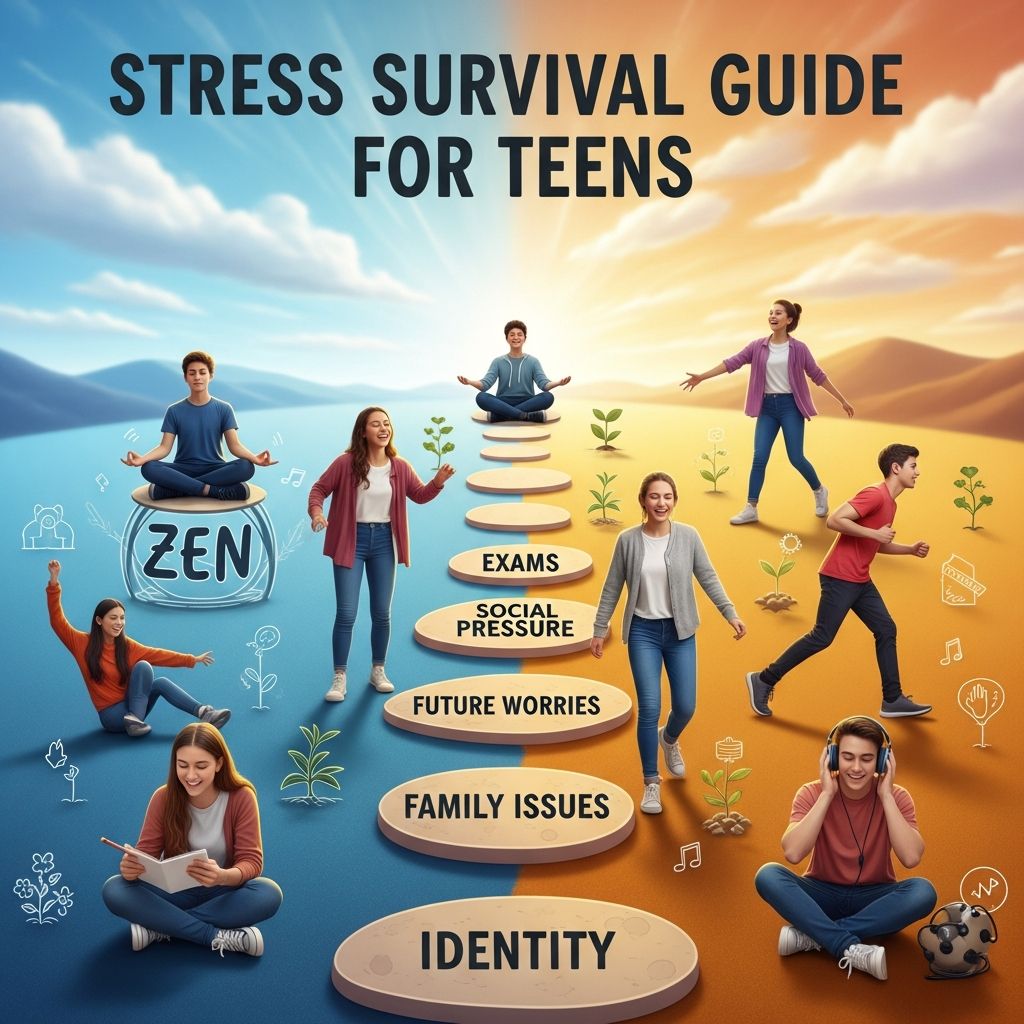
Stress is a normal part of life, especially during the teen years when school, family, friends, and future plans can all feel like a lot at once. This guide explains what stress is, how to tell when it’s becoming too much, and what you can realistically do to cope in healthy ways.
What Stress Actually Is
Stress is your body’s built-in reaction to anything you see as challenging, demanding, or threatening. When you feel stressed, your brain releases hormones that prepare you to act, often called the “fight, flight, or freeze” response.1
In small amounts, this response can help you:
- Focus before a test or game
- React quickly in an emergency
- Find motivation to study or practice
Stress only becomes a problem when it feels constant, intense, or when you don’t have enough tools or support to handle what’s going on.18
Common Stress Triggers for Teens
Every teen is different, but many people your age share similar sources of stress. Understanding your main triggers is the first step toward managing them.
| Area of Life | Examples of Stress Triggers |
|---|---|
| School & Grades | Homework overload, tests, college pressure, learning difficulties, fear of failure |
| Friends & Social Media | Drama, bullying, group chats, likes/followers, comparison to others |
| Family & Home | Arguments, divorce, money worries, strict rules, caring for siblings |
| Health & Appearance | Body image, chronic illness, puberty changes, sports injuries |
| Identity & Future | Who you are, gender or sexuality, culture, choosing a career, big decisions |
Some stressors are short-term (like a big exam), while others are ongoing (like family conflict or chronic illness). Both are real and deserve attention.
How Stress Shows Up in Your Body and Mind
Stress doesn’t just live in your thoughts; it affects your whole body. When stress sticks around for too long, it can impact your health, mood, and behavior.189
Physical Signs
- Headaches or migraines
- Stomachaches, nausea, or changes in appetite
- Racing heart, sweaty palms, or shaky hands
- Tight muscles in your neck, shoulders, or jaw
- Trouble falling or staying asleep, or feeling tired all the time
Emotional & Mental Signs
- Feeling overwhelmed, on edge, or easily annoyed
- Worrying a lot or expecting the worst
- Feeling sad, hopeless, or numb
- Difficulty concentrating or remembering things
- Feeling like you have to be perfect or can’t make mistakes
Behavior Changes
- Withdrawing from friends or activities you used to enjoy
- Procrastinating more than usual
- Snapping at people or starting arguments
- Using food, energy drinks, vaping, alcohol, or other substances to cope7
- Spending hours scrolling or gaming to avoid thinking about problems
If you notice several of these signs lasting for weeks or getting worse, it’s a signal to reach out for support.
Different Types of Stress
Not all stress is the same. Understanding the type you’re dealing with can help you choose the right coping strategy.
- Everyday stress: Short-term pressure from homework, chores, or sports. This type can often be handled with good habits and planning.
- Acute stress: A sudden, intense reaction to something specific, like a fight with a friend or a surprise quiz. It usually fades once the situation passes.
- Chronic stress: Ongoing stress from serious or long-term situations, such as family violence, serious illness, or persistent bullying.8 This type can really affect health and is a strong reason to get professional help.
Healthy Ways to Handle Stress Day-to-Day
You can’t erase stress from your life, but you can build a toolkit to handle it. Research shows that combining body-based strategies, emotional skills, and problem-solving works best.56
1. Take Care of Your Body
- Protect your sleep: Most teens need about 8–10 hours of sleep each night.8 Try to keep a regular bedtime, dim screens an hour before bed, and avoid energy drinks late in the day.
- Move your body: Physical activity, like walking, dancing, sports, or cycling, helps your brain release chemicals that improve mood and reduce stress.38
- Eat regularly: Skipping meals or loading up on sugar and caffeine can make stress feel worse. Aim for regular meals and snacks with a mix of protein, whole grains, fruits, and vegetables.3
- Limit caffeine and substances: Energy drinks, strong coffee, vaping, alcohol, or other drugs may seem like quick fixes but usually increase anxiety and interfere with sleep and mood.37
2. Calm Your Nervous System
Relaxation skills help your brain shift out of “emergency” mode so you can think more clearly.5
- Deep breathing: Inhale slowly through your nose for a count of 4, hold for 2, then exhale through your mouth for a count of 6. Repeat 5–10 times.
- Progressive muscle relaxation: Gently tense and then relax one muscle group at a time (hands, arms, shoulders, face, legs) to release physical tension.25
- Mindfulness: Pay close attention to the present moment—what you can see, hear, and feel—without judging it. You can do this while walking, eating, or listening to music.13
- Guided imagery: Imagine a place where you feel safe and calm (a beach, forest, room, or court). Picture the details—sounds, colors, temperature—as clearly as you can.
3. Think About Problems in Manageable Pieces
Some stress comes from the way we think about problems. You can’t control everything, but you can control how you respond.
- Break tasks down: Instead of “I have too much to do,” list out each step (e.g., read two pages, write three sentences, review one chapter). Focus on one piece at a time.2
- Set realistic goals: Replace “I have to get 100%” with “I want to improve my score” or “I’ll aim to do my best after studying for 30 minutes.”
- Challenge unhelpful thoughts: Notice thoughts like “I always mess up” or “Everyone thinks I’m stupid” and ask: “Is that 100% true? What’s another way to see this?”5
- Focus on what you can control: You can’t control other people’s opinions, but you can control your effort, your attitude, and how you treat yourself and others.2
4. Use Your Support System
Stress gets lighter when you don’t carry it alone. Reaching out is a sign of strength, not weakness.28
- Talk it out: Share what’s going on with someone you trust—a friend, parent, relative, coach, teacher, or school counselor.
- Ask for specific help: Instead of “I’m stressed,” try “I’m overwhelmed by math—can you help me review this?”
- Connect regularly: Even short moments of connection—joking with a friend, having dinner with family, or texting someone supportive—can buffer stress.89
- Seek professional support when needed: Therapists, school counselors, or doctors can teach coping skills and check for anxiety, depression, or other conditions that may need treatment.78
5. Make Time for Things That Refill You
When life is busy, it’s easy to drop the things that make you feel alive—yet those are often what help you handle stress better.
- Hobbies: Art, music, reading, gaming, coding, sports, baking, crafts—anything that lets you feel engaged and relaxed.
- Creative outlets: Writing, journaling, poetry, photography, or making videos can help you express what you’re feeling.
- Time outdoors: Even a short walk, sitting in a park, or shooting hoops can boost your mood and clear your head.9
- Acts of kindness: Helping someone else, volunteering, or supporting a cause you care about can give you a sense of purpose and reduce stress.46
Building Your Personal Stress Plan
You can create your own simple stress plan so you know what to do when things feel like “too much.” Experts often group coping strategies into a few main areas.46
- Tackle the problem: Identify what’s stressing you, break it into smaller parts, ask for help, and make a basic to-do list.
- Care for your body: Sleep, movement, food, hydration, and limiting substances.
- Handle emotions: Use breathing, mindfulness, journaling, music, or talking to someone to process how you feel.
- Look beyond yourself: Do something kind, support a friend, or contribute to your community in a small way.
Write down 1–3 strategies in each area that feel realistic for you. Keep your plan where you can see it—on your wall, in your notes app, or in a journal—so you’re not starting from scratch every time you feel stressed.
When Stress Might Be More Than Stress
Sometimes what feels like “just stress” is actually part of a mental health condition like anxiety or depression. Getting help early can make a big difference.78
Talk to a trusted adult or health professional if you notice things like:
- Feeling sad, empty, or hopeless most days
- Panic attacks, intense fear, or constant worrying
- Big changes in sleep or appetite that don’t go away
- Loss of interest in almost everything you used to enjoy
- Thoughts about hurting yourself, disappearing, or not wanting to be alive
If you ever think you might hurt yourself or are in immediate danger, contact emergency services or a crisis hotline in your country right away. You are not alone, and help is available.
Frequently Asked Questions (FAQs)
Q: Is all stress bad for me?
Not all stress is bad. Short bursts of stress can motivate you to study, practice, or react quickly in a serious situation. It becomes a problem when it is intense, constant, or makes it hard to function at school, at home, or with friends.
Q: How do I know if I’m just tired or actually stressed out?
Feeling tired from a long day usually improves after rest, food, and a break. Stress often comes with extra signs like worrying, irritability, headaches, trouble sleeping, or feeling like your mind won’t turn off. If those signs stick around for weeks, it is likely more than just being tired.
Q: What if I don’t feel comfortable talking to my parents?
You can still reach out to other trusted adults such as a school counselor, teacher, coach, relative, or doctor. Many communities and schools also offer hotlines, text lines, or online chats where you can talk to a trained listener.
Q: Does stress mean I’m weak or can’t handle life?
No. Stress is your body’s natural reaction to challenges. Everyone experiences it, including adults. Learning how to manage stress is a skill—like driving or playing a sport—that you can get better at over time.
Q: How fast will stress-management techniques start working?
Some tools, like deep breathing or muscle relaxation, can help you feel calmer within minutes. Others, like better sleep habits, regular exercise, or changing unhelpful thinking patterns, may take days or weeks to show big results. Practicing them regularly helps your brain and body respond more quickly over time.
References
- Managing Stress — Centers for Disease Control and Prevention (CDC). 2023-04-27. https://www.cdc.gov/mental-health/living-with/index.html
- How to Help Children and Teens Manage Their Stress — American Psychological Association (APA). 2022-09-01. https://www.apa.org/topics/children/stress
- For Teens: Creating Your Personal Stress-Management Plan — American Academy of Pediatrics / HealthyChildren.org. 2022-05-23. https://www.healthychildren.org/English/healthy-living/emotional-wellness/Building-Resilience/Pages/For-Teens-Creating-Your-Personal-Stress-Management-Plan.aspx
- Stress Management and Teens — American Academy of Child and Adolescent Psychiatry (AACAP). 2018-06-01. https://www.aacap.org/AACAP/Families_and_Youth/Facts_for_Families/FFF-Guide/Helping-Teenagers-With-Stress-066.aspx
- Teens, Stress and How Parents Can Help — Brown University Health. 2021-03-10. https://www.brownhealth.org/be-well/teens-stress-and-how-parents-can-help
- Managing Stress in High School — Harvard University Division of Continuing Education. 2022-08-15. https://summer.harvard.edu/blog/managing-stress-in-high-school/
- Stress Management Intervention to Enhance Adolescent Resilience — The Journal of Education and Health Promotion (NIH PubMed Central). 2021-10-04. https://pmc.ncbi.nlm.nih.gov/articles/PMC8525873/