Introducing Democracy Through Daily Family Life
Democracy functions as the foundation of many modern societies, yet many children grow up without understanding how their voices can shape the world around them. The process of introducing young people to voting and civic participation doesn’t require waiting until they reach adulthood. Rather, families can begin cultivating democratic values and understanding during childhood through intentional conversations and practical experiences. These early exposures help children grasp abstract concepts like collective decision-making and majority rule in tangible, relatable ways.
When parents engage their children in discussions about voting and democratic participation, they accomplish several important objectives simultaneously. They demonstrate the significance they place on civic engagement, create opportunities for children to practice decision-making skills, and normalize political discourse as a healthy family activity. Most importantly, these conversations help children understand that their preferences and voices matter within both their immediate family unit and their broader community.
The Foundation: Modeling Civic Engagement in Your Household
Children learn most powerfully through observation. When parents prioritize voting and treat it as an important personal responsibility, children internalize this behavior as something meaningful. Taking your child to the polling location, explaining your voting process, or discussing your reasons for supporting particular candidates or issues demonstrates that democratic participation deserves time and consideration.
This modeling extends beyond election day itself. Throughout the year, when discussing community issues, local improvements, or national events, parents can reference the voting process and explain how citizen participation influences outcomes. Over time, children develop an understanding that voting represents one of the most direct ways individuals can influence their environment and contribute to their community’s development.
Creating Democratic Experiences at Home
One of the most effective methods for teaching voting concepts involves establishing mini-democratic processes within the family structure. Rather than making all decisions unilaterally, parents can invite children to participate in voting on matters that affect household life. These opportunities allow children to experience the practical mechanics of voting while maintaining stakes that feel genuinely important to them.
Consider these family voting scenarios:
- Selecting which movie to watch during family movie night
- Choosing the restaurant for a special family dinner
- Deciding which game to play during indoor activities
- Determining what dessert to prepare for a family gathering
- Planning a family outing or weekend activity
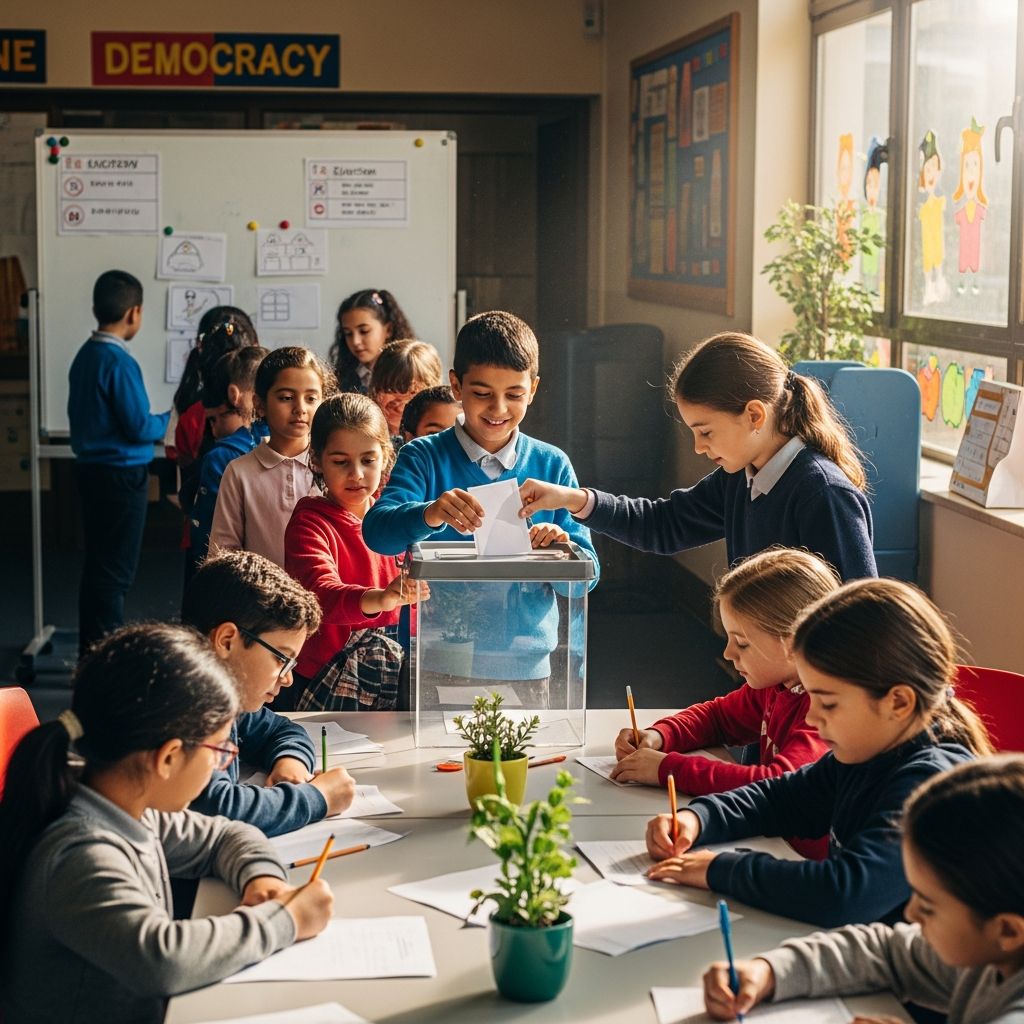
To enhance these experiences and make them more closely resemble actual voting procedures, families can establish a voting booth setup at home. This might involve a simple curtained area where each family member casts their vote privately, using a ballot box to collect responses, or even creating official-looking ballots. These theatrical elements reinforce the privacy and integrity associated with legitimate voting processes.
Scaffolding Understanding Through Age-Appropriate Concepts
Children develop cognitive understanding progressively, and educators recognize that voting comprehension follows a developmental trajectory. Younger children first need to grasp that different people hold different preferences and opinions. This foundational concept—that diversity of thought is natural and normal—provides the psychological framework for understanding why voting mechanisms exist.
As children mature, they can develop more nuanced understanding. They begin to recognize that even when their preference doesn’t align with the majority decision, they must accept the outcome while still maintaining their integrity and voice. This progression helps children avoid viewing voting results as personal rejection and instead understand voting as a mechanism for collective decision-making where individual preferences sometimes yield to group choice.
Older children can engage with more complex voting scenarios. These might involve nomination processes before voting, persuasion campaigns where children advocate for their preferred options, or discussions about consequences when their preference doesn’t win. For example, if children vote on playground equipment purchases and their choice doesn’t win, discussing how they might fundraise for their preferred option in the future teaches persistence and creative problem-solving within democratic frameworks.
Connecting Voting to Issues That Matter to Children
Abstract discussions about voting hold limited appeal for most children. However, when parents connect voting to issues that directly impact children’s lives, the relevance becomes immediately apparent. Local decisions about park maintenance, playground equipment, school programs, and community resources all represent areas where voting creates tangible outcomes.
Parents can initiate conversations by asking children how they feel about specific issues and then explaining which candidates or ballot measures align with those preferences. This approach accomplishes multiple educational objectives: it validates children’s opinions as worthy of consideration, it teaches that adults also hold opinions on these matters, and it demonstrates concrete connections between voting behavior and real-world outcomes.
Environmental issues frequently resonate with children, as do education-related policies and community safety matters. By discussing these topics in age-appropriate ways and connecting them to voting decisions, parents help children understand that their future wellbeing depends partially on voting choices made by current citizens.
Using Stories and Literature to Build Understanding
Children often grasp complex concepts more readily when they encounter them through narrative and storytelling. Books designed for young readers can introduce voting concepts in engaging, age-appropriate formats. Stories about characters making collective decisions, resolving disagreements through fair processes, or discovering their voices often resonate more powerfully than direct explanations.
Parents might select picture books that address fairness, decision-making, and collective problem-solving, even if they don’t explicitly focus on voting. These stories create entry points for conversations about how groups make fair decisions and why everyone’s voice deserves consideration. Following story time, parents can ask reflective questions that help children connect narrative concepts to real-world democratic processes.
Fostering Respectful Disagreement as a Democratic Skill
Democracy functions optimally when citizens can disagree respectfully and maintain relationships despite political differences. Yet many children grow up in environments where disagreement feels threatening or damaging. Parents can cultivate healthier relationships with political difference by modeling respectful disagreement at home and explicitly teaching that people can hold opposing views while remaining kind and connected.
When family members hold different political perspectives, this becomes an opportunity rather than a problem. Parents can demonstrate how they listen to opposing viewpoints, acknowledge valid points made by those with different preferences, and express disagreement without dismissing or disrespecting the other person. These practical demonstrations teach children that political discourse need not be hostile or relationship-damaging.
Children can observe parents discussing why they support particular candidates or positions, hear explanations of how others reasonably reach different conclusions, and witness civility throughout the process. Over time, children internalize that thoughtful people can reach different voting conclusions based on different values or priorities, and that this diversity strengthens rather than weakens democratic processes.
Sharing Your Values Without Imposing Your Choices
Parents understandably wonder about the appropriate balance between sharing their own voting preferences and allowing children to develop independent thinking. The answer involves distinguishing between articulating values and demanding specific voting outcomes. Parents absolutely can explain what matters to them politically and why, while simultaneously modeling openness to different perspectives and respecting others’ autonomous choices.
This approach teaches children that everyone holds values and priorities that inform their choices, that it’s appropriate to articulate those values, and that others might prioritize differently without being wrong or misguided. Children benefit from understanding their family’s values while also learning that thoughtful, principled people across the political spectrum exist.
Addressing Children’s Questions About Voting
Children naturally generate questions about voting as they observe election cycles and hear political discourse. Parents benefit from preparing straightforward, age-appropriate responses to common inquiries.
Why do people vote? Voting represents the primary mechanism through which citizens influence who makes important decisions and what policies get enacted. When large groups of people have a say in decisions, outcomes tend to reflect diverse perspectives rather than any single person’s preferences.
Why doesn’t everyone vote the same way? People prioritize different issues, hold different values, and interpret information differently. Someone might prioritize environmental protection while another prioritizes economic growth; both are legitimate perspectives, but they lead to different voting choices.
What happens if my candidate loses? Even when your preferred candidate doesn’t win, voting still matters because it expresses your voice and contributes to the overall outcome. Additionally, future elections provide additional opportunities to vote for your preferred candidates or causes.
Who gets to vote? In most democratic systems, voting eligibility depends on citizenship, age (typically eighteen), and residency requirements. These structures exist to ensure voters have a stake in the community’s future and understand its systems.
Building Lifelong Civic Participation Habits
Research consistently shows that voting habits established in childhood tend to persist into adulthood. When children grow up in households where voting receives regular attention, where democratic processes feel normal and important, and where civic participation is modeled consistently, they internalize voting as a normal adult responsibility.
Parents who involve their children in voting processes—whether through family voting activities, discussions about elections, or trips to polling locations—plant seeds that often bear fruit across the lifespan. Children who understand voting mechanics and recognize voting’s importance become adults more likely to prioritize voting themselves and to engage in other forms of civic participation.
Beyond voting specifically, these early lessons contribute to broader civic competence. Children learn that collective problems require collective solutions, that fair processes matter, that respectful disagreement is possible, and that individual voices, while sometimes yielding to group preferences, still deserve consideration and respect.
Creating Election Day Excitement
Election day itself offers opportunities to make voting feel exciting and important rather than mundane or stressful. Parents who approach voting with enthusiasm help children view it as a special occasion worthy of attention and energy. Making voting a family activity—preparing together, visiting the polling location, celebrating afterward—transforms it into a memorable event rather than a chore.
Many polling locations distribute \”I Voted\” stickers to voters. Collecting these stickers or creating family-made badges or buttons for children who participate in family voting activities extends the celebratory element. Some families establish election day traditions—special meals, conversations about the process, or activities centered on civic participation—that reinforce voting’s importance.
Supporting Diverse Forms of Civic Engagement
While voting represents the most direct form of democratic participation, numerous other civic activities deserve attention. Parents can help children understand that citizens contribute to their communities through volunteering, community service, contacting elected representatives, and participating in community organizations. These varied forms of engagement help children recognize multiple pathways for making a difference.
By supporting children’s interest in environmental clubs, community service projects, or advocacy around issues they care about, parents demonstrate that democracy includes multiple forms of participation. Children who engage in these activities alongside their understanding of voting develop more comprehensive civic competence.
Frequently Asked Questions
Q: At what age should I start discussing voting with my child?
A: You can introduce basic concepts of fairness and decision-making through voting activities with preschoolers and early elementary-aged children. More complex discussions about candidates, issues, and political processes suit older elementary and middle school students. Adjust your approach to match your child’s developmental stage and cognitive abilities.
Q: Should I tell my child who I’m voting for?
A: Yes, sharing your voting preferences and explaining why is appropriate. Children benefit from understanding their family’s values and priorities. Simultaneously, model respect for those who reach different conclusions, helping children understand that thoughtful people can vote differently.
Q: How do I handle disagreements between my child’s preferences and mine?
A: Use these moments as teaching opportunities. Explain your perspective respectfully, listen to your child’s reasoning, and acknowledge that both positions have merit even if you disagree. This demonstrates that family relationships can accommodate political differences.
Q: What if my child asks political questions I’m uncomfortable answering?
A: It’s acceptable to acknowledge complexity and admit uncertainty. Modeling intellectual humility—saying \”I’m not sure\” or \”That’s complicated\” rather than pretending certainty—teaches children that thoughtful people sometimes encounter genuine complexity.
Q: How can I prevent my child from simply copying my political preferences?
A: Encourage independent thinking by asking what your child believes about issues, presenting multiple perspectives respectfully, and validating their autonomous reasoning. As they mature, this foundation helps them develop genuine political thinking rather than rote repetition.
References
- Strong curricula for grade levels K-12 with interactive lessons at no cost to schools — Kids Voting USA. https://kidsvotingusa.org/about-us
- Election activities that encourage children to cast a vote and abide by the choice of their group can foster a greater understanding of citizenship — Edutopia. 2024. https://www.edutopia.org/article/teaching-young-children-voting/
- Teaching About Voting and Elections — Facing History & Ourselves. https://www.facinghistory.org/ideas-week/teaching-about-voting-elections
- 5 Ways You Can Teach Children About the Importance of Voting — HarperCollins Publishers. https://www.harpercollins.com/blogs/harperkids/children-importance-voting
- Grow a Good Citizen: How to Teach Your Kids About Voting — KinderCare Learning Companies. 2016. https://www.kindercare.com/content-hub/articles/2016/october/good-politics-how-to-teach-your-kids-about-voting
- Why Voting Matters and 5 Ways to Engage Our Children — First 5 Nevada. 2024-11-01. https://www.first5nevada.org/news-and-articles/why-voting-matters-and-5-ways-to-engage-our-children-election-day-is-november-5th/
- Helping kids understand voting can help them grow into citizens that participate in the election process — Connections Academy. https://www.connectionsacademy.com/support/resources/article/how-elections-work-why-voting-matters-for-kids/