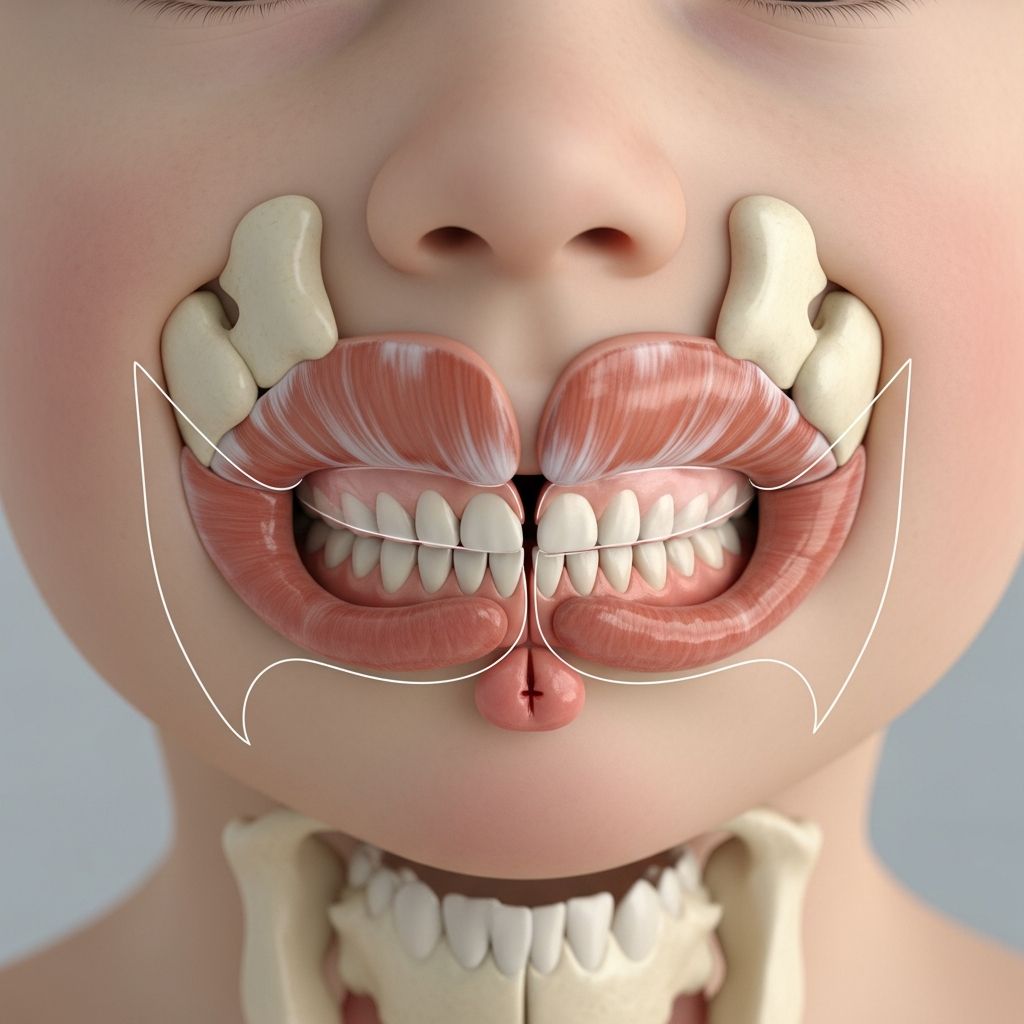
Submucous cleft palate is a less visible type of cleft palate that can affect a child’s feeding, speech, and ears, even when the roof of the mouth looks normal at first glance. Because it is often hidden under the lining of the mouth, it may be missed in newborn checks and only discovered later when problems appear.
What Is a Submucous Cleft Palate?
The palate is the roof of the mouth and has two parts:
- Hard palate – the front, bony part behind the upper teeth.
- Soft palate – the back, muscular part that moves when we swallow and speak.
In a typical cleft palate, there is a visible opening in the roof of the mouth. In a submucous cleft palate (SMCP), the opening or separation is in the muscle underneath the surface tissue (the mucous membrane), so the surface can look intact.
Because the muscles do not join as they should, the soft palate may not move effectively to close off the nose from the mouth during speech and swallowing. This can lead to:
- Speech that sounds overly nasal.
- Food or liquids leaking into the nose.
- Frequent middle-ear problems and ear infections.
How Common Is Submucous Cleft Palate?
Submucous cleft palate is less common than typical cleft lip or cleft palate. Estimates suggest it affects roughly 1 in 1,000–1,200 children, but it is likely underdiagnosed because it is harder to see.
Some children with SMCP never have noticeable problems, while others experience significant speech or feeding issues and need treatment.
Causes and Risk Factors
Submucous cleft palate develops early in pregnancy, when the tissues of the palate are forming. For reasons that are not fully understood, the muscles do not join in the usual way. This is a form of congenital (present at birth) difference.
Genetic and Environmental Factors
Research indicates that there is no single cause of SMCP. Instead, a mix of genetic and environmental influences is thought to be involved:
- Genetic factors – SMCP can run in families and shares similar hereditary risks with more obvious cleft palate types.
- Syndromes – SMCP can be one feature of a broader genetic condition. One of the more commonly associated syndromes is 22q11.2 deletion syndrome (also called velocardiofacial or DiGeorge syndrome).
- Environmental influences – as with other clefts, factors such as certain medications, illnesses, or exposures during pregnancy may contribute, although the specific causes are often unknown.
In many families there is no clear reason why a child develops SMCP, and parents should not blame themselves.
Key Signs Parents and Clinicians May Notice
Because the surface of the palate may look normal, signs can be subtle. Some children are identified in infancy, while others are not diagnosed until preschool or school age when they develop speech difficulties.
Visible and Physical Features
Common physical findings of submucous cleft palate include:
- Bifid uvula – a uvula that appears split or double instead of a single, teardrop-shaped piece of tissue.
- Translucent line in the middle of the soft palate – a bluish or see-through strip along the midline, sometimes called a zona pellucida.
- Notch at the back of the hard palate – a small dip or gap that may be felt by a specialist pressing gently on the roof of the mouth.
Feeding and Swallowing Clues
In babies, feeding issues can be one of the first signs:
- Milk or formula coming out of the nose during feeds (nasal regurgitation).
- Long feeding times or tiring easily during feeds.
- Difficulty creating good suction at the breast or bottle.
- Poor weight gain in some cases.
Ear and Hearing Problems
The soft palate helps control the Eustachian tubes, which equalize pressure and allow fluid to drain from the middle ear. When the palate muscles do not work well, children are at higher risk for:
- Frequent or chronic ear infections.
- Fluid behind the eardrum (ear effusions).
- Possible conductive hearing loss if infections and fluid are ongoing.
Speech and Resonance Symptoms
Many children with SMCP first come to attention because of speech concerns. Typical symptoms include:
- Hypernasal speech – speech sounds “too nasal,” with extra air and sound coming through the nose.
- Air escaping through the nose during talking, sometimes audible as a puff or rumble.
- Weak or imprecise production of certain consonants.
- Substituting nasal sounds (like /m/ and /n/) for oral sounds (like /b/, /p/, /d/).
- Speech that can be hard for others to understand.
How Submucous Cleft Palate Is Diagnosed
If a pediatrician, dentist, or parent suspects a problem, a child is usually referred to a cleft or craniofacial team or an ear, nose and throat (ENT) specialist with expertise in palate disorders.
Specialists Involved
- Cleft/craniofacial surgeon – evaluates the palate anatomy and decides if surgery is needed.
- Speech-language pathologist (SLP) – assesses speech, resonance, and feeding.
- ENT doctor (otolaryngologist) – evaluates ears, nose, and throat.
- Audiologist – checks hearing.
- Geneticist – may assess for associated syndromes.
Diagnostic Tools and Tests
Diagnosis usually involves a combination of:
- Detailed medical and family history – including feeding, ear infections, and speech development.
- Oral examination – to look for a bifid uvula, midline translucency, or a notch in the hard palate.
- Nasendoscopy – a small flexible camera passed gently through the nose to view how the soft palate moves during speech.
- Videofluoroscopy – a moving X-ray study that can show how the palate and throat work together when a child speaks or swallows (used in some centers).
- Hearing tests – to identify any hearing loss related to middle-ear problems.
Possible Complications if Untreated
Not all children with SMCP need surgery or intensive treatment. However, when the palate muscles are weak or misaligned, problems can persist or worsen without appropriate care.
| Area | Potential Issue | Possible Consequences |
|---|---|---|
| Speech | Hypernasality, articulation errors | Reduced intelligibility, frustration, social difficulties |
| Feeding | Nasal regurgitation, inefficient sucking | Slow weight gain, long feeding times, parental stress |
| Ears & Hearing | Recurrent ear infections, fluid buildup | Temporary hearing loss, risk for speech-language delay |
| Psychosocial | Noticeable speech or nasal regurgitation | Self-consciousness, teasing, reduced participation |
Treatment Options
Treatment is highly individualized. Some children need only monitoring and speech therapy; others benefit from surgery to improve the function of the soft palate.
When Is Surgery Considered?
Surgery is generally recommended when there is clear evidence that the palate cannot close properly against the back of the throat, a condition known as velopharyngeal dysfunction (VPD).
Reasons a team may suggest surgery include:
- Persistent hypernasal speech not improving with therapy alone.
- Significant nasal air escape during speaking.
- Combined speech and feeding issues believed to be related to the palate.
Types of Surgical Procedures
The exact procedure depends on the child’s anatomy and the surgeon’s assessment. Common surgical goals are to:
- Reposition or reconnect the soft palate muscles so they work more effectively.
- Improve closure between the soft palate and the back of the throat during speech.
These operations are usually done by a cleft or craniofacial surgeon experienced in palate repair. Children typically stay in the hospital for a short period and then continue recovery at home, following the team’s feeding and activity guidelines.
Speech-Language Therapy
Speech therapy is a key part of treatment, whether or not surgery is needed.
An SLP may:
- Assess which sounds are difficult and how nasal the child’s speech is.
- Teach correct placement and production of sounds.
- Help reduce learned or compensatory patterns children may develop to cope with an inadequate palate.
- Work with the family on home practice strategies.
Speech therapy often continues before and after any surgery to give the child the best chance of clear, understandable speech.
Managing Ear and Hearing Concerns
Because children with SMCP are at higher risk for middle-ear fluid and infections, regular monitoring is important.
- Hearing tests may be done at intervals to ensure the child is hearing well enough for normal speech and language development.
- Ear tubes (grommets) may be recommended by an ENT specialist if fluid or infections are frequent.
- Parents should report any signs of hearing difficulty, such as turning up the volume or not responding to sounds.
Feeding Support for Babies
Babies with SMCP often benefit from early support to make feeding safer and more efficient.
Health professionals may:
- Suggest different bottle nipples or feeding systems that require less suction.
- Recommend specific feeding positions that reduce nasal regurgitation.
- Monitor growth and weight gain closely.
- Involve a feeding specialist or speech-language pathologist with feeding expertise if needed.
Living With Submucous Cleft Palate
With appropriate care and follow-up, many children with submucous cleft palate go on to have normal or near-normal speech, good hearing, and typical growth.
How Parents Can Help
- Keep regular appointments with the cleft team, ENT, and SLP.
- Practice home exercises recommended by the speech therapist.
- Watch for changes in speech, hearing, or feeding and share concerns early.
- Support your child emotionally by reassuring them and working with school staff if speech-related teasing or misunderstanding occurs.
Questions to Ask Your Child’s Care Team
- Does my child definitely have a submucous cleft palate, or is it only suspected?
- Is there evidence of velopharyngeal dysfunction (VPD)?
- What are the goals of treatment in my child’s case?
- Is surgery recommended now, or should we watch and wait?
- How often should my child’s hearing be checked?
- What can we do at home to support speech progress?
Frequently Asked Questions (FAQs)
Can a child have submucous cleft palate with no symptoms?
Yes. Some children have SMCP but normal speech, feeding, and ears. In these cases, it may only be found incidentally during a medical or dental exam, and no treatment may be necessary.
Will my child definitely need surgery?
Not always. Surgery is typically recommended when there is clear velopharyngeal dysfunction causing persistent hypernasal speech or other significant problems. If your child’s speech and feeding are normal, the team may simply monitor over time.
Is submucous cleft palate the same as a regular cleft palate?
Both are types of cleft palate, but in SMCP the split is hidden under the mucous membrane rather than visible on the surface. The functional problems (especially with speech and ears) can be similar, which is why assessment by a cleft team is important.
Can speech therapy alone fix hypernasal speech from SMCP?
If the problem is mainly structural (the palate physically cannot close well), speech therapy alone usually cannot fully correct hypernasality. In those cases, surgery plus therapy offers the best results. When errors are mostly learned behavior, therapy alone may be enough.
Should my other children be checked for SMCP?
Because clefts can have a genetic component, it is reasonable to mention any family history to your pediatrician or genetic counselor. Siblings with speech, feeding, or ear problems should be examined closely, but routine invasive testing is not always required.
References
- Submucous Cleft Palate — American Cleft Palate-Craniofacial Association. 2020-01-01. https://acpacares.org/wp-content/uploads/2023/01/ACPA_booklet_Submucous.pdf
- Submucous Cleft Palate: Symptoms, Diagnosis and Treatment Options — Nationwide Children’s Hospital. 2023-05-01. https://www.nationwidechildrens.org/conditions/submucous-cleft-palate
- Submucous Cleft Palate — MPENTA. 2022-06-01. https://mpenta.org/learning-center/common-problems/submucous-cleft-palate/
- Cleft Lip and Cleft Palate – Symptoms and Causes — Mayo Clinic. 2024-02-09. https://www.mayoclinic.org/diseases-conditions/cleft-palate/symptoms-causes/syc-20370985
- Advice for Parents / Guardians of Children with an Unrepaired Submucous Cleft Palate (SMCP) — Cambridge University Hospitals NHS Foundation Trust. 2021-09-01. https://www.cuh.nhs.uk/patient-information/advice-for-parents-guardians-of-children-with-an-unrepaired-submucous-cleft-palate-smcp/
- Speech – Submucous Cleft Palate — Cincinnati Children’s Hospital Medical Center. 2020-01-01. https://www.cincinnatichildrens.org/-/media/Cincinnati-Childrens/Home/service/s/speech/hcp/doctor-info/information-resonance-PDF-submucous-cleft-3.pdf
- Submucous Cleft Palate — Sheffield Children’s NHS Foundation Trust. 2023-03-01. https://library.sheffieldchildrens.nhs.uk/wp-content/uploads/2023/03/Submucous-Cleft-Palate.pdf