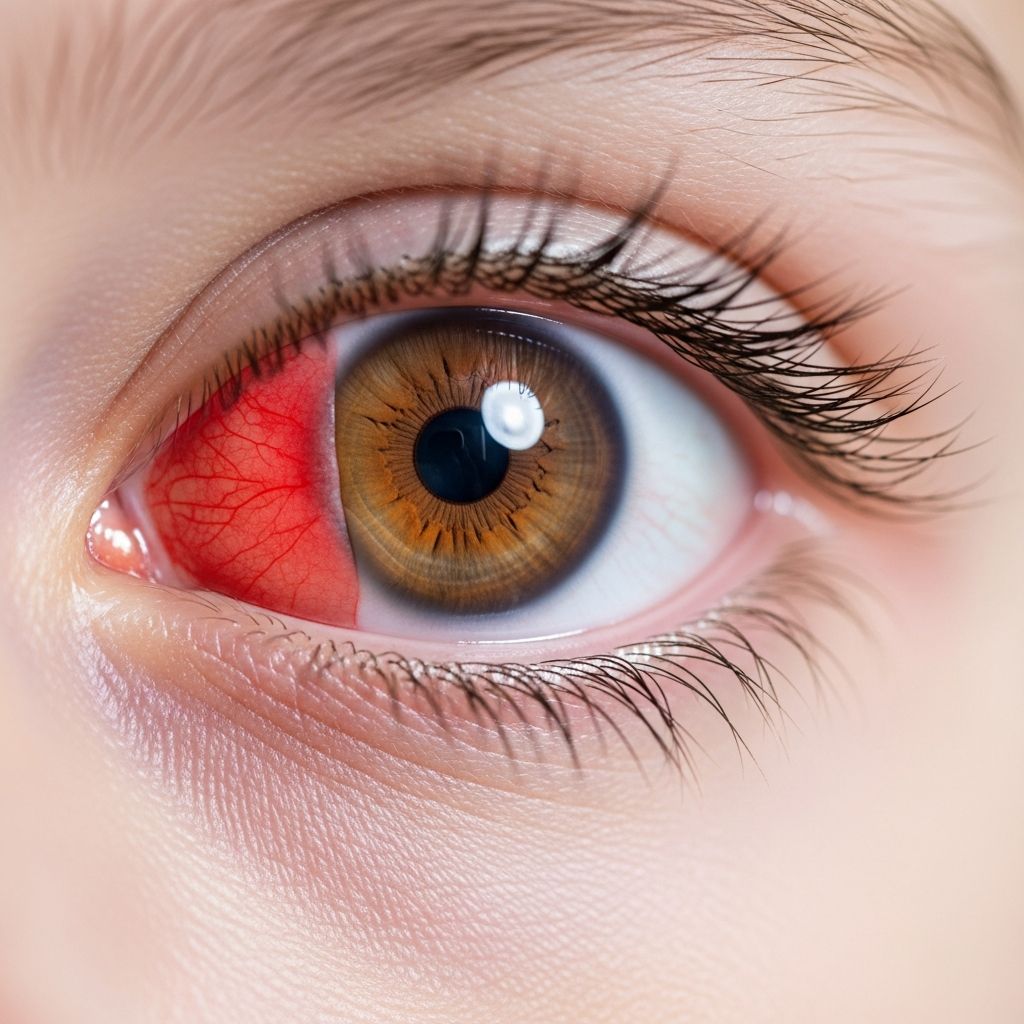
Seeing a bright red patch on the white of your child’s eye can be alarming, but it often looks far worse than it really is. In many cases, this red area is a subconjunctival hemorrhage, a small, self-limited bleed on the surface of the eye that usually clears on its own without treatment.
This guide explains, in parent-friendly language, what subconjunctival hemorrhage is, why it happens, how to recognize it, and when it is important to call your child’s doctor or eye specialist.
Understanding the Eye: A Quick Overview
To make sense of a subconjunctival hemorrhage, it helps to briefly review the basic parts of the eye involved in this condition.
- Sclera: The tough, white outer layer of the eyeball that you can easily see when someone looks to the side.
- Conjunctiva: A thin, transparent layer of tissue that covers the sclera and lines the inside of the eyelids, helping protect and lubricate the eye.
- Tiny blood vessels: Numerous delicate vessels run through the conjunctiva; if one of these breaks, blood can leak out and spread over the white part of the eye.
A subconjunctival hemorrhage occurs when one of these small surface blood vessels breaks and bleeds under the conjunctiva, creating a sharply outlined red patch on the white of the eye.
What Is a Subconjunctival Hemorrhage?
A subconjunctival hemorrhage is essentially an eye “bruise” on the surface of the eyeball. Instead of appearing under the skin like a typical bruise, the blood collects between the sclera and the conjunctiva, where it is clearly visible.
The key features of a subconjunctival hemorrhage are:
- A bright red, maroon, or dark patch on the white part of the eye.
- Usually no change in vision (your child can still see normally).
- Typically no pain, or only a mild scratchy or “something in the eye” feeling.
Because the conjunctiva is transparent and the blood is trapped underneath it, the red color cannot be wiped away or washed out with tears or water. The blood remains in place until the body gradually absorbs it.
How Does It Look and Feel?
Parents often discover a subconjunctival hemorrhage by surprise when looking at their child or after the child looks in the mirror. The appearance can be dramatic, but the child usually feels fine.
Typical appearance
- A well-defined red patch on the white of one eye (less commonly both).
- The color may start as bright red and then gradually shift to a darker red, brownish, or yellowish shade as it heals.
- The spot can be small, like a dot, or large enough to cover most of the visible white part of the eye.
Typical sensations
- No significant pain; your child may not notice anything at all.
- Possible mild irritation, dryness, or a feeling that something is in the eye.
- No thick discharge, no crusting, and usually no sensitivity to light.
If your child complains of strong pain, blurry vision, or cannot open the eye comfortably, this is not typical for a simple subconjunctival hemorrhage and needs prompt medical attention.
Common Triggers and Causes in Children
In many children, a subconjunctival hemorrhage appears without a clear cause. However, several everyday events can increase pressure in the tiny blood vessels and make them more likely to break.
Straining and pressure changes
Sudden increases in pressure in the small veins of the head and neck can cause a vessel in the eye to rupture. Examples include:
- Forceful coughing from a cold or respiratory infection.
- Hard sneezing, especially in allergy or flu season.
- Vomiting or retching from a stomach bug.
- Straining during a bowel movement (for example, with constipation).
- Lifting something heavy or intense crying in infants and toddlers.
Minor trauma or rubbing
Even a seemingly small bump to the eye area can be enough to damage a fragile surface vessel. Possible triggers include:
- Accidentally poking the eye while playing.
- Being hit by a toy, ball, or elbow.
- Vigorous or frequent eye rubbing due to itchiness or irritation.
- Contact lens use in older children and teens, especially if lenses are dry or poorly fitted.
Underlying medical factors
Less often, a child with repeated or widespread subconjunctival hemorrhages may have a medical condition that affects blood vessels or clotting. Possible contributors can include:
- Blood clotting problems or platelet disorders.
- Use of medications that thin the blood (for example, some chronic treatment plans).
- High blood pressure or systemic illnesses (more common in adults, but occasionally relevant in older teens).
- Severe infections or inflammatory conditions that involve the eyes.
If your child has other bruises, nosebleeds, or a known clotting disorder, any new subconjunctival hemorrhage should be discussed with the child’s doctor.
How Is It Different from “Pink Eye”?
Parents often worry that a red eye means an infection such as conjunctivitis (“pink eye”). While both conditions affect the outer surface of the eye, there are clear differences.
| Feature | Subconjunctival Hemorrhage | Pink Eye (Conjunctivitis) |
|---|---|---|
| Appearance | Solid, sharply outlined red patch on the white of the eye | Generalized pink or red tint across the white of the eye |
| Discomfort | Usually no pain; mild irritation at most | Often burning, gritty, or itchy feeling |
| Discharge | Typically none | May have watery, sticky, or pus-like discharge and crusting |
| Infectious? | Not contagious | Often contagious (especially viral or bacterial forms) |
| Vision changes | Vision usually normal | May be slightly blurry from discharge or irritation |
A clearly demarcated red “splotch” with no discharge and no discomfort strongly suggests a subconjunctival hemorrhage rather than an eye infection.
How Doctors Diagnose Subconjunctival Hemorrhage
In most children, diagnosis is straightforward and based on appearance alone. A pediatrician or eye doctor may:
- Look closely at the eye with a light and magnifier to confirm that the blood is on the surface and not inside the eye.
- Check the cornea (the clear front window) to be sure there are no scratches or deeper injuries.
- Ask about recent coughing, vomiting, injury, or rubbing, and about any bleeding problems in the family.
If the hemorrhage is related to a more serious trauma, recurs frequently, or is accompanied by other bleeding or concerning symptoms, additional tests may be ordered, such as blood pressure checks or blood work to evaluate clotting.
How Long Does It Last?
Although the first sight of the red patch can be shocking, subconjunctival hemorrhages usually heal on their own over time. The body gradually breaks down and reabsorbs the trapped blood, similar to how a bruise fades on the skin.
- Smaller patches may start to fade within several days.
- Larger areas can take up to two to three weeks, and occasionally a bit longer.
- As the hemorrhage heals, the color may change from bright red to darker red, then yellowish or greenish before completely disappearing.
It is normal for the red area to seem to spread slightly in the first day or two as the blood thins and moves under the conjunctiva, even though no new bleeding is occurring.
Home Care and Comfort Measures
Most children with a subconjunctival hemorrhage do not need prescription medication. However, parents can take simple steps to keep the child comfortable and protect the eye as it heals.
What you can do at home
- Use artificial tears: Over-the-counter lubricating eye drops (not redness removers) can ease mild irritation or dryness if your child is old enough to tolerate drops.
- Cool compresses: A clean, cool, damp washcloth placed gently over the closed eye may provide soothing relief, especially if the eye feels irritated.
- Encourage gentle blinking: Normal blinking helps spread tears and wash away tiny irritants.
- Monitor, don’t poke: Observe the area daily in good light, but avoid pressing on the eye or lifting the eyelids aggressively.
What to avoid
- Do not allow your child to rub or scratch the eye.
- Avoid using leftover prescription eye drops or any medicated drops not recommended by your child’s doctor.
- If your child wears contact lenses, follow your eye doctor’s advice, which often includes switching to glasses until the eye fully clears.
- Discourage rough play or sports that could lead to another eye injury while the eye is healing.
Simple reassurance is also important. Children may feel self-conscious about how their eye looks. Explaining that the eye is not permanently damaged and that the red color will fade can reduce anxiety.
When to Call the Doctor Right Away
Although subconjunctival hemorrhage is usually harmless, certain signs suggest that a child should be evaluated promptly by a health professional.
Urgent warning signs
- Eye injury from a hard blow, sharp object, or high-speed impact.
- Significant eye pain, a feeling of pressure, or the child refusing to open the eye.
- Sudden changes in vision, such as blurred vision, double vision, or dark spots.
- Blood covering or crossing over the colored part of the eye (iris) or pupil.
- Recurrent subconjunctival hemorrhages or frequent unexplained bruising or nosebleeds.
- Signs of infection: thick yellow or green discharge, fever, or swelling of the eyelids.
If any of these symptoms are present, call your child’s pediatrician, urgent care, or eye specialist for immediate guidance. In the case of a serious eye injury or severe pain, emergency evaluation may be necessary.
Possible Medical Treatments
Because subconjunctival hemorrhages typically resolve on their own, most children will not require specific medical treatment for the eye itself. However, a doctor might address contributing factors or provide supportive care.
- Lubricating eye drops: Recommended if dryness or irritation is bothersome.
- Treating underlying conditions: Managing allergies, infections, constipation, or chronic coughing can help reduce future episodes.
- Medication review: For children on long-term medications that affect clotting, the prescribing physician may review doses or alternatives if eye bleeding recurs.
In rare cases where a subconjunctival hemorrhage is linked to a serious underlying disease, treatment focuses on that condition rather than on the eye surface itself.
Prevention Tips for Parents
Not every subconjunctival hemorrhage can be prevented, especially when they arise spontaneously. Still, a few simple habits may reduce the risk, particularly for children who have had them more than once.
- Teach children to avoid rubbing their eyes, especially with dirty or rough hands.
- Use protective eyewear during sports where the eye may be struck by balls, equipment, or elbows.
- Encourage regular handwashing and allergy management to reduce itchy eyes.
- Address constipation early with diet, fluids, and pediatric guidance to limit straining on the toilet.
- Ensure contact lenses are fitted and worn as directed, and that teens understand proper lens hygiene.
For children with known blood or clotting disorders, following the care plan provided by their specialist is the most important preventive step.
Supporting Your Child Emotionally
The dramatic look of a subconjunctival hemorrhage can feel embarrassing or scary for a child, even when there is no pain. Parents can play a big role in helping them cope.
- Reassure your child that the eye is not permanently damaged and that the red color will fade.
- Explain in simple language that a tiny blood vessel broke on the surface, similar to a small bruise.
- Let teachers or caregivers know what is going on so they can respond with understanding rather than alarm.
- Normalize the appearance by focusing on everyday activities they can still enjoy safely.
For older children and teens, acknowledging any self-consciousness and offering practical solutions—such as glasses, hats, or strategic seating in photographs—may help them feel more in control.
Key Takeaways for Busy Parents
- A subconjunctival hemorrhage is a small bleed on the surface of the eye that usually looks worse than it feels.
- Most children have no pain and no change in vision, and the red patch clears on its own within one to three weeks.
- Home care usually focuses on comfort—lubricating drops, cool compresses, and avoiding eye rubbing.
- Call a doctor promptly if there is eye pain, vision changes, major trauma, discharge, fever, or repeated eye bleeding.
- Simple preventive steps—eye protection, less rubbing, and treating underlying issues—may reduce the chance of future episodes.
Frequently Asked Questions (FAQs)
1. Is a subconjunctival hemorrhage dangerous for my child’s eyesight?
In typical cases, a subconjunctival hemorrhage does not harm eyesight. The bleeding is on the surface of the eye, not inside it, and does not affect the clear cornea or deeper structures needed for vision. As long as your child sees normally and has no pain, permanent damage is very unlikely.
2. Should my child stay home from school?
Most children with a subconjunctival hemorrhage can safely attend school and participate in regular activities. The condition is not contagious, and classmates cannot “catch” it. Your child may need to avoid rough sports or games if instructed by your doctor, especially if the hemorrhage resulted from an injury.
3. Can I use over-the-counter “redness relief” eye drops?
Redness-relieving drops do not remove the trapped blood and are usually not necessary. Lubricating artificial tears are a better option if the eye feels dry or irritated. Always read labels carefully and ask your child’s doctor or pharmacist if you are unsure which product is appropriate.
4. How do I know if the red patch is getting better?
Over days to weeks, the size of the red area typically shrinks, and the color gradually changes—first darkening, then turning yellow or greenish, and finally fading away. Taking a daily photo in similar lighting can help you see progress more clearly.
5. My child has had several subconjunctival hemorrhages. Should I be worried?
Repeated episodes deserve a discussion with your child’s pediatrician or an eye specialist. Although many children with recurring subconjunctival hemorrhages are still healthy, doctors may want to check for blood pressure problems, clotting issues, or other conditions that could make blood vessels more fragile.
6. Can babies and toddlers get subconjunctival hemorrhages?
Yes. Infants and toddlers can develop these hemorrhages, often related to crying, coughing, or minor bumps. Any eye redness in a very young child should be evaluated by a pediatrician, especially if there is swelling, injury, or concern about possible abuse or significant trauma.
7. Will it come back once it heals?
Most children have only a single episode. However, because the condition can be triggered by common events like coughing or rubbing, another hemorrhage can occur in the future. Preventive steps and regular medical follow-up, when indicated, help minimize this risk.