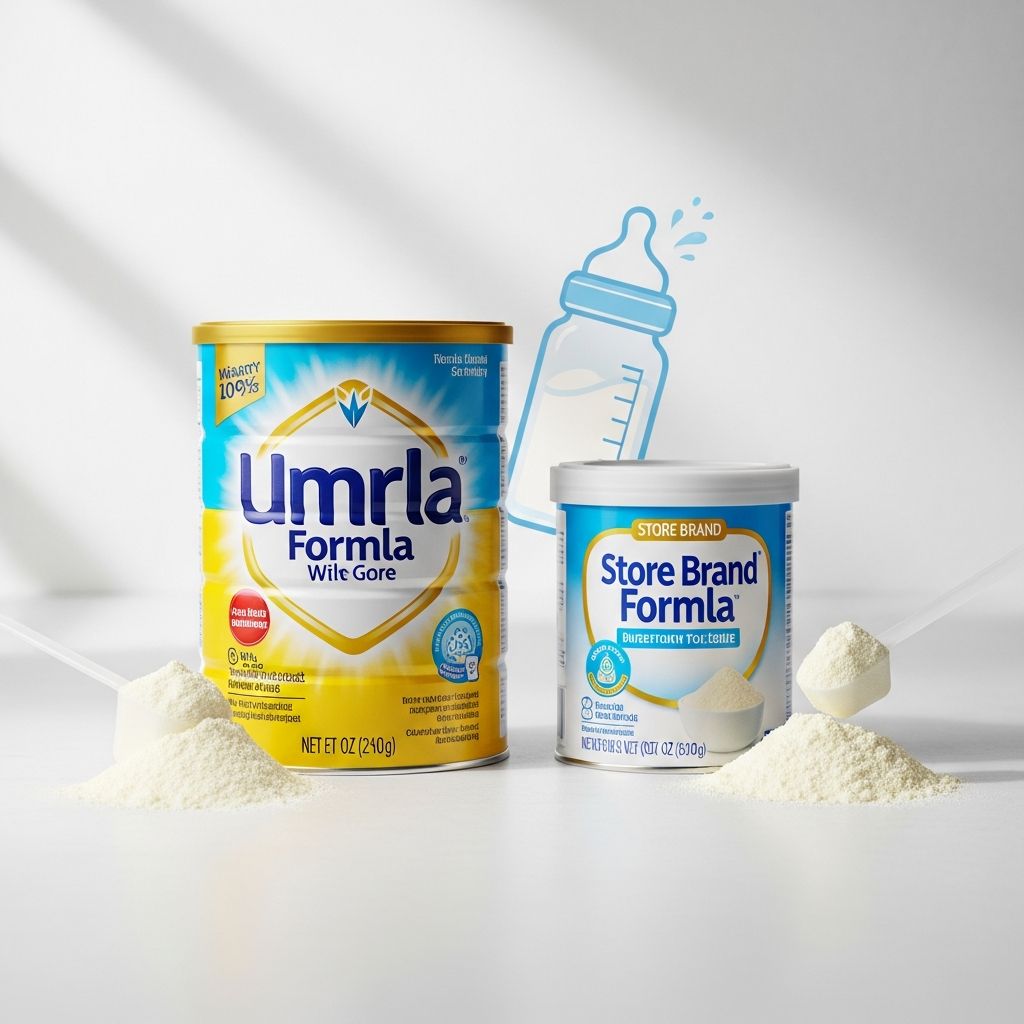
Parents often assume that expensive, heavily advertised infant formulas must be superior to the lower-priced store brands sitting on the same shelf. In reality, all infant formulas sold in the United States must meet the same federal nutrition and safety standards, whether they are national name brands or generic store labels.[web:3] This guide explains what those regulations require, how ingredients compare, why prices differ so much, and how to make a confident choice for your baby.
How Infant Formula Is Regulated
In the U.S., infant formula is regulated by the Food and Drug Administration (FDA) under specific laws that set minimum and some maximum levels for key nutrients such as protein, fat, carbohydrate, vitamins, and minerals.[web:3] Manufacturers must ensure their products meet these nutrient specifications over the entire shelf life of the formula, not just on the day it leaves the factory.[web:3]
Before a new infant formula is marketed, a manufacturer must register with the FDA and submit detailed information about nutrient content, manufacturing processes, and quality-control testing.[web:3] If a company makes a major change in formulation or processing, it must notify the agency again and provide updated data demonstrating the formula still meets all safety and nutrition requirements.[web:3]
What \”House Brand\” or Store-Brand Formula Means
Store-brand or \”house brand\” infant formulas are products that carry the name of a retailer such as Walmart, Target, Costco, or a grocery or pharmacy chain rather than a national formula brand.[web:1] Many of these store labels are actually manufactured by a small number of large contract manufacturers that specialize in infant nutrition, rather than by the retailers themselves.[web:1]
For example, a single major manufacturer supplies store-brand infant formula for dozens of U.S. retailers, using similar formulations that are then labeled with each store’s brand name.[web:1] Regardless of label, these formulas must still comply with exactly the same FDA nutrient and safety regulations as well-known national brands.[web:3]
Are Store-Brand Formulas as Nutritious as Name Brands?
All infant formulas sold in the U.S., including generic and store brands, must meet the same nutrient specifications listed in FDA regulations.[web:3] This means that, at a minimum, every infant formula on the shelf provides the required amounts of protein, essential fats, carbohydrates, and key vitamins and minerals needed to support normal growth and development.[web:3]
Manufacturers are allowed to develop proprietary formulations, so the exact amounts or sources of some nutrients can vary from one brand to another as long as they stay within legal limits.[web:3] Because of this, labels may show small differences in ingredients or nutrient levels, but these variations do not indicate that one formula is inherently unsafe or nutritionally inadequate compared with another.[web:3]
Typical Nutrient Comparison
When comparing nutrition labels, parents often find that store-brand formulas look remarkably similar to their name-brand counterparts, especially for standard cow’s-milk-based formulas designed for healthy, full-term infants.[web:1] Many store-brand packages even include a statement such as \”Compare to\” followed by the name of a prominent national product, signaling that the formulation is intended to match that brand’s nutrient profile within regulatory limits.[web:1]
| Nutrient | Name-Brand Formula | Store-Brand Formula |
|---|---|---|
| Protein | About 2 grams (must meet FDA minimums).[web:3] | About 2 grams (meets same minimums).[web:3] |
| Fat | Typically 5–6 grams with similar blends of vegetable oils.[web:3] | Typically 5–6 grams, also using vegetable oil blends.[web:3] |
| Carbohydrate | About 10–11 grams, usually lactose as primary source.[web:3] | Comparable amount, often with lactose as main source.[web:3] |
| Key vitamins and minerals | Levels set at or above FDA minimums for iron, calcium, vitamin D, etc.[web:3] | Also at or above the same minimums by law.[web:3] |
This type of table reflects how closely formulas align on core macronutrients and micronutrients, even when packaging and marketing messages differ dramatically.[web:1][web:3]
Ingredient Lists and Extra Additives
Parents sometimes feel uneasy when they see unfamiliar ingredients on an infant formula label, especially in ready-to-feed or concentrated liquid products. These formulas may include stabilizers such as lecithin, carrageenan, or mono- and diglycerides to help keep fat evenly distributed and prevent separation during storage.[web:3] These additives are permitted and are used by both name-brand and store-brand manufacturers to maintain consistent texture and quality.[web:3]
Many formulas also add specialized ingredients such as DHA, ARA, prebiotics, or probiotics, which are marketed as supporting brain and eye development or digestive health.[web:2] The presence or absence of these add-ons can explain slight ingredient differences between brands, but does not change the fact that all products must still meet baseline nutrient standards set in regulation.[web:3]
Why Name Brands Cost More
The most obvious difference between name-brand and store-brand infant formula is price. Store-brand formulas typically cost significantly less per ounce than national brands, with some estimates showing savings of up to hundreds of dollars per year when families consistently choose generics.[web:1][web:2] The lower price does not come from cutting corners on core nutrients, which are legally regulated, but instead from differences in marketing and brand strategy.[web:1]
National brands often invest heavily in advertising, samples, hospital marketing, loyalty programs, and sponsorships, and those costs are reflected in the retail price.[web:2] Store-brand formulas spend far less on consumer advertising and instead compete primarily on value, passing much of the savings on to families through lower shelf prices.[web:1]
Who Manufactures Store-Brand Formula?
In the U.S., a small number of companies manufacture the majority of infant formulas, including products sold under retailer labels.[web:1] One large manufacturer, for example, supplies formulas to numerous major retailers, producing a variety of cow’s milk, gentle, sensitive, soy, and hypoallergenic formulas that are then sold with different store-brand names.[web:1]
These manufacturing plants use milk and other ingredients sourced from leading dairies and must comply with the same inspection and quality-control requirements that apply to national brands.[web:1][web:3] As a result, two different retailers may sell very similar formulas in different packaging even though the underlying product came from the same facility.[web:1]
Types of Formulas Available in Both Categories
Most feeding needs that can be met by a name-brand formula can also be met by a comparable store-brand product. Retailer labels commonly offer standard cow’s-milk formulas, reduced-lactose or \”gentle\” products, soy-based formulas, and specialized options marketed for sensitivity or tolerance.[web:1] The packaging often includes a clear reference to the national brand it is designed to resemble, making it easier for parents to identify equivalents.[web:1]
- Standard cow’s-milk-based formulas for healthy, full-term infants.[web:3]
- Gentle or sensitive formulas with partially broken-down proteins or reduced lactose.[web:1]
- Soy-based formulas for families avoiding cow’s milk protein.[web:1][web:3]
- Hypoallergenic or extensively hydrolyzed formulas for certain medical needs, often only in national brands and prescribed under medical supervision.[web:3]
Choosing Between Name Brand and Store Brand
For most healthy, full-term infants without specific medical conditions, either a name-brand or store-brand standard formula that meets FDA requirements can be an appropriate choice.[web:3] Pediatric guidance usually emphasizes choosing a formula that supports steady growth, is tolerated well by the baby, and fits the family’s budget and preferences.[web:3]
- Check that the product is labeled as infant formula and is iron-fortified unless your pediatrician advises otherwise.[web:3]
- Compare the nutrition facts panel of your current formula to a potential store-brand alternative to ensure similar nutrient levels and type (for example, cow’s milk vs soy).[web:1]
- Introduce any new formula gradually and monitor your baby’s tolerance, stool patterns, and comfort.[web:3]
Common Myths About Store-Brand Formula
One persistent myth is that generic formulas are somehow \”weaker\” or less thoroughly tested than name-brand products. In reality, all infant formulas must meet the same nutrient specifications and are subject to the same regulatory oversight, regardless of branding.[web:3] Another misconception is that a lower price automatically signals inferior quality, but the cost difference is primarily attributable to marketing and branding strategies rather than lower safety or nutrition standards.[web:1][web:2]
Parents also sometimes worry that choosing a store brand may mean more frequent recalls or quality issues. All manufacturers, whether producing for major national brands or store labels, must follow strict good manufacturing practices and are required to report and act on any safety concerns under federal law.[web:3] Recalls, when they occur, can affect any brand and are typically handled in coordination with federal regulators.[web:3]
When a Specific Formula Is Necessary
Some infants have medical conditions or complex feeding needs that require specialized or therapeutic formulas, often prescribed and closely supervised by healthcare providers.[web:3] In those cases, the choice of formula may be more limited and heavily guided by the pediatrician or pediatric specialist, and a direct store-brand equivalent may not exist.[web:3]
Parents should always consult a healthcare professional before experimenting with specialized formulas marketed for conditions such as severe allergy, malabsorption, or metabolic disorders.[web:3] It is also important to avoid homemade formula recipes, which are not regulated and can lead to serious nutrient imbalances or contamination.[web:3]
Practical Tips for Comparing Formulas
Comparing formulas works best when done systematically, focusing on nutrition panels and product type rather than advertising claims. Many retailers and healthcare providers offer quick-reference guides showing which store-brand formulas are intended to correspond to specific national brands, helping families match products by features like protein type, lactose content, and additional ingredients such as DHA or prebiotics.[web:1][web:4][web:5]
- Identify the main type of your current formula (cow’s milk, gentle, soy, hypoallergenic) and look for the same category on store-brand shelves.[web:1]
- Compare iron content and ensure the alternative is similarly iron-fortified unless advised otherwise.[web:3]
- Check expiration dates and follow preparation, storage, and \”use by\” instructions carefully on any formula you choose.[web:3]
FAQs About Name-Brand vs Store-Brand Infant Formula
Do generic infant formulas differ nutritionally from name brands?
No, all infant formulas sold in the U.S. must meet the same nutrient specifications set in FDA regulations, whether they are national name brands or house-brand generics.[web:3] Brands can tweak formulations within those limits, but they cannot sell a formula that fails to meet minimum nutrient levels or exceeds allowed maximums where those exist.[web:3]
Is store-brand formula as safe as name-brand formula?
Yes. Safety standards, manufacturing practices, and inspection requirements apply to all formula manufacturers equally, regardless of branding.[web:3] Large contract manufacturers that make store-brand products must follow the same federal rules for quality control, contamination prevention, and testing that apply to well-known national brands.[web:1][web:3]
Why is store-brand formula so much cheaper?
Store-brand formulas typically spend less on advertising, promotions, and brand-building activities than national brands, which allows retailers to sell them at a lower price.[web:1][web:2] The savings primarily come from marketing and brand strategy rather than from reducing nutrient quality or skipping required safety steps.[web:1]
Can I switch from a name-brand formula to a store-brand formula?
Most healthy infants can switch from a name-brand to a comparable store-brand formula without problems, as long as the product type and main ingredients are similar.[web:1][web:3] It is sensible to discuss any change with your pediatrician and to watch your baby’s tolerance, digestion, and growth after switching.[web:3]
Should my baby take extra vitamins or minerals when using formula?
Generally, infants who consume enough iron-fortified formula to meet their energy needs do not require additional vitamin or mineral supplements unless a healthcare provider identifies a specific deficiency or risk.[web:3] Pediatricians may give individualized advice based on factors like prematurity, health conditions, or limited intake of formula.[web:3]
Is there a difference between buying store-brand formula from different retailers?
In many cases, different retailers’ store-brand formulas are made by the same manufacturer and share similar or identical compositions, although labels, names, and packaging may vary.[web:1] Parents should still read the nutrition facts panel and ingredient list to verify that a formula matches their baby’s needs, but quality standards do not depend on the specific store where it is purchased.[web:1][web:3]
Key Takeaways for Parents
- All infant formulas sold in the U.S. must satisfy the same federal nutrition and safety standards, whether they are name-brand or store-brand.[web:3]
- Store-brand formulas often closely match national products in nutrient content and ingredient profile but cost significantly less due to lower marketing expenses.[web:1][web:2]
- For most healthy, full-term infants, choosing a well-tolerated formula that fits the family budget and meets FDA requirements is more important than the brand name on the can.[web:3]