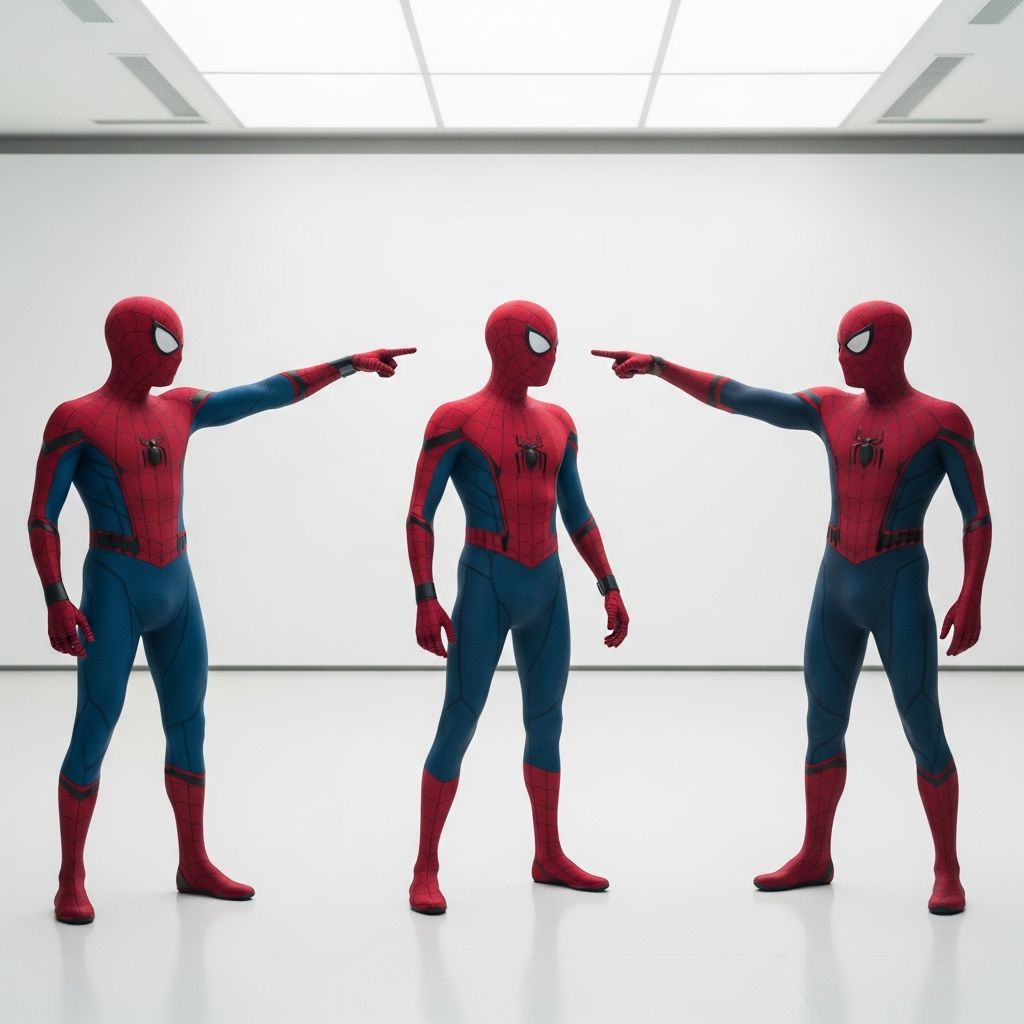
Long before screenshots and social media existed, a single frame from a 1960s Spider-Man cartoon quietly waited to become one of the internet’s most instantly recognizable jokes. Today, the image of two Spider-Men pointing at each other is everywhere: in political commentary, fan culture, brand marketing, and blockbuster superhero movies.
This article unpacks where that image came from, why it resonates so strongly, and how it transformed from a forgotten cartoon still into a visual shorthand for hypocrisy, similarity, and shared identity.
From Saturday Morning TV to Meme Template
The Spider-Man pointing meme is rooted in the first animated Spider-Man TV series, which ran from 1967 to 1970 and helped establish the character’s mainstream popularity beyond comic books.
The crucial episode: “Double Identity”
The frame used in the meme appears in a segment titled “Double Identity” from the 1967 cartoon’s first season.
In that story:
- An actor-turned-criminal named Charles Cameo uses his talent for imitation to carry out art heists.
- To avoid detection, he chooses his most dangerous disguise yet: impersonating Spider-Man himself.
- When the real Spider-Man confronts him, both end up facing each other in full costume, each insisting that the other is the fraud.
The moment when both masked figures extend an accusatory finger at one another created the now-famous visual: two Spider-Men, identical in costume and pose, locked in a comically confused standoff.
Why that single frame works so well
Even stripped of dialogue, the image communicates a complete idea:
- Duplicated identity – two characters who are supposed to be unique appear indistinguishable.
- Mutual accusation – each is blaming the other, highlighting denial or deflection.
- Simplicity – clear silhouettes, centered figures, and bold colors make it instantly readable at meme size.
Visually, it is the perfect setup for jokes about people or groups who are more alike than they want to admit.
How the Meme Emerged Online
The meme’s origin is mid-20th century television, but its rise belongs squarely to the age of social media and image macros.
Early circulation and first known edits
By the early 2010s, fans had begun mining older cartoon screenshots to create humorous image macros, often juxtaposing sincere superhero imagery with absurd or mundane captions. The pointing Spider-Men frame surfaced in this wave as part of collections of retro Spider-Man stills.
As it spread, the basic format solidified:
- The original shot of two Spider-Men pointing.
- A caption that identifies each Spider-Man with a label: two people, ideas, or institutions being compared.
- A punchline showing that the two sides are, functionally, the same.
Becoming shorthand for “you’re just like me”
Over time, the meme developed a recognizable set of meanings:
- Hypocrisy – calling out someone for behaviors they also exhibit themselves, similar to the idiom “the pot calling the kettle black.”
- Unexpected similarity – highlighting how rival brands, politicians, fandoms, or even music artists often mirror each other.
- Shared guilt – showing multiple parties complicit in the same problem.
- Mirror moments – poking fun at recognizing your own habits in someone else.
Because the concept is so broad, the format adapts easily to countless contexts, from silly fandom jokes to serious political commentary.
What the Meme Actually Means in Context
Although the image always looks similar, its message shifts depending on how creators label the two Spider-Men.
| Common Usage | Typical Labels | Implied Message |
|---|---|---|
| Hypocrisy | Two individuals or groups each accusing the other | “You criticize me for what you also do.” |
| Rivals who are similar | Competing products, sports teams, fandoms | “We pretend we’re different, but we’re nearly identical.” |
| Generational jokes | Parents and their kids, older vs. younger fans | “We repeat the same patterns even as we mock each other.” |
| Self-deprecation | “Me” vs. “Also me” or “Past me vs. present me” | “I’m calling myself out, really.” |
| Institutional critique | Governments, companies, or parties | “Different logos, same behavior.” |
Why audiences instantly “get it”
The meme relies on a type of visual metaphor. Cognitive research on metaphors and analogies shows that people process simple, familiar images quickly and can map them onto abstract concepts like fairness or similarity. The Spider-Man meme works because:
- Viewers already know that Spider-Man is supposed to be unique.
- Seeing two identical heroes side by side creates instant cognitive dissonance.
- The pointing gesture is globally recognizable as accusation or blame.
With only a few words of text, the image conveys a surprisingly layered idea about identity and denial.
From Niche Meme to Multiverse Cameo
Most memes never escape online culture. This one did. It grew so recognizable that official Marvel-related projects began referencing it directly, blurring the line between fan jokes and canon.
Animated Spider-Verse tributes
In Sony’s animated Spider-Verse films, the meme moves from screenshot to plot device.
- Spider-Man: Into the Spider-Verse (2018) includes a credits gag where Spider-Man 2099 encounters a retro, 1967-style Spider-Man. They end up pointing at each other, echoing the original TV frame as a self-aware joke for fans.
- Spider-Man: Across the Spider-Verse (2023) amplifies the idea: after an ambiguous order to “stop Spider-Man,” a vast crowd of Spider-people all turn and point at one another, transforming the meme into a chaotic, story-relevant set piece.
These scenes show the meme has become part of the character’s modern mythos, not just an external internet joke.
Live-action nods and promo images
The meme also crossed into live action with Spider-Man: No Way Home (2021), which brought together three cinematic versions of Peter Parker in a single film.
- Within the story, a lab scene features the three Peters confused over who is being addressed, recreating the pointing confusion—less literal than the cartoon’s image but clearly inspired by it.
- Promotional material later showed the three actors in costume directly mimicking the classic pointing pose, turning fan art into officially sanctioned iconography.
At this point, the meme’s logic has looped back on itself: canon references a meme that was originally extracted from canon, erasing the boundary between the two.
Why This Meme Endures While Others Fade
Many reaction images burn out in months. The Spider-Man pointing meme has persisted for over a decade, in part because it taps into themes that are constantly relevant.
Timeless social dynamics
The core ideas behind the meme are not era-specific:
- Hypocrisy and projection are recurring subjects in politics, workplaces, and personal relationships.
- Brand and identity mimicry appears across culture, from similar music trends to copycat tech products.
- Self-recognition—realizing we share traits with people we criticize—is a universally human experience.
Because these dynamics do not depend on a particular news cycle, the meme remains perpetually reusable.
Simple structure, infinite remixing
Memes that last often share structural traits: visual simplicity, easy captioning, and compatibility with new contexts. The Spider-Man template checks all three boxes. It can be:
- Re-captioned with text for specific communities or in-jokes.
- Redrawn with different characters wearing similar costumes.
- Expanded into multi-panel comics or animated sequences.
This flexibility mirrors how other durable memes, like the distracted boyfriend or Drake’s “Hotline Bling” panel, have been constantly reinterpreted rather than discarded.
How Brands and Institutions Use the Meme
As the pointing Spider-Men became widely recognizable, companies and public figures began to deploy it in marketing and communication.
The appeal for marketers
From a marketing perspective, using a popular meme offers several benefits when done carefully:
- Instant familiarity – audiences recognize the visual and understand the joke structure without explanation.
- Low text burden – a couple of well-chosen labels can deliver a brand message efficiently.
- Perceived relatability – joining a meme conversation signals awareness of online culture.
However, research on online communities suggests that perceived inauthenticity or opportunistic use of memes can trigger backlash, especially if the brand appears to misunderstand the meme’s tone or history.
Risks of overuse
The very simplicity that keeps the meme alive also makes it vulnerable to:
- Overexposure – excessive branded usage can make a meme feel forced or stale.
- Context collapse – jokes aimed at one audience may be misinterpreted by others when shared widely.
- Association with controversy – if the image gets used in polarizing political posts, later uses may carry unintended baggage.
For institutions, the safest uses tend to be light, self-aware references that acknowledge their own quirks instead of just mocking others.
What the Meme Reveals About Modern Fandom
The Spider-Man pointing meme is also a case study in how contemporary fans interact with fictional universes.
Fans as co-authors
In creating, sharing, and reframing the meme, fans effectively added a new layer to Spider-Man’s cultural meaning. Media studies scholars note that modern audiences increasingly act as producers of culture rather than mere consumers, remixing and reinterpreting official stories.
The meme encapsulates this trend:
- An obscure shot from a 1960s cartoon gains new life through fan creativity.
- That fan-created meaning becomes so influential that it shapes how later films depict the character.
- The official texts now rely on viewers recognizing a fan-originated visual joke.
Cross-generational recognition
Another reason the meme resonates is that it bridges age groups:
- Older viewers may remember the style of the 1960s cartoon or early reruns.
- Younger audiences meet the image first as a meme, then retroactively encounter it in Spider-Verse or clips from the original show.
- Fans of different Spider-Man eras—comics, cartoons, films, games—can all enjoy the same joke from their own angle.
This cross-generational familiarity reinforces Spider-Man’s status as a cultural touchstone and demonstrates how memes can serve as entry points into older media for new audiences.
Frequently Asked Questions (FAQs)
Q: What is the original source of the Spider-Man pointing meme?
A: The image comes from the 1967 animated Spider-Man series, in a story titled “Double Identity,” where a criminal impersonates Spider-Man and ends up pointing at the real hero as they accuse each other of being the imposter.
Q: When did the meme first become popular online?
A: The frame began circulating in online image collections in the early 2010s and gained broader traction as a reaction image and caption template around the mid-2010s, especially on social platforms that favored image macros.
Q: What does the Spider-Man pointing meme usually mean?
A: Most versions of the meme highlight hypocrisy, similarity, or shared guilt—situations where two people, groups, or ideas are almost identical despite accusing each other or insisting they are different.
Q: Which Spider-Man movies reference the meme?
A: The meme is explicitly acknowledged in Spider-Man: Into the Spider-Verse (2018) and Spider-Man: Across the Spider-Verse (2023) through animated recreations, and it is referenced in spirit and promotional imagery in the live-action film Spider-Man: No Way Home (2021).
Q: Why has this meme lasted so much longer than most?
A: Its endurance comes from a combination of a simple, instantly understandable visual; a broad theme—hypocrisy and similarity—that remains constantly relevant; and reinforcement by major films and official Spider-Man media, which keep reintroducing the image to new audiences.
References
- What Are The Origins of The Spider-Man Pointing Meme? — Game Rant. 2023-06-07. https://gamerant.com/spider-man-pointing-meme-origins/
- Spider-Man Meme in Across The Spider-Verse — Time Magazine. 2023-06-05. https://time.com/6284524/spider-man-meme-pointing-origins/
- The Origin Of The Spider-Man Pointing Meme — Screen Rant. 2023-06-08. https://screenrant.com/spider-man-pointing-meme-cartoon-origin/
- The History Of Spider-Man’s Pointing Meme Explained — Looper. 2023-06-07. https://www.looper.com/1307292/history-spidermans-pointing-meme-explained/
- Spider-Man Pointing at Spider-Man — Know Your Meme. 2017-08-03 (updated). https://knowyourmeme.com/memes/spider-man-pointing-at-spider-man