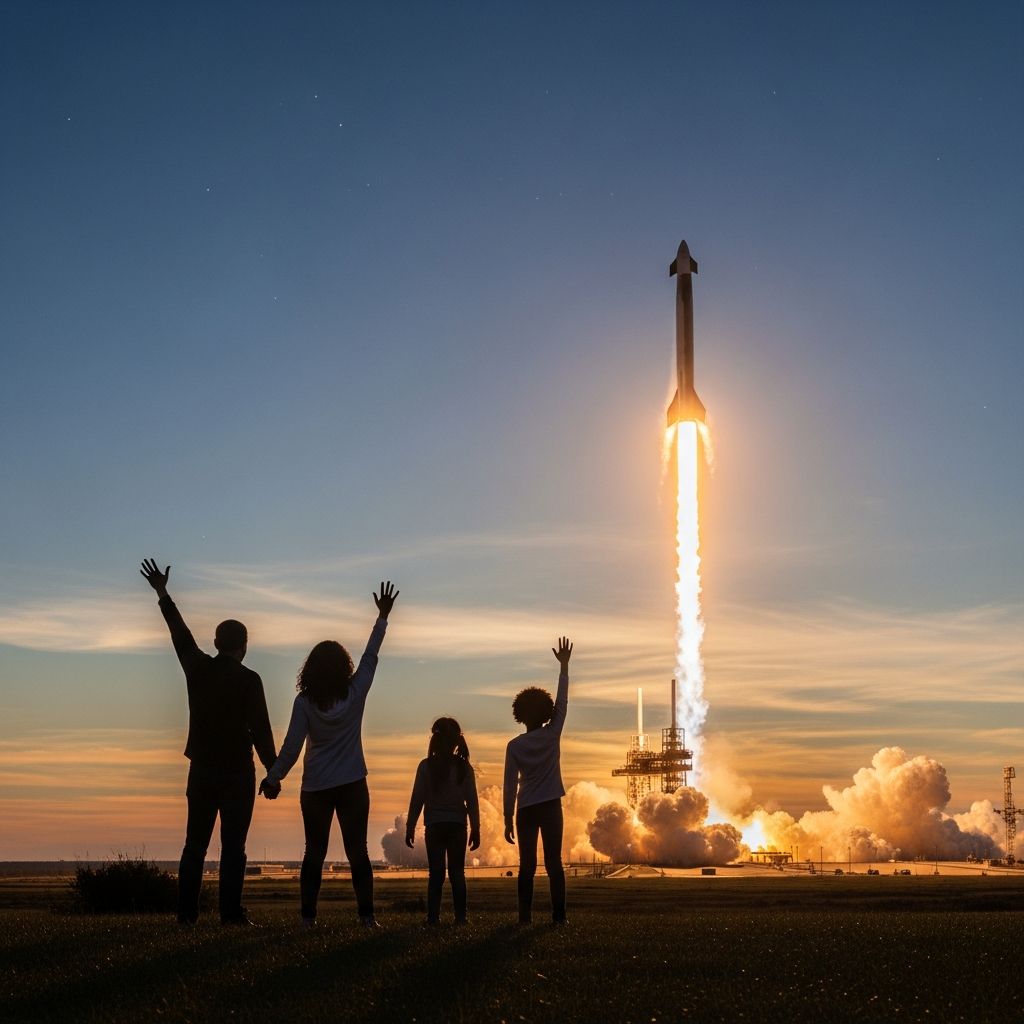
SpaceX achieved a monumental milestone with its Starship orbital test flight, captivating audiences worldwide and drawing emotional responses from Elon Musk’s own family. This launch from Starbase in South Texas marked a critical step toward reusable space travel, blending cutting-edge engineering with personal family pride.
The Dawn of Reusable Rocketry: Starship’s Orbital Ambitions
Starship represents SpaceX’s vision for fully reusable spacecraft capable of carrying humans to the Moon, Mars, and beyond. The April 20, 2023, test flight was the first attempt at orbital velocity, pushing the boundaries of rocket technology. Unlike traditional expendable rockets, Starship’s design allows both the Super Heavy booster and the upper stage to return and land, drastically reducing costs and enabling frequent launches.
During the flight, the Super Heavy booster executed a complex boostback burn, separating from the Starship upper stage before splashing down in the Gulf of Mexico. The Starship itself reached space, demonstrating hot-staging separation and attitude control with its Raptor engines. Though it disintegrated during reentry, the data gathered proved invaluable for future iterations.
Family at the Forefront: Maye and Kimbal Musk’s Live Reactions
In a heartfelt moment post-launch, Elon Musk’s mother, Maye Musk, and brother, Kimbal Musk, shared their unfiltered excitement. Maye, a renowned model and dietitian, expressed awe at the spectacle, noting the family’s long-standing support for Elon’s dreams. Kimbal, an entrepreneur in sustainable food, highlighted the emotional weight of watching the rocket soar, symbolizing years of relentless innovation.
Their reactions, captured in an on-site interview, underscored the human element behind SpaceX’s technical feats. Maye recalled early days of model rocketry in their garage, evolving into this historic event. Kimbal emphasized the launch’s role in inspiring global youth to pursue STEM careers.
Overcoming Cosmic Challenges: Launching Amid Solar Storms
SpaceX’s resilience shone in a Starlink mission on May 12, 2024, when a Falcon 9 rocketed 23 satellites into orbit from Cape Canaveral Space Force Station despite severe geomagnetic storms. Classified by NOAA as the most extreme since 2003, these storms stemmed from multiple coronal mass ejections, triggering auroras visible in Florida.
Elon Musk monitored the Starlink constellation closely via social media, ensuring no disruptions. The Falcon 9 lifted off at 8:53 p.m. EDT, with stage separation occurring flawlessly 2 minutes and 34 seconds later. The first-stage booster, on its 15th flight, landed precisely on the A Shortfall of Gravitas droneship, boosting the total Starlink satellites to 6,000 per orbital trackers.
Starlink’s Expanding Network: Connectivity from the Cosmos
Starlink satellites form a vast low-Earth orbit constellation providing high-speed internet to remote areas. Each launch adds capacity, with the May 2024 mission exemplifying SpaceX’s rapid deployment pace. These smallsats, weighing about 260 kg each, feature laser interlinks for efficient data relay.
- Global Reach: Serving over 3 million users across 100+ countries.
- Resilience: Designed to withstand space weather, as proven during the G4 geomagnetic storm.
- Future Growth: Plans for up to 42,000 satellites to blanket Earth with broadband.
This network supports disaster response, maritime operations, and aviation, transforming how the world stays connected.
Engineering Marvels: Falcon 9’s Reusability Record
The Falcon 9 booster’s 15th reuse highlights SpaceX’s maturation in rocketry. Previous missions included SES-22, HAKUTO-R, and multiple Starlink batches, proving reliability. Droneship landings minimize turnaround time, with some boosters flying back within weeks.
| Mission Highlights | Date | Payload |
|---|---|---|
| SES-22 | 2022 | Communications Satellite |
| HAKUTO-R Mission 1 | 2022 | Lunar Lander |
| Starlink Group 4-15 | 2024-05-12 | 23 Satellites |
This table illustrates the booster’s versatility across diverse payloads.
Broader Impacts: Crowds, Safety, and Public Fascination
Historic launches draw massive crowds, as seen in past Demo-2 events where NASA urged caution yet thousands gathered. Starship’s test flight similarly mesmerized viewers, with live streams amassing millions of views. Safety protocols, including road closures and no-fly zones, ensure public protection.
These events foster public engagement with space, much like Apollo missions, reigniting dreams of exploration.
Future Horizons: Mars Missions and Beyond
Starship paves the way for NASA’s Artemis program, aiming for lunar landings by 2026. SpaceX envisions Starship fleets colonizing Mars, with refueling depots in orbit. Starlink will provide essential comms for deep-space endeavors.
Challenges remain: perfecting reentry, scaling production, and regulatory approvals. Yet, each flight iterates progress.
Frequently Asked Questions (FAQs)
What was unique about the Starship orbital test flight?
The flight achieved orbital velocity for the first time, testing Super Heavy booster separation and Raptor engine performance in space.
How did solar storms affect the Starlink launch?
Despite G4-level storms, the launch succeeded flawlessly, with SpaceX monitoring impacts on the constellation.
Who are Maye and Kimbal Musk?
Maye is Elon’s mother and a professional model; Kimbal is his brother and founder of The Kitchen Restaurant Group.
How many times has the Falcon 9 booster flown?
This booster completed its 15th mission, landing successfully on a droneship.
What is Starlink’s total satellite count post-launch?
Approximately 6,000 satellites orbit Earth, enhancing global internet access.
Technical Breakdown: Key Innovations Driving Success
SpaceX’s Raptor engines use full-flow staged combustion, achieving higher efficiency than predecessors. Starship’s stainless-steel heat shield withstands reentry plasma, a breakthrough over legacy tiles.
Autonomous flight software handles real-time adjustments, from boostback burns to flip maneuvers. These advancements stem from iterative testing, with over 300 Raptor engines fired cumulatively.
Societal Ripple Effects: Democratizing Space Access
Reusable rockets slash launch costs from $10,000/kg to under $100/kg targeted. This enables smaller nations and startups to participate, fostering a space economy projected at $1 trillion by 2040.
Starlink bridges digital divides, aiding education in underserved regions. Family stories like the Musks’ humanize this revolution, showing perseverance’s power.
Environmental Considerations in Modern Launches
Critics note sonic booms and launch emissions, but SpaceX mitigates with ocean landings and methane-fueled engines cleaner than kerosene. Starlink sats deorbit responsibly, minimizing debris.
Long-term, reusable tech reduces manufacturing’s carbon footprint dramatically.
References
- SpaceX’s successful Sunday Starlink satellites Mother’s day launch — SatNews. 2024-05-12. https://news.satnews.com/2024/05/12/spacexs-successful-sunday-starlink-satellites-mothers-day-launch/
- Elon Musk’s mom and brother share their reaction after historic Starship launch — Ellie in Space (YouTube). 2023-04-20. https://www.youtube.com/watch?v=Knrnm7mggzQ
- SpaceX’s historic astronaut launch try draws huge crowds despite NASA warnings — Space.com. Undated (2020 context). https://www.space.com/spacex-demo-2-astronaut-launch-big-crowds-nasa-warnings.html
- National Oceanic and Atmospheric Administration Space Weather Prediction Center — NOAA. 2024-05. https://www.swpc.noaa.gov/