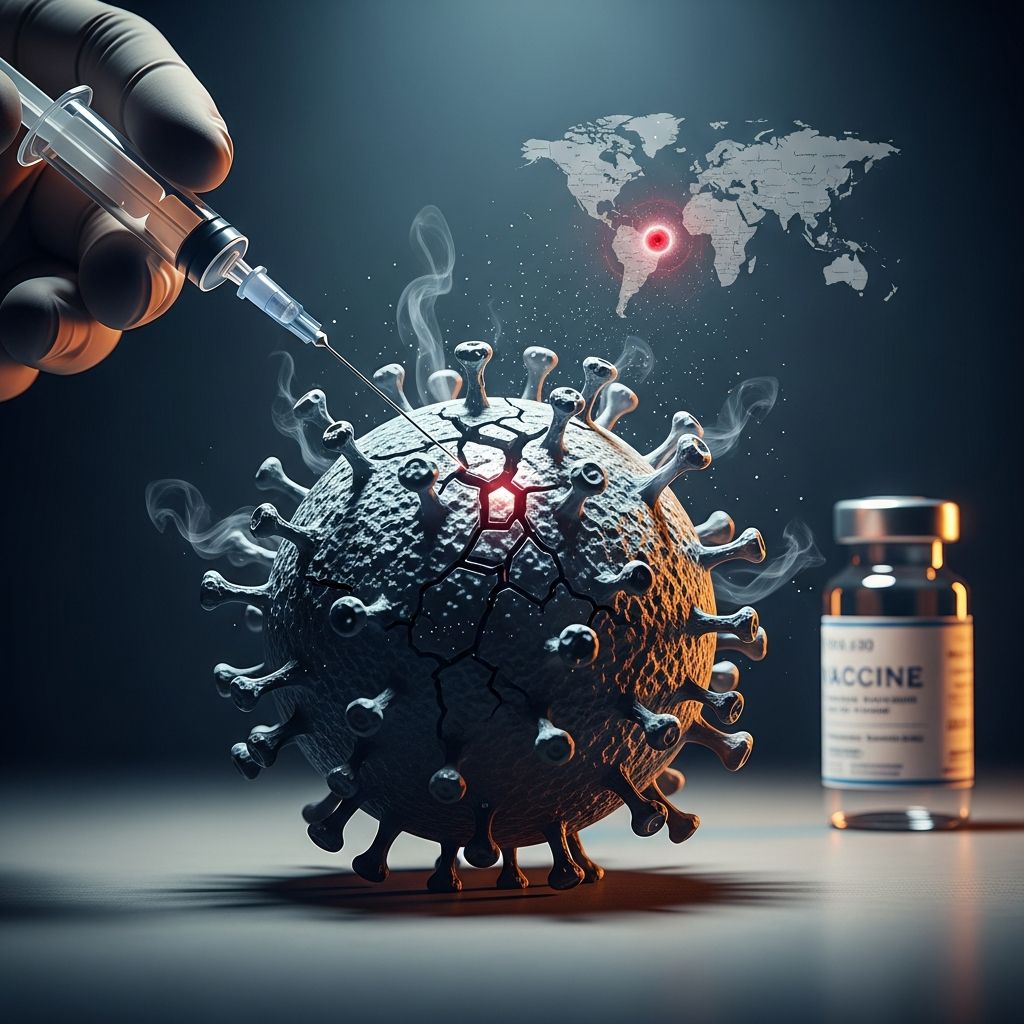
Smallpox, once the most feared infectious disease in human history, ravaged populations for millennia before being completely eradicated through pioneering vaccination efforts. Caused by the variola virus, it claimed hundreds of millions of lives, leaving survivors scarred and blinded.
Ancient Roots of a Deadly Plague
The story of smallpox begins in the shadows of prehistory, emerging around 10,000 BC amid the rise of early agricultural communities in northeastern Africa. Evidence from Egyptian mummies, including that of Pharaoh Ramses V from 1145 BCE, reveals pockmarked skin characteristic of the disease, confirming its presence over 3,000 years ago.
From Africa, the virus hitchhiked along trade routes to India and China by the 1st millennium BCE. Ancient texts from India (1500 BCE) and China (1122 BCE) describe outbreaks of a rash-inducing illness matching smallpox’s profile. By the 6th century, it reached Japan via trade with China and Korea, while Arab expansions in the 7th century carried it to northern Africa, Spain, and Portugal.
The Middle Ages saw explosive growth in Europe. The Crusades of the 11th century accelerated its spread, turning it into an endemic threat with mortality rates up to 30%. European colonization amplified the tragedy: introduced to the Americas during the Columbian Exchange, smallpox decimated Native American populations, with fatality rates soaring to 90% in some groups. In Australia, outbreaks in 1789 and 1829 devastated Aboriginal communities.
- Key Historical Milestones:
- ~1500 BCE: Earliest evidence in Egyptian mummies.
- 1st millennium BCE: Spreads to India via Egyptian traders.
- 6th century: Arrives in Japan.
- 11th century: Crusades fuel European epidemics.
- 16th century: Becomes global via European exploration.
- 18th century: Kills ~400,000 Europeans annually; causes one-third of blindness cases.
How Smallpox Spread and Infected the Vulnerable
Smallpox thrived as a highly contagious virus transmitted primarily through respiratory droplets from coughing or sneezing infected individuals. Close contact with contaminated objects, like bedding or clothing, also spread it, as the virus could survive outside the body for days.
After an incubation period of 7-17 days, infected people became contagious just before rash onset, shedding virus through oral secretions. The disease targeted everyone but hit children hardest, with outbreaks cycling every 5 years in unvaccinated populations. No cure existed; treatment was supportive, focusing on hydration and infection prevention.
| Transmission Mode | Description | Risk Level |
|---|---|---|
| Airborne Droplets | Coughing/sneezing in close proximity | High |
| Contact with Lesions | Touching scabs or fluid from rash | High |
| Contaminated Objects | Fomites like clothing/bedding | Moderate |
| Long-Distance Spread | Rare via dust particles | Low |
Recognizing the Telltale Signs in Children
Smallpox unfolded in distinct phases, making early recognition crucial historically. High fever (101-105°F), headache, backache, and fatigue marked the prodromal stage (2-4 days), often mimicking flu.
A hallmark rash then erupted: starting as flat red spots on the face, mouth, and forearms, evolving into fluid-filled vesicles (day 4), pustules (day 7), and scabbed lesions (week 2). Unlike chickenpox, smallpox lesions were deeper, more uniform, and appeared first on the face/extremities, spreading centrally. Scabs fell off after 3 weeks, often leaving permanent pockmarks.
Two forms existed: variola major (deadly, 30% fatality) with subtypes ordinary (most common), modified (milder in vaccinated), flat-type (95% fatal), and hemorrhagic (near 100% fatal). Variola minor was less severe (1% fatality).
- Progression Timeline:
- Days 0-17: Incubation (asymptomatic).
- Days 17-19: Prodrome (fever, malaise).
- Day 19: Macules (flat spots).
- Day 23: Vesicles/pustules.
- Week 3: Scabbing/healing.
Devastating Complications and Long-Term Effects
Beyond death, smallpox inflicted lifelong scars. Bacterial infections from open sores caused sepsis, pneumonia, and encephalitis. Corneal scarring led to blindness in 1/3 of survivors. Survivors bore disfiguring pockmarks, especially on the face, impacting social and emotional well-being.
In children, growth stunting and infertility were common. Hemorrhagic cases caused internal bleeding, killing within days. Globally, 300-500 million died in the 20th century alone before eradication.
Pioneering Defenses: From Variolation to Vaccination
Early countermeasures included variolation: inhaling dried scab powder or scratching pus into skin (16th-century China, 1721 Ottoman Empire via Lady Mary Wortley Montagu). Risky (1-2% fatality, spread potential), it was practiced in Africa and adopted in 1721 Boston by Cotton Mather and Zabdiel Boylston amid controversy.
Breakthrough came in 1796: Edward Jenner observed milkmaids immune due to cowpox. He inoculated 8-year-old James Phipps with cowpox pus from Sarah Nelmes, then challenged with smallpox—Phipps remained protected. Jenner’s 1798 publication birthed “vaccine” (from Latin vacca, cow).
By 1800, U.S. vaccinations began via Benjamin Waterhouse. Massachusetts mandated school vaccines in 1855.
The Global Campaign That Ended Smallpox
WHO’s Intensified Eradication Program (1967) deployed freeze-dried vaccines, bifurcated needles (using 1/100th dose), surveillance, and ring vaccination (targeting contacts). North America (1952) and Europe (1953) were cleared early; South America (1971), Asia (1975), Africa (1977) followed. Last natural case: Ali Maow Maalin, Somalia, 1977. WHO declared eradication in 1980; last U.S. outbreak 1949.
Samples remain in secure U.S./Russian labs for research.
Smallpox in Today’s World: Risks and Preparedness
Eradicated naturally, bioterrorism concerns persist. Vaccines stockpiled; antivirals like tecovirimat developed. Routine vaccination ended 1972 (U.S.), but military/health workers may receive it.
For parents: No natural cases since 1977; focus on current vaccines. Educate on history to appreciate public health victories.
Frequently Asked Questions
Is smallpox still a threat today?
No natural cases since 1977; eradicated globally. Lab stocks pose theoretical bioterror risk, but surveillance is robust.
What did smallpox look like on the skin?
Rash started on face/hands, evolved from spots to pus-filled blisters to scabs, deeper and more uniform than chickenpox.
How did Edward Jenner discover the vaccine?
In 1796, he used cowpox material on James Phipps, proving cross-protection against smallpox.
Could smallpox return naturally?
No, without animal reservoirs and no human cases, natural resurgence impossible.
Were children hit hardest by smallpox?
Yes, high child mortality; outbreaks cycled every 5 years in naive populations.
References
- History of Smallpox — Centers for Disease Control and Prevention (CDC). 2023. https://www.cdc.gov/smallpox/about/history.html
- Smallpox — Wikipedia (informed by primary sources). 2023. https://en.wikipedia.org/wiki/Smallpox
- History of Smallpox Vaccination — World Health Organization (WHO). 2023. https://www.who.int/news-room/spotlight/history-of-vaccination/history-of-smallpox-vaccination
- History of Smallpox: Outbreaks and Vaccine Timeline — Mayo Clinic. 2023. https://www.mayoclinic.org/diseases-conditions/history-disease-outbreaks-vaccine-timeline/smallpox
- Edward Jenner and the History of Smallpox and Vaccination — National Institutes of Health (NIH), PMC. 2005-01-01. https://pmc.ncbi.nlm.nih.gov/articles/PMC1200696/
- History of Smallpox and Its Spread in Human Populations — American Society for Microbiology. 2014. https://journals.asm.org/doi/10.1128/microbiolspec.poh-0004-2014
- About Smallpox — Centers for Disease Control and Prevention (CDC). 2023. https://www.cdc.gov/smallpox/about/index.html