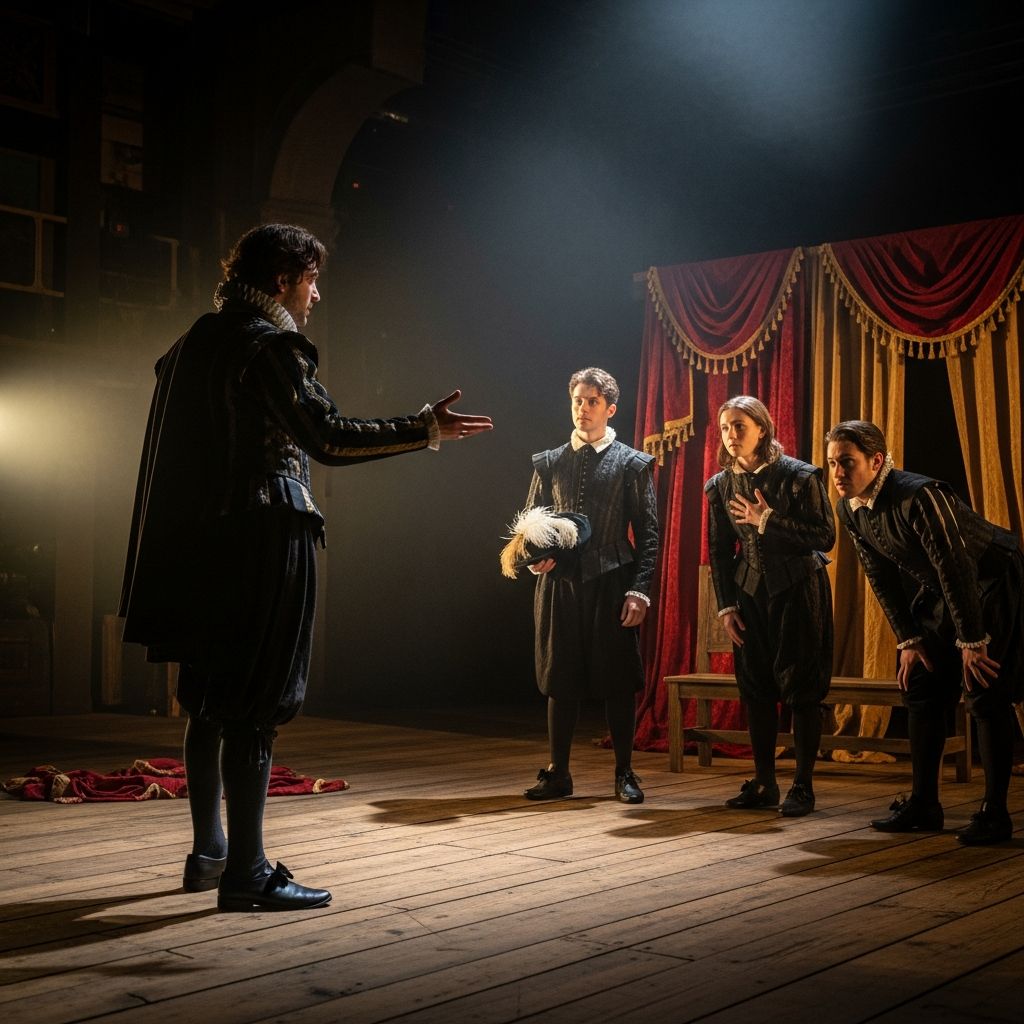
When people talk about Shakespeare, they usually focus on his poetry, his complex characters, and his influence on literature. Yet hidden inside Hamlet is something just as fascinating: Shakespeare’s own point of view on acting, spoken through Hamlet’s famous speech to a group of visiting players. This speech, often called “Hamlet’s advice to the players,” reads like an Elizabethan acting manual and reveals what Shakespeare thought good acting should and should not be.
This article explores those ideas in detail, organizing Shakespeare’s comments into clear themes: natural acting versus exaggeration, gesture and body language, voice and speech, the purpose of theatre, the use of comedy, and the enduring relevance of his advice to modern performers.
Overview: Hamlet as Shakespeare’s Mouthpiece on Acting
In Act 3, Scene 2 of Hamlet, the title character gives a long, carefully crafted speech to a troupe of actors he has hired to perform a play at Elsinore. Many scholars and theatre practitioners read this passage as Shakespeare stepping out from behind the character to speak directly to actors of his own time. Hamlet explains how he wants the play performed: with clarity, moderation, and truth, rather than noisy showmanship or lazy understatement.
- Hamlet criticizes actors who shout and “mouth” their lines as if they were town criers, suggesting Shakespeare disliked bombastic overacting.
- He also warns against being too lifeless or “tame,” indicating that real emotion and energy are still essential.
- Throughout the speech, Hamlet insists that the goal of acting is to “hold the mirror up to nature,” reflecting real human behavior and revealing moral and social truths.
Naturalism at the Core: Neither Overdone nor Underdone
One of the central principles in Hamlet’s advice is balance. Acting must avoid the extremes of theatrical exaggeration and dull restraint. Shakespeare is clearly frustrated with performers who confuse loudness and gesturing with real artistry, yet he also rejects cold, minimal performances that feel empty or disconnected from the text.
- Overacting: Hamlet complains about actors who rant and tear a passion to “tatters,” suggesting that such performers seem more interested in impressing the crowd than in telling the story truthfully.
- Underacting: He warns that if actors are too mild or indifferent, they fail to convey the emotional stakes of the scene, and the drama loses its power.
- Ideal balance: The best acting, in Shakespeare’s view, lives between these two extremes: full of genuine feeling, but shaped with control and taste.
Gestures and Body Language: Use All Gently
Shakespeare, through Hamlet, is surprisingly specific about physical acting. Hamlet tells the players not to “saw the air too much” with their hands. In other words, he criticizes wild, repetitive, and meaningless gestures that do nothing more than draw attention to the performer. Instead, physical expression should be purposeful and aligned with the words.
- Gestures must support, not overshadow, the text and emotion of the moment.
- Actors should aim for “temperance that may give it smoothness” in their physical choices, communicating intensity without flailing.
- Body language ought to emerge naturally from the character’s inner life and objectives, rather than being a collection of stock poses or theatrical tricks.
Voice and Speech: Speak the Speech Clearly and Simply
Hamlet opens his advice with a direct instruction: “Speak the speech, I pray you, as I pronounced it to you, trippingly on the tongue.” This line reveals at least three things about Shakespeare’s acting philosophy: the importance of clarity, a dislike for heavy, labored delivery, and a desire to hear his language spoken with rhythm and ease.
- Clarity of text: The actor’s first responsibility is to make the words understandable to the audience. Shouting, mumbling, or over-stressing every syllable only clouds meaning.
- Natural rhythm: Shakespeare’s verse is written with its own internal music. Hamlet’s phrase suggests that speech should flow lightly, not be hammered out in stiff, artificial patterns.
- Restraint in volume: Hamlet states that he would rather hear a town crier speak his lines than an actor who “mouths” them, indicating that shouting alone does not equal passion.
The Purpose of Theatre: Holding the Mirror Up to Nature
Perhaps the most quoted section of Hamlet’s advice is the passage where he explains the purpose of playing. Acting and theatre, Hamlet says, exist to “hold the mirror up to nature.” This expression has shaped acting theory and literary criticism for centuries, capturing Shakespeare’s belief that drama should reflect real life and reveal truths about human behavior.
| Aspect | Shakespeare’s View | Common Misconception |
|---|---|---|
| Main purpose of acting | To reflect nature and human life honestly, showing virtue and vice as they are. | To show off the performer’s talent, tricks, and emotional range. |
| Relationship to audience | To help the audience recognize themselves and their world in the play. | To dazzle or distract the audience with spectacle alone. |
| Moral dimension | To reveal “virtue her own feature” and “scorn her own image,” prompting reflection. | To entertain without asking deeper questions about right, wrong, or consequence. |
| Portrayal of the times | To show “the very age and body of the time his form and pressure,” capturing the spirit of the age. | To escape reality entirely and ignore contemporary issues. |
Shakespeare’s Critique of Showy Acting
Hamlet’s speech spends considerable time calling out a particular kind of bad acting: performances that are “o’erdone” in every way. Such actors, Shakespeare suggests, perform not for the integrity of the play, but to stir up “barren spectators” with flashy tricks. They add bits of business, unnecessary pauses, or exaggerated outbursts in hopes of easy laughter or applause.
- Hamlet remembers seeing performances in which an actor so overplayed the part that it “out-Herods Herod,” turning intense roles into caricatures.
- This type of playing distracts the audience from the story and damages the credibility of the entire production.
- Shakespeare’s disdain for this suggests that he valued ensemble work and storytelling over star-centered grandstanding.
Acting Objectives: Suit the Action to the Word
Another crucial principle in the speech is the instruction to “suit the action to the word, the word to the action.” This anticipates much later acting theory about objectives, motivation, and psychological truth. The line insists that what the actor does and what the actor says must be integrated and justified.
- The actor’s physical action should emerge from the character’s intention in the moment, not from an external idea of how the scene should look.
- The words should be delivered in a way that is consistent with the inner action: if the character is pleading, threatening, persuading, or hiding, the performance must reflect that.
- Shakespeare therefore presents acting as a craft of alignment: aligning body, voice, and inner purpose so that nothing feels arbitrary or mechanical.
Comedy and the Clowns: Keeping Jokes in Check
One of the most pointed sections of Hamlet’s advice concerns clowns and comic actors. Hamlet complains that some clowns speak “more than is set down for them,” improvising or inserting extra jokes to draw laughter, even when these additions interrupt important parts of the story. For Shakespeare, this was not just an artistic annoyance but a violation of the playwright’s design.
- Comic actors should not hijack the scene with unrelated business simply to win easy laughs.
- Jokes and improvisations that disrupt critical dialogue are described as “villainous” and a sign of poor ambition.
- Shakespeare’s view suggests that comedy must remain in harmony with the play’s structure and themes, rather than competing with them.
Shakespeare’s Own Experience as an Actor
Historical evidence indicates that Shakespeare was not only a playwright but also an actor in his own company. This background helps explain the specificity of Hamlet’s advice. The speech does not read like abstract theory; it reads like the practical notes of a man who had watched many performances, both good and bad, and knew what worked in front of an audience.
- His comments suggest familiarity with common actor habits: the temptation to over-gesture, over-shout, or pad roles with extra jokes.
- The detailed critique of clowns implies direct frustration with performers who disregarded his scripts.
- The strong emphasis on clarity and naturalism hints that Shakespeare wanted his verse to be heard and understood, not drowned in noise and spectacle.
Why Shakespeare’s Acting Advice Still Matters
Even though Shakespeare wrote over four centuries ago, his thoughts on acting still resonate with modern theatre and screen practice. Many contemporary acting methods—especially those that value truth, psychological motivation, and natural delivery—align closely with Hamlet’s guidelines. Teachers frequently use this speech in acting classes as a compact statement of performance ethics.
- The call to “hold the mirror up to nature” parallels modern commitments to emotional truth, realism, and authenticity.
- The warnings against overacting and showy tricks speak directly to current debates about subtle film acting versus broader stage styles.
- The insistence on respecting the text echoes contemporary respect for playwrights and scripts, even in highly collaborative or experimental environments.
Practical Takeaways for Modern Actors
Actors and directors can use Hamlet’s advice as a practical checklist when working on Shakespeare or any other playwright. These principles apply across genres and media, from classical theatre to television drama.
- Check for balance: Ask whether the performance leans toward melodrama or emotional emptiness, and adjust toward a truthful middle ground.
- Monitor gesture: Notice repetitive or meaningless movements; replace them with stillness or specific, motivated actions.
- Prioritize clarity: Make sure the audience can follow the language, even with complex or heightened text.
- Respect the script: Avoid unnecessary additions or improvisations that distract from the story, especially in key scenes.
- Align word and action: Regularly ask, “What is my character doing to the other person in this moment?” and let that aim shape voice and body.
Suggested Structure for a Shakespeare Scene Rehearsal
To apply Shakespeare’s ideas in rehearsal, actors and directors can structure their work around the key priorities identified in Hamlet’s speech. Below is a simple, practical sequence that reflects those principles.
- Text work: Clarify meanings, images, and verse structure, so that every line can be spoken with understanding.
- Simple run-through: Read or play the scene with minimal gesture, focusing on speaking the speech clearly and lightly.
- Action and objective: Decide what each character wants in each beat of the scene and how they pursue it.
- Layering gesture: Add physical choices that serve the objective and support the text, avoiding anything extraneous.
- Refinement: Remove moments that feel showy, false, or self-indulgent, keeping what feels truthful and essential.
FAQs on Shakespeare’s View of Acting
Did Shakespeare really believe in naturalistic acting?
Shakespeare’s theatre was not naturalistic in the modern, film-based sense, but Hamlet’s advice makes it clear that he valued performances that felt truthful and grounded. He criticizes overly exaggerated acting and urges players to mirror real human behavior. While the style of his time was more presentational, his instructions push actors toward a believable, internally consistent performance.
Is Hamlet’s advice meant only for Shakespearean actors?
No. Although the speech appears in a Shakespearean play and was shaped by the conditions of the Elizabethan stage, its principles are general. Ideas like balancing emotion with control, matching word and action, and avoiding self-indulgent showiness are relevant to any form of acting, from classical tragedy to contemporary television drama.
Why was Shakespeare so critical of clowns and improvisation?
Shakespeare’s complaints about clowns improvising extra lines reveal his concern for the integrity of the script and the clarity of the story. When comedians inserted unrelated jokes, important plot points could be lost on the audience. This diluted the dramatic impact he worked to create, so he argued that comic business should support, not sabotage, the narrative.
How can directors use Hamlet’s advice in modern productions?
Directors can share Hamlet’s speech with their cast as an early rehearsal resource and use it as an anchor for notes. Whenever a performance drifts into shouting, empty gesture, or cheap laughs, the director can refer back to Shakespeare’s own comments to steer the work toward clarity, balance, and truth.
Does Shakespeare’s advice conflict with bold or stylized productions?
Not necessarily. Bold design, stylized movement, or heightened staging can still honor Shakespeare’s principles if the actors remain truthful, clear, and connected to the text. The key is that style should amplify the story and the characters’ inner lives, not replace them or distract from them.