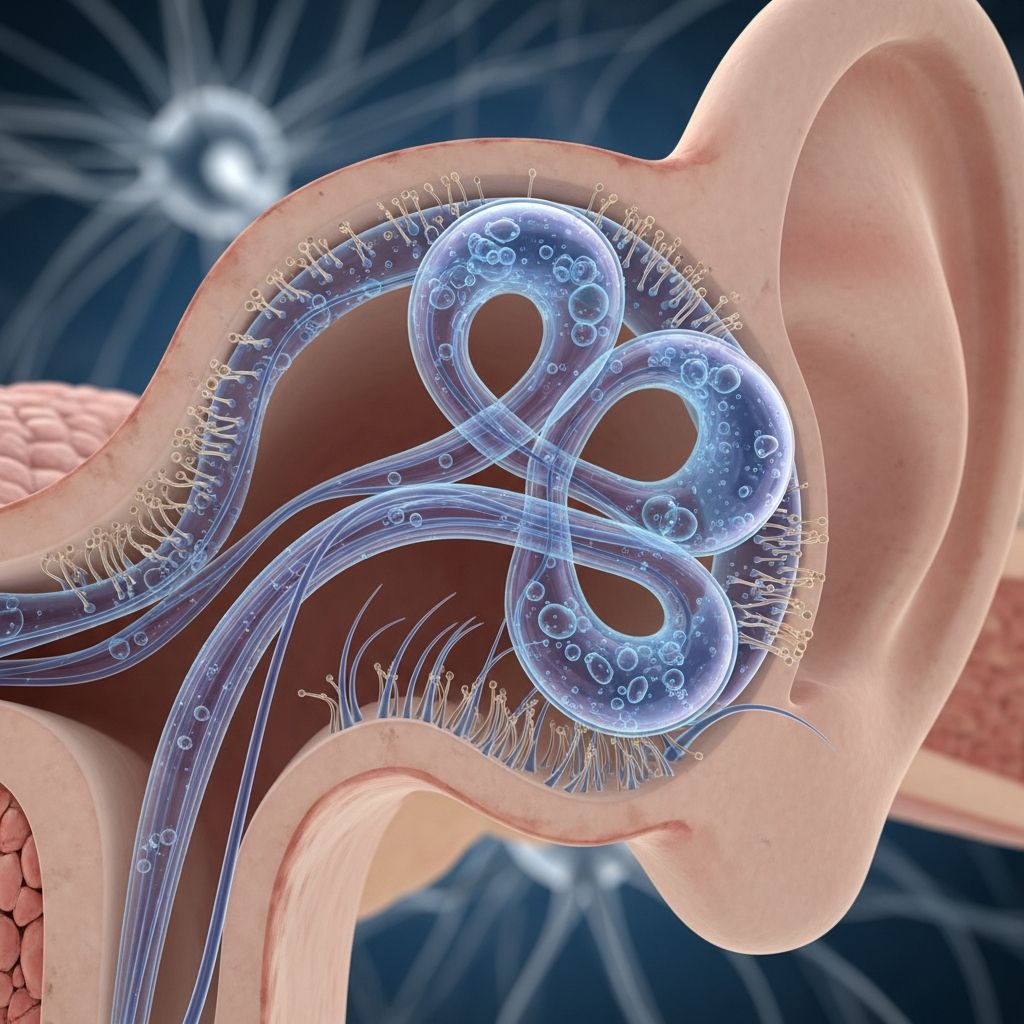
Your body is full of amazing hidden helpers, and some of the most important ones are tucked deep inside your ears. These helpers are called semicircular canals, and they quietly work every second to keep you from tipping over, bumping into things, or falling when you move your head.
This guide explains, in kid-friendly language, what semicircular canals are, how they work, and why they matter for everyday activities like walking, running, and spinning on the playground.
Meet Your Inner Ear Balance Team
The part of your inner ear that helps with balance is called the vestibular system. It works together with your eyes and your muscles to tell your brain where your head and body are in space so you can stay upright.
Your inner ear has two main kinds of balance helpers:
- Semicircular canals – three curved, fluid-filled tubes that sense head rotation, like turning, nodding, or tilting.
- Otolith organs (utricle and saccule) – tiny sacs that sense straight-line movements (like moving in a car or elevator) and which way is “down.”
Together, these parts send fast messages to your brain so you know if you are moving, stopping, or changing direction.
What Exactly Are Semicircular Canals?
Semicircular canals are three tiny, loop-shaped tubes inside each of your inner ears. They are filled with a special liquid called endolymph and lined with microscopic sensory cells.
There are three canals in each ear, and each one has a different orientation so your brain can sense movement in all directions:
- Horizontal (lateral) canal – helps sense when you turn your head left or right, like saying “no.”
- Superior (anterior) canal – helps sense when you nod your head up and down, like saying “yes.”
- Posterior canal – helps sense when you tilt your head toward your shoulder or lean back.
Because these tubes are set at roughly right angles to each other, they can detect rotation in three dimensions, similar to how three axes (x, y, and z) are used to describe directions in space.
How Do the Canals Sense Movement?
Even though you don’t feel them working, the semicircular canals are always busy. Here is what happens inside each canal when you move your head.
The Important Parts Inside Each Canal
Each semicircular canal has a special widened area at its base called the ampulla. Inside the ampulla is a flexible structure called the cupula that sticks across the canal like a little door or curtain.
Hidden inside the cupula are tiny hair cells with very small hair-like projections called stereocilia. These are not hairs like on your head; they are delicate sensory structures that change electrical signals when they are bent.
| Part | What It Is | What It Does |
|---|---|---|
| Endolymph | Fluid inside the canal | Moves when your head turns and pushes on the cupula |
| Ampulla | Bulged area at the base of the canal | Holds the cupula and hair cells |
| Cupula | Gel-like, flexible structure | Bends when fluid moves and bends the hair cells |
| Hair cells | Sensory cells with stereocilia | Turn bending into nerve signals to the brain |
Step-by-Step: From Movement to Brain Signal
- You move your head. Maybe you nod, spin in a circle, or look over your shoulder.
- The canals move with your skull. Because they are part of your inner ear’s bony structure, they rotate along with your head.
- The fluid lags behind. The endolymph inside does not move instantly because of inertia, so it stays still for a moment while the canal walls move.
- The cupula bends. As the fluid pushes against the cupula, the cupula tilts in the opposite direction of the head movement.
- Hair cells are bent. Stereocilia on the hair cells bend with the cupula. Bending one way increases their activity; bending the other way decreases it.
- Nerve signals are sent. Changes in activity travel along the vestibular nerve to the brain, telling it which way and how fast your head is turning.
When you keep turning at a steady speed, the fluid eventually catches up and moves with the canal, and the bending stops. That is why you mostly feel turning when you start or stop moving, not when you are spinning at a constant speed.
How Your Brain Uses These Balance Signals
Your brain receives messages from both ears, your eyes, and sensors in your muscles and joints. It compares all this information to make sure your sense of movement matches what you see and feel.
The semicircular canals in the left and right ears work in pairs:
- The left anterior canal pairs with the right posterior canal.
- The right anterior canal pairs with the left posterior canal.
- The two horizontal canals pair with each other.
When one canal in a pair senses increased activity, the partner canal usually senses decreased activity. This helps the brain detect the direction of movement more accurately.
The brain quickly uses this information to:
- Adjust your eye movements so you can keep looking at a point even while your head moves (this is called the vestibulo-ocular reflex).
- Send signals to your neck, back, and leg muscles to keep your body upright.
- Let you know if you are starting, stopping, or changing direction so you can react.
Why Spinning Makes You Dizzy
If you love swings, merry-go-rounds, or spinning in a chair, you have probably felt dizzy afterward. Your semicircular canals are a big reason for that “whoa” feeling.
Here is what goes on when you spin and then stop:
- At first, when you start spinning, the fluid in the canals lags behind and bends the cupula, so your brain knows you are turning.
- If you keep spinning, the fluid starts to move at almost the same speed as the canal, so the cupula straightens and you feel less motion.
- When you suddenly stop, the canal stops but the fluid keeps moving for a short time, bending the cupula in the opposite direction.
- Your brain receives signals that say you are still spinning even though your eyes see that you have stopped. This mismatch makes you feel dizzy or like the room is turning.
After a few moments, the fluid calms down, the cupula returns to its resting position, and you feel normal again.
Semicircular Canals and Everyday Activities
You use your semicircular canals in almost everything you do, even if you never think about them.
- Walking or running: They help your eyes stay focused so the world does not look shaky while your head bounces and turns.
- Sports: When you jump, spin, or quickly change direction, the canals help you stay coordinated and land safely.
- Riding in vehicles: Your canals sense when the vehicle turns, and your brain compares that to what your eyes see out the window.
- Dancing and gymnastics: Fast turns, flips, and spins all rely on the canals and vestibular system to help you know where “up” is.
When Semicircular Canals Don’t Work Properly
Most kids will never have a serious problem with their semicircular canals. But sometimes, in children or adults, these structures or the nerves connected to them can be affected by infections, injuries, or other conditions.
When the canals or other vestibular organs are not working well, a person might:
- Feel dizzy or like they are spinning when they are not (this is called vertigo).
- Have trouble keeping balance, especially in the dark or on uneven ground.
- Feel sick to their stomach when they move their head quickly.
- Find it hard to focus their eyes when turning their head.
One example in adults is a condition called superior semicircular canal dehiscence, where the bone over the top canal is very thin or missing. People with this problem can feel dizzy and may even hear their own body sounds (like heartbeat or eye movements) more loudly.
If anyone has balance problems or frequent dizziness, a doctor or specialist can do tests to check how well the inner ears and semicircular canals are working.
Taking Care of Your Inner Ear
Even though you cannot see your semicircular canals, you can still help protect this important part of your body.
- Wear helmets during biking, skating, or contact sports to reduce the chance of head and inner ear injuries.
- Avoid very loud noises, because the cochlea (for hearing) and vestibular organs sit close together in the inner ear.
- Tell an adult if you feel dizzy a lot, especially if it happens suddenly or with other symptoms like hearing loss or strong headaches.
- Follow doctor’s advice if you have an ear infection, and never put objects deep into your ear canal.
Quick Facts About Semicircular Canals
- Each ear has three semicircular canals, for a total of six.
- They are filled with fluid and lined with hair cells that sense movement.
- They detect rotational movements of your head, like turning, tilting, or nodding.
- They are part of your vestibular system, which helps you keep your balance.
- They send signals to your brain through the vestibular nerve (part of the eighth cranial nerve).
Frequently Asked Questions (FAQs)
Do semicircular canals help me hear?
No. Hearing mainly happens in a nearby part of the inner ear called the cochlea. The semicircular canals are focused on balance and movement, not sound.
Why do I feel dizzy after spinning games?
When you spin, the fluid inside your semicircular canals keeps moving for a short time after you stop. Your canals still send “spinning” messages while your eyes see that you are standing still. This mismatch makes you feel dizzy or off-balance.
Can something go wrong with just one semicircular canal?
Yes. Some disorders affect one canal or one ear more than the other. When that happens, the signals from the two sides do not match, and the brain may interpret that as spinning or tilting even when you are not moving.
Do animals have semicircular canals too?
Yes. Many animals, from fish to mammals, have semicircular canals or similar structures that help them sense rotation. The exact shape and size may differ, but the basic job—helping with balance—is similar.
Can I feel my semicircular canals working?
You usually do not notice them unless you spin, get dizzy, or have a balance problem. Most of the time, they quietly keep you steady without you even thinking about it.
References
- Semicircular canal — Encyclopaedia Britannica. 2024-01-15. https://www.britannica.com/science/semicircular-canal
- Vestibular System: Function & Anatomy — Cleveland Clinic. 2023-06-01. https://my.clevelandclinic.org/health/body/vestibular-system
- Inner Ear: Anatomy, Function & Related Disorders — Cleveland Clinic. 2023-09-14. https://my.clevelandclinic.org/health/body/24340-inner-ear
- The Semicircular Canals — In: Neuroscience, 2nd ed., NCBI Bookshelf (NIH). 2001-01-01. https://www.ncbi.nlm.nih.gov/books/NBK10863/
- How the Inner Ear Balance System Works — Fauquier ENT YouTube Channel. 2014-09-15. https://www.youtube.com/watch?v=YMIMvBa8XGs