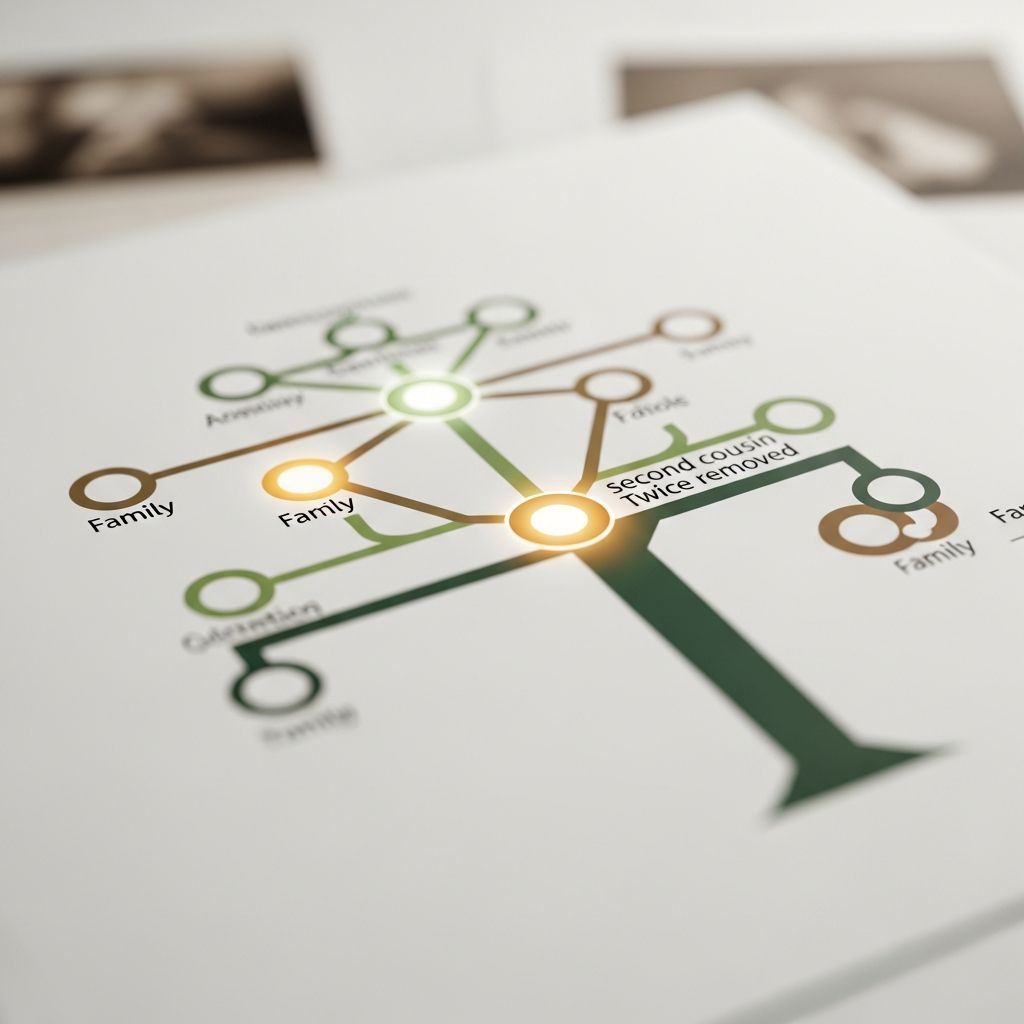
Extended family titles can be confusing, especially when words like second cousin and twice removed get thrown into everyday conversations. Many people are unsure exactly how a relative fits into the family tree, even when they see that person at every wedding and reunion. This guide explains cousin relationships in simple language, using clear examples and tables you can use as a reference.
Understanding Basic Family Tree Terms
Before looking at second cousins and removals, it helps to review a few core ideas that appear on every family tree. These concepts form the foundation for all the cousin labels.
- Generation: A horizontal layer in the family tree, such as you and your siblings, or your parents and their siblings.
- Common ancestor: The person or couple from whom two relatives both descend.
- Lineal relatives: People in a straight line up or down from you, such as parents, grandparents, children, and grandchildren.
- Collateral relatives: People who branch off the main line, such as aunts, uncles, and cousins.
Once these ideas are clear, it becomes much easier to understand why cousin labels depend on which ancestor you share and how many generations separate you from that ancestor.
What Makes Someone a Cousin?
In most family trees, cousins are defined as relatives who share at least one grandparent-level ancestor but who are not in a direct parent–child line. In other words, cousins are the children, grandchildren, or later descendants of siblings. The core pattern is that two cousins always trace back to siblings somewhere higher in the tree.
- Your cousin is never your direct ancestor or direct descendant.
- Your cousin and you share at least one person in the “middle” generations, usually a grandparent or great-grandparent.
- The specific type of cousin relationship depends on how far back that shared ancestor appears.
Different languages and cultures name these ties differently, but most genealogical charts use the same numbering system for first, second, third cousins and so on.
First Cousins Explained
The easiest cousin relationship to understand is first cousin. First cousins share a set of grandparents. Each person is two generations away from those grandparents, and the grandparents sit at the center of the relationship.
- Your first cousin is the child of your aunt or uncle.
- You and your first cousin are in the same generation in the family tree.
- You both have the same grandparents, but you do not share the same parents.
Because first cousins are in the same generation, there is no “removed” attached to the title. The “removed” part only appears when generations do not line up.
Second and Third Cousins
Second and third cousins follow the same basic pattern as first cousins, but the shared ancestor is farther back in time. The number in the cousin label tells you how many generations you have to go up from one cousin to reach the shared ancestor, starting from the cousin level.
- Second cousins share great-grandparents.
- Third cousins share great-great-grandparents.
Think of it as counting the “greats” minus one: if the closest shared ancestor is a great-grandparent, that relationship typically falls into the second cousin level. If the shared ancestor is a great-great-grandparent, the cousins are usually third cousins.
Simple Cousin Level Table
| Shared ancestor level | Example ancestor | Cousin level |
|---|---|---|
| Grandparents | Same grandma and grandpa | First cousins |
| Great-grandparents | Same great-grandma and great-grandpa | Second cousins |
| Great-great-grandparents | Same great-great-grandparents | Third cousins |
Cousins at the same level, such as second cousins, are always in the same generation. The differences appear when one person is higher or lower in the tree than the other; that is where the word “removed” is used.
What Does “Removed” Mean?
The term removed describes the difference in generations between two cousins who do not fall in the same horizontal row of the family tree. Instead of changing the cousin number, it tells you that one person sits one or more generations above or below the other.
- Once removed means the two people are separated by one generation.
- Twice removed means they are separated by two generations.
- The cousin number (first, second, third) still comes from the closest shared ancestor.
To find out whether someone is once or twice removed, compare how many steps each of you takes to reach that shared ancestor. The difference in those step counts gives the removal.
First Cousin Once Removed and Twice Removed
When most people ask about “removed” cousins, they are thinking about how they relate to relatives like their parents’ cousins or their cousins’ children. These are classic cases of first cousins, but shifted up or down by one or two generations.
- Your parent’s first cousin is your first cousin once removed.
- Your first cousin’s child is also your first cousin once removed.
- Your first cousin’s grandchild would be your first cousin twice removed because two generations separate you.
In each case, the grandparents that you share with your first cousin stay the same; the only difference is whether the other person is closer to or farther from those grandparents in the tree.
Second Cousin Once Removed
Second cousins once removed sit one generation away from a pair of regular second cousins. One person is part of the second cousin generation, and the other is either a parent or child of someone in that group.
- The child of your second cousin is your second cousin once removed.
- The second cousin of your parent is also your second cousin once removed.
In both examples, the closest shared ancestors are great-grandparents, which defines the second cousin number. The “once removed” label simply notes the one-generation gap between you and the other person.
What Is a Second Cousin Twice Removed?
A second cousin twice removed is a relative who is two generations away from the second cousin level. One person belongs to the group of second cousins, and the other is either two generations above or two generations below that group in the family tree.
- The grandchild of your second cousin is your second cousin twice removed.
- Your grandparent’s second cousin is also your second cousin twice removed.
In each scenario, the shared ancestors are still great-grandparents for at least one of the people involved, which preserves the “second cousin” part of the label. The difference lies in how many generations separate the two relatives, which is why the title includes “twice removed.”
Second Cousin Removal Table
| Relationship to you | Shared ancestor level | Label |
|---|---|---|
| Child of your second cousin | Great-grandparents | Second cousin once removed |
| Grandchild of your second cousin | Great-grandparents | Second cousin twice removed |
| Parent of your second cousin | Great-grandparents | Second cousin once removed |
| Grandparent of your second cousin | Great-grandparents | Second cousin twice removed |
This table shows that the cousin level stays at “second,” even when the generations do not line up. Only the “once removed” or “twice removed” part changes to reflect the generation difference.
How to Use a Cousin Chart
A cousin chart is a grid that lists generations down the side and cousin levels across the top. You start at yourself, find your relationship to the common ancestor, then trace across and up or down to locate the other person. The box where the two lines meet contains the correct cousin label.
- Find your position by locating your own relationship to the shared ancestor.
- Find the other person’s position the same way.
- Measure the difference in generations to determine whether the relationship is once or twice removed.
Many printable family charts and genealogy tools include built-in cousin finders that do this automatically. However, understanding the logic makes it much easier to explain the relationship out loud to other family members.
Mini Cousin Relationship Grid
| Your generation | One generation below | Two generations below | |
|---|---|---|---|
| Same grandparents | First cousins | First cousins once removed | First cousins twice removed |
| Same great-grandparents | Second cousins | Second cousins once removed | Second cousins twice removed |
| Same great-great-grandparents | Third cousins | Third cousins once removed | Third cousins twice removed |
This simple grid captures the pattern used in larger, more detailed cousin charts. Once you see one row, the others follow the same pattern.
Everyday Examples of “Removed” Cousins
Cousin terms can feel abstract until they appear in real situations. These common family examples help convert theory into something you can use at the next family gathering.
- If you play with the child of your first cousin at reunions, that child is your first cousin once removed.
- If your mother talks often about her second cousin, that person is your second cousin once removed.
- If an older relative describes someone as “your grandpa’s second cousin,” that person is your second cousin twice removed.
In all cases, the family bond is still warm and meaningful, even if the title sounds technical. Many families simply say “cousin” in casual conversation, saving the full term for genealogy work or legal documents.
Why Cousin Labels Matter
While many families are comfortable using “my cousin” as a general phrase, the detailed labels have real uses. Knowing exactly how two people are related can matter in family history research, legal contexts, and discussions about shared ancestry.
- Genealogy: Accurate labeling helps place people in the correct spots on a family tree.
- Medical history: Understanding how closely two people are related can clarify the likelihood of sharing genetic risk factors.
- Inheritance and property: Some legal systems pay attention to the degree of kinship when deciding rights or obligations.
Even in casual settings, explaining that someone is a second cousin twice removed can spark interesting conversations about shared ancestors and family stories.
Frequently Asked Questions (FAQs)
Is a second cousin twice removed still considered family?
Yes, a second cousin twice removed is still a blood relative, just one who connects to you through great-grandparents and who is two generations away from your own level in the family tree. Most families treat this person as extended family, especially if there is ongoing contact.
Is a second cousin closer than a third cousin?
Yes, a second cousin is generally considered more closely related than a third cousin because the shared ancestors (great-grandparents) are closer to both of you than the great-great-grandparents shared with a third cousin.
Why does the word “removed” sound confusing?
The word “removed” is confusing because it does not describe emotional distance, only generational distance. It does not mean someone has been taken out of the family; it simply means that person is one or more generations above or below you.
Do both people use the same cousin term for each other?
Yes, cousin terms are reciprocal. If you call someone your first cousin once removed, that person can also correctly refer to you as a first cousin once removed, even if you are in different generations.
Can cousin relationships change over time?
The basic cousin label between two people does not change. However, as new generations are born, new “once removed” or “twice removed” relationships appear when you compare older and younger family members.
Bringing It All Together
Once you understand that the cousin number comes from the level of the shared ancestor and the word “removed” comes from the difference in generations, every cousin label becomes easier to decode. A second cousin twice removed is simply a relative who shares great-grandparents with the second cousin generation but sits two generations away from that group in the family tree. With this framework, you can read cousin charts, label complex relationships, and explain extended family ties with confidence.