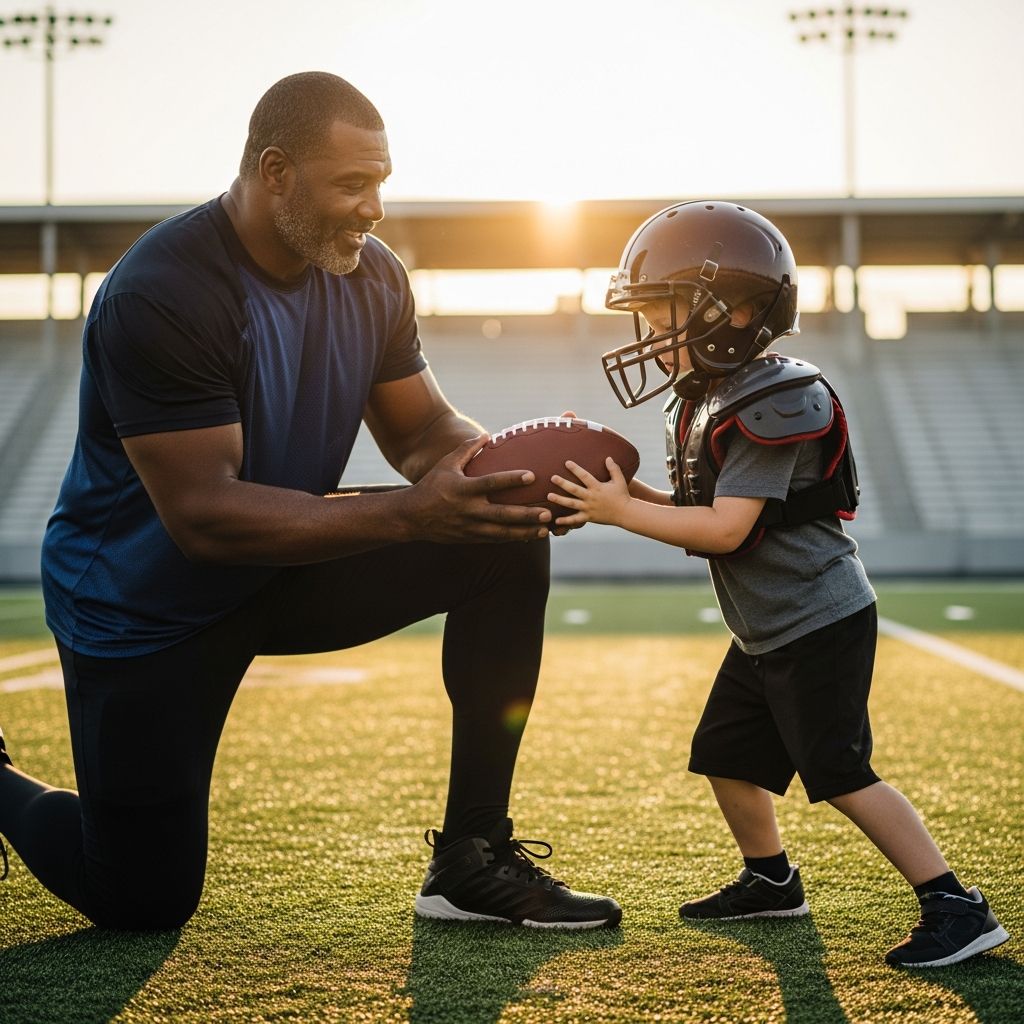
When a professional athlete becomes a parent, the values that once shaped their performance on the field often become the blueprint for how they raise their children. This is true for former NFL linebacker Ryan Nece, who has transformed lessons about discipline, teamwork, and humility into a thoughtful, grounded approach to fatherhood.
This article explores how experiences from elite sports, a complex family legacy, and a commitment to service all inform the way a modern dad can show up for his kids.
From the Gridiron to the Living Room
Ryan Nece grew up around football greatness and pressure, but once he became a father, the scoreboard changed. Instead of chasing trophies, his focus shifted to raising kind, resilient, and responsible children.
What carries over from the field to the living room is not fame or highlight reels, but qualities like:
- Consistency – showing up every day, even when it is not exciting
- Preparation – thinking ahead about how to react in tough parenting moments
- Accountability – owning mistakes as a dad and modeling how to repair them
These habits mirror what many sports psychologists emphasize: sustained effort and deliberate practice are more predictive of long-term success than talent alone.
A Complicated Legacy: Famous Parents and Real-World Values
Growing up with a famous parent can be both a gift and a burden. Children of professional athletes often face higher expectations, public scrutiny, and stereotypes about entitlement. Research shows that kids of high-profile parents can struggle with identity and pressure if their self-worth becomes tied to their family’s status rather than their own values and efforts.
Nece’s approach pushes in the opposite direction: he focuses on everyday character rather than last names or highlight clips. His core message to his children echoes what many family therapists recommend for kids in high-achievement households:
- Your value does not come from what your parents did, but from how you treat people.
- Gratitude and humility matter more than attention and applause.
- Use any privilege or platform you have to improve other people’s lives.
Core Principles of His Fatherhood Playbook
Instead of hard rules, Nece leans on a few guiding principles that shape daily decisions and long-term parenting goals.
1. Lead With Humility, Not Hype
Competitive sports can reward ego, but inside a home, humility is a better currency. Studies on effective parenting highlight the benefits of authoritative parenting—high in warmth and firm, but respectful guidance—over authoritarian or permissive extremes. Humility supports this balance, allowing a dad to admit when he is wrong, apologize, and invite conversation rather than demand blind obedience.
For Nece, that might look like:
- Sharing his own failures as clearly as he shares his successes
- Letting his kids see that he still has mentors and coaches in his adult life
- Listening fully to their perspective before responding with advice
2. Teach Grit Through Real Challenges
Grit—the combination of perseverance and passion for long-term goals—has been linked to higher achievement in academics and athletics when combined with supportive environments. Nece channels this lesson by allowing his children to struggle in age-appropriate ways instead of rescuing them at the first sign of frustration.
In practice, that might mean:
- Encouraging them to stick with a sport or activity for a full season before quitting
- Supporting them through hard homework instead of doing it for them
- Celebrating effort, preparation, and sportsmanship more than winning
3. Make Service a Family Habit, Not a Photo Opportunity
Nece is deeply involved in philanthropy, and he treats service not as a special event but as a normal part of family life. This aligns with research showing that adolescents who are engaged in meaningful community service tend to report higher levels of well-being and civic engagement later in life.
Rather than simply donating money, he models hands-on involvement and invites his kids into the work, giving them a sense of agency and responsibility.
| Football Lesson | Parenting Translation |
|---|---|
| Film study and game plans | Thinking ahead about family routines, boundaries, and consequences |
| Taking coaching feedback | Being open to your partner’s or kids’ feedback about your parenting |
| Playing through adversity | Staying steady during family crises or conflicts |
| Team-first mentality | Putting the family’s long-term health above short-term ego |
Discipline Without Breaking the Relationship
As a former linebacker, Nece understands rules, structure, and accountability. But his approach to discipline is less about punishment and more about teaching. This resonates with evidence that consistent, warm, and fair discipline—not harshness—is linked with better behavioral and emotional outcomes in children.
Clear Expectations
Nece emphasizes clarity: kids cannot meet expectations they do not understand. So he focuses on:
- Explaining the “why” behind rules
- Keeping household expectations simple and age-appropriate
- Agreeing in advance on reasonable consequences
Consequences That Match the Lesson
Instead of random punishments, he leans toward consequences that teach responsibility, such as:
- Repairing harm (apologizing, replacing something broken, or helping out)
- Losing privileges directly tied to the behavior (e.g., device limits after misuse)
- Trying again the right way, with guidance
Staying Calm Under Pressure
On the field, losing your cool can cost your team the game. At home, it can damage trust. Research on emotional regulation in parents shows that when adults manage their own stress, children are more likely to learn healthy coping strategies themselves. Nece treats stressful moments with kids almost like a two-minute drill: the stakes are high, but the most effective move is to remain calm and focused.
Building Identity Beyond Football
One of the hardest parts for any former athlete is redefining their identity after retirement. Instead of letting football be the only story, Nece works to show his children a wider spectrum of who he is—and who they can be:
- A learner who still studies, reads, and asks questions
- A community member who gives time and attention to others
- A dad who is more interested in who they are than how they perform
This helps protect kids from over-identifying with one role (such as being an athlete) and supports their long-term mental health by encouraging multiple sources of meaning and self-worth.
Modern Fatherhood: Present, Vulnerable, and Engaged
Nece’s story reflects a broader shift in modern fatherhood. Large-scale surveys show that contemporary fathers spend more time with their children and report a stronger desire to be actively involved in day-to-day caregiving than previous generations.
Key traits of this modern model that show up in his parenting include:
- Emotional presence – not just attending events, but actively talking about feelings and experiences
- Shared caregiving – partnering more equitably in tasks like meals, bedtime, and school routines
- Modeling vulnerability – admitting when he is scared, uncertain, or disappointed rather than pretending to be invincible
Practical Takeaways for Any Parent
You do not have to be a former NFL player to apply the principles that shape Nece’s approach. Any parent can borrow and adapt these ideas.
Daily Habits That Build Character
- Gratitude check-ins: Ask, “What are you grateful for today?” at dinner or bedtime.
- Effort over outcome: Praise preparation and persistence more than scores or grades.
- Service rituals: Schedule recurring ways to help others—monthly volunteer days, donation drives, or simple neighborhood kindness.
- Story time about failure: Share a mistake you made that day and what you learned.
Questions to Ask Your Kids
Borrowing from a coach’s mindset, these open-ended questions can deepen connection:
- “What was the hardest part of your day, and how did you handle it?”
- “Where did you show kindness today?”
- “What is something you want to get better at this month?”
- “How can I support you without taking over?”
Frequently Asked Questions (FAQs)
How can I teach my kids resilience without being too hard on them?
Offer challenges that are slightly above their current comfort level, then stay nearby with encouragement and guidance. Research suggests that resilience grows when children face manageable stress with reliable support, not when they are shielded from every difficulty or pushed beyond their limits.
My child compares our family to celebrity or sports families. What should I say?
Emphasize that every family has different resources and challenges, and that character—kindness, honesty, effort—is more important than fame or money. Reinforce that they are loved for who they are, not for who their parents are or what they achieve.
How can I involve my kids in community service in a meaningful way?
Choose causes that connect to their interests or experiences, explain the purpose in simple terms, and give them age-appropriate roles. Studies on youth volunteering show that when kids understand why they are helping and have real responsibilities, they gain more empathy and a stronger sense of purpose.
What if I did not grow up with a strong father figure—can I still be a good dad?
Yes. Many effective fathers build their own playbook by learning from mentors, partners, and trusted resources. Focusing on being consistent, emotionally available, and willing to learn has a far greater impact than trying to be perfect or replicate someone else’s model.
How do I balance wanting my kids to succeed in sports with not pressuring them?
Keep the primary goal centered on learning, health, and enjoyment. Ask your child regularly, “Are you still having fun?” and “What do you want from this activity?” Let their answers guide decisions about intensity and time commitment, and make sure your praise is not tied only to performance.
References
- Grit: Perseverance and Passion for Long-Term Goals — A. L. Duckworth et al., Journal of Personality and Social Psychology. 2007-06-01. https://doi.org/10.1037/0022-3514.92.6.1087
- Growing Up in a Celebrity Family: The Psychological Impact of Fame on Children — B. P. Schmid et al., in The Oxford Handbook of Media, Technology, and Organization Studies. 2020-01-15. https://doi.org/10.1093/oxfordhb/9780198838327.013.33
- Parenting Styles and Child Adjustment — N. Darling & L. Steinberg, Current Directions in Psychological Science. 1993-04-01. https://doi.org/10.1111/1467-8721.ep10772341
- Youth Civic Engagement and Positive Youth Development — C. Flanagan & L. Christens, in Handbook of Adolescent Psychology, Wiley. 2013-03-18. https://doi.org/10.1002/9781118584883.ch18
- Parental Emotion Regulation and Children’s Adjustment — M. Shaffer et al., Social Development. 2012-05-01. https://doi.org/10.1111/j.1467-9507.2011.00633.x
- The New Dad: Caring, Committed and Conflicted — Boston College Center for Work & Family. 2011-06-01. https://www.bc.edu/content/dam/files/centers/cwf/pdf/BCCWF_ND_Caring_Conflicted.pdf