Understanding a Child-Centered Educational Philosophy
The educational landscape for young learners has evolved significantly over the decades, with various methodologies emerging to support optimal development. One particularly influential approach originates from a small city in Northern Italy and has gained international recognition for its innovative perspective on how children learn and grow. This philosophy fundamentally reimagines the role of educators, the learning environment, and the capabilities of young children themselves. Rather than viewing education as a process of transferring knowledge from teacher to student, this model positions children as active architects of their own understanding, capable of constructing meaning through exploration and social interaction.
The Foundation: Reimagining How We View Young Learners
Central to this educational philosophy is a powerful and transformative image of the child. Unlike traditional models that may view young learners as blank slates requiring external instruction, this approach conceptualizes children as inherently competent, creative, and brimming with potential. Each child is understood to be intelligent, curious, and capable of constructing their own theories about the world from birth. This perspective extends beyond mere academic capability; it recognizes that children are social beings connected to peers and adults, possessing their own values and respecting those of others.
This foundational belief shapes everything that follows in the educational experience. When educators genuinely embrace the notion that children are strong, capable, and full of ideas rather than passive recipients of information, it fundamentally alters classroom dynamics, instructional choices, and the nature of adult-child interactions. Teachers working within this framework continuously reflect on how their practices either honor or diminish this powerful image of the child.
The Multiple Languages of Expression and Communication
One of the most distinctive and memorable concepts within this educational approach is the notion that children possess “a hundred languages”—a metaphorical expression emphasizing the countless ways children can communicate, explore, and make sense of their world. Rather than restricting children to traditional modes of expression such as writing or verbal speech alone, this philosophy celebrates the full spectrum of human expression available to young learners.
These varied languages encompass:
- Physical movement and bodily expression through dance, gesture, and spatial exploration
- Artistic creation via painting, drawing, sculpture, and other visual media
- Musical expression through singing, instrument play, and rhythm
- Symbolic representation through dramatic play, role-playing, and imaginative scenarios
- Sensory exploration involving touch, observation, listening, and multisensory engagement
- Verbal communication through discussion, storytelling, and dialogue
- Collaborative creation where multiple children work together to express shared ideas
By deliberately cultivating environments and opportunities for these diverse forms of expression, educators honor the natural inclinations of children to communicate in ways that feel authentic and meaningful to them. A child struggling to articulate feelings through words might express them vividly through painting or movement, and an educator’s recognition of this value validates the child’s communicative attempt.
Relationships as the Foundation of Learning
Learning does not occur in isolation within this educational model; instead, it emerges from and is strengthened by the quality of relationships that children experience. The philosophy places profound emphasis on reciprocal, respectful relationships where the perspectives and interpretations of all participants—children, educators, and families—are genuinely valued. Adults and children learn together, positioning educators as co-learners rather than sole authorities.
The structure of educator teams exemplifies this relational focus. Rather than assigning different teachers to children across the day, educators typically work in stable pairs with consistent groups of children, enabling deep, secure bonds to develop over time. This consistency allows educators to truly know each child—their interests, dispositions, struggles, and strengths—in ways that inform responsive teaching and meaningful support.
Parent and family involvement extends the relational network significantly. Families are not peripheral to the educational process but rather essential partners whose insights, values, and participation shape the child’s learning experience. Parents are encouraged to participate in school governance and decision-making, ensuring that educational practices reflect and respect family perspectives and community values. This collaborative relationship between school and home creates coherence in the child’s experience across contexts.
The Environment as an Active Educator
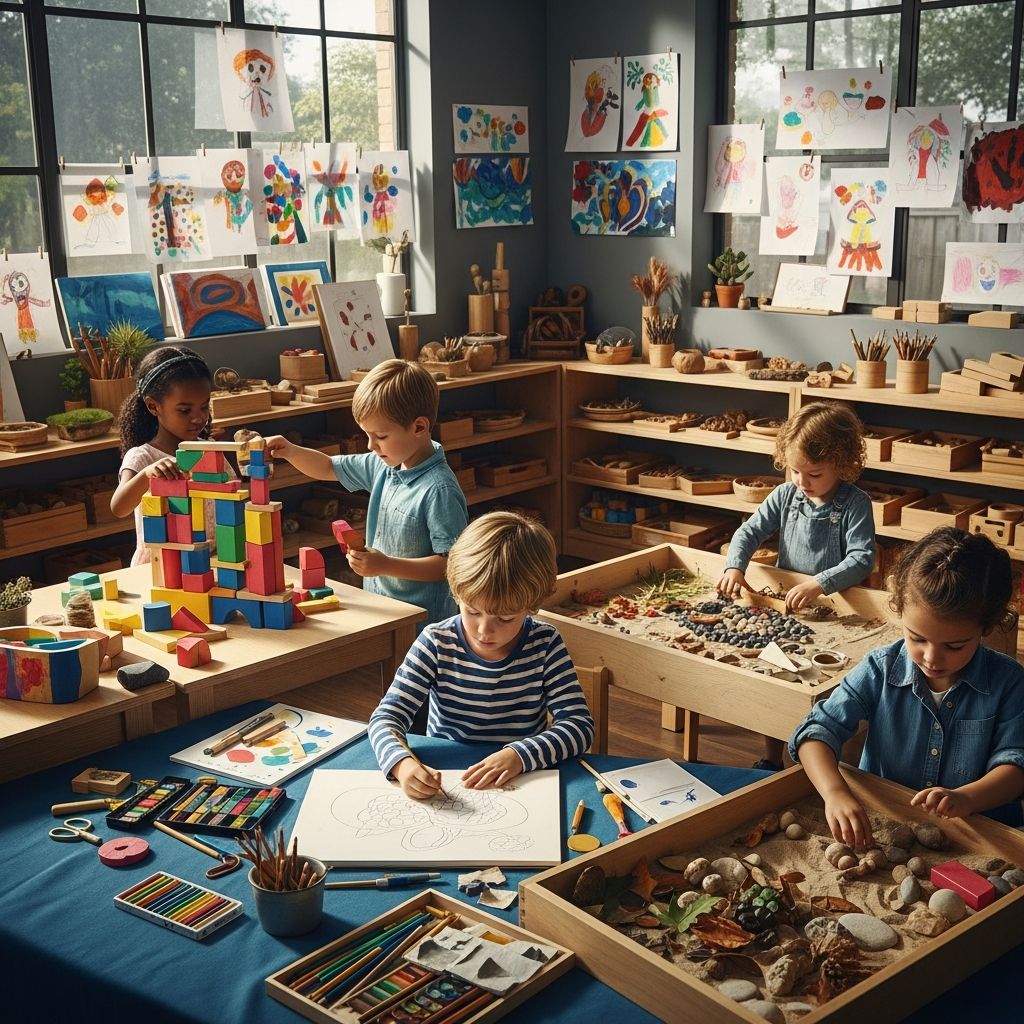
Within this philosophy, the physical learning environment itself functions as a teacher—not passively, but as an active force shaping learning opportunities and interactions. Educators thoughtfully design spaces to encourage specific types of learning, exploration, and social engagement. The arrangement of materials, the accessibility of resources, the flow of physical space, and the aesthetic quality of the environment all communicate powerful messages about what children are expected to do and become.
An intentionally designed Reggio-inspired environment typically includes:
- Natural light and connections to outdoor spaces and nature
- Open-ended materials that can be used in multiple ways—fabric, blocks, wire, clay, wood
- Thoughtfully displayed documentation showing children’s work and learning processes
- Accessible storage allowing children to independently select and return materials
- Diverse spaces serving different purposes: areas for quiet reflection, collaborative work zones, spaces for active movement
- Mirrors and windows reflecting and connecting the learning space with the broader world
- Natural materials like stones, branches, and shells alongside manufactured resources
Every element of the physical environment carries educational intention, inviting children to engage in specific ways while communicating respect for their autonomy and competence.
Making Visible the Learning Process Through Documentation
A critical practice within this approach is systematic documentation of children’s learning experiences and thinking processes. Rather than assessing children solely through standardized measures, educators create careful records—through photographs, videos, transcripts of children’s words, and samples of their work—that capture the journey of learning as it unfolds. This documentation serves multiple essential purposes simultaneously.
First, it provides a verbal and visual trace that allows children, families, and educators to revisit experiences, reflect on what transpired, and interpret meaning from the learning process. When children see visual evidence of their own thinking and growth, their confidence and self-image are strengthened. Second, documentation communicates to families what their children are learning and how, fostering partnership and shared understanding. Third, careful observation and documentation inform educators’ planning, revealing what children are genuinely interested in, what conceptual challenges they face, and where support might deepen learning.
Flexible Planning Responsive to Children’s Interests
Planning within this framework differs markedly from traditional curriculum design. Rather than predetermined lesson plans delivered uniformly to all children, educators engage in what is termed flexible planning—making proposals and creating possibilities based on careful observation of children’s expressed interests and emerging questions. This practice, sometimes called “progettazione” in its original Italian context, means developing investigative trajectories collaboratively with children.
An educator might notice that children are fascinated by the patterns in tree bark or the way water moves through different materials. Rather than ignoring these interests in favor of a predetermined curriculum, the educator deliberately creates provocations—thoughtfully designed materials, questions, or experiences that invite deeper investigation. The children’s exploration might unfold over days or weeks, with the educator continuously observing, asking wondering questions, and introducing new possibilities that extend and deepen the investigation.
The Art of Pedagogical Listening
Undergirding many of these practices is what educators describe as a “pedagogy of listening”—an approach where teachers genuinely listen to children, make proposals rather than issuing directives, and plan learning possibilities based on what children reveal through their actions and words. This represents a significant shift from traditional teaching models where educators determine what children should learn and how they should learn it.
Listening within this context is active and reciprocal. Educators listen not only with their ears but with their entire presence, attending to children’s questions, ideas, theories, and concerns. When a child asks “Why does the snail hide in its shell?” an educator practicing this approach doesn’t simply provide an answer but instead might ask the child what they think happens, create opportunities for the child to investigate, and follow the child’s emerging curiosity about mollusks, protection, homes, or change.
Collaborative Knowledge Construction
A fundamental principle underlying this philosophy is that knowledge emerges through social collaboration rather than individual acquisition. Children are encouraged to make their thinking explicit, engage in discussion and debate, and work through intellectual disagreements with peers and educators. This collaborative approach to meaning-making builds not only academic understanding but also critical social and emotional capacities.
When children encounter differing perspectives or conflicting ideas, they are supported in negotiating understanding through dialogue. An educator might facilitate discussion when children propose different theories about how something works, asking questions that help each child articulate their thinking and consider alternative possibilities. Through this process, children develop respect for diverse viewpoints, practice articulating and defending ideas, and experience the collective power of minds working together toward understanding.
Integration of Community and Broader Context
Rather than treating early childhood education as separate from community life, this philosophy deliberately weaves the broader world into the learning experience. Parents and community members participate in educational decision-making, shape policies, and contribute their expertise and perspectives. Field experiences take children beyond the classroom walls to explore meaningful aspects of their community—visiting local artisans, exploring natural areas, meeting community helpers, and understanding how their neighborhood functions.
This community integration serves multiple purposes: it helps children understand themselves as members of a larger social world, it enriches learning with authentic experiences and expert knowledge, and it reinforces the message that education is a shared responsibility of the entire community.
Practical Implementation in Daily Practice
How do these philosophical principles translate into concrete daily practices? In a classroom where this approach is authentically implemented, the day typically includes extended periods of child-directed exploration and play. Rather than a tightly scheduled day of structured activities, time is created for children to pursue their interests, collaborate with peers, and engage in investigations that capture their curiosity.
Educators circulate through the space, observing carefully, asking wondering questions, and occasionally introducing materials or ideas that might provoke new directions of thinking. Small group conversations allow educators to really listen to what children understand and wonder about. Meetings bring the whole learning community together to discuss shared experiences, make collective decisions, and celebrate learning.
The outdoor environment receives equivalent importance to indoor spaces, with children spending substantial time exploring natural areas, engaging in physical play, and experiencing the cycles and phenomena of the natural world.
Common Questions About Child-Centered Learning Philosophy
How does this approach address academic skill development like reading and mathematics?
Academic skills emerge naturally through investigation and meaningful contexts. When children engage in projects requiring measurement, documentation, or communication, they develop foundational numeracy and literacy skills. Rather than teaching skills in isolation, they’re developed as tools for pursuing meaningful inquiries.
Is this approach suitable for all children and learning styles?
Yes, because it explicitly honors multiple ways of learning and expressing understanding. Children with different strengths, interests, and learning preferences find pathways to engagement through the diverse materials, modes of expression, and flexible structure.
How do educators manage behavior in such open-ended environments?
Children co-construct the rules and culture of the learning community through discussion and collaboration. When children participate in creating community norms and when their choices are respected, behavioral challenges often naturally decrease.
What training do educators need to implement this philosophy?
Educators benefit from ongoing professional development in observation, documentation, child development theory, and reflective practice. This approach requires continuous learning and self-reflection from educators.
How can families support this approach at home?
Families can engage in observation and wondering with children about their interests, provide open-ended materials for exploration, participate in school activities, and maintain reciprocal communication with educators about their child’s learning.
References
- Reggio Emilia approach — Wikipedia. Accessed January 16, 2026. https://en.wikipedia.org/wiki/Reggio_Emilia_approach
- Reggio Emilia Approach: Key Principles — Early Childhood Education Program, Framingham Community Development Department. February 2021. https://ecep.fcbdd.org/wp-content/uploads/2021/02/Reggio-Key-Principles.3.3.pdf
- Philosophy and principles – The Reggio Emilia Approach — The Reggio Approach. Accessed January 16, 2026. https://thereggioapproach.weebly.com/reggio-philosophy-and-principles.html
- 12 Principles of the Reggio Emilia Educational Approach — Evoke Early Learning. Accessed January 16, 2026. https://evokeearlylearning.com.au/12-principles-of-the-reggio-emilia-educational-approach/
- Reggio Emilia Approach: Principles, 100 Languages, and Legacy — Early Excellence. Accessed January 16, 2026. https://earlyexcellence.com/practice-and-pedagogy/reggio-emilia-approach/
- What is the Reggio Emilia philosophy? — The Scots College. Accessed January 16, 2026. https://scots.college/what-is-the-reggio-emilia-philosophy/
- The Reggio Emilia approach — THE EDUCATION HUB. Accessed January 16, 2026. https://theeducationhub.org.nz/the-reggio-emilia-approach/