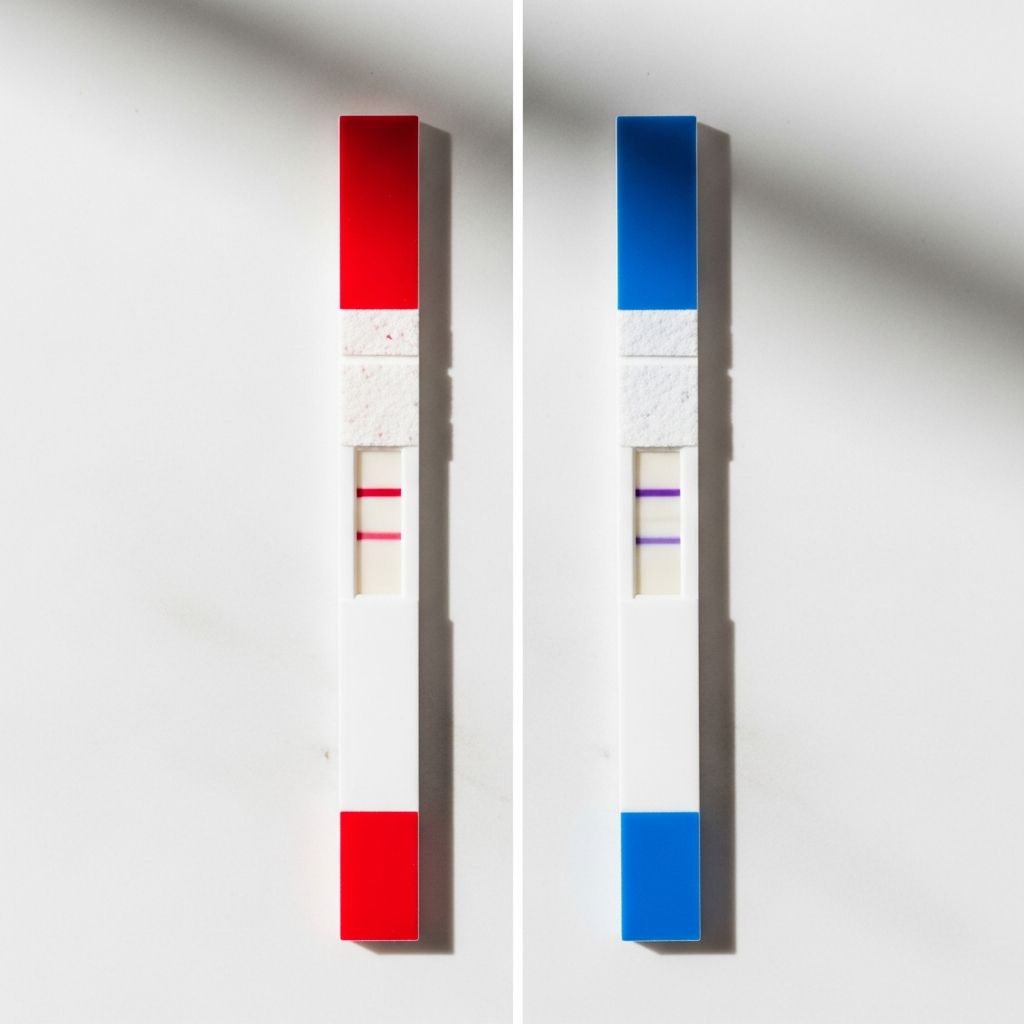
Home pregnancy tests are simple to buy and quick to use, but the choice between red (often called pink) dye and blue dye tests can be surprisingly confusing when you are staring at a drugstore shelf or anxiously testing at home.
How Home Pregnancy Tests Work
All over-the-counter pregnancy tests are designed to detect the hormone human chorionic gonadotropin (hCG) in urine, which appears after a fertilized egg implants in the uterus. The test strip contains antibodies that bind to hCG; when this reaction occurs, a dye is pulled across the strip to create a visible line or symbol in the result window.
Red/pink and blue dye tests use the same basic chemistry, but they differ in the color of the dye and often in how clear the result appears to the user. Digital tests also rely on hCG detection but translate the signal into words such as pregnant or not pregnant on a screen, instead of showing a line.
- All tests detect hCG, not the color of the dye itself.
- The main differences for users are readability, tendency to show confusing lines, and brand-specific sensitivity.
What Are Red (Pink) Dye Pregnancy Tests?
Red or pink dye pregnancy tests use a reddish dye to create the test and control lines, which many people find easy to see against the white background of the test strip. These tests often show a clear, crisp line when the hCG level is high enough to be detected.
Because the pink line contrasts strongly with the test background, very faint results can still look distinct, which may reduce user confusion when checking early or when squinting at the test from different angles.
Common Features of Red Dye Tests
- Typically display results as one control line and one test line.
- Often marketed for early detection, depending on brand sensitivity.
- Widely available as strip tests, midstream sticks, and combination packs.
What Are Blue Dye Pregnancy Tests?
Blue dye pregnancy tests use a blue or blue-gray dye to indicate results, usually in the form of lines or a plus symbol. The blue color can look bolder at first glance, but subtle, early test lines may appear more muted or hazy, which sometimes makes interpretation trickier.
Many well-known brands sell blue dye versions, and they may be placed prominently on store shelves, so it is common for first-time users to grab a blue dye test simply because it is the most visible box.
Common Features of Blue Dye Tests
- Often show results as a vertical blue line or a plus sign.
- May be available in both standard and rapid-detection formats.
- Are frequently grouped with digital tests in multipacks.
Main Differences Between Red and Blue Dye Tests
Although both types work on the same biochemical principle, users often notice real-world differences in how easy they are to read, how often they show confusing lines, and how early they seem to detect pregnancy. These differences are influenced by dye color, test design, and sensitivity of the particular brand.
The table below summarizes key distinctions many users care about when choosing a test at the pharmacy or online.
| Feature | Red / Pink Dye Tests | Blue Dye Tests |
|---|---|---|
| Typical readability of faint lines | Faint lines often appear clearly pink and easier to distinguish from the background. | Faint lines can look grayish or streaky, which may be harder to interpret. |
| Tendency for confusing evaporation lines | Perceived by many users as less prone to noticeable evaporation lines, especially when read on time. | Commonly reported online as more likely to show evaporation shadows that mimic positives if read late. |
| Brand sensitivity (varies by product) | Many popular pink dye brands offer relatively low hCG thresholds for early detection. | Some blue dye products are also sensitive, but often not marketed as aggressively for early testing. |
| Popularity in TTC communities | Frequently recommended by experienced testers and online forums. | Used widely, but often discussed with more caution due to readability concerns. |
| Result format | Usually two lines side by side in the same color family. | Lines or plus symbols; different directions of lines can add another layer of interpretation. |
Accuracy and Sensitivity: Is One Really Better?
When used correctly and at the right time, both red and blue dye pregnancy tests are designed to be highly accurate, often above 97% on or after the first day of a missed period according to many manufacturers. The hormonal threshold at which the test detects hCG is what primarily determines how early a result can appear, not the dye color itself.
Sensitivity is typically expressed in milli-international units per milliliter (mIU/mL). A test labeled as 10 or 15 mIU/mL may pick up pregnancy earlier than one at 25 or 50 mIU/mL, but users should still remember that implantation timing and personal hormone levels vary widely, which affects how soon a positive line will show.
- Check the package for the stated sensitivity level rather than assuming red or blue dye is automatically more accurate.
- Use first-morning urine for the highest hCG concentration, especially when testing very early.
Evaporation Lines and False Positives
A major concern in online communities is the “evap line” or evaporation line, which is a colorless or grayish mark that can appear after urine has dried on the test strip. This line is not a true positive; it simply reflects the path where the dye moved and dried.
Evaporation lines can appear on both red and blue dye tests, but many frequent testers feel that blue dye products show more prominent or confusing evap lines when the test is read outside the recommended time window. This can lead to unnecessary stress, retesting, and uncertainty about whether the result is real.
How to Reduce Confusion from Evaporation Lines
- Always read the result within the time frame listed in the instructions, usually 3–10 minutes.
- Discard and do not interpret tests that have sat for longer than the manufacturer specifies.
- If a line appears long after the window or looks colorless/gray, take it as invalid and test again later.
When to Use Red vs. Blue Dye Tests
Choosing between red and blue dye tests often comes down to personal preference and testing habits. People who test frequently and early, especially those tracking ovulation and symptoms closely, tend to favor tests with clear, easy-to-read lines and minimal risk of confusing evap lines.
By contrast, someone who tests closer to or after a missed period and is less likely to stare at the test for hours might feel comfortable using either type, or may switch to a digital test after a line-based test appears positive.
Situations Where Red Dye Tests May Be Preferred
- When you know you are likely to test before your missed period.
- If you have experienced confusing evaporation lines on previous tests.
- When you want a clear pink line that stands out from the background.
Situations Where Blue Dye or Digital Tests May Be Preferred
- If your local store only stocks certain brands and you need a test quickly.
- When you plan to confirm any faint line with a digital test that spells out the result.
- If you find the plus sign or bold blue line easier to notice at a glance.
Step-by-Step Tips for More Reliable Results
Regardless of which dye you choose, careful technique increases the odds of a clear result and reduces anxiety. Combining proper timing with careful reading and, when necessary, retesting, is more important than the color of the test line itself.
- Wait until the right time: If possible, test on or after the first day of your missed period for more dependable results.
- Use first-morning urine: Hormone concentration is often highest after several hours without urination.
- Follow instructions exactly: Pay attention to how long to dip or hold the test in urine and how long to wait before reading.
- Set a timer: Read the result at the recommended time, then discard the test so you are not tempted to interpret it later.
- Confirm faint lines: If you see a very faint but colored line, retest after 24–48 hours or back it up with a different brand or a digital test.
Cost, Availability, and Brand Choices
Red and blue dye tests span a wide range of price points. Name-brand tests often cost more per stick but may include digital options or specialized early-detection marketing, while generic or store-brand tests can be more affordable, especially when testing frequently.
Online retailers also sell bulk packs of strip-style red or blue dye tests, which can be especially appealing for people actively trying to conceive and testing often throughout their cycle.
- Compare price per test rather than just the sticker price on the box.
- Read user reviews for comments about line clarity and evaporation issues, not just the claimed sensitivity.
Frequently Asked Questions (FAQs)
1. Are red (pink) dye pregnancy tests more accurate than blue dye tests?
In terms of basic laboratory accuracy, both red and blue dye tests can be highly reliable when used according to the instructions and at the right time in the cycle. The dye color does not directly change the test’s ability to detect hCG, but user perception of line visibility and evaporation lines can influence how people interpret their results.
2. Why do people online recommend pink dye tests?
Many individuals in fertility and pregnancy communities prefer pink dye tests because they often find the pink lines easier to distinguish from the background and less likely to be confused with evaporation shadows. This preference is based largely on user experience and anecdotal reports rather than a fundamental chemical difference in accuracy.
3. Can a blue dye test give a false positive?
True false positives from any reputable home pregnancy test are rare, but blue dye tests have a reputation for more visible evaporation lines when read late, which can mimic a positive result. Reading within the specified time window and confirming any questionable line with another test or a digital option can help prevent misinterpretation.
4. Which test should I use for very early detection?
For early detection before a missed period, it is more important to select a test with a low hCG sensitivity threshold than to focus only on dye color. Many testers, however, still choose a sensitive pink dye test for early checks because faint pink lines may be easier to confirm as they darken over time with rising hCG.
5. Should I rely on a digital test instead?
Digital tests can be helpful when you want a clear yes/no answer without judging line intensity, but they are sometimes slightly less sensitive than certain dye tests and can cost more per use. A practical approach is to use dye tests for initial and repeated testing and then confirm with a digital test once a clear line appears, especially if you need a result to share with a partner or healthcare provider.
Key Takeaways for Choosing a Pregnancy Test
Red (pink) and blue dye pregnancy tests both detect the same pregnancy hormone and can deliver reliable results when used properly. The main differences that matter to users often involve readability, personal comfort with a particular design, and how easy it is to avoid misreading evaporation lines.
By focusing on test sensitivity, following directions carefully, reading results on time, and confirming questionable lines, you can feel more confident in your test choice—whether you reach for a red dye, blue dye, or digital pregnancy test.