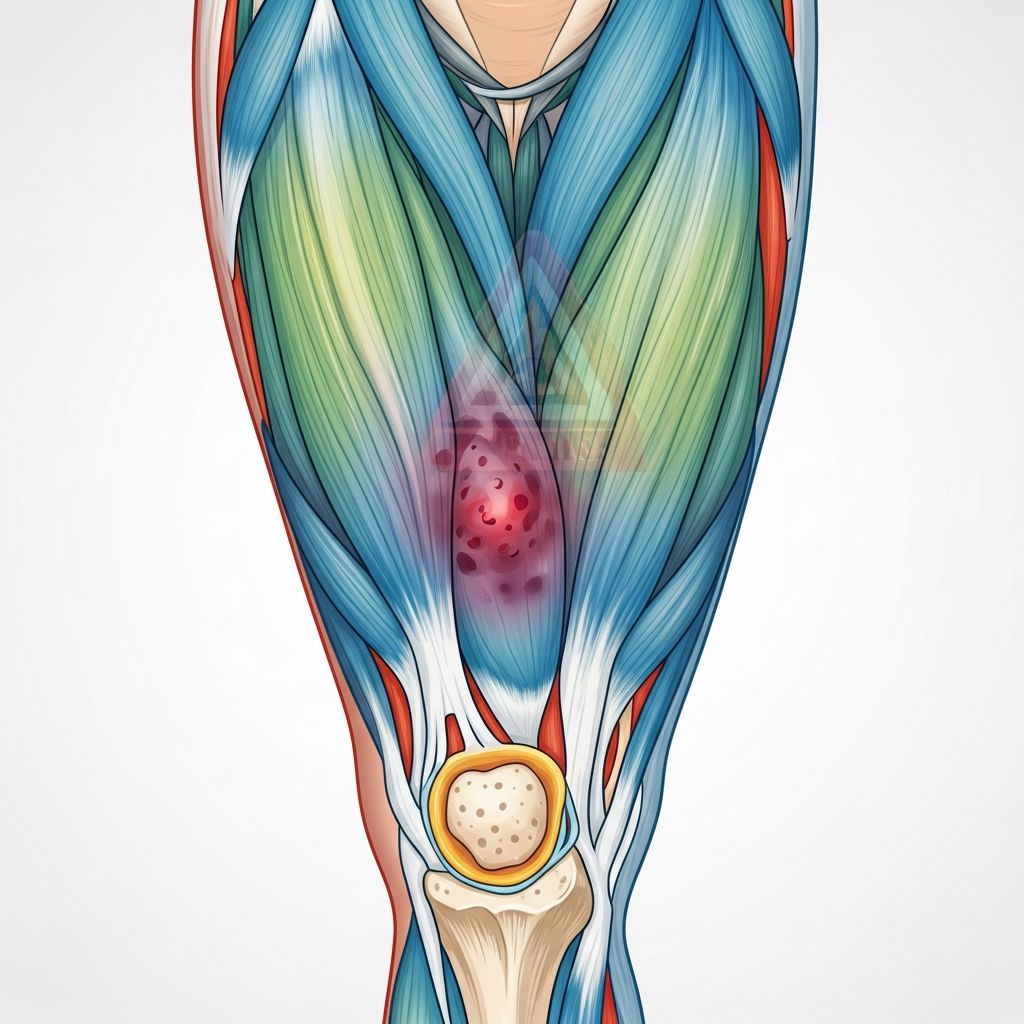
A hard hit to the front of the thigh during sports can leave you with more than just a simple bruise. When the big muscles at the front of your upper leg are badly bruised, it is called a quadriceps contusion or a deep thigh bruise.
This guide explains what happens inside the muscle, how to tell if your injury is serious, what to do in the first 48 hours, and how to get back to your usual activities safely.
What Are the Quadriceps?
The quadriceps (often shortened to “quads”) are a group of four muscles on the front of your thigh. They straighten your knee, help you run, jump, kick, and get up from a seated position.
- Location: Front of the upper leg, between the hip and the knee.
- Main jobs: Straightening the knee, stabilizing the knee joint, and helping you sprint, cut, and jump.
- Why they get hurt: They are large, active muscles and sit right under the skin, so direct hits easily damage them.
What Is a Quadriceps Contusion?
A quadriceps contusion is a deep bruise caused by a direct blow to the front of the thigh. Instead of a cut on the skin, the damage happens inside the muscle fibers and tiny blood vessels.
Blood leaks into the muscle tissue and surrounding area, causing swelling, pain, and sometimes a large, firm lump called a hematoma. The skin might look blue, purple, or yellow as the bruise develops.
How Do Quadriceps Contusions Happen?
These injuries usually happen in contact or high-speed sports where there is a risk of collisions or getting struck by equipment.
- Being kneed in the thigh while playing basketball or soccer.
- Getting hit by a helmet or shoulder pad during football or rugby.
- Falling directly onto the front of the thigh on a hard surface during skating, biking, or gymnastics.
- Being struck by a ball, puck, or stick in sports like baseball, hockey, or lacrosse.
The harder and more direct the impact, the more severe the contusion is likely to be.
Common Symptoms You Might Notice
Symptoms can show up quickly or build over several hours as swelling and bleeding inside the muscle increase.
- Immediate or gradually increasing pain in the front of the thigh.
- Visible bruise or discoloration that may change color over a few days.
- Swelling and a firm, sore area at the site of impact.
- Difficulty bending the knee fully or straightening it against resistance.
- Weakness when trying to run, jump, climb stairs, or get up from a squat.
- Stiffness, especially after sitting or when waking up the next day.
Severity Levels: Mild, Moderate, and Severe
Not all quad contusions are the same. Some feel like a bad charley horse, while others can make it hard to walk.
| Severity | Pain Level | Movement | Daily Impact |
|---|---|---|---|
| Mild | Achy but manageable; hurts with running or jumping | Can bend and straighten the knee almost fully | May limp slightly but can usually walk and go to school |
| Moderate | Clearly painful; walking and stairs are uncomfortable | Limited knee bending; squatting is hard or impossible | Noticeable limp; sports and gym class are usually off-limits |
| Severe | Sharp pain, especially with attempts at movement | Very restricted knee motion; sometimes cannot bend much at all | May need crutches; normal walking and daily tasks are difficult |
When to Seek Medical Help Right Away
Some quad contusions are minor and can be handled at home, but others need urgent evaluation.
Go to a doctor or emergency department urgently if:
- The pain becomes severe, especially if it feels tight or throbbing deep inside the thigh.
- You cannot walk more than a few steps without intense pain.
- The thigh looks significantly more swollen than the other side.
- The skin feels very tight, shiny, or unusually warm.
- You notice numbness, tingling, or weakness in the leg or foot.
- You develop a fever or feel generally unwell after the injury.
These signs can suggest complications such as compartment syndrome (dangerous pressure buildup in the leg) or other serious problems that must be treated quickly.
Home Care in the First 24–48 Hours
What you do right after the injury can affect how fast you recover and whether the muscle heals smoothly.
Use the R.I.C.E. Approach
- Rest: Stop playing or training immediately. Avoid running, jumping, or anything that increases pain.
- Ice: Apply a cold pack wrapped in a thin towel for 15–20 minutes at a time, several times a day. Do not put ice directly on skin.
- Compression: Use an elastic bandage or thigh sleeve to gently compress the area and limit swelling, without cutting off circulation.
- Elevation: When resting, prop the leg up on pillows so the thigh is slightly above heart level if possible.
Many healthcare providers also recommend keeping the knee gently bent during the early phase to reduce bleeding into the muscle. Your doctor may show you a safe position or provide a brace or wrap if needed.
Pain Relief and What to Avoid
Over-the-counter pain medicine can sometimes help, but always follow the label directions and check with a parent, guardian, or healthcare provider if you are unsure.
- Follow dosage instructions carefully for any medication.
- Avoid heat (hot packs, hot tubs, very hot showers) on the thigh in the first 48 hours, as it can increase bleeding and swelling.
- Do not massage the injured area early on, even if it feels tight, because this can worsen bleeding.
- Avoid alcohol, intense stretching, or heavy exercise while the area is still very sore and swollen.
What a Doctor or Sports Medicine Professional May Do
If you see a healthcare professional, they will usually start with questions and a physical exam focused on your thigh and knee.
- Asking how the injury happened and what sports you play.
- Checking for tenderness, swelling, and bruising.
- Testing how far you can bend and straighten your knee.
- Looking for signs of nerve or circulation problems.
In some cases, imaging such as an ultrasound or MRI may be ordered to see how deep the damage is or to check for a large hematoma or other issues.
Rehabilitation: From Rest to Full Activity
As the pain and swelling begin to settle, the focus shifts from protecting the muscle to gently using it again. Moving too quickly can delay healing, but staying too still can also lead to stiffness.
Early Movement Phase
- Start with pain-free range-of-motion exercises, such as gently bending and straightening the knee while seated or lying down.
- Try isometric contractions (tightening the quad without moving the knee), like pressing the back of the knee into the bed or floor.
- Walk short distances, increasing gradually as your pain allows.
Strength and Flexibility Phase
- Add light strengthening such as straight leg raises, mini-squats, and step-ups as approved by a professional.
- Include gentle stretching of the quadriceps and hamstrings to restore flexibility.
- Use low-impact cardio exercises, like stationary cycling or swimming, to maintain fitness if recommended.
Sport-Specific Phase
- When basic movements are pain-free, gradually add jogging, side-stepping, and light agility drills.
- Progress to sprinting, cutting, and jumping drills that simulate your sport.
- Only return to full competition when strength and movement on the injured side are close to or equal to the uninjured side.
How Long Does Recovery Take?
Healing time depends on the severity of the contusion, how quickly it is treated, and how well you follow your recovery plan.
- Mild contusions: Often improve noticeably within several days, with near-normal function in 1–2 weeks.
- Moderate contusions: May take 2–4 weeks before running and full sports participation feel comfortable again.
- Severe contusions: Can require many weeks or even a couple of months before you safely return to high-intensity activities.
Trying to rush back too soon can increase the risk of re-injury or complications, so it is important to listen to your body and your healthcare team.
Possible Complications (And Why Early Care Matters)
Most quadriceps contusions heal without long-term problems, but ignoring symptoms or returning to heavy activity too quickly can lead to complications.
- Persistent stiffness and weakness: If you skip rehab exercises, the thigh may stay tight and weak, raising your risk of future injuries.
- Large hematoma: A big pocket of blood in the muscle can cause ongoing pain and sometimes needs medical treatment.
- Myositis ossificans: In some cases, extra bone can start to form inside the bruised muscle, leading to a hard lump and limited motion.
- Compartment syndrome: Dangerous pressure buildup that threatens blood flow and nerve function; this is a medical emergency.
Early rest, ice, compression, and guided rehabilitation significantly reduce the chances of these problems and support a smoother recovery.
Preventing Quadriceps Contusions
Not every sports injury can be avoided, but you can lower your risk of serious quad bruises with smart habits and protective gear.
- Use proper protective equipment such as padded shorts or thigh pads in contact sports if recommended.
- Warm up thoroughly before practice and games with light cardio and dynamic stretches.
- Build muscle strength and balance in the hips, thighs, and core to better absorb impacts.
- Learn safe techniques for tackling, sliding, or taking contact in your sport.
- Report and rest minor injuries early instead of playing through significant pain.
Safe Return-to-Play Checklist
Before going back to full-speed practices or games, it helps to check a few boxes to make sure your thigh is truly ready.
- You can walk, climb stairs, and squat without pain.
- You can bend and straighten your knee almost as far as the uninjured leg.
- Your quadriceps strength feels nearly equal on both sides when doing exercises like squats or leg extensions (tested under guidance).
- Sport-specific drills (jogging, sprinting, cutting, jumping) do not cause a return of pain or limping.
- A healthcare or sports medicine professional has cleared you, especially after a moderate or severe contusion.
FAQs About Quadriceps Contusions
1. Is a quadriceps contusion the same as a charley horse?
A charley horse is usually a sudden, painful muscle cramp. A quadriceps contusion is a bruise caused by direct impact that damages muscle fibers and blood vessels. The pain may feel similar at first, but a contusion leads to swelling, discoloration, and longer-lasting soreness.
2. Can I keep playing if I can still walk?
Being able to walk does not mean it is safe to keep playing. Continuing intense activity on a freshly bruised quad can increase bleeding inside the muscle and turn a mild injury into a moderate or severe one. It is safer to stop, cool the area with ice, and get it checked if pain is more than mild.
3. Do I always need an X-ray or MRI?
Many quadriceps contusions can be diagnosed based on your story and a physical exam alone. Imaging tests are usually reserved for more severe cases, when there is concern about a bone injury, a very large hematoma, or complications that might need special treatment.
4. Could a quad contusion lead to permanent damage?
Permanent problems are uncommon when the injury is treated properly and rehab is completed. However, ignoring ongoing pain, forcing yourself through intense workouts too early, or skipping follow-up care can increase the risk of long-term stiffness, weakness, or abnormal bone growth in the muscle.
5. Is stretching good or bad after a thigh bruise?
Very early on, aggressive stretching can actually worsen bleeding and pain. Gentle, pain-free stretching becomes helpful later in the healing process to restore normal flexibility. The key is timing and following the guidance of your healthcare provider or physical therapist.
6. When should I worry about my bruise getting bigger?
Some spreading of color under the skin is normal in the first few days. But if swelling increases rapidly, the pain becomes intense, or the thigh starts to feel extremely tight or hard, you should seek medical attention quickly, as this can signal more serious internal bleeding or pressure problems.
Key Takeaways for Teens
- A quadriceps contusion is a deep bruise to the large thigh muscles caused by a direct hit.
- Pain, swelling, stiffness, and difficulty bending the knee are common signs.
- Early rest, ice, compression, and elevation can shorten recovery and lower the risk of complications.
- Gradual rehabilitation with stretching, strengthening, and sport-specific drills is crucial before returning to full-speed play.
- Listening to your body and your healthcare team helps protect your long-term performance and leg health.