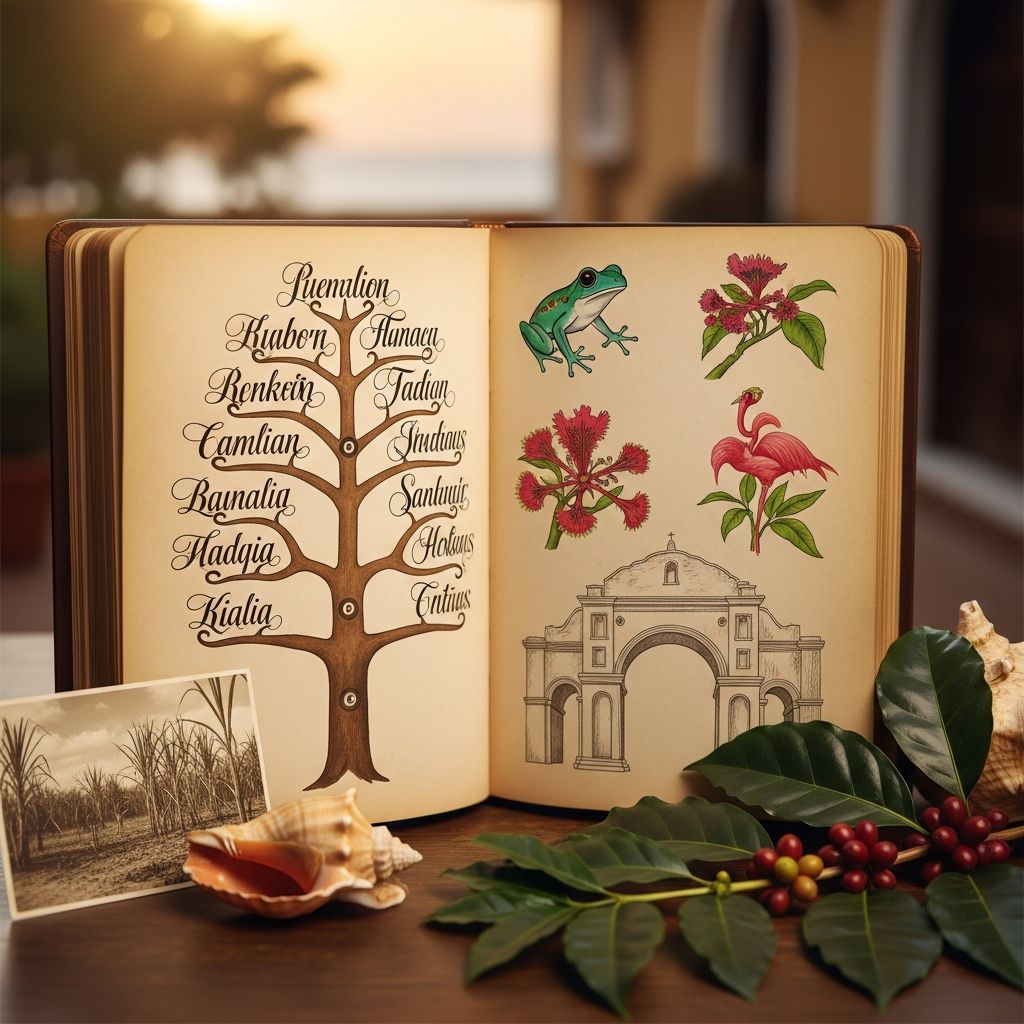
Puerto Rican last names are more than labels on official documents. They are living records of migration, colonization, resistance, and cultural blending that stretch from Indigenous Caribbean communities to modern-day families across the world.
This guide explains how Puerto Rican surnames developed, what common last names mean, and how to read and use them for family history, all in clear, practical language.
Why Puerto Rican Last Names Matter
Studying last names in Puerto Rico can help you:
- Trace family origins back to Spain, Africa, Indigenous Caribbean peoples, and other immigrant communities.
- Understand historical events such as Spanish colonization, slavery, and 19th-century immigration that shaped naming patterns.
- Decode records in church books, civil registries, and census documents using the double-surname system.
- Connect DNA test results with geographic and linguistic clues embedded in surnames.
The Double-Surname System in Puerto Rico
Like most Spanish-speaking societies, Puerto Rico traditionally uses two surnames instead of one. This custom is vital to understanding how families are recorded in official documents.
How the Two Last Names Are Formed
Under the traditional system, a child receives:
- The first surname from the father (his first last name).
- The second surname from the mother (her first last name).
Example format:
- First name + Father’s first surname + Mother’s first surname
So if a father is Carlos Rodríguez López and a mother is Ana Rivera Torres, a child might be registered as María Rodríguez Rivera.
Modern Variations and Hyphenation
In the United States and other places that typically use a single last name, Puerto Ricans often adjust their surnames to fit local systems:
- They may hyphenate the two last names, for example, Rodríguez-Rivera, so both are recognized as a joint family name.
- Some forms only capture the first surname, which can create confusion when trying to match records later.
- Recent practice in some Spanish-speaking regions allows parents to choose the order of surnames, emphasizing gender equality, though the two-name system remains central.
| Context | Typical Appearance of Last Names |
|---|---|
| Traditional record in Puerto Rico | First name + Father surname + Mother surname |
| U.S. school or medical form | First name + One surname (often father’s), or hyphenated double surname |
| Passport or legal documents | May show both surnames or a hyphenated form, depending on jurisdiction |
Historical Roots of Puerto Rican Surnames
Today, most common Puerto Rican last names are Spanish in origin, but that is only part of a much richer story.
Spanish Colonization and Naming Patterns
Spanish surnames arrived with the early waves of colonization at the end of the 15th century, when Spain established permanent settlements on the island then known as Borikén.
- European settlers brought hereditary surnames that were already common in Spain.
- These surnames were passed to their descendants and often to Indigenous Taíno and enslaved Africans, sometimes by force or administrative practice.
- Over time, Spanish civil and church authorities formalized how surnames appeared in records, which is why many Puerto Rican surnames today look distinctly Iberian.
Taíno, African, and Other Influences
While Spanish names dominate, Puerto Rican surnames reflect multiple histories:
- Taíno ancestry is more visible in given names and place names than in surviving surnames, because many Indigenous people were recorded under Spanish family names in colonial documents.
- African heritage is often encoded indirectly: enslaved people and their descendants frequently carried the surnames of slaveholders or baptismal sponsors, which were usually Spanish.
- Immigration in the 19th century (encouraged by Spanish decrees) brought newcomers from regions such as Corsica, France, and other parts of Europe, introducing non-Spanish surnames that remain in Puerto Rico today.
How Surnames Became Hereditary
Across Europe, surnames began as descriptive labels — for a job, a physical trait, or a place — and only gradually turned into fixed family names. Genealogical studies show that:
- Surnames emerged in Western Europe during the Middle Ages to distinguish people with the same given name as towns grew.
- At first, a “surname” might not pass to the next generation consistently, but by the late 15th and 16th centuries, hereditary surnames were the norm in Iberia.
- Puerto Rico inherited this more stable, hereditary naming system through Spanish colonization.
Types of Puerto Rican Surnames and What They Mean
Although every family has its own story, most Puerto Rican last names fall into a few broad categories based on their linguistic roots.
1. Patronymic Surnames (From a Father’s Given Name)
Patronymic surnames originated from a father or ancestor’s first name. In Spanish, these often end in -ez, which historically meant “son of.”
- Rodríguez – “son of Rodrigo.”
- González – “son of Gonzalo.”
- Hernández – “son of Hernán” or “Fernando.”
- Martínez – “son of Martín.”
Because such names were common among Spanish settlers, they became widespread in Puerto Rico and across Latin America.
2. Locative Surnames (From Places and Landscapes)
These surnames describe an original home region, town, or geographic feature.
- Rivera – “riverbank” or someone living near a river.
- Del Valle – “from the valley.”
- Del Río – “from the river.”
- Navarro – originally referring to someone from Navarra in Spain.
For family historians, these names can offer hints about where an ancestor’s line may have originated in Spain or elsewhere.
3. Occupational Surnames
Some surnames reflect a trade or social role, similar to “Smith” or “Baker” in English.
- Molina – linked to “molinero,” or miller.
- Herrera – from “herrero,” meaning blacksmith.
- Pastor – shepherd.
4. Descriptive or Nickname-Based Surnames
These surnames started as nicknames related to a physical trait, personality, or reputation.
- Delgado – “slender” or “thin.”
- Blanco – “white,” possibly referring to light hair or skin tone.
- Bravo – “brave” or sometimes “wild” or “fierce.”
5. Non-Spanish and Mixed-Origin Surnames
Not all Puerto Rican last names are purely Spanish. Historical migration brought other naming traditions to the island:
- Italian and Corsican surnames often end in -i or have distinct spellings reflecting clan-based naming customs.
- French surnames may preserve forms associated with settlers and merchants from nearby islands and Europe.
- Some surnames hint at Germanic influences that entered Spain centuries ago and later traveled to the Caribbean through Spanish families.
Common Puerto Rican Last Names and Their Significance
Government and genealogy data show that Puerto Rico shares many of the most frequent surnames found across the Spanish-speaking world, especially of Iberian origin.
Here are examples of widely encountered surnames and simplified meanings:
- Rodríguez – patronymic “son of Rodrigo.”
- Rivera – associated with riverbanks or riverside towns.
- García – very common Iberian surname, possibly from an old Basque given name.
- Martínez – “son of Martín.”
- Hernández – “son of Hernán/Fernando.”
- Colón – “colonist” or derived from the surname used by families linked symbolically or historically to Christopher Columbus.
Using Puerto Rican Last Names for Genealogy
Because Puerto Rican naming customs preserve both paternal and maternal lines, they are a powerful tool for building a family tree.
Reading Names in Historical Records
When you find a record such as a baptismal certificate or marriage entry, look closely at how surnames appear:
- Each person typically appears with two surnames — learning which is paternal and which is maternal helps you link individuals across documents.
- Some records may abbreviate or omit second surnames over time, especially in non-Spanish-speaking jurisdictions.
- Spelling variations are common; listen for the sound of the name rather than focusing only on one exact spelling.
Connecting Surnames and DNA
Modern DNA testing often pairs genetic results with surname analysis:
- Shared rare surnames between matches can indicate a more recent common ancestor.
- Locative surnames can suggest geographic origins that align with DNA ethnicity estimates.
- Knowing that many enslaved people and Indigenous people were recorded under Spanish surnames helps explain why a family may have deep Caribbean ancestry despite Iberian-sounding last names.
Frequently Asked Questions About Puerto Rican Last Names
Why do many Puerto Rican people have two last names?
Puerto Rico follows the traditional Spanish naming system, where children inherit the first surname of each parent. One comes from the father, one from the mother, so both family lines remain visible in official records.
Are all Puerto Rican last names Spanish?
No. While most common surnames are Spanish, Puerto Rican last names also reflect African heritage, Indigenous ancestry recorded under Spanish names, and immigrants from places like Corsica, Italy, and France during the 19th century.
Why do some forms only show one of my last names?A: Many non-Spanish-speaking countries only expect one surname. When Puerto Ricans fill out such forms, systems may drop the second surname or treat it as a middle name. Some people avoid this by hyphenating their two surnames into a single compound name.
Q: Can the order of the two surnames be changed?
In some modern legal systems, parents can decide whether the father’s or the mother’s surname appears first, often as a way to promote gender equality. However, the idea of preserving two surnames — one from each parent — remains core to the tradition.
How can I start researching my Puerto Rican family names?
Begin with the full two-surname names of parents and grandparents, then look for church records, civil registrations, and census documents that match those combinations. Guides from major genealogical organizations provide step-by-step help for reading Puerto Rican name patterns and historical sources.
References
- Etymological Pedigree: Surname Origins — BoricuaGenes. 2023-05-01. https://boricuagenes.com/etymological-pedigree-surname-origins/
- Puerto Rico | Family History Learning Hub — Ancestry. 2023-10-01. https://www.ancestry.com/c/family-history-learning-hub/puerto-rico
- Puerto Rican Surnames — PuertoRicanGenealogy (Weebly). 2022-07-15. https://puertoricangenealogy.weebly.com/surnames.html
- Puerto Rico Naming Customs — FamilySearch Research Wiki. 2020-09-24. https://www.familysearch.org/en/wiki/Puerto_Rico_Naming_Customs
- Being Puerto Rican: Traditions and Genealogy — MyHeritage Blog. 2025-08-05. https://blog.myheritage.com/2025/08/being-puerto-rican-traditions-and-genealogy/