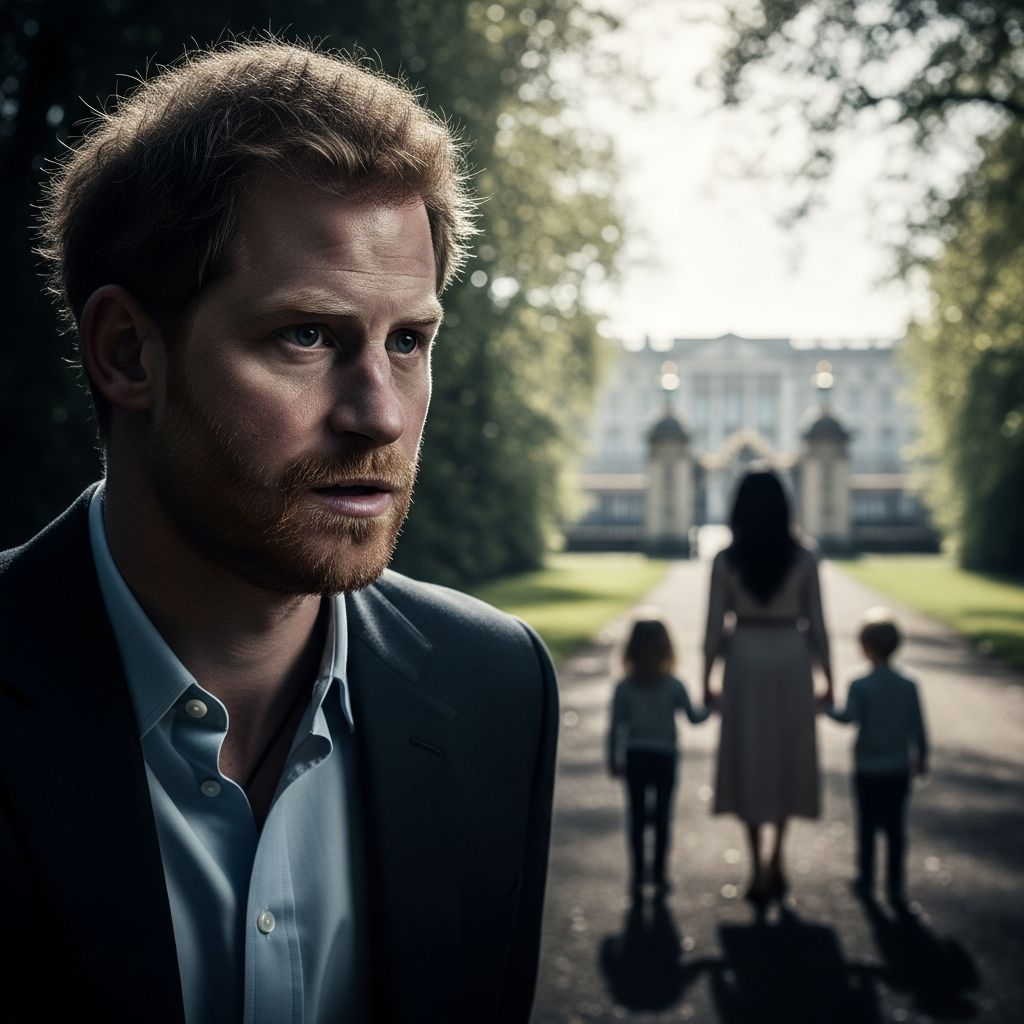
Prince Harry’s recent court testimony has shed new light on the tumultuous decision to step away from senior royal responsibilities. Far from a voluntary choice, the Duke of Sussex asserts that he and his wife, Meghan Markle, were compelled to prioritize their family’s well-being over continued service to the monarchy. This revelation emerged during a High Court hearing in London, where Harry’s legal team challenged the downgrade of his state-funded police protection during UK visits.
The Compelled Departure: A Decision Born of Desperation
In early 2020, the world watched as Harry and Meghan announced their intention to transition to a more independent role within the royal framework. What was dubbed ‘Megxit’ appeared as a bold step toward financial autonomy while maintaining ties to Queen Elizabeth II. However, court documents now paint a starkly different picture: the couple felt unprotected by the royal institution itself, prompting their exit.
Harry’s barrister, Shaheed Fatima KC, emphasized that on January 8, 2020, the pair believed they had no alternative but to withdraw from full-time duties. They expressed a desire to support the late Queen as privately funded royals, yet institutional barriers made this untenable. The Duke’s written statement poignantly captures the emotional toll: ‘It was with great sadness for both of us that my wife and I felt forced to step back from this role and leave the country in 2020.’
Security Concerns at the Heart of the Rift
Central to Harry’s narrative is the erosion of security provisions. Upon relinquishing working royal status and relocating to the United States, his protection level was adjusted by the Royalty and VIP Executive Committee (Ravec). No longer entitled to the same automatic coverage as active royals, Harry now receives ‘bespoke’ arrangements assessed case-by-case—a process his lawyers deem discriminatory and inferior.
- Pre-2020 Status: Full-time police protection as a senior royal.
- Post-Megxit: Downgraded to tailored, non-automatic security.
- Harry’s Objection: Argues this ‘bespoke’ label masks unfair treatment without proper risk evaluation.
During the hearing, Fatima KC contested Ravec’s methodology, noting it deviated from standard procedures applied to others. She asserted, ‘The appellant does not accept that bespoke means better. In fact, in his submission, it means that he has been singled out for different, unjustified and inferior treatment.’ This claim underscores Harry’s belief that his unique profile—marked by military service and high visibility—warrants consistent safeguards.
Persistent Threats and Personal Risks
Harry’s security fears are not abstract. Court submissions reference specific dangers, including an Al-Qaeda call for his murder following the 2020 security changes. His memoir Spare further amplified risks by disclosing his service in Afghanistan, where he neutralized 25 Taliban fighters—details that reportedly escalated online vitriol and real-world perils.
These elements compound the vulnerability felt by Harry, who refuses to expose Meghan or their children, Archie and Lilibet, to harm. ‘I cannot put my wife in danger like that and, given my experiences in life, I am reluctant to unnecessarily put myself in harm’s way too,’ he stated. The UK remains integral to his children’s heritage, yet safety concerns bar safe visits.
| Factor | Impact on Security | Source |
|---|---|---|
| Military Background | Increased targeted threats post-Spare | |
| High-Profile Status | Lifelong risks from royal association | |
| Family Presence | Heightened need for child protection | |
| Al-Qaeda Threat | Direct calls for violence |
Legal Battle: Challenging Government Decisions
This marks the latest chapter in Harry’s protracted litigation. A 2024 High Court ruling upheld Ravec’s decision as lawful, prompting an appeal. The two-day London hearing, partially private due to sensitive details, saw opening arguments in public. Harry’s team seeks to prove procedural unfairness and inadequate threat assessment.
Though Harry attended the April 8, 2025, session at the Royal Courts of Justice, subsequent days focused on submissions without his presence. Judge Sir Geoffrey Vos managed time constraints, highlighting the case’s complexity. Outcomes could redefine security protocols for non-working royals.
Family Legacy and Emotional Stakes
Beyond legalities, Harry’s stance reflects profound familial priorities. He envisions the UK as central to Archie and Lilibet’s identity—a homeland they cannot safely embrace. This resonates with parents worldwide navigating protection amid public scrutiny. Stepping back, though saddening, was framed as essential for their stability in California.
The Duke’s insistence on the UK as ‘my home’ reveals lingering affection amid estrangement. Yet, unresolved security issues perpetuate distance from royal circles and extended family.
Broader Implications for the Monarchy
Harry’s case probes the monarchy’s duty to ex-members. It questions how institutions adapt to evolving threats in a digital age, where profiles persist post-departure. Comparisons arise with other VIPs, but Harry’s royal lineage and service set him apart.
Public discourse often frames Megxit as personal ambition, yet court evidence reframes it as institutional failure in safeguarding. This could influence future arrangements for royals seeking semi-independent paths.
Public Reaction and Media Scrutiny
Media coverage has been intense, with outlets dissecting every filing. Supporters view Harry as a protective father; critics question taxpayer burdens. The hearing’s partial privacy shields threat specifics, fueling speculation.
Future Outlook: Resolution on the Horizon?
As the appeal concludes, rulings may affirm or alter Harry’s protections. Success could restore fuller coverage; defeat might solidify case-by-case norms. Regardless, it amplifies Harry’s voice on mental health, privacy, and paternal duties—themes echoing his post-royal endeavors.
Frequently Asked Questions
Why did Prince Harry step back from royal duties?
Harry claims he and Meghan were forced to leave due to insufficient institutional protection, prioritizing family safety despite sadness over the decision.
What security changes occurred after Megxit?
Harry’s protection shifted from automatic full royal coverage to bespoke, case-by-case arrangements by Ravec, which he contests as unfair.
Is Prince Harry still fighting for UK security?
Yes, in a 2025 Court of Appeal hearing, he challenges a prior ruling dismissing his Home Office claim.
How do threats factor into Harry’s case?
Documented risks include Al-Qaeda murder calls and backlash from his Afghanistan revelations in Spare.
Can Harry and his family safely visit the UK?
Harry argues current arrangements prevent safe visits, hindering his children’s connection to their UK heritage.
References
- Prince Harry says he was ‘forced’ to ‘step back’ from royal duties — The Independent. 2025-04-11. https://www.independent.co.uk/life-style/royal-family/news/prince-harry-secret-high-court-case-b2460257.html
- Harry, Meghan ‘forced’ to step back from royal duties — The New Daily. 2025-04-09. https://www.thenewdaily.com.au/life/entertainment/celebrity/royal/2025/04/09/harry-meghan-forced-to-step-back-from-royal-duties
- Prince Harry and Meghan Markle felt they were ‘forced to step back’ — Times of India. 2025-04-09. https://timesofindia.indiatimes.com/life-style/relationships/family/prince-harry-and-meghan-markle-felt-they-were-forced-to-step-back-from-royal-duties-his-lawyer-tells-uk-court/articleshow/120100917.cms