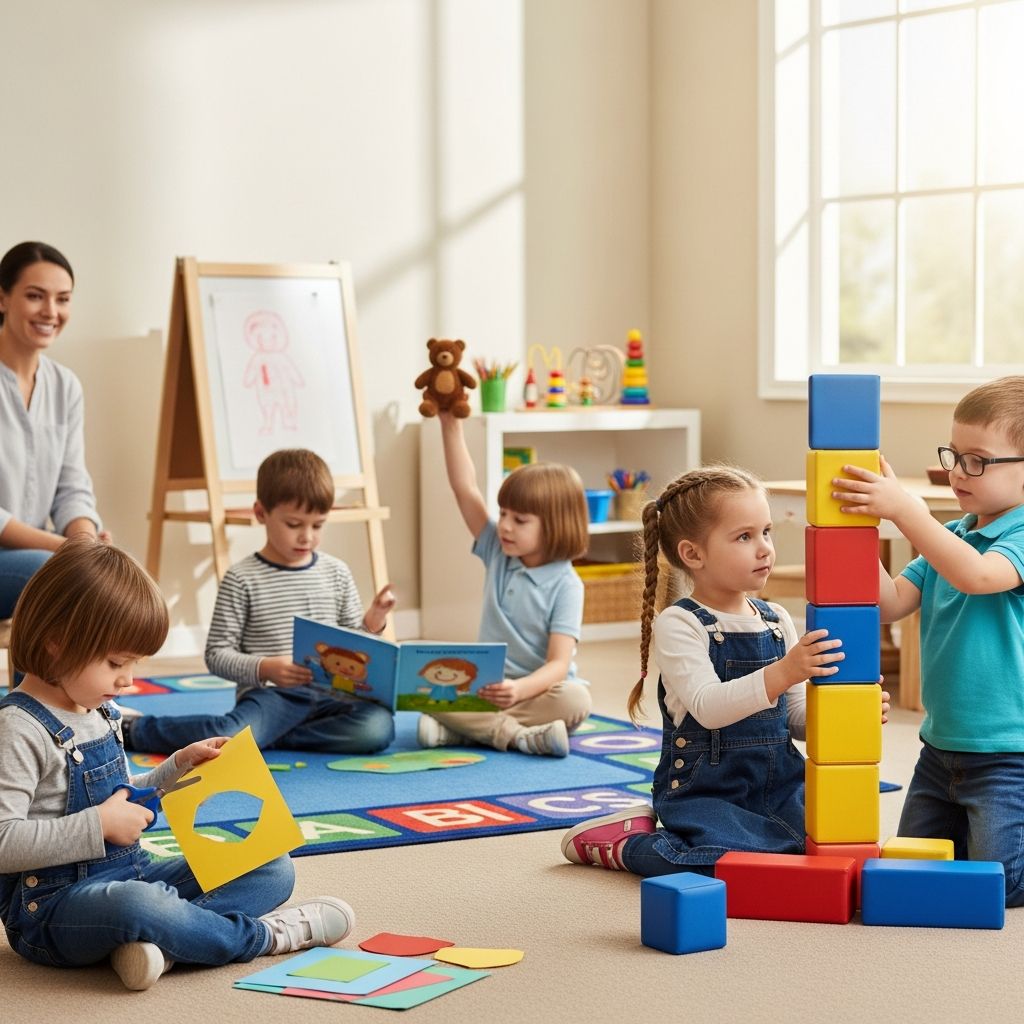
Preschool serves as a critical bridge between home and formal schooling, where children aged 3 to 5 build foundational abilities that influence their future academic and personal success. Through structured play, guided activities, and interactive exploration, young learners develop cognitive, social-emotional, physical, language, mathematical, scientific, artistic, and practical life skills. These competencies not only prepare children for kindergarten but also foster independence, curiosity, and resilience.
Building Strong Foundations Through Play-Based Learning
At the heart of preschool education lies play-based learning, which integrates fun with purposeful skill-building. Educators design daily routines blending free play, group circles, and hands-on projects to target multiple developmental areas simultaneously. This approach stimulates brain growth during peak neuroplasticity periods, helping children form neural connections essential for problem-solving and self-regulation. Parents can support this at home by providing open-ended toys like blocks and puzzles that encourage creativity without rigid instructions.
Research from early childhood frameworks emphasizes holistic growth, ensuring no single area overshadows others. For instance, a balanced day might include outdoor movement, storytime, and collaborative art, promoting well-rounded progress. Understanding these elements empowers parents to align home activities with classroom goals, reinforcing learning seamlessly.
Cognitive Growth: Sparking Curiosity and Critical Thinking
Cognitive development in preschool focuses on nurturing inquiry, memory, and reasoning. Children learn to observe, question, and experiment, laying groundwork for logical thinking. Key objectives include recognizing patterns, solving simple puzzles, and making connections between ideas.
- Explore cause-and-effect through stacking blocks or mixing colors.
- Practice memory by recalling sequences in songs or games.
- Develop flexibility by adapting to rule changes in play scenarios.
- Demonstrate persistence in completing multi-step tasks like building a tower.
These skills build executive function, enabling children to focus, plan, and self-correct. Programs often use thematic units, such as ‘weather wonders,’ to integrate concepts across subjects, making abstract ideas tangible. By year’s end, most preschoolers show improved attention spans and inventive problem-solving.
Social-Emotional Development: Nurturing Empathy and Independence
Social-emotional learning equips children to navigate relationships and manage feelings. Preschoolers practice sharing, expressing emotions, and resolving conflicts, fostering empathy and self-awareness[10].
Common milestones include:
- Identifying basic emotions like happy, sad, or frustrated.
- Taking turns and cooperating in group games.
- Using words to articulate needs instead of tantrums.
- Building friendships through role-play and team projects.
- Practicing self-control, such as waiting for a turn.
Educators model positive interactions and use tools like emotion charts or puppet shows to teach perspective-taking. This domain is vital, as strong emotional regulation predicts better academic outcomes and mental health. Challenges like separation anxiety are addressed through consistent routines and parent communication.
Physical Development: Mastering Movement and Coordination
Physical skills divide into gross motor (large muscles) and fine motor (small muscles), both crucial for daily independence and confidence. Gross motor activities like running, jumping, and climbing enhance balance and strength, while fine motor tasks build dexterity.
| Skill Type | Examples | Benefits |
|---|---|---|
| Gross Motor | Skipping, throwing balls, balancing on one foot | Improves coordination, spatial awareness, health |
| Fine Motor | Using scissors, buttoning clothes, drawing shapes | Enhances precision, supports writing readiness |
Outdoor play and obstacle courses are staples, with indoor options like threading beads for rainy days. Progress is evident when children independently zip jackets or pour drinks, signaling kindergarten readiness. Health practices, such as handwashing, are woven in to promote lifelong habits.
Language and Literacy: Unlocking Communication and Reading Readiness
Language blooms in preschool through rich conversations, books, and songs. Objectives target vocabulary expansion, listening skills, and phonemic awareness—understanding sounds in words.
- Retell simple stories with beginning, middle, and end.
- Recognize and name letters, especially in their own name.
- Engage in rhyming games and identify initial sounds.
- Participate in show-and-tell to build expressive skills.
- Understand print concepts, like reading left to right.
Daily read-alouds expose children to diverse narratives, boosting comprehension and imagination. Writing begins with scribbles evolving to letter formation, often using sand trays for sensory fun. Bilingual programs enhance cognitive flexibility for dual-language learners.
Early Mathematics: Numbers, Shapes, and Patterns
Math in preschool demystifies numbers through play, developing number sense and spatial reasoning. Children count objects, compare quantities, and sort by attributes.
Core goals:
- Count verbally to at least 20 and recognize numerals.
- Match quantities one-to-one, like placing one block per spot.
- Identify basic shapes (circle, square, triangle) and describe them.
- Recognize and extend simple patterns, e.g., red-blue-red-blue.
- Understand positional words: over, under, beside.
Activities like board games or measuring ingredients make math engaging. These foundations prevent later gaps, as early numeracy strongly correlates with school achievement.
Science and Discovery: Exploring the World Around Us
Preschool science ignites wonder via hands-on investigations. Children use senses to observe plants growing, magnets attracting, or water changing states.
- Investigate living things, like animal needs and life cycles.
- Experiment with physical properties, such as sink/float tests.
- Observe weather patterns and seasonal changes.
- Use simple tools like magnifying glasses or balances.
Social studies complement this with community roles, maps, and cultural celebrations, broadening worldviews.
Creative Arts: Expression Through Art, Music, and Movement
Arts foster imagination and self-expression. Children explore paints, clay, instruments, and dance, learning no ‘right’ way exists.
- Create freely with various materials.
- Respond to music through clapping or moving.
- Dramatize stories with props.
- Appreciate diverse artistic styles.
These outlets build confidence and emotional processing.
Daily Routines and Life Skills: Fostering Independence
Practical skills like dressing, cleaning up, and healthy eating routines promote autonomy. Structured schedules provide security, with transitions smoothed by songs.
Frequently Asked Questions
What age group does preschool typically serve?
Preschool generally targets children aged 3 to 5, preparing them for kindergarten entry.
How can parents support preschool learning at home?
Read daily, play counting games, encourage outdoor activity, and discuss emotions.
What if my child struggles with separation?
Short goodbyes, consistent drop-offs, and teacher communication ease this common phase.
Are preschool goals standardized nationwide?
While state guidelines vary, core domains like those in Head Start align nationally.
How do I know if my child is on track?
Use kindergarten readiness checklists focusing on self-help, social skills, and basic academics.
References
- Essential Preschool Learning Objectives for Holistic Child Development — Brightwheel. 2023. https://mybrightwheel.com/blog/preschool-learning-objectives
- Pre-K Academic Goals — St. Jude Early Learning Ministry. 2024. https://www.stjude-elm.org/about-us-elm/prekindergarten/pre-k-academic-goals
- Preschool Curriculum — Purdue ELM. 2025. https://elmcurriculum.org/preschool/
- A Guide to Preschool Learning Objectives (Ages 2-5) — TS Anywhere. 2024. https://www.tshanywhere.org/post/preschool-education-goals-learning-objectives
- Preschool Learning Objectives — Sioux City Community Schools. 2023. https://www.siouxcityschools.org/page/preschool-learning-objectives