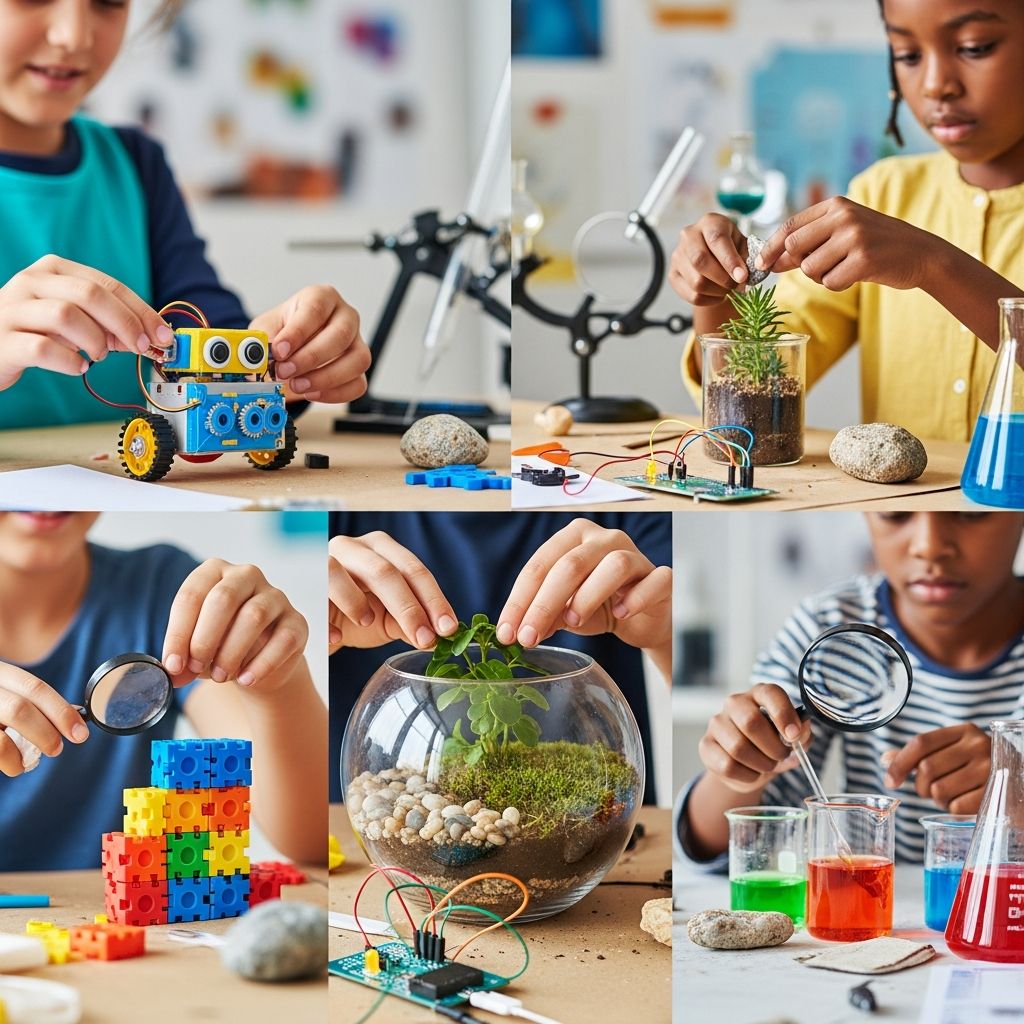
Engaging Children Through Practical STEM Craft Projects
In an increasingly technology-driven world, introducing children to STEM concepts early creates a foundation for lifelong learning and innovation. Rather than limiting STEM education to textbooks and classroom lectures, hands-on craft projects provide an accessible entry point where children can explore scientific principles, engineer solutions, and develop mathematical reasoning through creative play. These practical activities transform abstract concepts into tangible experiences, allowing young learners to see immediate results from their efforts and develop confidence in their ability to understand complex ideas.
The beauty of STEM crafts lies in their flexibility and accessibility. Most projects require materials already found in household drawers or easily purchased at minimal cost. By combining creativity with scientific inquiry, these activities demonstrate that learning extends far beyond the classroom and that curiosity can be nurtured anywhere—at home, in community centers, or during family gatherings.
Why STEM Crafts Matter for Child Development
STEM craft activities serve multiple developmental purposes simultaneously. When children engage in hands-on projects, they develop fine motor skills through cutting, gluing, and assembling materials. They strengthen cognitive abilities by following instructions, troubleshooting problems, and adapting their approach when initial attempts don’t produce desired results. These projects also build resilience and persistence—essential traits in any field—by encouraging children to view failures as learning opportunities rather than setbacks.
Beyond skill development, STEM crafts foster collaborative learning. When children work together on projects, they learn to communicate ideas, negotiate approaches, and appreciate different perspectives. These social-emotional benefits complement the academic advantages, creating well-rounded learning experiences that prepare children for future success in classroom and professional environments.
Polymer Science Through Slime Creation
One of the most accessible and engaging STEM crafts involves creating slime, which introduces children to polymer chemistry in a format that feels like pure play. Slime demonstrates how simple chemical reactions combine basic household ingredients into a substance with completely unexpected properties. When children mix glue, activator solution, and water, they witness polymers—long chains of molecules—forming bonds that create that distinctive stretchy, satisfying texture.
This hands-on experience with polymers helps demystify chemistry. Rather than memorizing definitions of molecular chains, children see and feel how these structures behave. They observe that varying the proportions of ingredients produces different textures, introducing concepts about how chemical composition affects material properties. The sensory nature of working with slime—the tactile feedback, the visual transformation, the surprising elasticity—creates memory anchors that help children retain what they’ve learned.
Educational benefits extend beyond basic chemistry. Making slime naturally introduces measurement and ratios. When following recipes, children learn to read measurements carefully and understand that precision matters in scientific work. They can experiment with adding food coloring to explore color mixing and absorption, connecting chemistry with visual arts.
Understanding Weather Systems with Tabletop Experiments
Creating a miniature weather system in a clear container transforms abstract meteorological concepts into observable phenomena. Using basic materials—a jar, water, food coloring, shaving cream, and perhaps glitter—children can visualize the water cycle and see how weather actually works on a small scale. When shaving cream represents clouds and colored water represents precipitation, children grasp how water moves through the atmosphere in ways that diagrams alone cannot convey.
This experimental approach makes weather science personal and tangible. Rather than learning that “condensation occurs when water vapor cools,” children see clouds forming in their jar and watch “rain” fall when the weight of accumulated water becomes too heavy for the cloud layer to support. This direct observation creates deeper understanding because children witness cause-and-effect relationships in real time.
The activity also introduces basic scientific method principles. Children make predictions about what will happen before conducting the experiment, observe actual results, and discuss why their predictions were accurate or inaccurate. This reflective process develops critical thinking skills and encourages the kind of evidence-based reasoning that characterizes scientific thinking.
Mechanical Engineering Through Artistic Innovation
Combining engineering with creativity, children can build spinning art machines using simple mechanical components. By attaching markers to the spinning motor of a device and placing paper at the center, children create intricate artistic patterns while learning about rotational motion and mechanical energy. This project elegantly demonstrates that engineering and art are not separate disciplines but can combine to create something neither could produce alone.
As children construct their spinning devices, they encounter practical engineering challenges: How do you balance the spinning platform? What speed creates interesting patterns versus chaotic ones? How can you ensure markers stay in place while rotating? Solving these problems requires hands-on problem-solving and iteration—children test approaches, observe results, and refine their designs.
The mathematical elements emerge naturally. Children observe how the distance from the center affects the size and shape of patterns created. They notice that the speed of rotation determines whether lines appear smooth or jagged. They might measure angles between spinning arms or count rotations to understand rotational speed. All these concepts emerge from genuine curiosity about how their creation works rather than from forced mathematical instruction.
Physics and Sustainability Through Wind-Powered Design
Building wind-powered vehicles introduces children to renewable energy, physics principles, and sustainable thinking—all within a single engaging project. Using household materials like plastic cups, straws, and paper, children design cars that harness wind power, teaching them about force, motion, and aerodynamics. This project immediately makes abstract physics concepts relevant by producing a working model children can test and modify.
The design process naturally incorporates the engineering method. Children start by examining how wind affects objects, then hypothesize about vehicle designs that would capture wind efficiently. They construct initial prototypes, test them, observe performance, and identify improvements. Perhaps the body shape needs adjustment for better aerodynamics, or the wheels need modification for smoother rolling. Each modification teaches cause-and-effect relationships and reinforces that engineering involves iteration and refinement.
Beyond physics, this project introduces environmental consciousness. Discussing renewable energy—why wind power matters, how it differs from fossil fuels—connects children’s craft to global sustainability issues in age-appropriate ways. Children understand that the wind-powered car they built demonstrates real technology being used to generate electricity and power vehicles worldwide.
Practical Tips for Successful STEM Craft Experiences
Creating conditions for successful STEM crafts involves more than gathering materials. Consider the following approaches:
- Preparation and Workspace: Set up organized workspaces with all necessary materials arranged accessibly. Having supplies ready prevents frustration and allows children to focus on the learning experience rather than searching for items.
- Clear Instructions with Flexibility: Provide step-by-step guidance while remaining open to creative modifications. Children learn more when they understand the process but feel empowered to experiment with variations.
- Managed Expectations: Help children understand that STEM crafts may not produce perfect results immediately. Embrace “failures” as data points that inform future attempts, reinforcing growth mindset principles.
- Documentation and Reflection: Encourage children to photograph or sketch their work and discuss what they learned. This reflection deepens understanding and helps children articulate their learning process.
- Safety Considerations: Always supervise appropriately based on child age and activity type. Ensure any chemical experiments use food-grade or non-toxic materials, and follow safety guidelines for electrical components or sharp tools.
Adapting STEM Crafts for Different Age Groups
While the fundamental concepts behind STEM crafts remain consistent, presentation and complexity should match developmental stages. Younger children (ages 4-7) benefit from simpler projects with fewer steps, emphasis on sensory exploration, and direct adult guidance. Projects like making slime or simple weather jars allow this age group to observe scientific phenomena without requiring complex reading or advanced coordination.
Older elementary students (ages 8-11) can handle more intricate instructions and longer project timelines. They’re ready for projects requiring measurement precision, sequential planning, and troubleshooting. Wind-powered vehicles and spinning art machines suit this age group’s emerging ability to understand mechanical systems and adapt designs based on testing.
Middle and high school students can tackle more sophisticated versions of basic concepts—perhaps building more complex vehicles, exploring polymer chemistry in greater depth, or integrating programming into their projects. The underlying activities remain the same, but complexity and depth increase to match cognitive dev