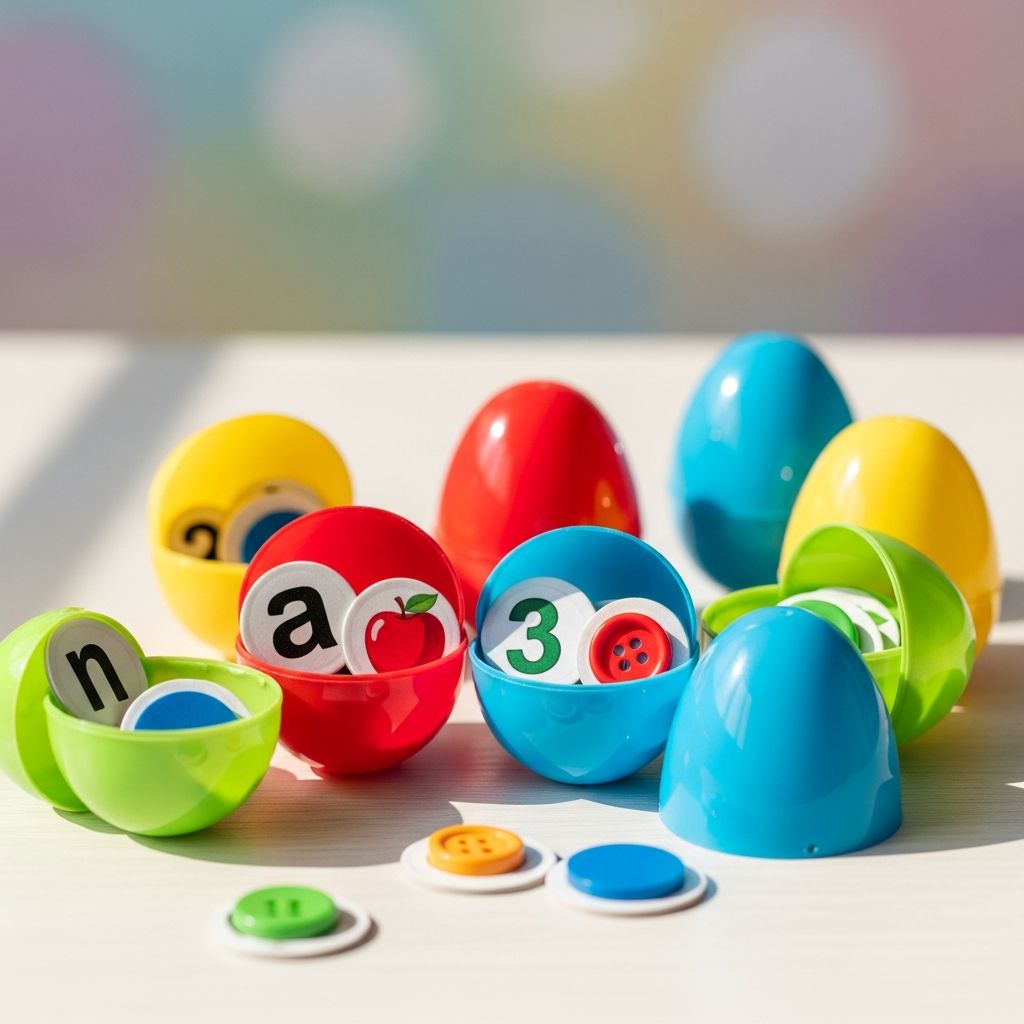
Those brightly colored plastic Easter eggs hanging around after the holiday can be so much more than just candy containers. With a bit of creativity, you can transform them into a reusable memory and matching game that keeps kids busy, supports learning, and gives those eggs a second life.
This guide walks you through how to create an original egg match-up game, ways to adapt it for different ages, and ideas for turning simple play into sneaky learning.
Why Turn Plastic Eggs into a Matching Game?
Matching and memory games are more than entertainment. Research on early childhood play shows that hands-on, playful activities help build attention, working memory, and self-regulation, all of which are foundational for later academic success. Simple games that ask kids to notice patterns or remember object locations can strengthen these skills in age-appropriate ways.
Reusing plastic eggs for a matching game also offers:
- Low-cost fun – Use items you already own.
- Less waste – Give holiday leftovers a new purpose.
- Family bonding – Craft and play together across ages.
- Customizable learning – Adjust difficulty with colors, pictures, numbers, or words.
What You Need to Get Started
You can make this game as simple or as elaborate as you like. At its most basic, you just need plastic eggs and matching pairs of something to hide inside.
| Item | Purpose | Suggested Alternatives |
|---|---|---|
| Plastic Easter eggs (at least 12 halves) | Game shells for hiding pictures or objects | Paper egg cutouts, small cups, or muffin tin cavities |
| Cardstock or thick paper | Drawing or writing matching symbols | Sticker sheets, thin cardboard from cereal boxes |
| Markers, crayons, or colored pencils | Decorating eggs and symbols to match | Stickers, paint pens |
| Scissors | Cutting small picture or symbol cards | Pre-cut stickers or labels that fit inside eggs |
| Optional: glue dots or tape | Attach symbols inside egg tops and bottoms | Removable adhesive putty |
If you want a version that uses objects instead of drawings, gather pairs of small, safe items like buttons, beads, or pom-poms and skip the drawing step entirely.
Step-by-Step: Create Your Egg Match-Up Set
Use these steps as a framework and adjust as needed based on the supplies you have and the ages of the kids playing.
1. Decide What Will Match
Before you decorate anything, choose the type of matches you want to include. Consider the skill level of your players:
- For toddlers: Simple color blocks, basic shapes (circle, star, heart), or familiar pictures (sun, house).
- For preschoolers: Patterns (stripes vs. dots), simple counting pictures (1–5 objects), or basic emotion faces.
- For early elementary kids: Numbers and dots, upper and lowercase letter pairs, simple sight words, or simple equations and answers.
Choose 6–10 different matches to start. Each “pair” will have one symbol in the egg’s top half and the same (or related) symbol in the bottom half.
2. Prepare the Eggs
Separate all the plastic eggs into tops and bottoms. Mix colors if you like, or intentionally keep matching halves in different colors to make it more challenging.
- Check that all eggs close securely.
- Wipe them quickly if they are dusty from storage.
- Remove any old stickers that may distract from the new game markings.
3. Make Your Matching Symbols
On cardstock, lightly sketch a grid of small circles roughly the size of the inside of an egg half. Draw one symbol per circle.
For each pair you plan to use:
- Draw or write the first version of your symbol (for example, three red dots).
- Draw or write the second version, matching as closely as possible.
- Color boldly so it is easy for kids to see at a glance.
Cut out each symbol circle and try fitting it inside an egg half. Trim the edges until it sits flat. Then:
- Place one symbol in an egg top.
- Place the matching symbol in an egg bottom.
- Secure with a small piece of tape or glue dot if you want them to be permanent.
4. Mix and Build the Game Board
Once all the eggs have symbols inside, it is time to mix them up.
- Lay the egg halves face-down (open side down) in a neat grid on the table or floor.
- Randomly alternate tops and bottoms so players cannot guess based on egg shape alone.
- A typical starting layout for younger kids is 3 x 4 (12 halves); older kids can handle 4 x 5 or larger.
How to Play the Classic Egg Memory Game
The core rules are similar to a traditional turned-over card memory game, but the eggs add a tactile twist.
Basic Rules
- Set up: Arrange egg halves face-down in a grid.
- Take turns: On your turn, flip over any two egg halves.
- Check for a match: If the symbols match according to the rule you’ve chosen (for example, same picture, or number and same number of dots), keep the pair.
- No match: Turn them back over in the same spots. The next player tries.
- Winning: When all matches have been collected, the player with the most pairs wins.
Cooperative Version for Younger Kids
Instead of competing, kids can work together to “rescue” all the egg pairs.
- Play with all players sharing one score pile.
- Cheer whenever anyone finds a match.
- End with a shared celebration once every egg has found its partner.
Skill Levels and Learning Goals
Matching games with physical objects like eggs naturally support short-term memory and visual discrimination. Studies show that memory training tasks in childhood can improve working memory and attention, skills that are linked to later reading and math performance. While this egg game is not a formal training program, it uses the same basic processes in a playful way.
| Age Range | Suggested Focus | Example Match Types |
|---|---|---|
| Toddlers (2–3) | Color and shape recognition, simple turn-taking | Red vs. blue, circle vs. square, sun vs. moon |
| Preschool (3–5) | Visual patterns, counting small sets | Striped vs. dotted eggs, 1–5 dots, small sequences |
| Early Elementary (5–8) | Letter-sound connections, number facts | Upper/lowercase pairs, 3 + 1 and 4, simple sight words |
| Older Kids (8+) | Strategy, attention, flexible rules | Vocabulary word/definition, fraction/visual model, multi-step patterns |
Creative Variations to Keep the Game Fresh
Once you have a basic egg set, you can easily reskin the game for different seasons or learning goals by swapping the symbols inside.
1. Sensory Surprise Match
Rather than drawing, hide pairs of small objects inside eggs and close them. Kids gently shake or feel the eggs to match pairs by sound or weight.
- Use beads, rice, paper clips, or cotton balls (two eggs per filler type).
- Challenge kids to match only by sound before opening to check.
- Discuss which fillers are louder, heavier, or softer to build descriptive language.
2. Color Mix & Match
For a visual challenge, purposely mis-match egg tops and bottoms.
- Place one symbol in a yellow top and its pair in a blue bottom, for instance.
- Ask kids to ignore shell color and focus only on the drawings or numbers inside.
- This pushes them to attend to relevant vs. irrelevant information, a key executive function skill.
3. Story Starter Eggs
Turn the game into a storytelling prompt:
- Create pairs of related images (e.g., cat / ball of yarn, spaceship / planet).
- Each time a player makes a match, they add a sentence to an ongoing group story that includes those two things.
- This version works well for mixed-age groups and supports creativity and language development.
4. Timed Challenge Mode
For older kids, add a simple timer.
- Give each player one minute to collect as many matches as possible.
- Reset the board between players.
- Encourage them to use strategies, like scanning rows in order and verbalizing where symbols are.
Tips for Adults: Make It Fun and Low-Stress
To get the most out of this game, keep the mood light and focus on process rather than perfection.
- Let kids help design: Choosing which images to draw or objects to hide gives them a sense of ownership.
- Adjust difficulty on the fly: If kids are frustrated, remove a few pairs. If they are breezing through, add more.
- Model thinking out loud: Say things like, “I remember a star near the corner…” to demonstrate simple strategies.
- Celebrate effort: Praise careful looking and patient turn-taking as much as finding matches.
Storage, Safety, and Reuse
With a little care, your egg match-up set can last for many seasons.
- Store in a labeled bag or box so pieces do not mix with regular Easter eggs.
- Check for cracks and sharp edges on eggs, especially if toddlers will play.
- Supervise small parts for children who still mouth objects, following common safety guidance on choking hazards for kids under three.
- Refresh symbols from time to time to match new interests—animals one year, space the next.
Frequently Asked Questions (FAQs)
What is the best age for this plastic egg memory game?
The game can be adapted for children from about two years through early elementary school. For younger kids, use fewer egg halves and very simple pictures. For older kids, increase the number of pairs and use more abstract matches, like math facts or vocabulary.
How many egg halves should I start with?
For toddlers and young preschoolers, 6–8 halves (3–4 pairs) is usually enough. Preschoolers can handle 10–12 halves, while school-age children may enjoy 16–20 or more. The key is to keep it challenging but not overwhelming.
Can I use this game in a classroom or group setting?
Yes. Prepare several small sets so kids can play in pairs or groups of three. You can rotate sets with different themes (colors, letters, story pictures) from table to table to keep interest high.
How do I clean and disinfect the eggs?
You can wash the plastic shells with warm soapy water and let them air dry completely before reassembling. If you have paper symbols inside, avoid soaking and instead gently wipe the outside of the eggs with a lightly damp cloth or a child-safe disinfecting wipe that is safe for toys.
What if I don’t have plastic eggs?
You can still play a similar game by drawing egg shapes on cardboard, cutting them in half, and decorating each top and bottom with matching or related symbols. Place the cardboard halves face-down like cards and use the same rules.
References
- The Power of Play: A Research Summary on Play and Learning — Whitebread, D. University of Cambridge. 2012-06-01. https://www.importanceofplay.eu/IMG/pdf/dr_david_whitebread_-_the_importance_of_play.pdf
- The Role of Play in Early Childhood Development and Education — Yogman, M., Garner, A., et al. American Academy of Pediatrics. 2018-09-01. https://publications.aap.org/pediatrics/article/142/3/e20182058/38618/The-Power-of-Play-A-Pediatric-Role-in-Enhancing
- Working Memory Training and Its Effects on Academic Performance in Children — Morrison, A. B., & Chein, J. M. Current Directions in Psychological Science. 2011-06-01. https://journals.sagepub.com/doi/10.1177/0963721411404388
- Executive Function in Early Childhood — Center on the Developing Child at Harvard University. 2011-01-01. https://developingchild.harvard.edu/resources/building-the-brains-air-traffic-control-system-how-early-experiences-shape-the-development-of-executive-function/
- Choking Hazards — U.S. Consumer Product Safety Commission. 2023-05-18. https://www.cpsc.gov/Safety-Education/Safety-Education-Centers/Choking-Hazards