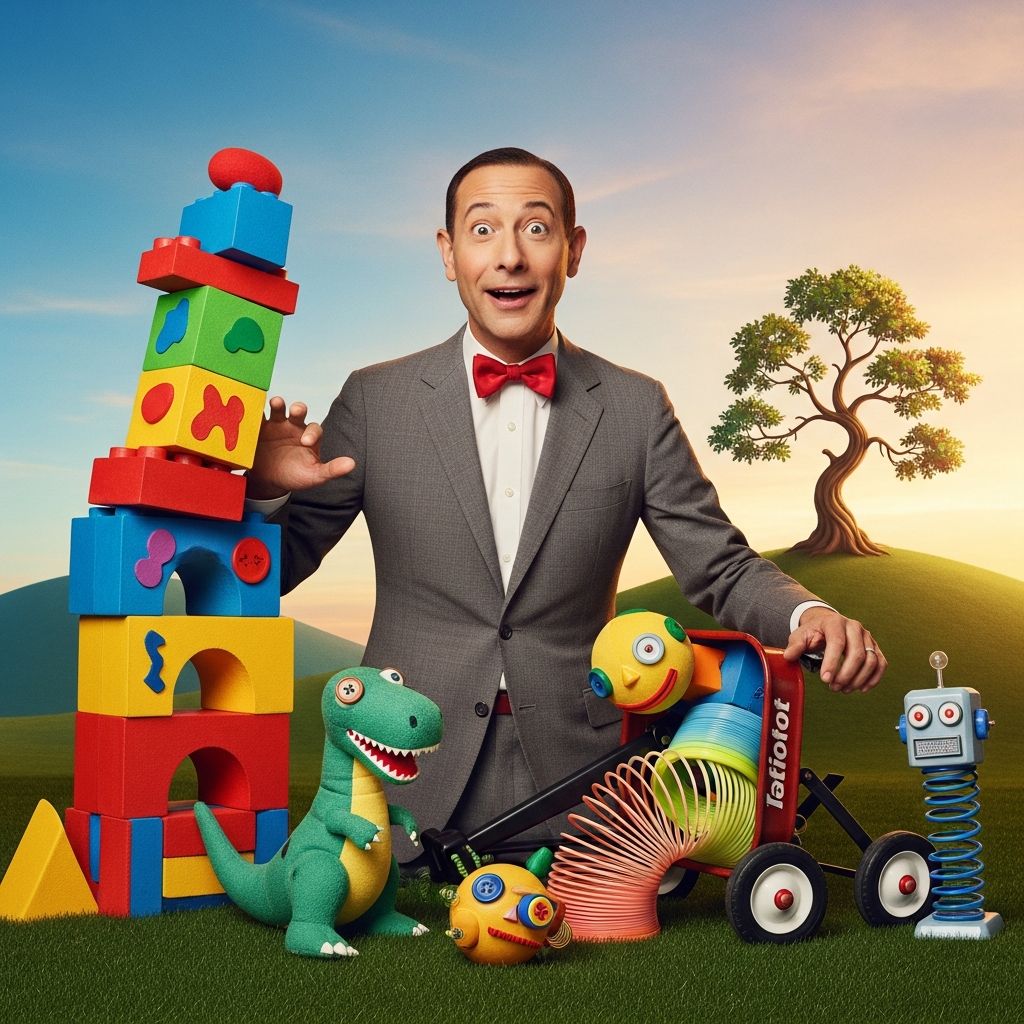
For many kids growing up in the 1980s and early 1990s, childhood was filtered through a red bow tie, a too-small gray suit, and a laugh that sounded like nothing else on television. Pee-wee Herman, created and performed by Paul Reubens, was not just a character; he was a whole version of what childhood could look like: loud, surreal, rule-breaking, and oddly kind.
This article looks at how Pee-wee Herman emerged from an experimental comedy scene, conquered children’s television, weathered scandal, and ultimately changed how adults and kids understood play, imagination, and being “weird” together.
The Unlikely Origins of a Man-Child Icon
Long before he was a Saturday-morning staple, Paul Reubens was a theater kid and improv obsessive who spent years learning how to get laughs on purpose. He studied acting formally and then joined The Groundlings, a Los Angeles improvisational comedy troupe known for turning out future television and film stars. Within that environment, performers were encouraged to create highly specific, original characters and then refine them in front of live crowds.
Pee-wee Herman was born from one of those experiments. Reubens wanted to play a would-be stand-up comic who was obviously terrible at telling jokes and bad at social cues. Instead of abandoning that idea, he leaned in, exaggerating the character’s awkwardness, voice, and childlike mannerisms until Pee-wee became a fully realized person—part bratty kid, part old-time showman. The name itself came from a toy harmonica brand and the surname of a boy Reubens had known, chosen precisely because it sounded oddly real and slightly neglected.
What began as a bit in an improv show quickly grew into a persona that Reubens would inhabit on stage, on talk shows, and eventually across multiple media. The character moved from the fringes of a comedy theater to national television because audiences could not stop looking at him—a cartoonish misfit who somehow felt emotionally true.
From Nightclub Stages to Children’s Mornings
Pee-wee’s journey from alternative comedy to children’s entertainment was anything but straightforward. In the early 1980s, Reubens developed The Pee-wee Herman Show, a live stage production that mixed variety-show spectacle with intentionally offbeat humor. The show was recorded and aired as an HBO special, reaching a far larger audience than any nightclub could hold.
The special’s success positioned Pee-wee as a cult figure among adults who liked punk rock, late-night comedy, and off-center performance art. Yet the character’s bright colors, simple emotions, and toy-box aesthetic were also unmistakably appealing to kids. When Reubens wrote the film Pee-wee’s Big Adventure and teamed up with director Tim Burton, the character moved into mainstream cinema. The movie, released in 1985, became a commercial success, following Pee-wee on an earnest and absurd cross-country quest to recover his stolen bicycle.
That success gave television executives a new idea: if Pee-wee could charm both adults and children, maybe he could anchor a big-budget kids’ series. A major broadcast network eventually backed Pee-wee’s Playhouse, a live-action Saturday-morning show with an unusually high per-episode budget for children’s TV at the time. Reubens was given extensive creative control, which allowed him to build an entire universe that looked and felt like the inside of a child’s imagination.
Pee-wee’s Playhouse: Television as a Living Toy Box
When Pee-wee’s Playhouse premiered in 1986, it looked unlike anything else on television. Sets were bursting with color and texture; inanimate objects talked; puppets and live actors shared the same space without explanation. The show did not try to imitate reality—it tried to imitate the way kids played with their toys, making up rules as they went.
Several distinctive qualities set the series apart:
- Visual overload: Every corner of the set carried patterns, gadgets, talking furniture, and Easter eggs, rewarding close attention.
- Interactive rituals: Repeated bits—like the “secret word” that made everyone scream—gave kids permission to join in loudly, not just watch quietly.
- Diverse characters: Human guests and residents of the Playhouse came from different backgrounds and cultures, reflecting a more pluralistic view of America than many other shows at the time.
- Positive chaos: Rules were flexible but kindness and curiosity were consistent; grown-up authority barely existed.
While many children’s programs of the era leaned on direct education or moral messaging, Pee-wee’s Playhouse delivered learning more indirectly. It encouraged experimentation, emphasized emotional expression, and normalized being a little bit strange. That made it deeply memorable to kids who rarely saw their own messy inner lives reflected back at them.
How Pee-wee Redefined Childhood on Screen
In the world of Pee-wee Herman, adulthood was not the destination—it was almost irrelevant. Pee-wee was an adult by age but childlike in behavior, living in a home where play, rather than responsibility, set the schedule. This inversion of the usual kids’ TV hierarchy changed how audiences thought about childhood itself.
| Traditional kids’ TV adult | Pee-wee Herman as adult |
|---|---|
| Teaches rules and lessons | Breaks rules but stays kind |
| Models calm, rational behavior | Models big emotions and silliness |
| Acts as authority figure | Acts as co-conspirator in play |
| Focuses on correct answers | Focuses on joyful experimentation |
This shift mattered for several reasons:
- Emotional permission: Children saw an adult who could be loud, goofy, and vulnerable without shame, making some viewers feel safer about their own big feelings.
- Creative validation: The Playhouse’s dream-logic world validated imaginative thinking over rigid realism, aligning with developmental research that links pretend play to cognitive and social growth.
- Queer-coded and gender-nonconforming energy: Without ever being labeled, Pee-wee’s aesthetic and manner challenged fixed ideas of masculinity, helping some children unconsciously recognize that different ways of being a boy or a man were possible.
For many adults who grew up with the show, Pee-wee represented the idea that growing older did not have to mean abandoning the parts of childhood that felt most alive.
Scandal, Disappearance, and the Cost of Public Weirdness
In the early 1990s, Paul Reubens’s career was derailed by a highly publicized arrest that led to the abrupt end of Pee-wee’s Playhouse and a sudden shift in how the character was discussed in the media. At a time when moral panic around children’s media and public behavior was particularly intense, the fallout was swift. Reubens largely withdrew from public life, and Pee-wee disappeared from television screens.
The scandal highlighted a tension that had always been present: Pee-wee was a character created for adults and then repurposed for children. That dual identity made it difficult for people to separate the performer’s private life from the figure they saw as a kind of surrogate playmate for their kids. Conversations about art, morality, and forgiveness played out in tabloids and living rooms, often with little nuance.
Yet within the comedy and artistic communities, Reubens remained respected as a performer and creative force. Over time, the initial media furor faded, and nostalgia began to reframe Pee-wee Herman less as a controversy and more as a crucial part of 1980s pop culture.
Quiet Years, Cameos, and the Slow Work of Reinvention
After stepping back from the spotlight, Reubens continued to work in smaller or less visible roles, often far removed from Pee-wee’s bright aesthetic. He took on character parts in films and television, bringing his offbeat timing and physical comedy skills to roles that did not directly reference his famous alter ego.
As years passed, the children who had grown up watching Pee-wee’s Playhouse became adults with their own cultural power. They wrote articles, created shows, and greenlit projects influenced by the playful surrealism they had absorbed as kids. In that environment, Pee-wee began to feel less like a scandal and more like a beloved artifact of a stranger, freer TV landscape.
Reubens eventually revisited the character on stage and on late-night talk shows, testing whether audiences were ready to see Pee-wee again. The response was warm: people cheered, not just for nostalgia, but for a chance to reconnect with a version of themselves they associated with Saturday mornings and unstructured imagination.
The Comeback and Pee-wee for a New Generation
In the 2000s and 2010s, Reubens staged a formal Pee-wee comeback. He mounted a new live show, appearing once again in costume on contemporary talk programs and eventually collaborating on a feature-length film that brought Pee-wee into the streaming era. These projects updated the character for new viewers while preserving the core qualities that had made him memorable: relentless enthusiasm, childlike logic, and a world that ran on in-jokes and visual gags.
The comeback underscored something important about legacy in entertainment: some characters are too structurally strange to be imitated directly, but their DNA shows up everywhere. Modern children’s series that embrace absurdist humor, mixed media, and nontraditional adults owe a debt—whether they acknowledge it or not—to the odd little man in the gray suit.
How Pee-wee’s Spirit Echoes in Modern Kids’ Media
Even when Pee-wee Herman is not explicitly referenced, elements of his universe can be felt across contemporary children’s entertainment and family-friendly comedy.
- Maximalist visuals and “live cartoons”: Shows that treat sets as characters and use bright, impossible spaces echo the Playhouse’s toy-box design philosophy.
- Adults as co-conspirators: Many programs now feature grown-ups who play along with kids rather than simply instruct them, mirroring Pee-wee’s friend-not-parent role.
- Meta-humor: Pee-wee often seemed aware he was on a show, playing with the fourth wall—an approach that has become common in children’s media.
- Celebration of weirdness: Characters who are unapologetically odd, from animated misfits to live-action eccentrics, follow in a tradition Pee-wee helped normalize.
Beyond television, Pee-wee’s influence can be felt in live performance, theme-park design, and even internet culture, where curated chaos and layered irony are now everyday languages.
Why Pee-wee Still Matters to Former Kids
For adults thinking back on their childhoods, Pee-wee Herman occupies a special, sometimes complicated, emotional space. He is both a reminder of carefree mornings and an example of how fragile public figures can be. Yet his lasting value might lie in what he taught kids—often without saying it directly—about themselves.
Many viewers absorbed lessons like:
- It is acceptable to be loud, joyful, and emotionally big.
- Strangeness is not a flaw; it can be a superpower.
- Playful spaces matter, and adults can help protect and participate in them.
- Imagination can turn any room into a world.
As mental health conversations have become more open, some adults now see Pee-wee as an early model of emotional permission: a character who did not tamp down his feelings to be “normal,” but instead created a world where normal did not apply.
Frequently Asked Questions (FAQs)
Who was Paul Reubens?
Paul Reubens was an American actor, writer, and comedian best known for creating and portraying the character Pee-wee Herman in stage shows, films, and the television series Pee-wee’s Playhouse.
Was Pee-wee Herman originally meant for children?
No. Pee-wee Herman began as a character in an adult-oriented improv and stage environment. The role was gradually adapted into more child-friendly forms for film and television, especially with Pee-wee’s Big Adventure and Pee-wee’s Playhouse.
Why did Pee-wee’s Playhouse end?
The show ended in the early 1990s after Paul Reubens was arrested in a widely reported incident, which prompted networks and sponsors to distance themselves from the character at the time. Production did not resume, though Pee-wee later returned in new projects.
How did Pee-wee Herman influence children’s television?
Pee-wee Herman helped expand what children’s TV could look like by mixing surreal visual design, interactive rituals, and a non-authoritarian adult lead. This approach paved the way for later shows that embraced oddball humor and more visually experimental worlds.
Did Paul Reubens work on a memoir?
Yes. Before his death, Reubens worked on a memoir that reportedly combined stories from his life and career, including his experiences as Pee-wee Herman, and had finished a first draft.
References
- Paul Reubens – Biography — IMDb. 2023-08-01. https://www.imdb.com/name/nm0000607/bio/
- Pee-wee Herman — Wikipedia (summary of character history, citing primary media sources). Last updated 2024-01-10. https://en.wikipedia.org/wiki/Pee-wee_Herman
- Paul Reubens | The Man Behind the Bowtie | A Docu-Mini — YouTube, Warner Bros. Entertainment. 2023-08-02. https://www.youtube.com/watch?v=qBXcYQApqrw
- Paul Reubens was writing memoir featuring Pee-wee Herman — Los Angeles Times. 2023-08-01. https://www.latimes.com/entertainment-arts/books/story/2023-08-01/paul-reubens-memoir-death-pee-wee-herman-book
- Pee-wee as Himself — HBO Max (show synopsis). 2023-08-05. https://www.hbomax.com/shows/pee-wee-as-himself/284e1634-0dda-4b42-bafb-de090ade6c5d