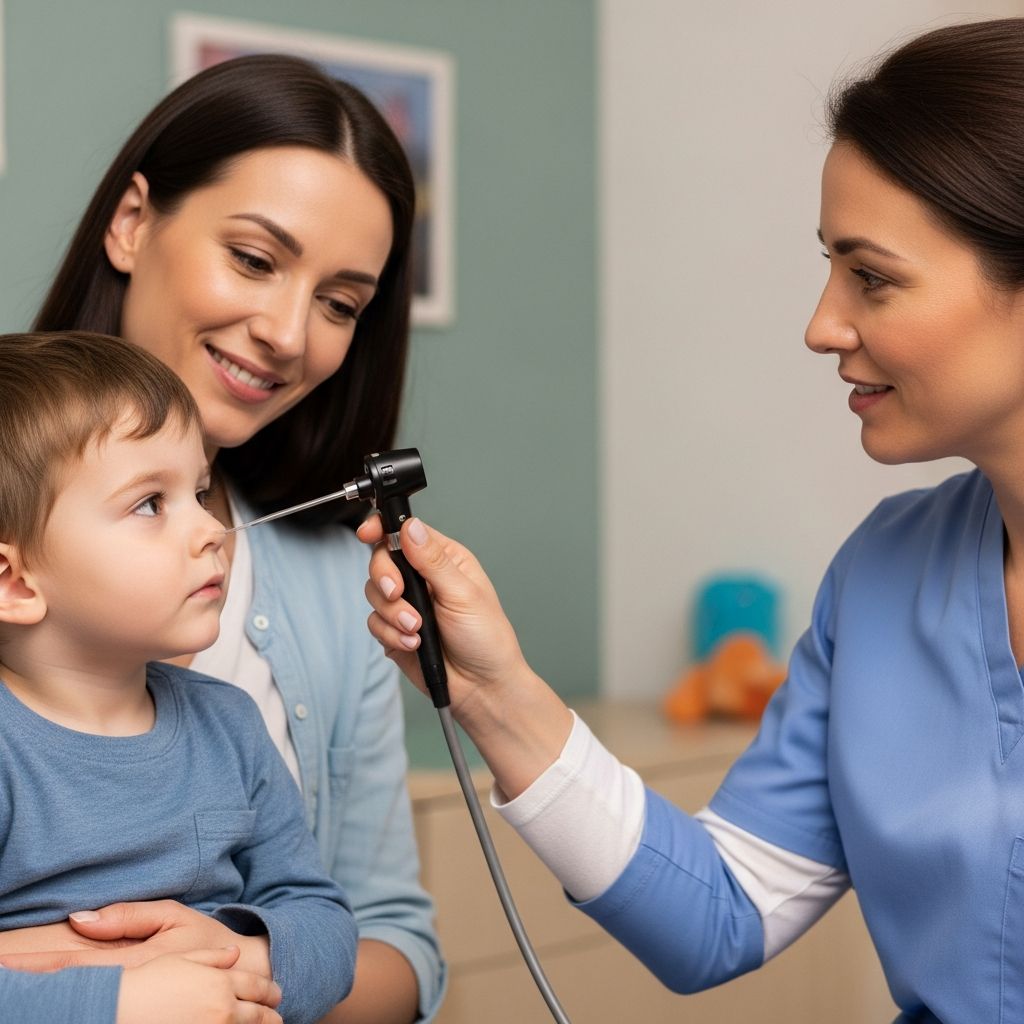
A nasopharyngoscopy is a quick diagnostic exam where a thin, flexible tube with a camera is gently passed through a child’s nose to view the nasal passages, throat, and voice box. This office-based procedure helps identify issues like infections, growths, or speech-related problems without surgery.
Understanding the Basics of Nasal Endoscopy in Pediatrics
Nasal endoscopy, also called nasopharyngoscopy, uses a fiberoptic scope about the size of a spaghetti strand to explore hard-to-see areas in a child’s upper airway. It’s particularly valuable for young patients because it avoids radiation and can be done awake in cooperative children or under minimal sedation for infants.
The scope’s tiny light and camera transmit real-time images to a screen, allowing specialists to spot abnormalities precisely. For parents, knowing this tool’s role demystifies what might seem intimidating.
Common Reasons Children Undergo This Procedure
- Persistent nasal congestion or discharge: To check for blockages, polyps, or swelling.
- Recurrent ear infections: Examining Eustachian tube function and adenoid size.
- Speech or swallowing difficulties: Assessing velopharyngeal closure for issues like hypernasality.
- Voice changes or breathing problems: Evaluating larynx and vocal cords for inflammation or masses.
- Suspected sleep apnea: Observing airway collapse during maneuvers like Müller’s.
- Post-treatment monitoring: After surgery, radiation, or chemo to ensure healing.
These symptoms often prompt ear, nose, and throat (ENT) specialists to recommend it, as early detection can prevent complications.
How Doctors Perform Nasopharyngoscopy Step by Step
The procedure typically lasts 2-5 minutes and occurs in an outpatient setting. Here’s what happens:
- Preparation: Consent is obtained from parents. The child sits upright or on a parent’s lap. A numbing spray (like lidocaine and Afrin) is applied to the nose to minimize discomfort.
- Insertion: The lubricated scope enters one nostril slowly, advancing to the nasopharynx. The doctor narrates to reassure everyone.
- Examination: Views include nasal cavity, adenoids, throat base, epiglottis, and larynx. The child may be asked to say ‘eee,’ swallow, or puff cheeks for dynamic assessment.
- Completion: The scope is withdrawn gently. Photos or videos may be recorded for review.
| Step | Duration | Child’s Role |
|---|---|---|
| Numbing | 1-2 min | Stay still |
| Scope insertion & exam | 2-4 min | Breathe normally, follow simple instructions |
| Removal & recovery | 1 min + 20 min numbness | Rest briefly |
No anesthesia is usually needed for kids over toddlers who can follow directions.
Preparing Your Child for a Smooth Experience
Preparation eases anxiety. Explain it’s like a ‘nose camera check-up’ using age-appropriate terms—avoid ‘scary’ words. Practice breathing through the mouth and saying sounds.
- Arrive early for paperwork.
- Dress comfortably; no fasting required unless sedation is planned.
- Bring a comfort item like a toy.
- Parents stay present.
For infants, feeds continue normally; the exam is swift.
Safety Measures and What to Expect During the Exam
Scopes are sterilized rigorously per hospital protocols to prevent infections. Discomfort is mild—like a tickle or sneeze urge. Children feel pressure but rarely pain due to numbing.
Specialists watch for reactions. In rare cases with epiglottitis or stridor, it’s done cautiously under expert supervision. Videos help review findings immediately.
Potential Findings and Their Implications
Doctors inspect:
- Nasal area: Deviated septum, polyps, crusting, or foreign bodies.
- Nasopharynx: Enlarged adenoids, Eustachian tube issues, or masses.
- Throat and larynx: Epiglottis inflammation, vocal cord paralysis, or velopharyngeal gaps.
Abnormalities guide treatments like adenoidectomy or speech therapy.
After the Procedure: Recovery and Next Steps
Throat numbness fades in 20-60 minutes. Avoid eating/drinking for 1 hour to prevent choking. Mild nosebleeds or sneezing may occur—normal and short-lived.
Discuss results right away; watch recorded footage together. Follow-up might include biopsies or imaging if needed. Most kids resume activities same day.
Benefits Over Other Diagnostic Methods
Unlike X-rays, it’s radiation-free, real-time, and inexpensive. Allows functional tests (e.g., speech) impossible with static images. Ideal for pediatrics due to minimal invasiveness.
Risks, Complications, and When to Call the Doctor
Complications are rare (<1%): minor bleeding, vasovagal response, or scope intolerance. Contraindications include severe facial trauma or uncooperative patients needing sedation elsewhere.
Call if: persistent bleeding, fever, worsening breathing, or pain beyond 24 hours.
Frequently Asked Questions (FAQs)
Is nasopharyngoscopy painful for children?
Most feel only mild discomfort from numbing spray or pressure; pain is uncommon.
How long does it take?
2-5 minutes total.
Can babies have it?
Yes, if stable; cooperative toddlers and up are ideal without sedation.
Will my child need anesthesia?
Rarely; topical numbing suffices for most.
What if my child won’t stay still?
Reschedule with mild sedation or try behavioral prep.
Does insurance cover it?
Usually, as a standard diagnostic test.
Empowering Parents: Questions to Ask Your ENT
- What specific issues are we checking?
- Are there alternatives?
- What do results mean for treatment?
- Any home care post-exam?
- When is follow-up?
Active involvement ensures best outcomes.
Advances in Pediatric Nasopharyngoscopy
Modern scopes are thinner, with better imaging. Portable units enable bedside exams. Integration with AI for anomaly detection is emerging, enhancing accuracy.
For speech disorders, combined SLP-ENT evaluations improve velopharyngeal diagnostics.
References
- Nasopharyngoscopy — Dana-Farber Cancer Institute. 2023. https://www.dana-farber.org/health-library/nasopharyngoscopy
- Nasopharyngoscopy — Wikipedia. 2024-01-15. https://en.wikipedia.org/wiki/Nasopharyngoscopy
- Naso-pharyngoscopy – Procedure — GenesisCare UK. 2024. https://www.genesiscare.com/uk/diagnostics/pathology-tests/nasopharyngoscopy
- Flexible Nasopharyngoscopy (Nasal Endoscopy) — MD Searchlight. 2023-06-01. https://mdsearchlight.com/diagnostics/flexible-nasopharyngoscopy-nasal-endoscopy/
- Nasopharyngoscopy and Nasal Endoscopy (Adult, Peds) — UCSF Medical Affairs. 2022. https://medicalaffairs.ucsf.edu/sites/g/files/tkssra856/f/wysiwyg/ahpPrivileges/Nasopharyngoscopy%20and%20Nasal%20Endoscopy%20(Adult,%20Peds).pdf
- Nasopharyngoscopy — Virtual Center for VCFS. 2023. https://www.vcfscenter.com/nasopharyngoscopy
- Nasopharyngoscopic Evaluation of Velopharyngeal Closure During Speech — Nationwide Children’s Hospital. 2024. https://www.nationwidechildrens.org/family-resources-education/health-wellness-and-safety-resources/helping-hands/nasopharyngoscopic-evaluation-of-velopharyngeal-closure-during-speech
- Flexible Nasopharyngoscopy — NCBI Bookshelf / StatPearls. 2023-07-17. https://www.ncbi.nlm.nih.gov/books/NBK539740/