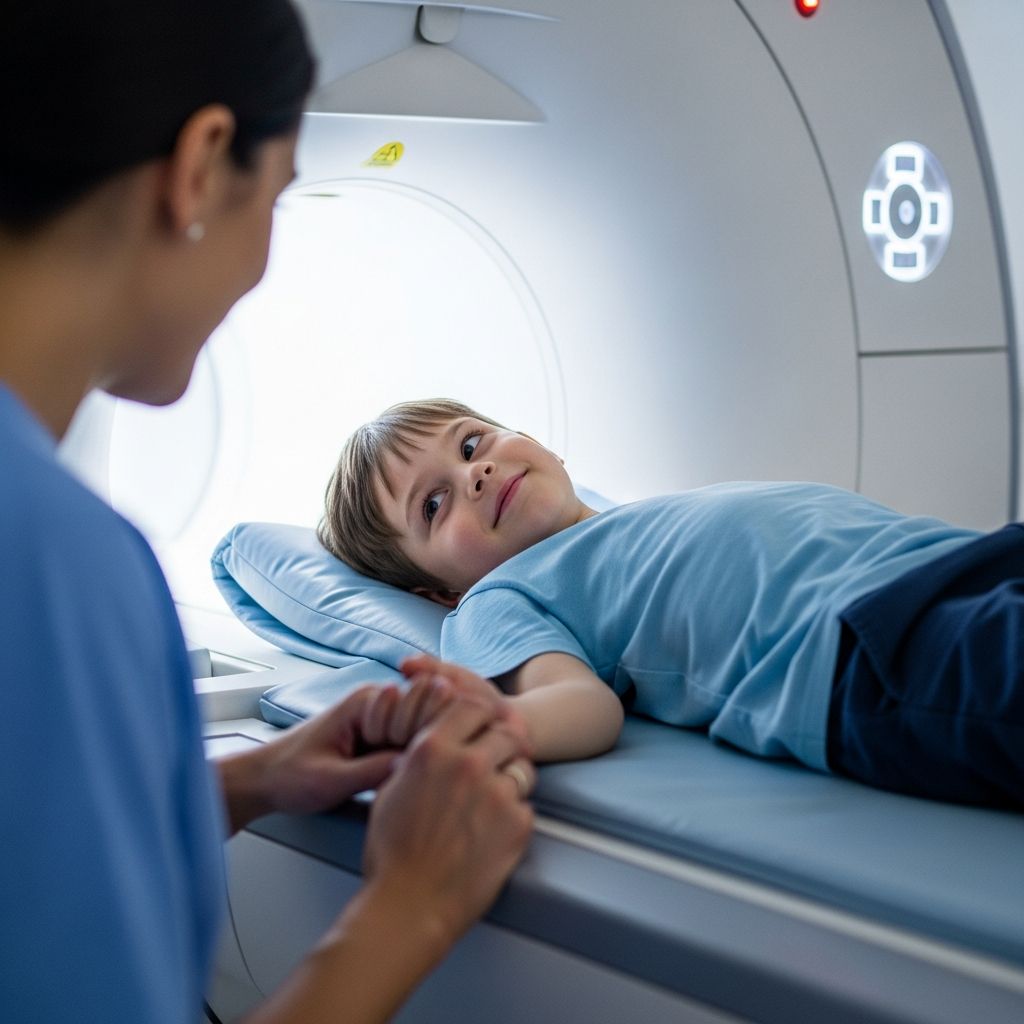
Magnetic Resonance Imaging (MRI) is a powerful, non-invasive diagnostic tool that provides detailed images of a child’s internal organs, tissues, and bones using strong magnets and radio waves, avoiding harmful radiation.
Understanding How MRI Technology Works in Pediatric Care
At its core, an MRI scanner generates a strong magnetic field that aligns hydrogen atoms in the body’s water molecules. Radio waves then disrupt this alignment, and as atoms realign, they emit signals captured by the machine’s computer to create high-resolution, cross-sectional images. Unlike X-rays or CT scans, MRI does not use ionizing radiation, making it safer for repeated use in children.
For kids, this technology excels at visualizing soft tissues like the brain, spinal cord, muscles, and joints, which are often harder to assess with other methods. The process involves lying still inside a tube-shaped magnet, where gradient coils create precise images by varying the magnetic field.
Common Reasons Doctors Recommend MRI for Kids
Pediatricians order MRIs to investigate a range of conditions. For brain and spinal issues, it detects tumors, inflammation, injuries, or developmental abnormalities. In orthopedics, it reveals ligament tears, cartilage damage, or bone infections without radiation exposure.
- Neurological concerns: Seizures, headaches, or suspected multiple sclerosis.
- Musculoskeletal problems: Sports injuries, scoliosis, or hip disorders.
- Abdominal scans: To evaluate organs like the liver, kidneys, or appendix.
- Cardiac assessments: Checking heart structure and function in congenital cases.
Functional MRI (fMRI) even maps brain activity, aiding surgical planning by showing language or movement areas.
Preparation Steps for Your Child’s MRI Appointment
Preparing a child for MRI starts with clear communication. Explain the scan in simple terms: it’s like a big camera taking pictures inside the body while they lie super still, like a superhero staying frozen.
Screen for safety: Inform the doctor about implants, braces, or metal objects, as the magnet can move them or cause heating. Remove all jewelry, watches, and hairpins. Facilities screen for claustrophobia or anxiety, offering sedation if needed for young or restless kids.
| Preparation Checklist | Details |
|---|---|
| Clothing | Wear metal-free clothes like cotton scrubs provided by the center. |
| Fasting | May be required if sedation or contrast is used; follow instructions. |
| Comfort Items | Bring a favorite blanket, toy, or music playlist (if headphones allowed). |
| Practice | Do ‘stillness drills’ at home to simulate lying motionless. |
Arrive early to complete paperwork and tours. Some centers offer mock scanners for familiarization.
Step-by-Step: What Happens During a Child’s MRI Scan
The procedure lasts 15-60 minutes, depending on the area scanned. Your child lies on a padded table that slides into the scanner. Technologists position a coil near the scan area for better signals.
- Positioning: Child is secured comfortably, often with straps for younger ones.
- Scanning: The machine hums and bangs loudly—earplugs or headphones with music help.
- Breathing Instructions: Hold breath briefly for clear abdominal images.
- Communication: A speaker allows talking to the tech; a squeeze bulb signals discomfort.
Open or upright MRIs suit claustrophobic kids, though images may be less detailed. Real-time MRI monitors motion for dynamic views, like joint movement.
Safety Considerations and Potential Risks for Children
MRI is very safe, with no radiation, but the magnet poses risks for metal implants, pacemakers, or certain tattoos. All patients undergo screening questionnaires and sometimes X-rays to check for shrapnel.
Contrast agents like gadolinium enhance images but rarely cause allergies; kidney function is checked first. Sedation risks are minimal with monitoring, used for 20-30% of pediatric cases.
The noise (up to 100 decibels) is mitigated by protection. Long scans may cause minor heating, but modern machines regulate this.
Easing Anxiety: Tips for a Smooth Experience
Children often fear the enclosed space and noise. Preparation reduces tears by 50%, per studies.
- Watch age-appropriate videos of MRI machines beforehand.
- Use storytelling: Pretend it’s a spaceship adventure.
- Practice deep breathing or guided imagery.
- Stay nearby: Many centers allow parents in the room if gowned.
- Post-scan rewards build positive associations.
For toddlers, child life specialists use distraction techniques like bubbles or tablets.
After the Scan: Results, Follow-Up, and Care
No recovery time needed; resume normal activities unless sedated. A radiologist analyzes images, sending reports to your doctor within days.
Discuss findings promptly. Multiple scans may be needed for monitoring chronic conditions.
Comparing MRI with Other Imaging Options for Kids
| Modality | Pros for Children | Cons | Best For |
|---|---|---|---|
| MRI | Detailed soft tissue; no radiation | Expensive, noisy, time-consuming | Brain, joints, tumors |
| CT Scan | Fast; good for bones | Radiation exposure | Emergencies, trauma |
| Ultrasound | No radiation; real-time | Limited to superficial areas | Abdomen, pregnancy |
| X-ray | Quick, cheap | Radiation; 2D only | Bones, chest |
MRI is preferred for non-emergency, detailed pediatric imaging.
Advanced MRI Techniques Tailored for Pediatrics
Innovations like parallel imaging speed scans by using multiple coils, reducing motion artifacts in wiggly kids. Diffusion-weighted imaging detects early strokes or infections. 3T magnets offer higher resolution for tiny structures.
Frequently Asked Questions About Children’s MRI Scans
Is MRI safe for babies and toddlers?
Yes, with precautions. Sedation ensures stillness; no radiation makes it ideal for repeated scans.
How long does a pediatric MRI take?
Typically 30-45 minutes, but shorter sequences exist for young children.
Can my child eat before the MRI?
If no sedation, yes. Fasting is required for contrast or anesthesia.
What if my child has braces?
Braces may need removal or special protocols; consult the center.
Will my child feel pain during the scan?
No, it’s painless—just requires lying still.
Can parents stay with their child?
Often yes, if screened for metal and wearing safe clothing.
This guide empowers parents to navigate MRI confidently. Consult your pediatrician for personalized advice.
References
- MRI (Magnetic Resonance Imaging): What It Is & Results — Cleveland Clinic. 2023-10-12. https://my.clevelandclinic.org/health/diagnostics/4876-magnetic-resonance-imaging-mri
- Magnetic resonance imaging — Wikipedia. 2026-01-10. https://en.wikipedia.org/wiki/Magnetic_resonance_imaging
- MRI — Mayo Clinic. 2024-05-02. https://www.mayoclinic.org/tests-procedures/mri/about/pac-20384768
- Magnetic Resonance Imaging (MRI) — RadiologyInfo.org. 2025-03-15. https://www.radiologyinfo.org/en/mri
- MRI Basics — Case Western Reserve University School of Medicine. 2022-08-20. https://case.edu/med/neurology/NR/MRI%20Basics.htm
- Prepare for Magnetic Resonance Imaging (MRI) — UCSF Radiology. 2024-11-05. https://radiology.ucsf.edu/patient-care/prepare/mri