When parents separate, one of the most important decisions they will ever make is how to share time with their children. A well-designed visitation schedule does more than divide days; it creates emotional safety, preserves strong relationships with both parents, and helps children adjust to a new normal.
This guide walks through how to design a child-centered schedule, from core principles and age-based ideas to practical weekly patterns, decision-making tips, and frequently asked questions.
What Makes a “Good” Visitation Schedule?
There is no one perfect schedule that fits every family. Instead, a strong parenting plan is one that fits your child’s needs and your family’s realities while minimizing conflict and confusion. Think of the schedule as a framework that holds your child’s daily life steady during a time of big change.
- It reduces your child’s stress instead of adding to it.
- It supports a meaningful relationship with both parents whenever it is safe to do so.
- It is detailed enough to prevent constant renegotiation but flexible enough to handle real life.
Foundations: Core Principles to Guide Your Plan
Before choosing specific days and times, agree on a few principles. These act as a compass whenever you face tough scheduling decisions or future changes.
1. Child’s Wellbeing Comes First
The schedule exists for your child’s benefit, not the adults’ convenience or sense of fairness. A plan that is mathematically equal but emotionally draining for the child is not actually “fair.” Prioritize emotional security, rest, and developmental needs over perfect 50/50 symmetry.
- Ask regularly: “How does this feel for our child?” not only “Does this feel fair to us?”
- Be willing to adjust if your child shows signs of chronic stress, sleep problems, or school difficulties linked to the schedule.
2. Predictability and Routine
Children cope better with big changes when they can predict what happens next. A clear, repeatable weekly rhythm is more soothing than a constantly shifting patchwork of days, even if those changes are well intentioned.
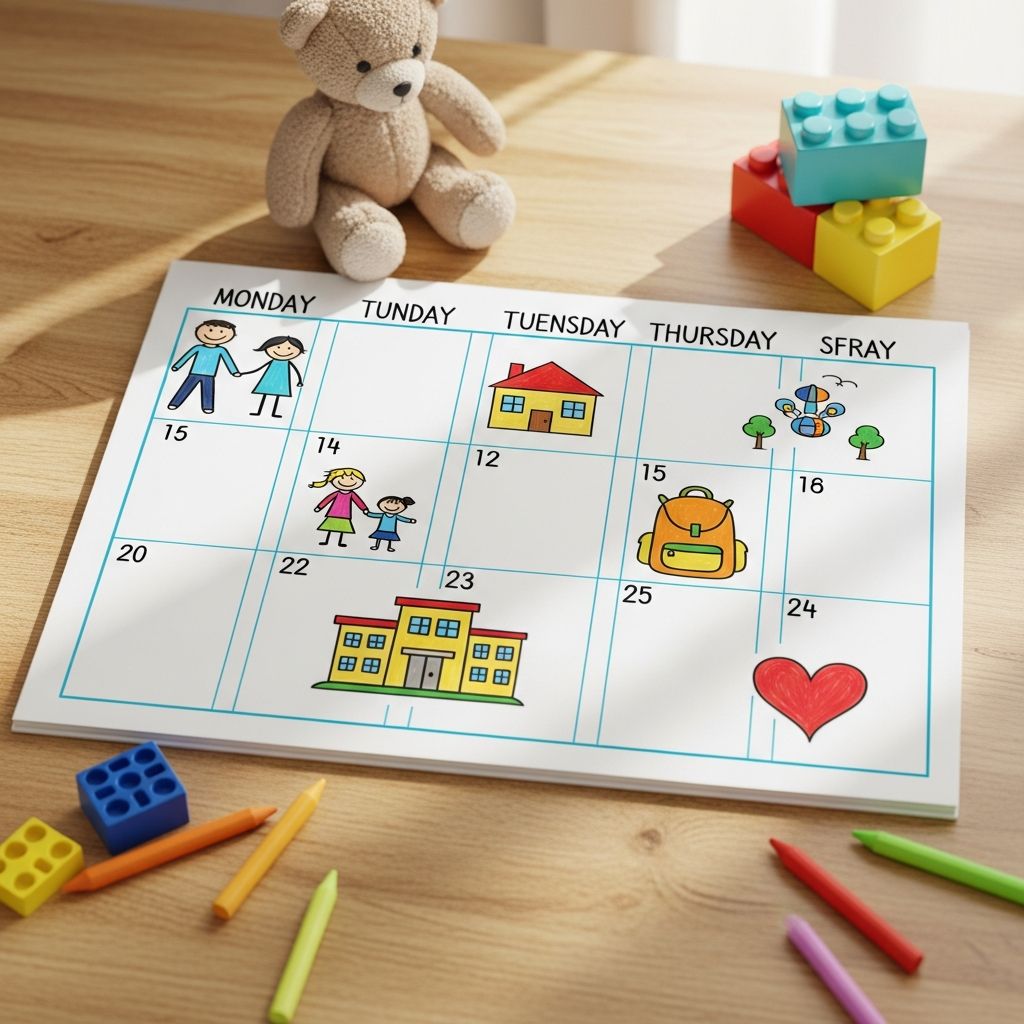
- Use a calendar, color-coding, or visual chart so your child can literally see where they will be and when.
- Keep morning and bedtime routines as similar as possible in both homes.
3. Frequent, Reliable Contact with Both Parents
In most families, children thrive when they have regular, positive time with each parent. Long gaps without seeing one parent can create anxiety or feelings of abandonment, especially in younger children who do not understand time well.
- Aim to avoid very long stretches away from either parent unless distance or safety makes that impossible.
- Use video calls or phone calls to bridge longer gaps when in-person visits are not feasible.
4. Low-Conflict Transitions
Exchanges can be the most stressful moments of the schedule if adults argue or use them to send messages through the child. The more peaceful transitions become, the easier it is for children to move between homes without emotional whiplash.
- Keep exchanges brief, polite, and child-focused, not a time to rehash disputes.
- Use school or a neutral location as the handoff point if direct contact is high conflict.
5. Practical Reality and Sustainability
A schedule that looks perfect on paper but constantly collides with work hours, commutes, or school logistics will create resentment and chaos. It is better to choose a plan that is slightly less ideal in theory but realistically sustainable.
- Map your schedule onto an actual calendar including work shifts, extracurriculars, and travel time.
- Check whether each parent has enough time to supervise homework, appointments, and rest, not just fun outings.
Age-Appropriate Considerations
Children’s needs change as they grow, especially in how long they can comfortably be away from each parent and how often they can handle moving between homes. Use the guidelines below as starting points, not rigid rules.
Babies and Toddlers (0–3 years)
Very young children rely on frequent contact and consistent caregiving to feel secure. Long separations from a primary attachment figure can be distressing, but so can rarely seeing the other parent.
- Favor shorter, more frequent visits rather than rare, long stretches away from either parent.
- Keep naps, feeding routines, and bedtime rituals as similar as possible in both homes.
Preschoolers (3–5 years)
Preschoolers still have a limited sense of time but can handle slightly longer stays. They benefit from regular rhythm and a lot of reassurance about where they will sleep and when they will see each parent again.
- Use simple, repetitive weekly patterns so your child can anticipate the routine.
- Offer transition rituals, like reading the same story on the first night in each home.
School-Age Children (6–12 years)
Once in school, children’s schedules become more complex, and homework and activities must fit around the custody plan. At this stage, too many transitions during the school week can be exhausting.
- Strive for balance between frequent contact and enough stability to keep school mornings and homework calm.
- Consider which parent lives closer to school or has a more flexible schedule for weekday responsibilities.
Teens (13+ years)
Teenagers need increasing autonomy, social time, and consistency for academics and extracurricular activities. They may also have strong opinions about where they stay and when.
- Involve teens in discussions, while remembering that adults still make final decisions.
- Plan longer blocks of time in each home, with agreed flexibility for social events and school commitments.
Sample Weekly Rhythms for Shared Custody
Below are examples of how time can be shared across a typical week. These are not prescriptions but tools to help you imagine patterns that might work for your family. You can adjust days, overnights, or midweek visits to fit your needs.
| Pattern Type | Basic Structure | Best For | Potential Challenges |
|---|---|---|---|
| Frequent Switches | Child moves between homes several times a week (for example, every 2–3 days). | Very young children who need frequent contact with both parents. | Can be tiring if homes are far apart or parents’ communication is tense. |
| Balanced Week Plus Weekends | One parent has certain weekdays, the other has different weekdays, and weekends are shared or alternate. | School-age children who benefit from a predictable school-week rhythm. | Requires careful planning for homework and extracurricular activities. |
| Alternating Weeks | Child spends one full week with one parent, the next week with the other, repeating. | Older children and teens, or families who live near each other’s schools. | Time away from each parent is longer; can be hard on younger kids. |
| Primary Home with Extended Visits | Child spends most school days in one home and longer blocks (weekends, holidays, part of vacations) in the other. | Situations with long-distance travel, demanding work schedules, or significant school considerations. | Less day-to-day involvement for one parent; needs intentional effort to stay emotionally close. |
Whichever of these patterns you lean toward, try first mapping it across a full month on a calendar. Look at how many nights the child spends with each parent, when transitions fall, and how often major routines like homework, sports, and medical appointments land on each side.
Holidays, Vacations, and Special Occasions
Regular weekly schedules are only part of the picture. Children also care deeply about holidays, birthdays, and special traditions. Planning for these in advance helps prevent painful last-minute conflict.
- Alternate major holidays (for example, one parent has a holiday in even-numbered years and the other in odd-numbered years).
- Where possible, preserve key traditions in each home, even if the date occasionally shifts slightly.
For long school breaks or vacations, consider allowing each parent a set number of days or weeks each year to schedule uninterrupted travel time with reasonable advance notice. Clarify how travel costs and passports or other documents will be handled.
Designing the Schedule Together
Creating a healthy visitation plan is not only a logistical task; it is an emotional negotiation during a vulnerable time. Keeping the process structured and respectful makes it more likely that the agreement will last and that both parents will honor it.
Step 1: List Non-Negotiables
Start by listing what cannot easily change: work hours, school start and end times, distance between homes, medical appointments, and any safety restrictions. This prevents designing a beautiful plan that falls apart as soon as life begins.
- Note which mornings and evenings each parent can reliably cover.
- Identify high-conflict times of day and consider using school or a neutral site as the exchange point then.
Step 2: Clarify Goals for the Child
Before debating days, agree on 3–5 goals for your child. For example: \”Our child will see each parent at least twice during the school week\” or \”Our child will not need to change homes more than three times a week.\” These shared goals reduce the focus on winning or losing specific days.
- Write the goals somewhere visible during your planning discussion.
- Use them later to evaluate whether a proposed change supports or undermines the shared intentions.
Step 3: Draft, Test, and Refine
Once you settle on a draft schedule, treat it as a pilot plan. Live with it for several weeks or a couple of months. During that time, pay attention to how your child is doing across sleep, school, mood, and transitions.
- Schedule a check-in date to review what is working and what is not.
- Adjust gradually instead of overhauling everything at the first sign of difficulty, unless a serious problem arises.
Supporting Your Child Through Transitions
Even the most carefully crafted schedule involves saying goodbye and hello over and over. How those moments are handled shapes children’s experience of the entire arrangement.
- Create consistent goodbye and welcome rituals, such as a special hug, a phrase, or a small routine (unpacking together, having a snack).
- Avoid asking the child to act as messenger or spy between homes; direct communication should happen between adults.
- Encourage children to keep a few comfort items that can travel easily, like a favorite stuffed animal or book.
When Parents Live Far Apart
Long distances between homes limit frequent short visits. In these cases, the goal shifts from frequent contact to meaningful, predictable blocks of time and creative ways to stay connected in between.
- Focus on school-year stability in one home, with extended holiday and summer stays in the other.
- Use technology intentionally: regular video chats, shared online games, or reading the same book and discussing it together.
- Plan travel in advance, including who buys tickets, how handoffs occur, and what happens if travel is disrupted.
Signs Your Schedule Needs Adjustment
No plan is perfect forever. Children grow, jobs change, and what once worked smoothly may start to strain the family system. Staying attentive to warning signs allows you to adapt before problems deepen.
- Consistent school issues that seem linked to certain transitions or days.
- Ongoing sleep problems that cluster around exchanges or first nights in each home.
- Frequent complaints of stomachaches, headaches, or vague illnesses on transition days.
- Intense anxiety about going to one parent’s home, beyond normal reluctance to change activities.
If these patterns appear, consider whether the problem lies in the schedule itself, in conflict between parents, or in something else in the child’s environment. Sometimes the solution is to simplify the number of transitions; other times it is to reduce adult conflict the child is witnessing.
Working with Professionals
Parents do not have to design a visitation schedule alone. Family therapists, mediators, and child specialists can all help you understand your child’s needs and find practical solutions. Courts sometimes require or recommend professional support in high-conflict cases.
- A mediator can help you negotiate a plan you both feel able to follow.
- A child therapist can give insight into how your child is coping and what kind of rhythm might feel safest.
- Legal professionals can help ensure the agreement is clear, enforceable, and in line with local requirements.
Frequently Asked Questions
1. Is a 50/50 schedule always best?
Equal time can work very well for many families, but it is not automatically the healthiest option. If a strict 50/50 arrangement leads to constant disruption, endless conflict, or extreme fatigue for your child, adjusting the schedule to favor more stability may be wiser. A child-centered plan focuses on quality of time and emotional safety, not only on splitting days exactly in half.
2. How much say should my child have?
Children deserve to be heard, but they should not carry the burden of making adult decisions. Younger children can share which routines feel comforting or difficult, while older children and teens can participate more actively in planning. Parents are responsible for listening carefully and then making decisions that balance those wishes with safety, practicality, and long-term wellbeing.
3. What if one parent is unreliable?
If a parent frequently cancels visits, shows up late, or cannot provide safe care, the schedule may need to change. Document patterns, communicate concerns directly when it is safe to do so, and consider involving professionals or the legal system if your child’s safety or emotional health is at risk. A child should never be expected to manage an adult’s inconsistency alone.
4. How do we handle new partners and blended families?
Introducing new adults and step-siblings can complicate routines and emotions. Whenever possible, avoid changing the basic schedule just to accommodate a new relationship at the beginning. Give your child time to get to know new partners gradually, maintain their connection to both biological parents, and protect at least some one-on-one time with each parent.
5. Can we change the schedule later?
Yes. Custody arrangements often evolve as children grow and family circumstances shift. You may need to revise the plan when children start school, become involved in more activities, or reach adolescence. Plan for periodic review, and approach changes with the same guiding principles: child first, stability, strong relationships, and workable logistics.
Key Takeaways for Parents
- There is no single perfect visitation schedule; the best plan is the one that genuinely supports your child’s security and development.
- Prioritize predictability, low-conflict transitions, and regular positive time with each parent over strict mathematical fairness.
- Adapt the schedule to your child’s age, temperament, school life, and the realities of travel and work.
- Stay open to revisiting the arrangement as life changes, and seek professional help if conflict is high or your child is struggling.
When parents work together to design and honor a thoughtful visitation schedule, children gain something priceless: the sense that, even though their family looks different now, they remain loved, safe, and at the center of both parents’ hearts.