Magnetic Resonance Imaging, or MRI, provides doctors with incredibly detailed views of a child’s internal body structures using magnets and radio waves, without any radiation exposure.
Why Doctors Choose MRI for Children
MRI stands out as a top choice for pediatric imaging because it reveals soft tissues, organs, and bones in ways that X-rays or CT scans cannot match, especially for growing bodies. Unlike radiation-based methods, MRI aligns hydrogen atoms in the body with radio waves to capture energy signals, forming precise cross-sectional images.
This technology excels at spotting issues hidden by bone, such as brain abnormalities, spinal cord problems, or joint injuries common in active kids. It’s invaluable for conditions like tumors, infections, developmental delays, or sports injuries.
Key Areas Where MRI Shines in Pediatrics
- Brain and Spine: Detects cysts, tumors, swelling, strokes, seizures, or multiple sclerosis; evaluates pituitary gland or herniated discs.
- Abdomen and Pelvis: Identifies appendicitis, trauma injuries, infections, or tracks cancer treatment progress.
- Bones and Joints: Reveals cartilage damage, bone cancer, fractures, or marrow issues like leukemia.
Pediatric hospitals prioritize MRI for its non-invasive nature and ability to monitor chronic conditions or congenital defects.
How an MRI Machine Creates Those Amazing Pictures
Inside the MRI suite, a powerful magnet creates a strong magnetic field that temporarily realigns hydrogen atoms abundant in body water and fat. Radio waves pulse to disrupt this alignment, and as atoms realign, they release energy signals unique to each tissue type—fat, muscle, bone, or fluid.
A computer processes these signals into detailed 2D or 3D images, showing slices like pages in a book. The process involves no heat, chemicals, or pain; kids might feel the table move or hear rhythmic knocking from gradient coils.
| Scan Type | Uses Radiation? | Best For | Noise Level | Scan Time |
|---|---|---|---|---|
| MRI | No | Soft tissues, brain, joints | Loud (knocking) | 20-90 min |
| X-ray | Yes | Bones, quick checks | Silent | Minutes |
| CT | Yes | Fast trauma views | Quiet | 5-30 min |
| Ultrasound | No | Organs, babies | Silent | 15-45 min |
This table highlights why MRI is preferred for detailed, radiation-free diagnostics in children.
Getting Ready: Steps for a Smooth MRI Day
Preparation starts at home: inform the doctor about metal implants, braces, or claustrophobia. Remove jewelry, watches, or clothing with zippers; hospitals provide gowns.
Pack comfort items like a favorite blanket or stuffed animal. For younger kids, practice lying still with eyes closed while listening to music via headphones.
Many centers offer pre-visit tours or videos to familiarize children with the “doughnut machine.” Fasting may be needed if sedation is planned.
At the Hospital: Check-In to Scan
- Arrive with ID, insurance, and medication list; get an ID bracelet.
- Meet child life specialists who explain using toys, books, or play demos.
- Change into a gown; secure belongings in lockers.
- If contrast dye is used, a nurse inserts an IV—brief pinch, possible metallic taste.
- Lie on the padded table; straps keep position steady.
During the Scan: What Kids Experience
The technologist positions the child, slides the table into the tunnel (open-ended in many kid-friendly machines), and starts scanning. Noises like thumping or beeping signal image capture; earplugs or movies distract.
Stay still—key for clear pictures. Breaks allow wiggling; total time 20-90 minutes based on body area. Parents often stay nearby, communicating via mirror or intercom.
Sedation for under-6s or anxious kids: mild meds or general anesthesia with monitoring of vitals. Child life experts reduce sedation needs through prep.
“With support from specialists, many kids skip sedation entirely, making recovery instant.”
Safety First: Why MRI is Kid-Approved
MRI’s radiation-free profile makes it ideal for repeated use in pediatrics. The magnetic field is intense but contained—no flying objects if screened properly.
Contrast agents like gadolinium are rare allergens compared to CT dyes. Data from decades of scans confirm safety, even for infants. Facilities monitor sedated kids closely.
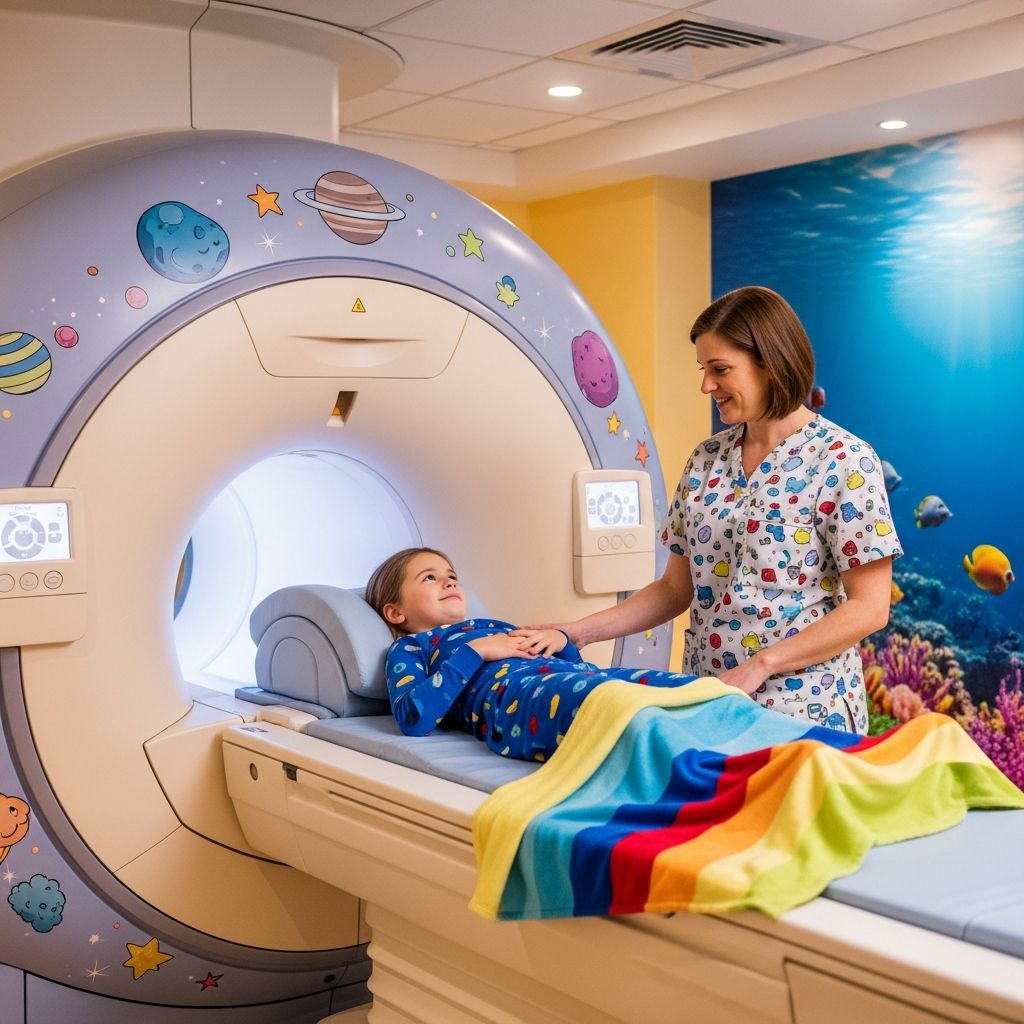
Special “ambient” rooms with colorful projections or DVD players turn scans into adventures.
After the MRI: Quick Recovery and Results
Post-scan, kids resume normal activities unless sedated—then monitored until alert. IV sites might bruise slightly.
Radiologists analyze images promptly; results go to the doctor for discussion. Clear visuals aid treatments from surgery to therapy.
Fun Ways to Explain MRI to Your Child
Use analogies: “It’s like a superhero camera taking pictures inside without cutting!” Watch kid cartoons showing the machine as a noisy robot friend.
- Practice: Timer games for stillness.
- Comfort: Headphones with playlists.
- Reward: Ice cream post-scan.
Frequently Asked Questions (FAQs)
Is MRI painful for kids?
No, it’s painless—just lie still. IV contrast might pinch briefly.
How long does a kid’s MRI take?
Typically 20-90 minutes, with breaks.
Do kids need to be sedated?
Often not, especially with prep; under 6s may.
Can parents stay during the scan?
Yes, outside the room or via intercom, if no metal.
Does MRI use radiation like X-rays?
No, only magnets and waves—safer for kids.
Choosing the Right Pediatric MRI Center
Look for child-focused facilities with sedation expertise, short wait times, and tech like open MRIs. Multiple locations enhance access.
Advanced 4D MRI even captures heart motion dynamically.
References
- Pediatric MRI — RadiologyInfo.org. 2023-05-15. https://www.radiologyinfo.org/en/info/pediatric-mri
- Magnetic Resonance Imaging (MRI) at Children’s Hospital Colorado — Children’s Hospital Colorado. 2024-02-10. https://www.childrenscolorado.org/doctors-and-departments/departments/imaging-services/magnetic-resonance-imaging/
- What Happens During an MRI for Children? — Hospital for Special Surgery (HSS). 2023-11-20. https://www.hss.edu/health-library/move-better/what-happens-during-an-mri-for-children
- Magnetic Resonance Imaging (MRI) — Nemours KidsHealth. 2024-01-05. https://kidshealth.org/en/parents/mri.html
- MRI for Children — Children’s Hospital of Philadelphia (CHOP). 2023-08-12. https://www.chop.edu/treatments/magnetic-resonance-imaging-mri