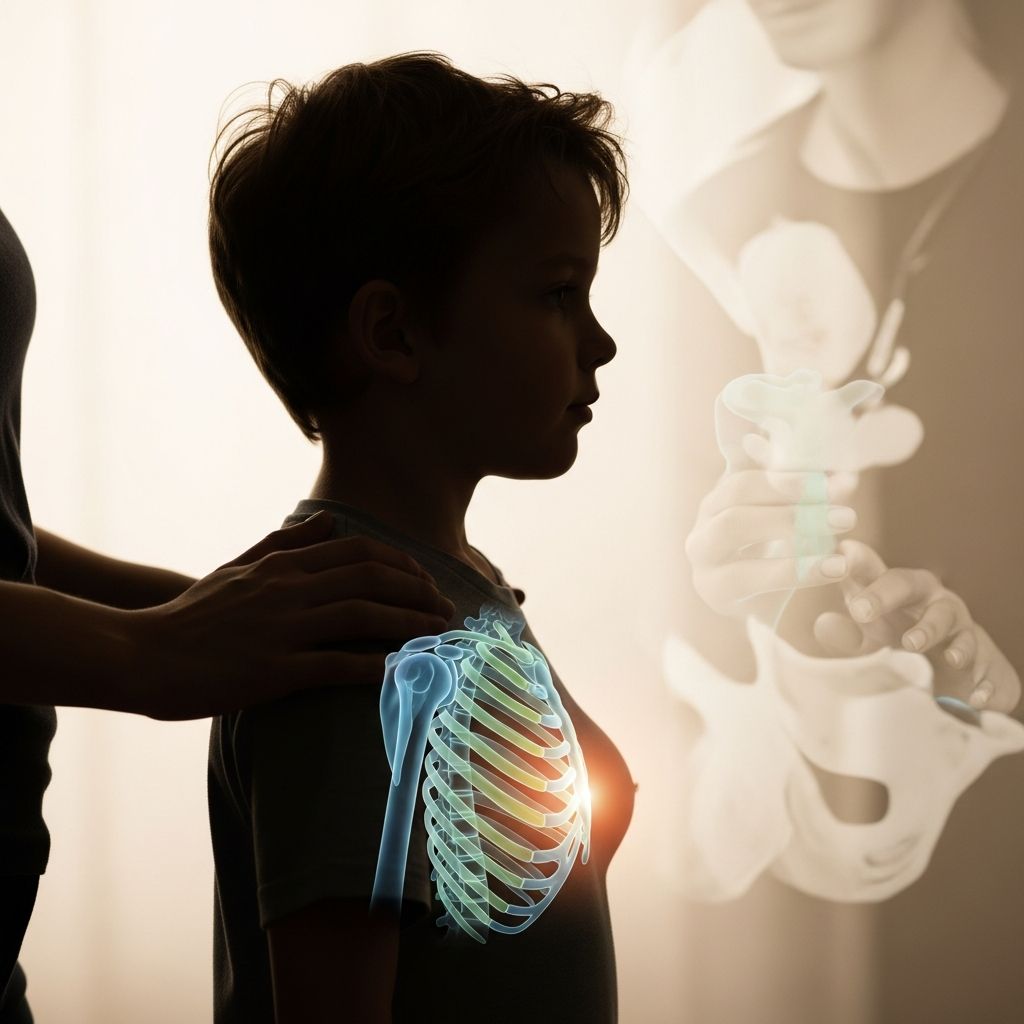
Pectus carinatum is a condition in which a child’s breastbone and nearby ribs push outward, giving the chest a more prominent or bumpy appearance rather than lying flat.
Although the unusual shape can be worrying to families, this chest wall difference usually does not threaten a child’s health and often can be improved with simple, non-surgical treatment.
What Is Pectus Carinatum?
Pectus carinatum is a structural difference in the front of the chest where the sternum (breastbone) and attached ribs bow outward, sometimes in the center and sometimes more on one side.
Because the chest may look like the front of a bird’s chest, the condition is sometimes informally called “pigeon chest,” a term many doctors and websites still use.
- The outward bulge may be narrow and sharp or broad and rounded.
- Some children have a mixed pattern, with one area that sticks out and another area that looks slightly sunken.
- The shape often becomes more obvious as children reach the rapid growth years of late childhood and early adolescence.
Who Tends to Develop It?
Pectus carinatum can appear in children of any sex, but it is more frequently diagnosed in boys than in girls.
Many families first notice the change in chest shape around the ages when kids are shooting up in height, often between about 11 and 15 years old.
- In some cases, a subtle protrusion is visible in early childhood and becomes more obvious with growth.
- The condition may affect only one side of the chest or both sides to different degrees.
- Because the appearance change can be gradual, it is sometimes picked up during routine physicals for sports or school.
Possible Causes and Risk Factors
Experts do not fully understand why pectus carinatum develops, but many believe it is related to overgrowth or stiffness of the cartilage that connects the ribs to the breastbone.
The condition often runs in families, suggesting that genes and inherited traits may play an important role.
- Some children with pectus carinatum also have scoliosis (curving of the spine) or other skeletal differences.
- Occasionally, pectus carinatum appears along with certain genetic or connective-tissue syndromes, which is why doctors sometimes ask about family history and examine joints, spine, and heart.
- In many children, no related condition is ever found and the chest difference exists on its own.
What Parents and Teens Usually Notice
Most families first notice pectus carinatum because the chest looks different, not because the child seems ill or weak.
For many children, the condition causes little or no physical discomfort, but the way the chest looks can strongly affect self-confidence, body image, and social comfort.
Typical physical features
- Breastbone and nearby ribs that stick out farther than the surrounding chest.
- Uneven chest, with one side more raised than the other.
- Occasional feeling of tightness, tenderness, or mild pain in the front of the chest, especially with certain positions or activities.
- In some teens, a barrel-shaped chest or flatter areas near the protrusion.
Less common physical symptoms
- Shortness of breath or feeling winded with intense exercise.
- Frequent respiratory infections in some children, especially younger ones.
- Rarely, chest discomfort that limits activity or prompts additional evaluation of the heart and lungs.
Emotional and social impact
- Feeling embarrassed to change clothes in front of others or to go swimming.
- Worry that peers will stare, tease, or ask uncomfortable questions about the chest.
- Lowered self-esteem, social withdrawal, or increased anxiety during the teen years.
Is Pectus Carinatum Dangerous?
For most children and teenagers, pectus carinatum does not significantly damage heart or lung function and is not considered a life-threatening condition.
Severe or unusual cases may be studied more closely, but for the majority of young people the main issue is appearance and the emotional effect of looking different.
- Light to moderate exercise is usually safe and encouraged, unless a doctor has given specific limits.
- Some children report mild breathing changes with intense sports, and their doctors may order lung function testing to check for problems.
- Certain heart valve irregularities have been linked to chest wall differences, so some specialists perform heart tests when needed.
How Doctors Evaluate the Condition
Diagnosis usually starts with a careful physical exam, during which the clinician looks at the shape of the chest, posture, spine, and breathing pattern.
Additional tests are chosen based on the child’s symptoms, severity of the deformity, and whether other conditions are suspected.
Common evaluation steps
- Medical history: Questions about growth, exercise endurance, family members with similar chest shapes, and any heart or lung issues.
- Physical examination: Observation of chest from several angles and checking for scoliosis, chest tenderness, or unusual heart or lung sounds.
- Imaging tests: Chest X-ray or CT scan may be used in some cases to better understand bone and cartilage structure.
- Heart and lung testing: Electrocardiogram, echocardiogram, or pulmonary function tests may be ordered when symptoms or severity suggest possible involvement.
Treatment Options: From Watchful Waiting to Surgery
Not every child with pectus carinatum needs active treatment, and the decision is usually based on the degree of protrusion, physical symptoms, and the child’s feelings about appearance.
When treatment is chosen, the most common approach is external bracing, while surgery is reserved for cases that do not respond to bracing or that are particularly severe or complex.
Bracing: A non-surgical first choice
A pectus brace is a custom-fitted device that applies gentle, constant pressure to the prominent area of the chest to gradually reshape the cartilage over time.
Bracing tends to work best in younger teens and preteens, when the chest wall is more flexible and growth is still ongoing.
- The brace is usually worn under clothing and may be adjustable to fine-tune the amount of pressure.
- Many programs recommend wearing the brace for most of the day at first, then decreasing usage as the chest improves and stabilizes.
- Success depends heavily on consistency, so family support and realistic daily routines are crucial.
Surgery: When it may be considered
Surgery is less commonly needed but may be offered when bracing does not work, the chest deformity is very rigid, or there are other structural issues of the chest wall.
Procedures vary by center but generally aim to reshape the breastbone and cartilage so that the chest wall lies flatter and more symmetric.
- Hospital stay and recovery time depend on the specific surgical technique used and the child’s overall health.
- Surgeons discuss possible scars, risks such as infection or pain, and expected improvements before a family decides.
- Surgery is often delayed until growth is more complete unless symptoms are significant.
Observation without active treatment
For mild pectus carinatum that does not bother the child, many clinicians recommend simple monitoring during routine checkups.
Families are encouraged to return earlier if they notice rapid changes in the chest shape or new symptoms such as breathing difficulty or chest pain.
Bracing Versus Surgery at a Glance
| Treatment | How it works | Best candidates | Key considerations |
|---|---|---|---|
| External bracing | Applies steady pressure on the outward chest area to gradually remodel cartilage. | Growing children and teens with flexible chest walls and mild to moderate deformity. | Requires daily wear and good adherence; usually avoids the risks of surgery. |
| Surgery | Reshapes or repositions bone and cartilage to create a flatter chest wall. | Patients with severe, rigid, or complex deformities, or those who did not respond to bracing. | Involves hospital stay, recovery time, scars, and surgical risks but can produce permanent structural changes. |
| Observation | Regular checkups to watch for changes without active correction. | Children with mild deformity who are comfortable with their appearance and have no symptoms. | No treatment side effects but may require later intervention if the deformity progresses. |
Daily Life With a Chest Brace
Wearing a pectus brace can feel like a big adjustment at first, but with planning and support, most children learn to work it into school, sports, and social activities.
Health care teams usually give specific instructions for how many hours per day the brace should be worn and how to increase wear time gradually to avoid skin irritation and discomfort.
- Soft clothing such as a thin T-shirt under the brace can reduce rubbing and help with comfort.
- Kids may need short breaks from the brace during vigorous sports, depending on the type of device and medical advice.
- Setting small goals and tracking progress can help motivate consistent use, especially for teens.
Exercise, Posture, and Overall Health
Most children with pectus carinatum are encouraged to stay active, because regular exercise supports heart, lung, and muscle strength as well as emotional wellbeing.
Posture exercises and core strengthening can also help the chest look more balanced and may ease mild aches by supporting the spine and rib cage.
- Stretching the chest muscles and strengthening the upper back can counteract slouching and emphasize a more open posture.
- Aerobic activities like walking, cycling, and swimming are usually excellent options unless a provider suggests limits.
- Families should check with their child’s care team about contact sports or heavy lifting if surgery has been performed or is planned.
Supporting Your Child Emotionally
The emotional side of pectus carinatum can be just as important as the physical aspect, especially as children move into middle school and high school years.
Parents, caregivers, teachers, and clinicians can all play a role in helping a young person feel accepted, informed, and confident.
- Keep communication open by inviting your child to share feelings about appearance, sports, and social situations.
- Work with the care team to find age-appropriate ways for your child to explain the condition to peers if they wish.
- Consider counseling if self-esteem, mood, or anxiety seem significantly affected by the chest difference.
Talking With the Health Care Team
Because decisions about bracing, surgery, or observation are personal and depend on many factors, it helps to go to appointments prepared with questions.
Some families find it useful to involve the child in decision-making, especially when the child is old enough to understand the trade-offs and daily responsibilities of each option.
- Ask how severe the deformity is and whether there are any concerns about heart or lung function.
- Discuss the expected duration of brace wear or recovery time if surgery is considered.
- Clarify how progress will be measured and what signs would prompt a change in the treatment plan.
Frequently Asked Questions
Can pectus carinatum go away on its own?
The unusual chest shape typically does not disappear without some form of correction, because the change is related to how the rib cartilage and breastbone have grown.
However, mild cases may remain stable and not require active treatment if the child is unconcerned about appearance and has no symptoms.
Is pectus carinatum the same as pectus excavatum?
No; pectus carinatum involves an outward protrusion of the chest, while pectus excavatum refers to a sunken or caved-in appearance.
Some children have features of both conditions at once, which doctors sometimes describe as a mixed chest wall deformity.
Will my child be able to play sports?
Most children with pectus carinatum can safely participate in physical activities, and exercise is often encouraged.
Any restrictions usually relate to recent surgery, severe symptoms, or specific advice from the care team rather than the chest shape alone.
Does bracing hurt?
When first wearing a brace, children often notice pressure or mild soreness, similar to the feeling of new orthodontic braces on teeth.
Most programs adjust the brace gradually and recommend strategies like soft clothing and short adaptation periods to keep discomfort manageable.
Could pectus carinatum mean my child has a genetic syndrome?
Pectus carinatum can occur by itself or as one feature of a broader genetic or connective-tissue condition.
Doctors look for other signs during the exam and will recommend further testing or referrals only when there are specific reasons to suspect a syndrome.
When should we seek urgent care?
Most concerns around pectus carinatum are non-urgent, but sudden chest pain, severe shortness of breath, or fainting always require prompt medical attention.
These symptoms are not usually caused by the chest shape alone, so they need evaluation to rule out other medical problems.
Key Takeaways for Families
- Pectus carinatum changes how the chest looks but generally does not pose a serious threat to health for most children.
- Non-surgical bracing is an effective option for many growing children and teens when used consistently under medical guidance.
- Emotional support, open communication, and encouragement to stay active are essential parts of caring for a child with this condition.
- A partnership with an experienced health care team helps families choose the approach that best fits their child’s needs and goals.