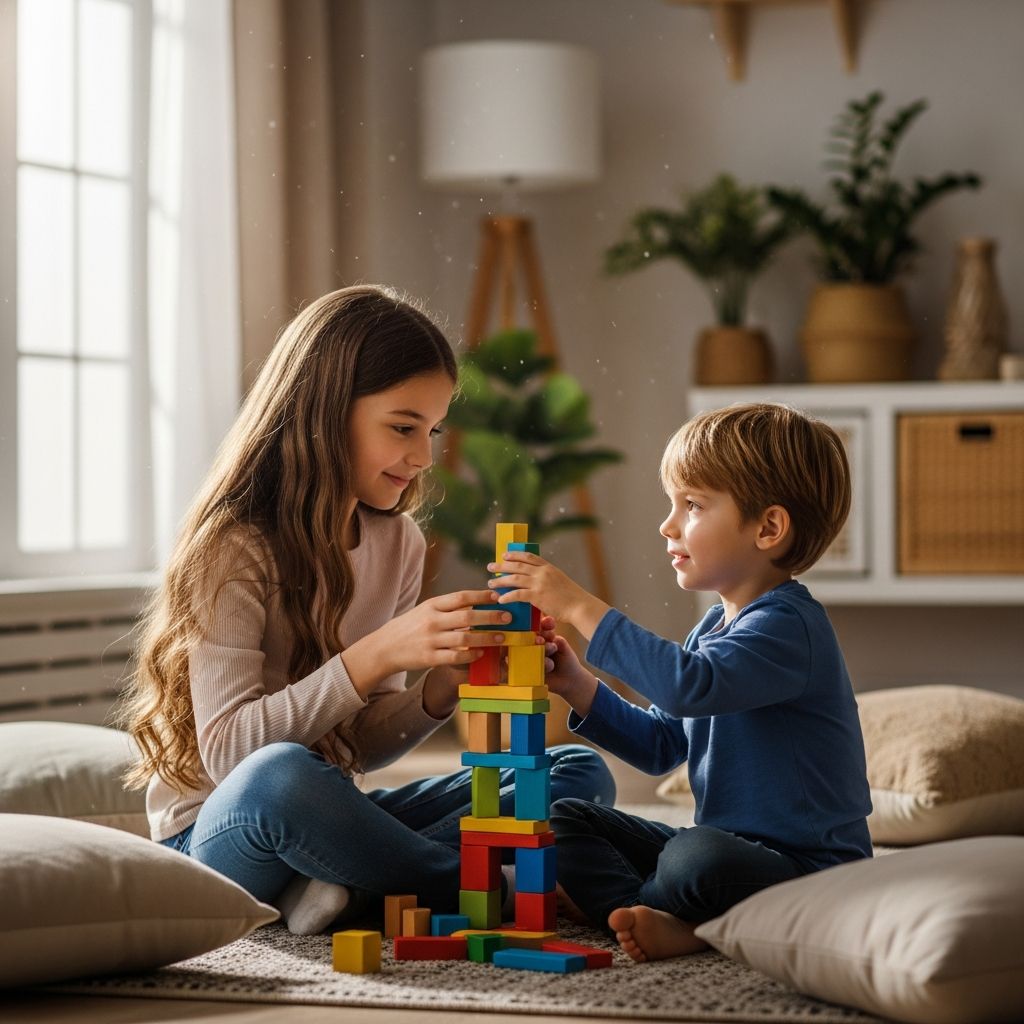
Brothers and sisters can be best friends one moment and fierce opponents the next. A peaceful, connection-based approach to parenting gives children what they really need: tools to manage big feelings, skills to resolve conflict, and daily proof that there is enough love for everyone.
This guide explores how to reduce constant bickering, prevent resentment from taking root, and help your children grow into allies for life.
Why Sibling Rivalry Happens (Even in Loving Homes)
Rivalry between siblings is not a sign that something is wrong with your family; it is a normal part of growing up in the same household.
Research suggests that moderate conflict between siblings can actually help children develop social understanding and negotiation skills, as long as parents guide rather than shame or punish.
| Common Trigger | What Children Often Feel | What Them Need From Parents |
|---|---|---|
| Birth of a new baby | Fear of being replaced, jealousy, confusion | Reassurance, special one-on-one time, empathy |
| Frequent comparisons | Shame, competition, insecurity | Recognition of unique strengths, no labels |
| Uneven attention | Invisible, resentful, angry at sibling | Consistent connection, chances to be heard |
| Lack of skills | Overwhelmed, impulsive, misunderstood | Coaching in calming, problem solving, words |
The Core of Peaceful Parenting: Connection Before Correction
Peaceful parenting does not mean permissive parenting. It means you set firm limits, but you do it with warmth, respect, and curiosity instead of threats or shame.
Studies on positive parenting show that warm, responsive relationships combined with consistent boundaries predict better emotional regulation and fewer behavior problems over time.
Key Principles of a Peaceful Approach
- Regulate yourself first: Children borrow your calm. Taking a breath before you respond changes everything.
- See the need beneath the behavior: Behind the shove or the scream is often a child who is tired, lonely, anxious, or needing connection.
- Stay on the same team: Address the problem (hitting, grabbing, teasing) without turning against the child.
- Teach skills, don’t just stop the fight: Aim for long-term learning, not just short-term silence.
Preventing Rivalry: Everyday Habits That Build Safety
Much of sibling harmony is built outside of arguments. Small daily choices can lower the overall tension in your home.
1. Protect Each Child’s Sense of Being Deeply Loved
- Offer regular one-on-one time with each child, even ten focused minutes a day.
- Use eye contact, touch, and warm words to signal, “You are important to me.”
- When a new baby arrives, narrate aloud how the older child is still precious and needed.
2. Stop Comparison and Labels
Praise and criticism that pit children against each other fuel competition. Child development experts emphasize that comparing siblings increases rivalry and damages self-esteem.
- Avoid labels like “the smart one”, “the easy one”, or “the difficult one”.
- Describe specific behavior instead: “You worked hard on that puzzle.”
- Talk about strengths without dragging another child into the sentence.
3. Honor Differences and Personal Space
- Give each child some belongings that do not have to be shared.
- Use simple boundaries such as:
- “You can borrow that toy only if your brother says yes.”
- “Knocking before entering your sister’s room keeps her body and feelings safe.”
- Create quiet corners where a child can retreat to calm down or play alone.
4. Build a Culture of Teamwork
- Use language like “We are a team” and “In this family, we help each other.”
- Give siblings shared, achievable tasks (tidying a space together, making a snack together).
- Point out moments of kindness: “You helped your brother reach that book. That was thoughtful.”
What To Do During a Sibling Fight
When siblings clash, your role is less referee and more calm coach. You keep everyone safe while helping them practice healthier ways of handling conflict.
Step 1: Ensure Safety Without Blame
- Move in calmly and separate children if anyone is being hurt.
- Use neutral statements such as, “I won’t let you hit” instead of accusations.
- Lower your voice and slow your speech to reduce the emotional temperature.
Step 2: Acknowledge Feelings on Both Sides
Validation does not mean you agree; it means you understand. Studies on emotion coaching show that when children’s emotions are acknowledged, they are better able to calm themselves and problem-solve.
- “You wanted the toy, and you grabbed it.”
- “You felt angry when your brother knocked over your tower.”
- “You are both frustrated and hurt right now.”
Step 3: Set Clear, Firm Limits
- State the limit simply: “No hitting. Hitting hurts.”
- Keep rules consistent: the same boundaries apply to every child.
- Avoid moral labels like “mean” or “bad”; focus on behavior and impact.
Step 4: Coach Better Options
Once children are a bit calmer, help them practice words and problem-solving.
- Offer scripts: “Say, ‘Can I have a turn when you’re done?’”
- Brainstorm together: “What are two ways we could solve this that feel fair?”
- Ask each child for one idea and write them down for bigger kids.
Step 5: Encourage Repair
Repair is not forced apologies; it is learning to mend the relationship.
- Ask, “What could you do to help your sister feel better?”
- Accept different kinds of repair: drawing a picture, offering an ice pack, rebuilding a tower, or saying “I’m sorry.”
- Model your own repair when you lose your temper: “I yelled just now. That wasn’t helpful. I’m sorry; I’m going to try again more calmly.”
When to Step In and When to Step Back
Not every disagreement needs an adult. Children benefit when they are trusted to experiment with negotiation, as long as no one is being harmed.
- Step in early if:
- There is physical aggression or bullying.
- One child is consistently overpowered or afraid.
- There are threats, humiliation, or repeated targeting.
- Hang back and listen if:
- The argument is loud but no one is being hurt.
- Children are testing out words like “Let’s trade” or “How about…”
- They are moving toward a solution on their own.
Supporting Sensitive, Neurodivergent, or Very Different Siblings
In many families, children have different temperaments, abilities, or neurotypes. A peaceful approach is especially important when one or more children are neurodivergent, anxious, or highly sensitive.
Experts in neurodevelopmental conditions emphasize tailoring support to each child’s strengths and challenges, and making expectations clear and concrete.
- Use predictable routines so siblings know what to expect.
- Preview upcoming changes: “Your brother will need the quiet area for homework; let’s plan where you can play.”
- Teach siblings about each other’s needs in neutral, respectful language.
- Adjust fairness: equal does not always mean identical. Explain, “Fair means everyone gets what helps them.”
Creating Daily Rituals That Strengthen Bonds
Even in busy families, small rituals can send a powerful message: we belong to each other.
- Connection check-ins: Invite each child to share one good thing and one hard thing about the day at meals.
- Shared humor: Read silly books, create family jokes, or have a weekly “laugh night” with charades or dancing.
- Gratitude moments: Ask, “What’s one thing your sibling did today that you appreciated?”
- Cozy traditions: Movie night with shared snacks, weekend breakfast all together, or an evening walk.
Sample Family Agreements for More Peace
Simple family agreements make expectations clear and reduce arguments about what is “fair.”
| Area | Example Agreement |
|---|---|
| Respect | We don’t call each other names. We talk about what we feel or need instead. |
| Personal items | If it is special, you must ask before using it. “No” is an acceptable answer. |
| Screen time | We follow a schedule so everyone knows when it is their turn. |
| Conflict | We try words first. If we can’t solve it, we ask an adult to help us listen. |
Frequently Asked Questions (FAQs)
Q: Is all sibling fighting harmful?
Not necessarily. Occasional disagreements are a normal part of development and can help children learn negotiation and empathy, especially when adults model calm conflict resolution and step in only to ensure safety.
Q: How do I avoid taking sides when one child clearly started it?
Focus on the situation instead of the “starter.” You can say, “We have a problem: one toy and two kids,” then support each child to share their perspective and brainstorm solutions. If one child hurt the other, address that behavior firmly while still listening to their feelings.
Q: What if my kids seem to hate each other?
Strong words like “I hate you” usually signal big feelings, not the full truth about the relationship. Prioritize one-on-one time with each child, reduce comparisons, and create low-pressure chances for positive interaction, such as working on a project or game they both enjoy. If aggression or cruelty persists, consider getting guidance from a qualified family or child therapist.
Q: Are punishments like taking away toys effective for sibling conflict?
Punishments may stop behavior in the moment but often increase resentment and do not teach children what to do differently next time. A teaching approach—calming, setting limits, and practicing new skills—supports long-term cooperation and self-control.
Q: How can I help my only child adjust to a new sibling?
Prepare them with simple explanations, involve them in small caregiving tasks if they are interested, and protect regular special time that is just for them. Expect some regression or clinginess and respond with extra warmth and reassurance that your love is not divided, only expanded.
References
- Dunn J. Sibling relationships. — In: Bornstein MH, ed. Handbook of Parenting. 2nd ed. Lawrence Erlbaum Associates. 2002. https://psycnet.apa.org/record/2002-18109-018
- McGuire S, Shanahan L. Sibling Experiences in Diverse Family Contexts. — Child Development Perspectives. 2010-12-01. https://doi.org/10.1111/j.1750-8606.2010.00137.x
- American Academy of Pediatrics. Positive Parenting Strategies. — HealthyChildren.org. 2018-07-24. https://www.healthychildren.org/English/family-life/family-dynamics/communication-discipline/Pages/Positive-Parenting.aspx
- American Academy of Pediatrics. Sibling Rivalry. — HealthyChildren.org. 2019-11-21. https://www.healthychildren.org/English/family-life/family-dynamics/Pages/Sibling-Rivalry.aspx
- Gottman JM, Katz LF, Hooven C. Meta-Emotion: How Families Communicate Emotionally. — Routledge. 1997-05-01. https://doi.org/10.4324/9781134891497
- Centers for Disease Control and Prevention. Essentials for Parenting Toddlers and Preschoolers. — CDC. 2020-06-22. https://www.cdc.gov/parents/essentials/index.html