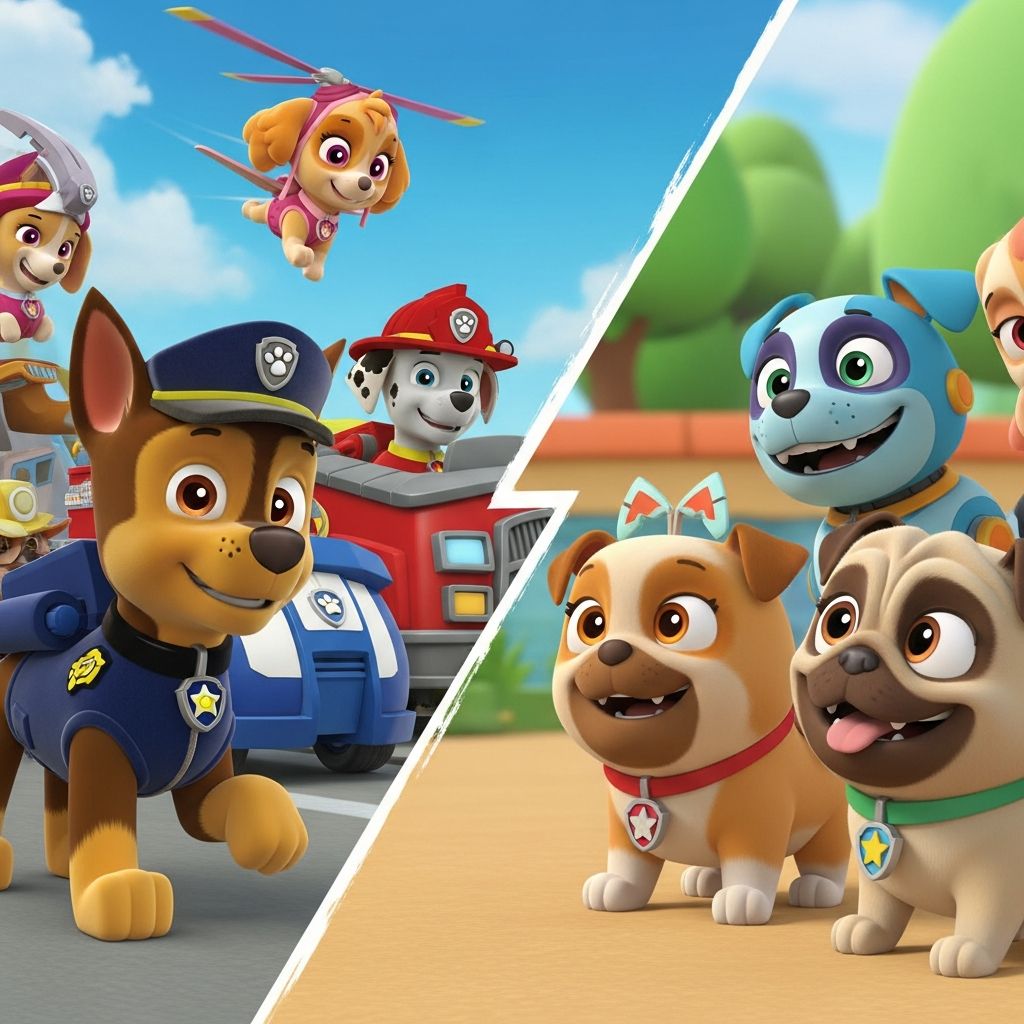
Two animated puppy shows dominate many preschool watchlists: Paw Patrol, with its rescue-ready team of pups, and Puppy Dog Pals, featuring adventurous sibling pugs on globe-trotting missions. Both series promise fun, teamwork, and simple life lessons, but they deliver those themes in very different ways. For parents trying to manage screen time wisely, understanding those differences matters.
This guide breaks down what each show offers – from characters and stories to educational value and emotional tone – so you can confidently decide which one (or what mix of both) fits your child, your household rules, and your sanity.
Big Picture Overview
Before diving into details, it helps to think of these shows in terms of their core vibe. Paw Patrol is built like a mini action-adventure franchise for preschoolers, with a recognizable mission structure and toy-friendly vehicles. Puppy Dog Pals feels more like a light travel and friendship comedy that happens to feature puppies as its leads.
| Aspect | Paw Patrol | Puppy Dog Pals |
|---|---|---|
| Core concept | Rescue team of pups solving community emergencies in a small town. | Two pug brothers going on lighthearted missions for their owner and friends. |
| Structure | Mission-of-the-day rescue, often with vehicles and gadgets. | Short adventures that feel like mini trips, often outside the neighborhood. |
| Energy level | High-energy, action-oriented, lots of movement and excitement. | Still energetic, but softer, bouncier, and more playful. |
| Main appeal for kids | Heroes, vehicles, “saving the day,” and strong role play potential. | Silly antics, sibling dynamics, and imaginative travel. |
| Main appeal for parents | Clear teamwork messages and problem-solving in crises. | Warm family tone, gentle humor, and lower-stakes plots. |
Characters and Role Models
Characters are usually what preschoolers latch onto first, and both shows offer distinct types of role models. One leans into heroic archetypes; the other leans into goofy siblings learning from mistakes.
Paw Patrol: Tiny Heroes with Big Jobs
Paw Patrol revolves around a human child leader and a team of specialized puppies, each associated with a specific job – such as firefighting, construction, or aviation. Every pup has a clear job title, recognizable color, and vehicle, which makes it very easy for young viewers to understand and imitate during play.
- Each dog represents a community helper role (firefighter, police officer, pilot, etc.), which can spark early interest in real-world jobs.
- The team structure gives kids an early sense of hierarchy and responsibility: there is a leader, there are roles, and each role matters.
- Because the show is mission-driven, heroism and competence are front and center, which many kids find empowering.
However, the rescue framing can make some children feel that “being helpful” always looks dramatic, high-stakes, and gadget-heavy, which might not match the quiet ways kids actually help at home.
Puppy Dog Pals: Sibling Pugs and Found Family
Puppy Dog Pals centers on Bingo and Rolly, two young pugs who adore their owner and each other, along with a small circle of animal friends. The show taps into sibling dynamics, everyday curiosity, and an affectionate relationship with a somewhat absent-minded but loving adult.
- The pug brothers model cooperation and occasional conflict in a way that feels familiar to siblings or close friends.
- Their owner is framed as a creative caretaker rather than a traditional authority figure, which can broaden kids’ ideas of grown-ups.
- The show emphasizes affection, apologies, and emotional repair after mishaps, subtly modeling social skills.
This softer, relationship-centric approach may resonate more with kids who are sensitive to tension or who are less interested in “saving the day” and more interested in being silly with friends.
Storylines and Emotional Intensity
Even short kids’ episodes can feel intense when there is an emergency on screen. Understanding how each show handles danger and problem-solving helps parents decide what kind of emotional ride they want for their kids.
Paw Patrol: Emergency-Driven Plots
Most Paw Patrol episodes begin with a problem in the community – a missing animal, a stuck vehicle, a weather issue, or a minor disaster that needs urgent attention. The pups are called in, receive a plan from their leader, and then execute the rescue.
- There is almost always a clear “uh-oh” moment, followed by dramatic but safe-feeling problem-solving.
- The show tries to keep stakes low for adults, but for very sensitive kids, the alarms, countdowns, and suspense may feel intense.
- Because the pups always succeed, children may develop a sense that every problem has a quick, gadget-based solution, which is fun but a bit unrealistic.
This structure suits kids who enjoy tension and cheering for heroes but may be overstimulating for children prone to anxiety or those winding down before bed.
Puppy Dog Pals: Light Problems, Big Adventures
In Puppy Dog Pals, the pups typically set out to solve a small problem for their owner, a friend, or themselves: finding a lost object, fixing a minor mistake, or helping someone feel better. The stakes are low, but the adventures can stretch across neighborhoods, cities, or even countries.
- Problems feel personal and small – emotional slipups, simple misunderstandings, or lost items – which might be easier for kids to relate to.
- The tone tends to be more comedic than suspenseful, with an emphasis on mishaps and sight gags rather than danger.
- Success often involves flexible thinking and friendship rather than specialized gear.
This makes Puppy Dog Pals a good pick for kids who like adventure but don’t need constant emergencies to stay engaged.
Educational and Social-Emotional Value
Parents increasingly want children’s shows to do more than entertain. While neither of these series is a pure “curriculum” show, both sneak in lessons about problem-solving, relationships, and community.
Paw Patrol: Teamwork and Civic Spirit
Paw Patrol shines when it comes to modeling coordinated teamwork in community situations. Every mission requires the characters to combine skills, listen to instructions, and support one another.
- Kids see that different talents and tools are valuable; the pup with the right skill saves the day, underscoring the idea that everyone has something to contribute.
- The show subtly presents concepts like planning, delegation, and following steps in order.
- Its focus on civic helpers can spark early conversations about firefighters, police officers, construction workers, and other essential roles.
The trade-off is that academic skills (numbers, letters, science concepts) stay mostly in the background, while social and civic messages take the lead.
Puppy Dog Pals: Curiosity and Feelings
Puppy Dog Pals tilts toward emotional intelligence and curiosity about the wider world. Your child is likely to see characters dealing with disappointment, jealousy, accidental hurt feelings, and the process of making amends.
- Many episodes highlight the importance of saying sorry, trying again, or considering someone else’s point of view.
- Travel-leaning plots give light exposure to other places, customs, or landmarks, even if they are simplified and cartoonish.
- Creative solutions often come from experimentation and imaginative thinking rather than strict planning.
If you are prioritizing gentler social-emotional learning over action, Puppy Dog Pals may feel like the stronger daily choice.
Representation, Diversity, and Gender Coding
Even in lighthearted kids’ shows, representation matters. Children absorb unspoken messages about who gets to be a leader, who is brave, and what different genders and species are allowed to do on screen.
Paw Patrol: Heroism and Gender Expectations
Paw Patrol’s original lineup tilts heavily male, with a few female pups filling specific niches. Later additions and spin-offs have tried to broaden that range, but the core imagery – a boy leader commanding a mostly male team – is baked into the brand.
- Some kids, especially boys, quickly identify with the leader and the more traditionally “tough” roles like policing or firefighting.
- Girls and non-conforming kids absolutely can and do enjoy the show, but may have fewer on-screen characters that reflect them directly in heroic positions.
- The show’s popularity has also driven a large toy ecosystem, which sometimes reinforces familiar gender coding through colors and marketing.
Parents who are intentionally seeking more balanced or subtle gender cues may wish to pair Paw Patrol with other shows that center different kinds of heroes.
Puppy Dog Pals: Softer Lines, Smaller Statements
Puppy Dog Pals tends to feel less rigidly coded in terms of gender and roles, partly because its conflicts are smaller and its characters behave more like silly kids than job-holding adults. There are still patterns and stereotypes, but the show’s identity is less built around uniforms and ranks.
- Because the main pups are framed as very young, they mostly explore universal kid experiences like sharing, curiosity, and wanting attention.
- Supporting characters, including non-dog animals, bring a variety of personalities and energy levels that are not linked tightly to gender.
- The creative adult character offers an alternative model of masculinity that is nurturing, imaginative, and slightly absent-minded rather than purely heroic.
Families who want a show that quietly undercuts some traditional expectations without making a big statement may appreciate this softer approach.
Practical Considerations: Merch, Screen Time, and Rewatch Value
Beyond themes and characters, it helps to think realistically about how these shows will live in your home. That includes how often you will be asked to press play, whether you are comfortable with related products, and how easy it is to use episodes as time-filling tools.
Merchandise and Marketing
Paw Patrol is a merchandising powerhouse, with vehicles, figurines, clothing, and playsets available nearly everywhere. This can be both a blessing and a curse: it supports rich imaginative play away from the screen, but it also invites constant “Can we get that?” questions.
- If your child latches onto Paw Patrol, expect strong brand recognition at stores, in birthday themes, and on playgrounds.
- The show’s structure – pups plus vehicles – translates directly into toys, making it easy for kids to re-enact episodes in detail.
Puppy Dog Pals typically has a smaller merchandising footprint. There are toys and apparel, but they are less omnipresent.
- This can lower pressure on your budget and reduce the sense that every viewing session must be followed by a purchase.
- On the flip side, kids who love to act out very specific scenes may find fewer ready-made playsets.
Screen-Time Strategy and Rewatching
For many families, these shows become part of everyday routines – a short episode before school, something to watch during dinner prep, or a reward during long weekends. Understanding how each show feels on the tenth rewatch is crucial for parental sanity.
- Paw Patrol episodes are formula-based, which some kids love and adults eventually find predictable. The catchphrases and repetitive mission structures can be comforting or grating, depending on your tolerance.
- Puppy Dog Pals often leans into gentle humor, wordplay, and background silliness that adults may find slightly more palatable on repeat.
If your household relies heavily on background shows while you handle chores, you may personally prefer the series that feels less intense and more quietly amusing in the background.
Which Show Fits Which Kid?
There is no universal winner. Instead, each show maps better onto different temperaments, interests, and family values. Thinking through your child’s personality can clarify which series to emphasize.
When Paw Patrol Is the Better Fit
Consider leaning toward Paw Patrol if your child:
- Loves vehicles, tools, and anything mechanical.
- Enjoys clear good-guy/bad-guy or problem/solution structures.
- Thrives on excitement and isn’t easily rattled by sirens, countdowns, or near-misses.
- Is fascinated by firefighters, construction workers, and other civic helpers.
In these cases, Paw Patrol can be a great way to channel high energy into narratives about helping others, responsibility, and teamwork.
When Puppy Dog Pals May Work Better
Puppy Dog Pals may be a better center-stage show if your child:
- Is sensitive to loud noises, emergencies, or on-screen peril.
- Is deeply invested in relationships, siblings, or pets.
- Likes to imagine traveling, exploring, and meeting new friends, even in low-stakes adventures.
- Needs help learning about apologies, patience, and fixing small mistakes.
In these situations, Puppy Dog Pals offers gentle stories that still feel adventurous but keep emotional intensity lower.
Blending Both Shows Thoughtfully
Many families will end up with both series in the rotation. Instead of seeing them as competing, it can help to assign each show a role in your weekly rhythm.
- Use Paw Patrol for daytime or active playtimes, when kids are already full of energy and want to pretend they’re on missions.
- Use Puppy Dog Pals closer to quiet time, naps, or bedtime routines, when a softer emotional tone is helpful.
- Talk with your child about the differences: “In this show, the dogs help by doing rescues. In that one, they help by fixing everyday problems.”
Framing them this way can even open up simple conversations about different kinds of helping and different ways to be brave.
Frequently Asked Questions
Is Paw Patrol too intense for very young toddlers?
That depends on your child. Some toddlers delight in the sirens, fast vehicles, and cliffhanger moments; others find the alarms and near-disasters overwhelming. If your child startles easily or talks about being scared after episodes, consider saving Paw Patrol for when they are a bit older or limiting it to daytime viewing.
Does Puppy Dog Pals actually teach kids anything, or is it just cute?
While it is definitely cute, Puppy Dog Pals consistently folds in lessons about sharing, apologizing, and thinking about other people’s feelings. Many stories show the pups making a small mistake, feeling bad about it, and then taking concrete steps to fix it, which gives kids models for handling everyday mishaps.
Which show is better for siblings to watch together?
Both can work, but Puppy Dog Pals may resonate especially well with siblings because the central relationship is between two close littermates who often disagree but always reconnect. Watching them negotiate turns, share tasks, and repair hurt feelings can mirror what happens between siblings at home.
What about toy pressure and marketing?
Paw Patrol is more likely to trigger requests for toys, clothing, and playsets simply because the brand is everywhere and the vehicles lend themselves to products. If you are trying to keep consumer pressure low, Puppy Dog Pals’ smaller merchandising presence may feel gentler on your wallet and your patience.
Can these shows fit into a healthy screen-time routine?
Yes, as long as you keep boundaries clear. Short episodes make it easier to stick to one or two episodes at a time, use them as conversation starters about feelings and helping others, and balance viewing with offline play, books, and outdoor time. The goal is to make the shows a tool you use, not a default background noise all day long.
Final Thoughts for Parents
Paw Patrol and Puppy Dog Pals both offer cheerful, puppy-powered worlds where problems get solved and friendships matter. One wraps those ideas in sirens, vehicles, and town-saving missions; the other wraps them in sibling goofiness, travel, and small emotional stakes. When you choose which to emphasize – or how to mix them – you are really choosing the emotional tempo and type of heroism you want your child to see most often.
Whichever way you go, staying engaged – occasionally watching with your child, talking about what happened, and connecting on-screen lessons to real life – turns either show from simple distraction into a shared, meaningful part of your family’s story time.